



Education Journalist | Study Abroad Lead
Hexagonal close-packing is layers of spheres packed so that spheres in alternating layers overlie one another. Component particles in crystalline solids are arranged in a regular and recurring pattern. A crystal lattice is a diagrammatic depiction of three-dimensional groupings of component particles in a crystal, with each particle portrayed as a point in space. Atoms in a crystal lattice are relatively close together, leaving very little space between them. This arrangement of components in solids also helps in determining a compound's formula. In three-dimensional solid packing, you have learned that it may be packed in two ways: cubic close packing (CCP) and hexagonal close packing (HCP).
| Table of Content |
Key Terms: Crystal Lattice, Amorphous Solid, Closed packaging, Crystalline Solid, Atoms, Molecules, Compound
Hexagonal Close Packing
[Click Here for Sample Questions]
There are two types of voids involved in hexagonal close packing (HCP), namely octahedral voids and tetrahedral voids. We know that in a lattice, there are twice as many tetrahedral voids as there are close-packed particles. While the number of octahedral voids produced is the same as the number of tightly packed particles.
Other variables influence the particle arrangement in these spaces. In ionic solids, for example, the larger ions from the close-packed structure occupy the spaces, whereas the smaller ions occupy the voids. If the latter ions are tiny, tetrahedral gaps are occupied. Whereas octahedral spaces are occupied when the later ions are larger. The percentage of octahedral or tetrahedral gaps occupied by the molecules aids in calculating the compound's formula.
Hexagonal Close Packing
Read More:
| Related Articles | ||
|---|---|---|
| Electrical properties of solids | Conductors | Insulators |
| Classification Of Crystalline Solids | Hydrosphere | Metallic Bonds |
Types of Packing Present in Solids
[Click Here for Sample Questions]
- Cubic close packing (ccp)- AAAA type arrangement
- Hexagonal close packing (hcp)- ABAB type arrangement
The crystal structures of solid materials are distinct. Based on the arrangement of their component particles, they can be classed as crystalline or amorphous. A crystalline solid is made up of a vast number of tiny crystals, each with its distinct geometrical shape. The arrangement of component particles in these crystals is orderly and repeatable in three dimensions.
If we know the arrangement of particles in one section of the crystal, we may precisely anticipate the arrangement of particles in another location. As a result, a crystal exhibits long-range order, which indicates that there is a regular pattern of particle arrangement that repeats itself throughout the whole crystal periodically.
The unit cell of a crystal is the smallest collection of component particles that possess the overall symmetry of the crystal and may be used to build the full lattice by repeating it in three dimensions.
Structure
[Click Here for Sample Questions]
Hexagonal tight packing structure is made up of alternating layers of spheres or atoms stacked in a hexagon, with one extra atom in the middle. A triangular layer of atoms is sandwiched between these two hexagonal layers, and the atoms in this layer fill the tetrahedral gaps generated by the top and bottom layers. A diagram of such a construction may be found below:

Lattice Structure
The lattice structure, as seen in the figure above, is simply an alternate arrangement of layers 'a' and 'b'. .....a-b-a-b-a-b-…..and so on.
Hexagonal packing structure is made up of three layers. In the top and bottom layers, there are six atoms each organized in the shape of a hexagon, with a seventh atom amid the hexagon. Between the atoms of the top and bottom layers, there are three layers in the intermediate layer.
There are two types of voids in hexagonal tight packing: octahedral and tetrahedral voids.
HCP Structure Unit Cell
[Click Here for Sample Questions]
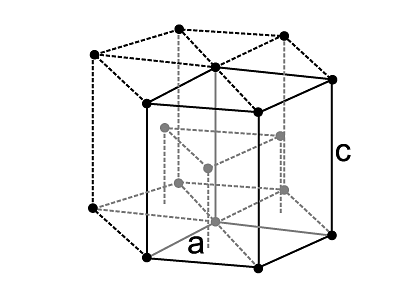
The hcp structural diagram was provided in the preceding section. In this part, we'll go over the hcp unit cell in further depth. The following is a representation of an Hcp unit cell:
The atoms in the centre layer of this unit cell are not shared with any other unit cell, but the atoms in the top and lower levels are shared with neighbouring unit cells. The top and bottom layers' core spheres or atoms are shared with one other unit cell, hence they only contribute 12 to one unit cell.
Because the atoms at Hexagonal vertices in the top and bottom layers are shared with five other unit cells, they only contribute 1/6 of a unit cell to each. We can calculate the number of atoms per unit cell in an hcp structure using this knowledge:
- Number of atoms fully contributing to the unit cell= 3 (all in the middle layer)
- Number of atoms contributing ½ to the unit cell= 2 (1 in the top and 1 in the bottom layer, respectively)
- Number of atoms contributing 1/6 to the unit cell= 12 (6 in the top and 6 in the bottom layer, respectively)
The number of atoms in the unit cell is the total number of atoms= 3+1/2×2+1/2×12 = 3+1+2=6
As a result, each hcp structure unit cell has 6 atoms. For the hcp structure, the coordination number, or the number of atoms around the central atom, is 12. The centre atom in layer B is surrounded by 6 atoms from the same layer, as well as 3 atoms from the top and bottom layers. As a result, the total number of surrounding atoms is 6 + 3 + 3 = 12, giving the hcp structure a coordination number of 12.
The volume of Hcp Unit Cell = 3√3a²c/2
In an hcp structure, the ratio of space occupied by spheres to vacant space is around 74 percent:26 per cent. The formula determines how much space is occupied.
π/3√2
which approximately translates to 0.74048.
Hexagonal densely packed lattice structure's unit cell is shaped like Hexagonal prism. The angle formed by two equal axes or sides of length 'a' is 120 degrees, while the angle formed by height 'c' and side 'a' is 90 degrees.
This concludes our discussion of "Hexagonal Close Packing." We hope you had fun learning and understanding the ideas. We hope you will be able to address difficulties related to the topic after reading this article.
Things To Remember
- Its dimensions are a, b, and c along the three edges. These edges may or may not be perpendicular to one another.
- (between b and c), (between a and c), and (between a and c) angles between the edges (between a and b). A unit cell is therefore defined by six parameters: a, b, c, α, β and γ.
- There are two types of voids in hexagonal tight packing: octahedral and tetrahedral voids.
- The volume of Hexagonal unit cell is equal to the product of the cell's height and the base's area.
- Hexagonal packed structure's stacking sequence is ABABAB.
- An hcp crystal structure has a packing factor of 0.74.
Read More:
Sample Questions
Ques. Atoms of element Y form hexagonal close packing lattice and those of the element X occupy 1/4th of tetrahedral voids. What is the formula of the compound formed by the elements X and Y? (2 Marks)
Ans. The number of tetrahedral voids formed = 2 × (number of atoms of element Y)
Since only 1/4th of these voids is occupied by X, the ratio of elements of X to Y can be given by:
2 × (1/4):1 or 1:2
Thus, the formula of the compound is XY2.
Ques. Mention some similarities between hexagonal close packing and cubic close packing. (3 Marks)
Ans. The following are some commonalities between hexagonal and cubic tight packing.
In both hexagonal and cubic close packing, there are 12 surrounding spheres.
The spheres of the atoms occupy 74 percent of the volume in both hexagonal and cubic tight packing, while unoccupied spaces occupy the remaining 26%.
Both the hcp and ccp crystal structures have a coordination number of 12.
Ques. What are amorphous solids? (4 Marks)
Ans. Amorphous solids are solids that have no particular shape. The component particles of amorphous materials do not have a consistent 3-D configuration. Because their molecules are organized randomly, amorphous solids are sometimes known as supercool liquids. Gels, rubber, ceramics, and other materials are examples. Geometric and crystalline solids are both amorphous. When amorphous substances are heated or cooked, they eventually crystallize.
Ques. What is HCP structure? (3 Marks)
Ans. Layers of spheres packed in such a way that spheres in alternating layers overlie one another are referred to as hexagonal close-packed (hcp). Hexagonal tight-packed is a close-packed structure with a slip mechanism. Beryllium and Cadmium are two elemental metals that have the hcp structure.
Ques. How does HCP have 6 atoms? (3 Marks)
Ans. The number of atoms per unit cell in an HCP Structure is 2+1+3=6 when you include the number of corner atoms in a unit cell, the number of base-centered atoms in a unit cell, and the number of atoms inside the volume of the unit cell. As a result, the HCP Structure has a total of 6 atoms per unit cell.
Ques. Are hcp and FCC the same? (3 Marks)
Ans. You would not think a face-centered cubic (FCC) crystal and Hexagonal close-packed (HCP) crystal have much in common, yet they are the same thing under specific criteria! With a 74 per cent atomic packing factor, 12 closest neighbours, and identical interstitial sites, FCC and HCP are both densely packed.
Ques. Are HCP structures strong? (3 Marks)
Ans. BCC metals, such as iron, are less ductile but stronger, whereas HCP metals are often brittle. Zinc is a high-carbon metal that, unlike copper, is difficult to bend without breaking. Many other characteristics of metals, such as density, deformation processes, alloying behaviour, and so on, are influenced by their crystal structure.
Ques. What is the importance of hexagonal packing? (5 Marks)
Ans. In Hexagonal close-packed configuration, the atoms efficiently occupy 74% of the space, leaving 26% unoccupied. The coordination number of hexagonal closest packed is 12 and each unit cell comprises 6 atoms. Body-centered cubic and face-centered cubic crystal formations have substantially more slip than hcp metals. In hcp, each atom has twelve closest neighbours. The distance between the planes in the ideal structure is 1.633a, where an is the distance between the atoms.
Ques. What is the difference between square close packing and hexagonal close packing? (3 Marks)
Ans. The abbreviation CCP stands for cubic tight packing. In one repeating unit, there are three layers of spheres. The main distinction between hexagonal close packing and cubic close packing is that Hexagonal close packing unit cell has 6 spheres, whereas a cubic close packing unit cell contains 4 spheres.
Ques. How are voids formed in a close packing? (5 Marks)
Ans. When two sets of equilateral triangles point in opposite directions with six spheres, the void is generated. The vacuum has a significantly lower volume than spherical particles. The vacuum has a modest volume. The tetrahedral void is 2N when the number of closely packed spheres is N. In a three-dimensional structure, there are two types of interstitial voids: Tetrahedral voids (tetrahedral voids): The spheres of the second layer rest atop the triangular voids of the first layer in a cubic tightly packed configuration. Each sphere touches the first layer's three spheres.
For Latest Updates on Upcoming Board Exams, Click Here: https://t.me/class_10_12_board_updates
Check-Out:



Comments