



Education Journalist | Study Abroad Lead
Aluminum is the 13th element in the periodic table, and it is a silvery-white metal. It bears the Al symbol. Aluminum is one of the most abundant metals on Earth, accounting for more than 8% of the planet's total core mass. It is the third most abundant chemical element on the planet, behind oxygen and silicon. Pure aluminum, on the other hand, does not occur in nature due to its proclivity for reacting with other elements.
| Table of Contents |
Key Terms- Aluminum, Metal, Periodic table, Oxygen, Silicon, Boron, Earth, steel, light metal, corrosion
What is Aluminum?
[Click Here for Sample Questions]
Aluminum is a silvery-white, soft metal which is non-magnetic and belongs to the Boron Group in the periodic table. Though aluminum was created for the first time in 1824, but it took another fifty years for humans to figure out how to mass-produce it
Also Read:
| Related Articles | ||
|---|---|---|
| Copper | Iron | Occurrences of Metals |
| Concentration of Ore | Calcination | Ellingham Diagram |
Physical Properties of Aluminium
[Click Here for Sample Questions]
The following are the physical characteristics of aluminum.
- The color of aluminum is silvery-white.
- It's a very light metal.
- In nature, aluminum is a highly reactive metal.
- It's soft and flexible.
- It has a density and rigidity roughly one-third that of steel.
- It is resistant to corrosion.
- It is naturally superconductive.
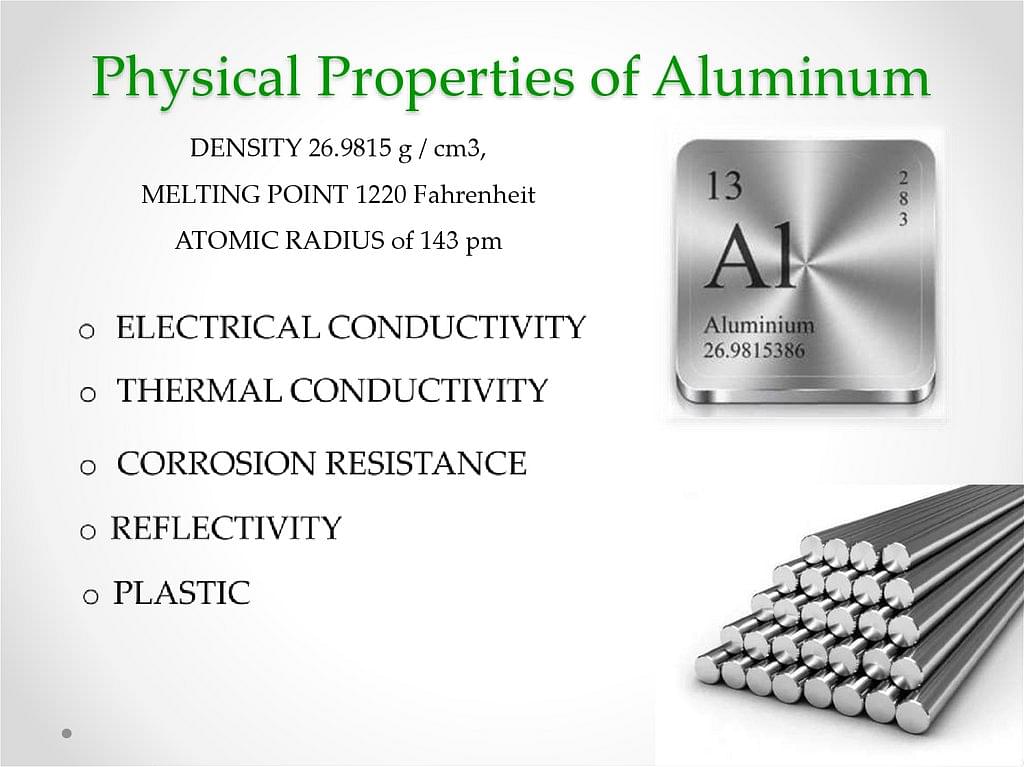
Physical Properties of Al
Chemical Properties of Aluminium
[Click Here for Sample Questions]
Here are the chemical properties of Aluminium-
- The HCl-Aluminum Reaction
At room temperature, aluminum reacts with dilute hydrochloric acid. Aluminum chloride and colorless hydrogen gas are produced when the metal aluminum dissolves in hydrochloric acid. The chemical reaction between aluminum and hydrochloric acid is irreversible.
2Al + 6HCl –> 2AlCl3 + 3H2 → 2AlCl3 + 3H2
- Aluminum and Sodium Hydroxide Reaction
The action of sodium hydroxide on elemental aluminum, which is an amphoteric metal, also produces sodium aluminate. Once formed, the reaction is extremely exothermic and is accompanied by the fast development of hydrogen gas.
2NaOH + 2H2O → 2NaAlO2 + 3H. 2NaOH + 2H2O → 2NaAlO2 + 3H
- Water and Aluminum Reaction
Aluminum metal forms a thin coating of aluminum oxide, a few millimeters thick, that prevents it from interacting with water. According to the equation, aluminum interacts with water to generate hydrogen gas.
3H2 + Al2O3 → 2Al + 3H2O
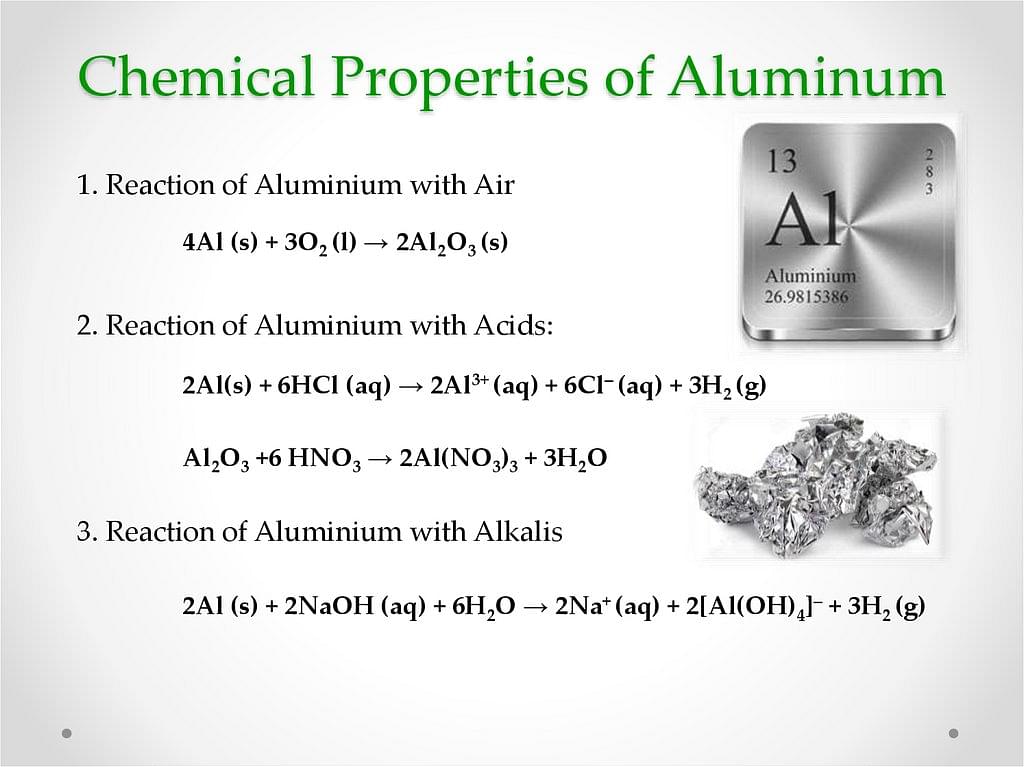
Chemical Properties of Al
Uses of Aluminum
[Click Here for Sample Questions]
Here are some important uses of aluminum-
- Foils, cans, window frames, cooking utensils, beer kegs, and airplane parts are just a few examples of how aluminum is utilized in everyday life. As it's simple to cast, shape, and machine, and it's resistant to corrosion. It's also non-magnetic and non-sparking.
- As aluminum is not very robust, it is commonly employed in the form of an alloy. Copper, magnesium, manganese, and silicon alloys, on the other hand, are light yet strong. They are crucial in the manufacture of airplanes and a variety of other modes of transportation.
- Aluminum is also a good electrical conductor, which is why it is extensively employed in electrical transmission lines. It is less expensive than copper and has a weight that is roughly two times that of a conductor.
- Aluminum creates a highly reflective covering for both light and heat when it is evaporated in vacuum. It does not corrode in the same way as a silver coating does. Packages, telescope mirrors, ornamental paper, and toys all benefit from aluminum coatings.
Things To Remember
- Aluminum is a silvery-white metal that has more than 8% of the planet's total core mass of Earth,
- Pure aluminum does not occur in nature due to its proclivity for reacting with other elements.
- Aluminum is highly reactive, non-magnetic, soft and flexible and naturally superconductive, belonging to the Boron Family.
- Aluminum chloride and colorless hydrogen gas are produced when the metal aluminum dissolves in hydrochloric acid.
- Foils, cans, window frames, cooking utensils, beer kegs, and airplane parts are just a few examples of how aluminum is utilized in everyday life.
Also Read:
Sample Questions
Ques: What are the many applications of aluminum compounds? (4 Marks)
Ans: Here are a few examples of how various aluminum compounds are used.
- Aluminum oxide is utilized as a catalyst in a variety of industrial processes.
- Aluminum sulfates are utilized in a variety of industrial and commercial applications, including paper production.
- It's also used as a mordant in dyeing, deodorizing mineral oils, tanning leather, pickling seeds, and the manufacture of numerous other Aluminum compounds.
- In the dyeing industry, chemical and petrochemical industries, and in the synthesis of various inorganic and organic chemicals, anhydrous Aluminum Chloride is employed as a catalyst.
Ques: What are some of the most popular applications for aluminum? (4 Marks)
Ans: Aluminum is a metal that may also be used as a compound. A few applications of aluminum as a metal are listed below.
- Because of its low density, it is used in transportation.
- Due to its non-adsorbing and non-toxic characteristics, it is utilized in packaging foils, cans, frames, and other items.
- It's also used in construction and building.
Ques: Is aluminum considered a metal? (2 Marks)
Ans: Aluminum is a lightweight, silvery-white metal. It's pliable and flexible. Cans, foils, cooking utensils, window frames, beer kegs, and airplane components are all made of aluminum. It's the second-most malleable and sixth-most ductile metal.
Ques: Why is steel more affordable than aluminum? (2 Marks)
Ans: Aluminum is significantly more costly than carbon steel. Aluminum repair is much more costly than steel repair. When steel is strained, the carbon component makes it tougher, more dent resistant, and more robust. Steel is a strong material that is less prone to warp, deform, or bend when subjected to weight, force, or heat.
Ques: What are aluminum's three properties? (3 Marks)
Ans: Here are three important properties of Aluminum-
- This is due to its unique characteristics.
- It has a low density, is non-toxic, has a good thermal conductivity, is corrosion resistant, and can be cast, machined, and shaped with ease.
- It's also non-sparking and non-magnetic. It's the second-most malleable and sixth-most ductile metal.
Ques: What is the most important feature of aluminum alloys? (2 Marks)
Ans: Pure aluminum is soft, ductile, corrosion-resistant, and electrically conductive. It's often used for foil and conductor cables, but it needs to be alloyed with other elements to get the greater strengths required for other uses.
Ques: What are the two types of aluminum alloy classifications? (2 Marks)
Ans: Casting alloys and wrought alloys are the two main types, each of which is further split into heat-treatable and non-heat-treatable subcategories.
Ques: How can we identify that an airplane is made of Aluminum? Explain the reason behind this. (2 Marks)
Ans: We can understand the airplane is made of Aluminum as the color is silvery-gray and shiny. Airplanes are made of Aluminum because it has the highest melting point.
For Latest Updates on Upcoming Board Exams, Click Here: https://t.me/class_10_12_board_updates
Check-Out:



Comments