



Content Writer
The boron family comprises boron (B), aluminium (Al), gallium (Ga), Indium (In), thallium (Tl), and Nihonium (Nh). Each one of the elements has three electrons in the external shell of their nuclear structure.
- Boron Family is also known as Group 13 elements or triels.
- The general electronic configuration of Group 13 elements is ns2 np1.
- Boron exhibits properties different from other members of the group due to its small size and absence of d-orbitals.
- The dissociation of boron family members requires a large amount of energy as they are thermodynamically inert.
- The boron tends to exhibit the properties of metalloids, while other members belong to post-transition metals.
- LED lighting, ceramic pots, and electrical gadgets are made using members of the boron family.
Key Terms: Boron Family, Group 13 Elements, Aluminium, Gallium, Boron, Indium, Thallium, Elements, Oxidation State, Electronic Configuration, Atomic Radii, Ionic Radii, Electronegativity, Periodic Table
What is the Boron Family?
[Click Here for Sample Questions]
The boron family contains the semi-metal boron (B) and the metals aluminium (Al), gallium (Ga), indium (In), and thallium (Tl). Boron is the fifth element of the periodic table (Z=5), located in Group 13 of the periodic table.
- It is classified as a metalloid due to its properties reflecting a combination of metals and nonmetals.
- The boron family has three electrons in the outermost shell.
- Nihonium is the only element that is produced as an individual atom in particle accelerators.
- The use of these compounds can be traced back to the Egyptians, who used them as a metallurgical flux.
- Boron family members require a large amount of energy to remove the fourth electron from the inner shell.
- The maximum valency of these elements is four.
- They are characterized by having three valence electrons.
- They are collectively called the boron group.
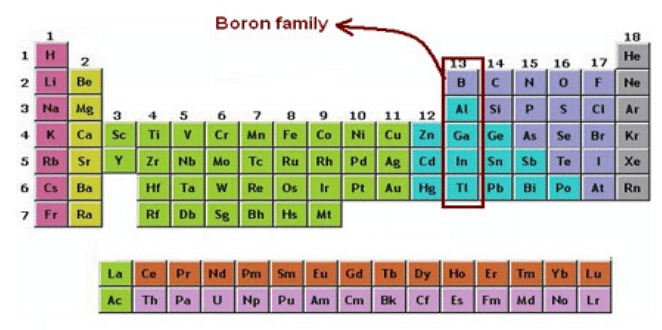
Periodic Table
Also Read:
| Related Articles | ||
|---|---|---|
| Carbonates | Polarity of Bonds | Hydroboration Oxidation |
Elements of the Boron Family
[Click Here for Sample Questions]
Boron family consists of chemical elements which are a part of group 13 in table p of the periodic table. In all the six groups there is a similarity in their electronic configuration i.e. in general the valence shell electronic configuration is ns2np1-6.
- The significant point in p block elements is that their last electron enters the outermost p orbital.
- It mainly comprises of 6 elements:
Boron (B)
Boron is a metalloid. It is fairly rare non-metal. It is extremely hard and is black in color. It occurs because of hitting by subatomic particles produced from natural radioactivity disrupting the nuclei.
Aluminium (AI)
Aluminium is the third most abundant element found in the Earth’s crust (approx. 8.3%). It is considered to be a safe element and doesn’t contain any toxicity.
Gallium (Ga)
Gallium is found on earth in abundance. It is also used in semiconductors. They are considered to be environmentally friendly. It also has the ability to increase metabolism as it has the power to bind itself to iron proteins.
Indium (In)
Indium is the 61st most abundant element found in earth’s crust. It is mostly used to stimulate the metabolism of the human body.
Thallium (Tl)
Thallium is found in moderate quantities. It is highly toxic as it seems to be interfering with the vital parts of the body and it is mostly used as pesticide.
Nihonium (Nh)
Nihonium’s traces are not found on the earth and is considered to be a synthetic element.
| Category | Data |
|---|---|
| Group | 13 |
| Period | 2 |
| Boiling point | 4000oC, 4273K, 7232oF |
| Block | p |
| Atomic number | 5 |
| State at 20oC | Solid |
| Electronic configuration | [He] 2s2 2p1 |
| Melting point | 2077oC, 2350K, 3771oF |
| Density (g cm-3) | 2.34 |
| Relative atomic mass | 10.81 |

The boron family
Density of Boron Family
[Click Here for Sample Questions]
Talking about the density of the boron family, then density increases down the group. However, we can see a huge increase in the density from Al to Ga because gallium has electrons.
- These electrons exhibit less shielding effect, which causes the atomic size to decrease.
- Volume increase is also comparatively less; hence, the density increases as density is inversely proportional to volume.
The same reason applies for In and Tl because of the f electron along with the pre-existing d electrons, due to which atomic size decreases volume also decreases, causing an increase in density.
- The tabulated table below showcase the density of boron family.
| Property | Boron(B) | Aluminium(Al) | Gallium(Ga) | Indium(In) | Thallium(Tl) |
|---|---|---|---|---|---|
| Density/g cm-3 | 2.35 | 2.70 | 5.90 | 7.31 | 11.85 |
Electronic Configuration of Boron Family
[Click Here for Sample Questions]
The electronic configuration of various elements of boron family are as follows:
| Element | Atomic Number | Electronic Configuration |
|---|---|---|
| Boron (B) | 5 | [He] 2s22p1 |
| Aluminium (Al) | 13 | [Ne] 3s23p1 |
| Gallium (Ga) | 31 | [Ar] 3d104s24p1 |
| Indium (In) | 49 | [Kr] 4d105s25p1 |
| Thallium (Tl) | 81 | [Xe] 4f14 5d106s26p1 |
Melting Point and Boiling Point
[Click Here for Sample Questions]
Talking about the melting and boiling point of the boron family, the melting and boiling point increases down the group. However, there is an exception in group 13 because the melting point of boron (2352k) is exceptionally high.
- The reason is the structure of boron consists of a crystalline structure which is called “icosahedrons”.
- It means it contains a 20-faced polygon, which is not easily breakable.
- On the other hand, gallium melting point (303k) is the lowest.
- In fact, in summer, gallium exists as a liquid and has a high boiling point.
- This is the reason gallium is used for measuring high temperatures.
- The difference is due to the structure, which mostly looks like a diatomic molecule.
The tabulated table below showcase the melting and boiling point of boron family.
| Property | Boron | Aluminium | Gallium | Indium | Thallium |
|---|---|---|---|---|---|
| Melting point/K | 2352 | 933 | 303 | 430 | 576 |
| Boiling point/K | 2823 | 2740 | 2676 | 2353 | 1730 |
Electronegativity
[Click Here for Sample Questions]
Talking about the electronegativity of the boron family, the atom tends to pull a shared pair of electrons toward itself. It basically depends on atomic size & electron.
- In group 13, electrons are the same, i.e. 3 (valence electrons) in the outermost shell.
- However, the atomic size is not the same because electronegativity increases after aluminium.
- It is due to the presence of d and f electrons, which increase the size but also increase the nuclear charge.
- The reason is that d and f electrons have a poor shielding effect.
- Thus, the force of attraction increases.
The tabulated table below showcase the electronegativity of boron family.
| Property | Boron | Aluminium | Gallium | Indium | Thallium |
|---|---|---|---|---|---|
| Electronegativity | 2.0 | 1.5 | 1.6 | 1.7 | 1.8 |
Atomic and Ionic Radii
[Click Here for Sample Questions]
In general, as we go down, the table radius increases down the group due to the addition of new shells. We can see that aluminum's atomic radius is greater than that of gallium because of the addition of ‘d‘ electrons in gallium and indium and the presence of ‘d’ and ‘f’ orbitals in thallium.
- As we know, nuclei are positively charged, and electrons are negatively charged, so they will attract each other.
- Here, the charge experienced by valence electrons (outermost) will depend on the shielding effect.
- The presence of [3d] electrons has a poor shielding effect as nuclei will attract electrons, thus reducing the radius of gallium.
The tabulated table below showcase the atomic and ionic radii of boron family.
| PROPERTY | Boron | Aluminium | Gallium | Indium | Thallium |
|---|---|---|---|---|---|
| Atomic radius/ pma | 85 | 143 | 135 | 167 | 170 |
| Ionic radiusM3+/pm b | 27 | 53.5 | 62.0 | 80.0 | 88. |
Oxidation of Boron Family
[Click Here for Sample Questions]
The oxidation of boron of family are as follows:
- The oxidation state of boron and aluminium is +3.
- The remaining elements, Indium, Gallium and Thalium, are +1 and +3.
- Elements with a +1 oxidation state are more stable than elements with a +3 oxidation state.
- This means TlCl is more stable than compound TlCl3.
Uses of Boron Family
[Click Here for Sample Questions]
The uses of the boron family are as follows:
- The boron is used in fibreglass, alloys, washing products and metals.
- They are also used in insecticides and microbicides.
- Gallium is used in solar cells, semiconductors and liquid thermometers.
- The element is used in the preparation of mirrors.
- Aluminium is used in electrical gadgets and canning food items.
- Thallium is used in the manufacture of electronics, optical lenses, and imitation precious jewels.
Things to Remember
- The boron family contains the semi-metal boron (B) and the metals aluminium (Al), gallium (Ga), indium (In), and thallium (Tl).
- Boron is the fifth element of the periodic table (Z=5), located in Group 13.
- It is classified as a metalloid due to its properties reflecting a combination of metals and nonmetals.
- The atomic radius increases as we move down the group.
- Similarly, melting and boiling points increase down the group.
- The boron-10 isotope is used as a neutron absorber in nuclear reactors and is part of the emergency shutdown systems.
Also Read:
Sample Questions
Ques: Explain the group 13 of the periodic table? (3 marks)
Ans: The boron group in group 13 of the periodic table consist of chemical elements comprising of boron, aluminium, gallium, indium, thallium and nihorium. The common property of the group is that each one of the elements has three electrons in the external shell of their nuclear structure. It consists of metals, non metals and even metalloids.
Ques: Why is it called the Boron family? (2 marks)
Ans: It is called the boron family because it is the first element in the group 13 and it is the only metalloid in the table. Boron is chemically unreactive except at high temperatures. The structure of boron is called “icosahedrons” which means 20 faced polygons which are closely packed.
Ques: What are the properties of Boron? (4 marks)
Ans: The following properties are:
- Every element in this group has three electrons in the outermost shell also known as valence electron
- It is hard and black in color.
- The compound is non metallic in nature.
- It has an unusually high melting point because of its crystalline structure.
- They have high electrical conductivity.
Ques: What are the uses of Boron? (5 marks)
Ans: There are several uses of Boron. Some are as follows:
- It is used in fiberglass and heat resistant glasses
- The metal used in ceramics.
- Borosilicate glass has a great resistance to thermal shock.
- It is used as a rocket fuel igniter.
- The compound is used for making bullet proof vests.
- It is used as mild antiseptic
Ques: What are the uses of aluminum? (4 marks)
Ans: It is the second most used metal behind iron in all types of industry.
- Aluminium is used in power transmission and power distribution because it is a better conductor of electricity and most commonly used in electrical appliances.
- Smartphone’s, tablets, laptops, flat-screen TVs and other electronics are increasingly using aluminum in their production.
- Replace steel and plastic.
- used in refrigerators and air conditioners.
Ques: What are the uses of gallium? (4 marks)
Ans: Its uses are as follows:
- The aluminium is used in electronic circuits, semiconductors and even LEDs.
- It is high speed semiconductors used for making mobile phones, solar panels etc.
- The compound is used in medical thermometers because of low melting point.
- Liquid gallium is used for making mirrors.
Ques: Why is the melting point of the Boron element the highest? (3 marks)
Ans: Boron has high melting point because the structure of boron consists of crystalline structure which is called “icosahedrons” which means 20 faced polygons that are closely packed which requires a large amount of heat to break. The electronic configuration makes it a different element from the others due to 3 electrons in the outermost shell.
Ques: Why is electronegativity increasing after aluminum? (2 marks)
Ans: The reason due to which electronegativity is increasing after aluminium is if we see the electronic configuration because of the presence of d and f electrons which increases the size but at the same time also increases the nuclear charge because d and f electrons have the poor shielding effect. Thus the force of attraction increases.
Ques: Explain the reactivity of group 13 elements with hydrides? (3 marks)
Ans: As an element's atomic mass and atomic number increase, the majority of elements in the boron group exhibit increasing reactivity. The first element in the group, boron, is often unreactive with a variety of elements, with the exception of high temperatures, although it can occasionally form a number of compounds with hydrogen that are referred to as boranes. Either diborane or B2H6 is the most basic borane.
Ques: Are boron family elements toxic in nature? (3 marks)
Ans: When present in sufficient amounts, any elements within the boron group might be considered hazardous. others are harmful just to plants, others only to animals, and some toxic to both.
- As an illustration of boron toxicity, barley has been observed to be harmed by amounts higher than 20 mm.
- There are many signs of boron toxicity in plants.
- In smaller doses, aluminum does not present a significant toxicity risk, but at very high concentrations, it does.
- Despite certain possible negative effects, gallium is not thought to be hazardous.
- While most of indium's compounds are not poisonous and can be handled with about the same concerns as gallium, some of them are mildly to moderately toxic.
Ques: Mention the physical properties of boron family? (4 marks)
Ans: The physical elements of boron family are as follows:
- In comparison to Thallium, Indium has a smaller nuclear radius. The compression of lanthanide is the cause of this.
- The +1 oxidation state proves to be more stable than the +3 states as we proceed down the group. The inert pair impact is mainly to blame for this.
- Boron's icosahedral structure accounts for its high melting point. Among the boron family, gallium has the lowest melting point.
- At high temperatures, all elements in the boron family ignite in oxygen, producing M2O3.
- An amphoteric compound is aluminum. It indicates that the metal dissolves in aqueous sodium hydroxide and weaker mineral acids.
For Latest Updates on Upcoming Board Exams, Click Here: https://t.me/class_10_12_board_updates
Check-Out:



Comments