



Education Journalist | Study Abroad Lead
Modern Physics is a branch of Physics that is a culmination of two of the most important fundamental theories of the 20th century: Einstein’s Theory of Relativity and Quantum Mechanics. It describes the wonders of nature in a way that is different from classical Newtonian physics. Quantum theory deals with the physical phenomena taking place at a small scale whereas the theory of relativity deals with gravity and related physics concepts on a larger scale. In this article, we will learn about Modern Physics, its origin, and its various branches.
Read More:
| Table of Content |
Key Terms: Modern Physics, Mass-Energy Equivalence, speed of light, Planck’s constant,Franck-Hertz experiment.
What is Modern Physics?
[Click Here for Sample Questions]
Modern Physics is a branch of Physics that consists of the two most fundamental theories of the 20th century:
- Einstein’s Theory of Relativity, and
- Quantum Mechanics.
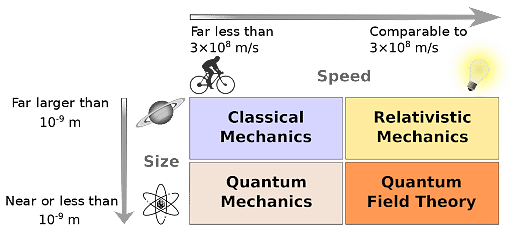
Modern Physics has completely changed the vision of humanity with which we used to see the world around us. It involves the description of nature that is pretty advanced. Both Quantum Mechanics and the Theory of Relativity deal with the different phenomenon. For example, Quantum Mechanics deals with shorter distances whereas Relativity deals with distances that are in light-years and speeds that are comparable to the speed of light.
Modern Physics
Father of Modern Physics
Albert Einstein is considered to be the Father of Modern Physics for his contribution to the field of science in the early 20th century. His contributions include Theory of Relativity, Photoelectric Effect, and many more. He also gave one of the most famous equations in science, called the Mass-Energy Equivalence (E = mc2).
He was awarded the Nobel Prize in Physics for the year 1921 for "his services to Theoretical Physics, especially the discovery of the law of the photoelectric effect".
Also Read:
| Related Articles | ||
|---|---|---|
| LASER LIGHT | Avogadro's Number | Laser |
| Value of c | Particle Physics | Bohr Radius |
What is Quantum Mechanics?
[Click Here for Sample Questions]
As mentioned above, Quantum Mechanics deals with the concepts of nature at the microscopic level. It involves atoms and other subatomic particles. The need for Quantum Mechanics arose from the inability of Classical Physics to explain the phenomenon of a bounded system like energy, momentum, angular momentum, wave-particle duality, etc.
Furthermore, Quantum Mechanics also helped in explaining Max Planck’s solution to the black-body radiation problem, Einstein’s equation for the Photoelectric Effect, and other concepts were developed by physicists such as Niels Bohr, Erwin Schrodinger, Werner Heisenberg. Max Born, and others.
Max Planck came up with the concept of small energy packets called quanta. Einstein later called them Photons. The energy of each photon is calculated as:
E = hv
The concept of photons described light as particles. During the same period, experiments related to interference patterns and stability of atoms deduced light to be a wave. De Broglie came up with his hypothesis that said matter behaves like a wave. He called its nature the Matter-Wave. Its wavelength was:
? = h/p
where p and h are momentum and Planck’s constant respectively. Quantum theory is necessary to describe the concepts of physics at an atomic scale. It helps to quantify the various quantities such as angular momentum, energy, etc.
What is Einstein’s Theory of Relativity?
[Click Here for Sample Questions]
Einstein’s Theory of Relativity is a set of two theories: Special Relativity and General Relativity theory. The theory of relativity governs the movement of a body under the influence of gravity. Special Relativity deals with physical phenomena in the absence of gravity.
Through his relativity, Einstein proposed that both space and time are a single entity and any observation is relative to both space and time. He called this singular entity spacetime and it played a key role in his theory. He also included other concepts like time dilation, length contraction, and relativity of simultaneity.
Einstein’s Theory of Relativity is one of the biggest discoveries in the history of science and has helped in uncovering astronomical phenomena like black holes, gravitational waves, and neutron stars. It also gave us one of the most famous equations in science, called the Mass-Energy Equivalence:
E = mc2
Here, m is the mass of the body and c refers to the speed of light in the vacuum.

Einstein’s Theory of Special Relativity
Concepts under Modern Physics
[Click Here for Sample Questions]
The concepts that are covered under Modern Physics are:
- Atomic Theory: Atomic Theory states that all matter is composed of small microscopic particles called Atoms. Modern Physics helped in coming up with a detailed and precise model for the structure of matter.
- Black-Body Radiation: Black-Body Radiation refers to the radiation emitted by a black body (a perfect, non-reflective surface) in its surrounding. Max Planck came up with a solution for calculating the black-body curve in 1901.
- Franck-Hertz Experiment: Franck-Hertz experiment was an electrical experiment done by James Franck and Gustav Hertz that showed the quantum nature of an atom.
- Geiger-Marsden Experiments: The series of experiments carried out by Hans Geiger and Ernest Marsden helped the scientists to know that all the positive charge and mass of an atom is concentrated in its nucleus.
- Gravitational Lensing: Gravitational Lensing refers to phenomena in which the light coming from distant galaxies is magnified and distorted by the gravitational field of a cluster of galaxies that are in front of the incoming light. This helps in studying the galaxies that are too far to be seen by the telescopes.
- Michelson-Morley Experiment: Michelson-Morley Experiment was carried out to prove the existence of the aether, a medium that helps in carrying the light waves in space. Its failure proved that light waves do not need a medium to travel in space.
- Photoelectric Effect: Photoelectric Effect refers to the emission of electrons from the surface of the matter when struck by light. The emitted electrons are called Photoelectrons.
- Quantum Thermodynamics: Quantum Thermodynamics is the culmination of the concepts of Quantum Mechanics and Thermodynamics. It deals with the physical phenomena of light and matter.
- Perihelion Precession of Mercury: Newton’s equations were not able to describe the orbit of Mercury correctly. Einstein’s General Theory of Relativity solved this problem.
- Stern-Gerlach Experiment: Stern-Garlech Experiment was carried out by Otto Stern amd Walther Gerlach. It showed that the spatial arrangement of angular momentum is quantized. Therefore, an atomic-scale system shows intrinsically quantum properties.
- Wave-Particle Duality: Wave-Particle helps in understanding the dual nature of every particle. It describes how a particle is described both as a wave and as a particle in different situations.
Modern Physics Formulas
[Click Here for Sample Questions]
| Quantity | Formula |
|---|---|
| Photoelectric Effect | hf = Φ + Ek |
| Black Body Radiation | Bv (v,T) = 2hv3/c2 {1/(e(hv/kT)-1)} |
| Energy of Photon | E = hf |
| Mass-Energy Equivalence | E = mc2 |
| Radioactive Half-Life | ln (Nt/N0) = -kt |
Things to Remember
- Modern Physics is a branch of Physics that is a culmination of two of the most important fundamental theories of the 20th century: Einstein’s Theory of Relativity and Quantum Mechanics.
- Quantum Mechanics deals with shorter distances whereas Relativity deals with distances that are in light-years and speeds that are comparable to the speed of light.
- Quantum Mechanics helped in explaining Max Planck’s solution to the black-body radiation problem, Einstein’s equation for the Photoelectric Effect, and other concepts that were developed by physicists such as Niels Bohr, Erwin Schrodinger, Werner Heisenberg. Max Born, and others.
- Einstein’s Theory of Relativity is a set of two theories: Special Relativity and General Relativity. It governs the movement of a body under the influence of gravity. Special Relativity deals with physical phenomena in the absence of gravity.
- Albert Einstein is considered to be the Father of Modern Physics for his contribution to the field of science in the early 20th century.
Also Read:
Sample Questions
Ques. What does Modern Physics consist of? (2 marks)
Ans. Modern Physics is a branch of Physics that is a culmination of two of the most important fundamental theories of the 20th century: Einstein’s Theory of Relativity and Quantum Mechanics. Quantum Mechanics deals with shorter distances whereas Relativity deals with distances that are in light-years and speeds that are comparable to the speed of light.
Ques. What is Quantum Mechanics? (2 marks)
Ans. Quantum Mechanics deals with the concepts of nature at the microscopic level. It involves atoms and other subatomic particles. It helped in explaining Max Planck’s solution to the black-body radiation problem, Einstein’s equation for the Photoelectric Effect, and other concepts that were developed by physicists such as Niels Bohr, Erwin Schrodinger, Werner Heisenberg. Max Born, and others.
Ques. What is Einstein’s Theory of Relativity? (2 marks)
Ans. Einstein’s Theory of Relativity is a set of two theories: Special Relativity and General Relativity. It governs the movement of a body under the influence of gravity. Special Relativity deals with physical phenomena in the absence of gravity. Einstein proposed that both space and time are a single entity and any observation is relative to both space and time. He called this singular entity - Spacetime and it played a key role in his theory. He also included other concepts like time dilation, length contraction, and relativity of simultaneity.
Ques. What are the different concepts studied under Modern Physics? (5 marks)
Ans. The different concepts that are studied under Modern Physics include:
- Atomic Theory
- Michelson-Morley Experiment
- Wave-Particle Duality
- Phototelectric Effect
- Quantum Thermodynamics and many more
Ques. Define Franck-Hertz Experiment, Michelson-Morley Experiment, and Geiger-Marsden Experiments. (3 marks)
Ans. These experiments can be understood as:
- Franck-Hertz experiment was an electrical measurement done by James Franck and Gustav Hertz that showed the quantum nature of an atom.
- The series of experiments carried out by Hans Geiger and Ernest Marsden helped the scientists to know that all the positive charge and mass of an atom is concentrated in its nucleus.
- Michelson-Morley Experiment was carried out to prove the existence of the aether, a medium that helps in carrying the light waves in space. Its failure proved that light waves do not need a medium to travel in space.
Ques. How does Einstein’s Theory of Relativity describe Mercury’s orbit? (4 marks)
Ans. Mercury’s perihelion (point in its orbit which is closest to the sun) seems to shift with every rotation. The shift is referred to “Precession of the Perihelion of Mercury”. It is calculated to be around 5600 arcseconds of rotation per century. About 5030 arcseconds per century of this shift comes from a classical two-body system of Sun and Mercury and around 530 arcseconds per century comes from the gravitational effect of other planets. This leaves around 40 arcseconds per century of unexplained movement. Einstein’s Theory of Relativity proved that the unexplained movement is due to the curvature of spacetime by Sun and Mercury.
Ques. What is Photoelectric Effect? (2 marks)
Ans. Photoelectric Effect refers to the emission of electrons from the surface of the matter when struck by light. The emitted electrons are called Photoelectrons. In this process, an electron absorbs the energy of a photon which increases its energy to more than the binding energy. This results in the emission of the electron. Photoelectric Effect is generally shown by metals and other conductors.
Ques. What is Black Body Radiation? (2 marks)
Ans. Black-Body Radiation refers to the radiation emitted by a black body (a perfect, non-reflective surface) in its surrounding. The radiation contains a specific spectrum of wavelengths and it is inversely proportional to the body’s temperature.
For Latest Updates on Upcoming Board Exams, Click Here: https://t.me/class_10_12_board_updates
Do Check Out:



Comments