



Education Content Expert
Periscope is an optical instrument used in land and sea warfare and submarine navigation. It allows an observer to see the surroundings underwater or submerged.
- Periscope allows the observer to look at an object that is not visible in a direct line of sight.
- It works on the principle of reflection of light.
- It consists of an exterior box with mirrors at each end positioned parallel to each other at a 45° angle.
- Jules Carpentier, a French engineer, and inventor designed the submarine periscope.
- It was widely used during World War II in tanks and armored vehicles.
Periscopes were widely used during World War II in tanks and armored vehicles. Tank Periscopes can also be used in pointing and firing the guns when fitted with a small, auxiliary gunsight telescope.
| Table of Content |
Key Terms: Periscope, Reflection, Refraction, Mirrors, Magnification, Vision, Submarine, Prism, Endoscopy Technology, Optical instruments, Light
What is Periscope?
[Click Here for Sample Questions]
Periscope is an optical tool used for observing over, around, or through an obstacle or object that prevents direct line-of-sight observation from the current position of the observer.
- Periscopes are of great benefit to Submariners.
- It permits submarines to see above the water's surface.
- It acts as a navigational aid beneath the water.
- A simple periscope just requires mirrors, but a more complex periscope also uses prisms.
- More complicated periscopes use prisms or modern optical fibre to provide the magnification required on submarines.
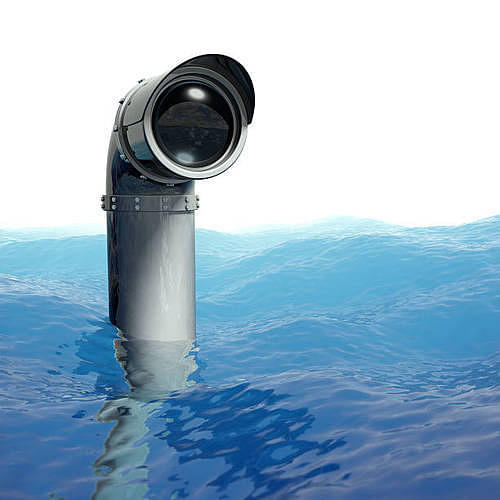
Periscope
Read More:
Working of Periscope
[Click Here for Previous Year Questions]
Periscope works on the basic principle of reflection of light where the angle of reflection (the angle formed by the reflected ray and the normal to the reflecting surface or mirror) equals the angle of incidence (the angle formed by the incoming beam and the normal).
- A periscope is made up of two mirrors or reflecting prisms that modify the direction of the light coming from the source.
- The first mirror deflects the light down through a vertical tube.
- The second mirror diverts it horizontally so that the object may be viewed from a below level.
- A telescopic optical system is frequently used to provide magnification and provide a wide arc of vision.
- It contains a crossline or reticle pattern to establish the line of sight to the object under study.
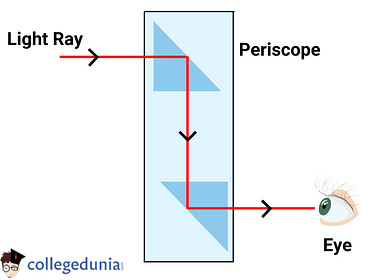
Working of Periscope
Types of Periscopes
[Click Here for Sample Questions]
Periscopes are classified into two major categories:
- Simple Periscope: A simple periscope consists of an outer case with mirrors at each end set parallel to each other at a 45o angle. This form of periscope with the addition of two simple lenses served for observation purposes in the trenches during World War-I.
- Complex Periscope: In complex periscopes, prisms are used instead of mirrors. Advanced fiber optics are used instead of mirrors to provide magnification. They are used in submarines and in various fields of science.
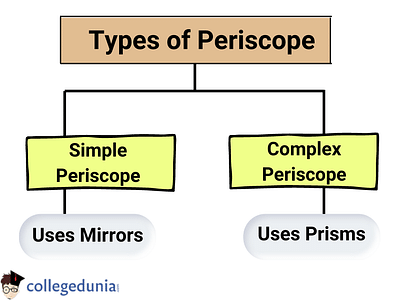
Types of Periscopes
Uses of Periscope
[Click Here for Previous Year Questions]
Periscopes are used in varied fields which are described as follows:
Submarine
- Periscopes are widely used in submarines as they provide a view of what is happening above the sea surface from underwater.
- Periscopes also allow defense submarines to locate and identify enemy warships.
- It helps in determining and calculating the correct time and distance for a torpedo attack.
Military
- Periscopes are also used in the military, especially in warfare submarines.
- Besides submarines, it is used during wartime when battles happen in uneven altitude places.
- Periscopes help the soldier at a lower altitude to know what is happening at a higher altitude.
Medicine
- A similar working principle like periscopes is also used in endoscopy technology.
- Endoscopy is a technique where advanced equipment built with lenses and prisms is inserted into the body through the throat.
- This helps in identifying any types of abnormal growth or causes of illnesses inside the human body.
Check More:
Things to Remember
- Periscope is an optical instrument used in land and sea combat, and submarine navigation.
- It allows an observer to see the surroundings while remaining concealed, behind armor, or underwater.
- Periscopes are made of two mirrors placed at 45o angles at each other.
- Light reflects through these mirrors and shows what is at the other end of the lens.
- Most periscopes are made of mirrors, while some advanced and complex periscopes are made of reflecting prisms.
- Periscopes work on the principle of reflection of light where the angle of reflection equals the angle of incidence.
- Periscopes are generally used in armed forces, especially in the naval forces where submarines used these to see through the water.
Previous Year Questions
- When light passes from one medium to another, there… (KCET 1996)
- The magnifying power of a telescope is nine. When it… (MHT CET 2019)
- For what distance is ray optics a good approximation… (Delhi UMET/DPMT 2009)
- A ray is incident at an angle of incidence i on one surface… (NEET 2020)
- A ray of light travels from an optically denser to a rarer… (KCET 2002)
- Optical fibers are based on… (NEET 2001)
- The branch of optics dealing with the formation of images…
- Consider telecommunication through optical fibers… (AIEEE 2003)
- The magnifying power of an astronomical telescope can be…
- To increase magnifying power of the telescope, we should… (Punjab PMET 2006)
Sample Questions
Ques. What is a Periscope? (2 Marks)
Ans. Periscope is an instrument that is used to monitor over, around, or through any object or obstacle. It is used in those conditions in which the direct line-of-sight observation is prevented from the observer’s current position. Thus, a periscope is an optical instrument that allows viewing those objects which are not in direct line of sight of view. Periscopes are extremely important for the working of submariners as they allow them to view above the surface of the water.
Ques. What is the difference between a telescope and a periscope? (2 Marks)
Ans. Telescopes and Periscopes are both optical instruments. A telescope is a monocular optical instrument that has the magnification capacity of distant objects. They are mainly used in the field of astronomy. On the other hand, a periscope is a form of viewing device which allows the observer to see things at different height levels. It works in a situation with minimal visibility.
Ques. What are the uses of Periscope? (3 Marks)
Ans. The various applications of Periscopes are:
- Periscopes are majorly used in submarines for general navigation and detection.
- In a similar kind of threat detection application, they are often used on battlefields too.
- The most widely used application for periscopes now is in medicine.
- It helps for its less obtrusive method of diagnostic techniques.
Ques. Why do periscopes have a Z shape? (2 Marks)
Ans. Periscopes are usually used to see objects at some height by hiding underground. Due to this particular reason, the beam of light, incident on the first mirror must be incident on the second mirror too after the reflection from the first one. Therefore, periscopes have a Z shape.
Ques. What is the structure of a Periscope? (2 Marks)
Ans. A periscope is a long, tubular device through which a person can see objects which are out of the direct line of sight. There are two plane mirrors in a periscope that are used to see over the top of things. A periscope works on the reflection of light from two plane mirrors arranged parallel to one another.
Ques. What are the types of Periscopes? (2 Marks)
Ans. There are two main types of periscopes:
- Simple Periscope: This type of periscope uses only mirrors for the reflection of light.
- Complex Periscope: They use prisms too for the reflection of light.
Ques. On which principle does a periscope work? (2 Marks)
Ans. A periscope works on the principle of reflection of light. It works by using two mirrors to bounce light from one place to another. It uses two mirrors placed at a 45-degree angle to the direction in which the observer desires to see. The light bounces from one end to the other and then reaches the eye of the observer.
Ques. What type of mirror is used in a Periscope? (5 Marks)
Ans. A plane mirror is used in the periscope. Since light can only travel in a straight line, the picture of the object does not reach the observer's eye when the object and the observer are at different levels. The reflection from one mirror will route the beams perpendicular to the incoming direction at a 45o inclination to the approaching object ray. The reflection from the second mirror at a 45-degree angle will generate the appropriate level change to reach the observer.
- Plane mirrors work well for this purpose and are protected by a perpendicular Z-shaped pipe.
- Plane mirrors reflect the exact shape and size of the object.
- The picture's distance is also the same as that viewed from plane mirror reflections.
- However, a complex structure of these mirrors is utilized to generate a fine image.
- As a result, the interior of the periscope is formed by a plane and lenses.
Ques. What type of Image is formed by a Periscope? (3 Marks)
Ans. The image created by a periscope is virtual, and the mirrors set parallel to each other at a 45-degree angle cause it to be laterally inverted twice. When a ray is reflected by the first mirror, the incident ray is moved toward the second mirror, resulting in a virtual image with no lateral inversion. Because two lateral inversions cancel one other out, the image created in a periscope is virtual. As a result, the image created in a periscope is virtual and does not exhibit lateral inversion.
Ques. State the working principle of a Periscope in detail. (5 Marks)
Ans. A basic periscope is an optical instrument used to examine objects that may be at a different height level or have barriers in the observer's and the object's direct line of sight.
- A simple periscope operates on the reflection concept of a mirror.
- Mirrors are arranged so that the angle of incidence of the light ray is 45o degrees.
- Since the angle of incidence is equal to the angle of reflection according to the rules of reflection, the angle of reflection will also be 45o.
- As a result, the light ray will be effectively twisted by 45o + 45o = 90o.
- Thus, the observer can observe the item by making 90o spins of light with the help of appropriately placed mirrors.
- The object's light rays enter the periscope and are rotated by 90o by a mirror.
- A second mirror reverses it by 90o degrees, and the light ray reaches the spectator's eye, allowing the observer to see the object at a new height level.
For Latest Updates on Upcoming Board Exams, Click Here: https://t.me/class_10_12_board_updates
Check-Out:



Comments