



Education Journalist | Study Abroad Lead
Polarisation of light is an important phenomenon that occurs due to the wave-like nature of electromagnetic radiations. The polarisation of light has an impact on the focus of laser beams, the cut-off wavelengths of filters, and can be useful in preventing unwanted back reflections. Sunlight is a perfect example of an electromagnetic wave that reaches the earth’s surface by travelling through a vacuum. The interaction between the electric and magnetic fields gives rise to these electromagnetic waves. This makes it crucial for many optical applications. This article discusses the topic in detail along with some solved questions.
| Table of Content |
Key Terms: Polarisation, Plane- Polarised Light, Unpolarized, Polarizer, Single Slit Diffraction, Young’s Single Slit Experiment, Photons, Huygens' Principle, Brewster’s Law, Reflection, Selective Absorption
What is Polarisation?
[Click Here for Sample Questions]
Light travels in the form of transverse electromagnetic waves. The underlying oscillation is along directions perpendicular to the propagation direction, in this instance, oscillating electric and magnetic fields. Polarisation is the process of restricting the vibration of light waves to one direction.
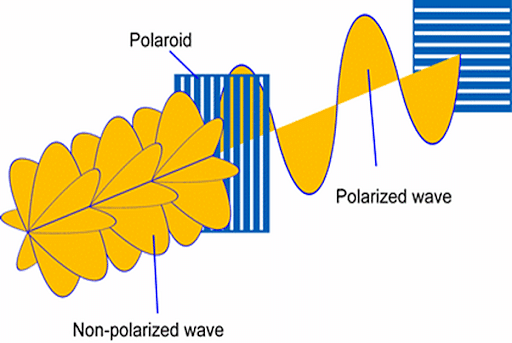
Polarisation Process
Polarised or Plane Polarized Light
Polarised or plane polarised light is defined as light that oscillates only in one plane.
- The plane of oscillation refers to the plane in which polarised light oscillates.
- The plane of polarisation is the plane perpendicular to the plane of oscillation.
- When light passes through certain crystals, such as tourmaline or polaroids, it becomes polarised.
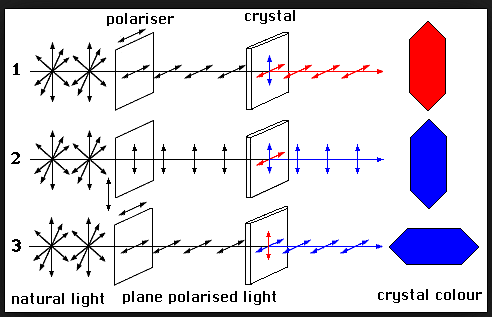
Plane Polarised Light
Unpolarised Light
Unpolarised light is the light that has electric field oscillations in all directions on a plane perpendicular to the propagation direction. The oscillation may be resolved into the horizontal and vertical components.

Unpolarised Light
Most natural light sources emit unpolarized light, which is made up of several wave trains with fully random oscillation directions.
Also Check:
Polariser
[Click Here for Previous Year Questions]
A polarizer or polariser is an optical filter that lets light waves of a specific polarisation pass through while blocking light waves of other polarisations. Light oscillations parallel to the transmission axis can pass through polaroids. It can convert an undefined or mixed polarised light beam into polarised light by filtering it.
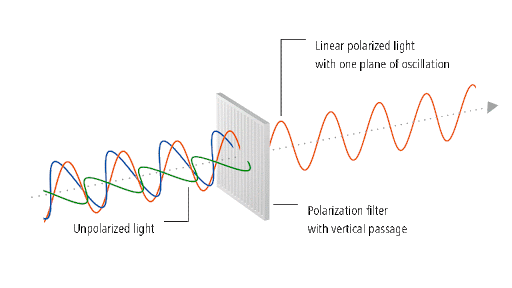
Polariser
- Linear polarizers and circular polarizers are the two most prevalent forms of polarizers.
- The polariser is the crystal or polaroid on which unpolarized light is incident.
- An analyzer is a crystal or polaroid on which polarised light is incident.
Brewster’s Law
[Click Here for Sample Questions]
Brewster's law states that an unpolarized light beam becomes polarised to its maximum when it strikes an interface of another medium at a specific angle of incidence known as Brewster's angle. The rays that are reflected and refracted are perpendicular to one another. The polarisation of the reflected light is complete.

Brewster’s Law
The refractive index of the transparent medium is numerically equal to the tangent of the angle of polarisation. If q is the polarisation angle and μ is the clear medium's refractive index, then,
tan θ q = μ
Types of Polarisation of Light
[Click Here for Previous Year Questions]
The polarisation of light is categorised into three categories based on the transverse and longitudinal wave movement. Let us look at these types in detail.
Linear Vibration
The electric field vibrates in a linear path perpendicular to the wave axis, and the magnetic field vibrates in a direction perpendicular to both the advancement axis and the direction of the electric field in a linearly polarised light wave.
The direction of polarisation is considered to be the vibrational direction of the electric field. Polarisation can occur in any direction that is perpendicular to the wave axis. The 180-degree rotation of the polarisation does not result in a rationally different state.

Types of Polarisation
Circular Polarisation
It is a type of polarisation in which the electromagnetic field has the same magnitude at all points but rotates with a constant value in a plane perpendicular to the wave's direction. The electric field vector of a circularly polarised wave can spin in one of two ways:
- According to the direction of propagation in a right-hand sense
- According to the direction of propagation in a left-hand sense
This is because light behaves as a two-dimensional transverse wave, the phenomenon of polarisation arises.
Elliptical Polarisation
It is a kind of polarisation in which the electric field vector's tip defines an ellipse in any fixed plane across the propagation direction. Bifurcation of an elliptically polarised wave into two linearly polarised waves with polarisation planes perpendicular to each other is possible. Elliptically polarised waves exhibit chirality because the electric field can rotate clockwise or anti-clockwise while propagating.
Methods of Polarisation of Light
[Click Here for Sample Questions]
The following methods can be used to create polarised light:
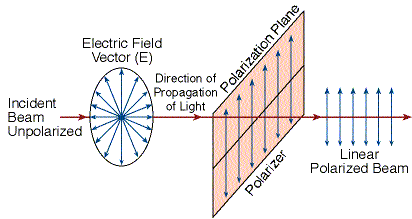
Polarisation Method
Polarisation by Reflection
When ordinary light is incident at a polarising angle on transparent materials such as water or glass, the ray of light after reflection becomes plane polarised light because every vibration of the electric vector may be resolved into parallel and perpendicular components to the plane.

Polarisation by Reflection
The perpendicular components are transmitted, while the parallel components are reflected. A polarising angle is the angle of incidence at which the intensity of reflected light is totally polarised.
Polarisation by Selective Absorption
polarisation can be done with the use of a Polaroid and a doubly refracting crystal. The attribute of dichroism is that it absorbs normal light and produces polarised light. Polaroids are also used to create plane polarised light.

Polarisation by Selective Absorption
Only the electric field vector oscillating in a direction perpendicular to the alignment of molecules passes through polaroids when unpolarised light falls on it, therefore the transmitted light has the electric field vector oscillating perpendicular to the direction of the alignment of molecules. The light that is transmitted is plane polarised.
Polarisation of Light by Scattering
When an unpolarized light beam strikes the molecules of dust particles or molecules, the beam scatters and becomes polarised. It's because every molecule behaves like an electric dipole, absorbing energy from the incident particle and causing the molecule's electric dipole to vibrate, emitting light with the same frequency as the incident particle in the form of polarised light.

Polarisation by Scattering
Polarisation by Transmission
This method necessitates the use of filter materials with a unique chemical composition. They are known as Polaroid filters. These polaroid filters can block electromagnetic waves in one of two planes. When unpolarized light passes through these polaroid filters, one-half of the light's vibrations are filtered out in a single plane. The intensity of this polarised light is half that of normal light.

Polarisation by Transmission
Applications of Polarisation
[Click Here for Previous Year Questions]
- In sunglasses, polarisation is used to reduce glare.
- In the plastics industry, Polaroid filters are used to perform stress analysis testing.
- Polarisation is used to create and display three-dimensional movies.
- Differentiating between transverse and longitudinal waves is done via polarisation.
- Polarisation is used in infrared spectroscopy.
- It is used to study earthquakes in seismology.
- In chemistry, polarisation techniques are used to determine the chirality of organic molecules.

Applications of Polarisation
Also Check Out:
Things to Remember
- Polarisation is the process of restricting the vibration of light waves to one direction.
- There are three types of polarisation depending on the transverse and longitudinal wave motion, i,e. Linear polarisation, Circular polarisation and Elliptical polarisation
- There are various methods to produce plane polarised light from unpolarised light. An instrument that produces polarized light from unpolarized light is called a polarizer.
- Polaroid is a plane sheet containing a thin plastic sheet, made up of a long chain of molecules aligned in a particular direction.
- There are a few methods used in the polarisation of light like polarisation by Transmission, polarisation by Reflection, polarisation by Scattering, polarisation by Refraction.
- Applications for polarized light: Polaroid sunglasses, the use of special polarizing filters for camera lenses, room and stage lighting to reduce glare, optical microscopy and many more.
Previous Year Questions
- Frequency of Hollow cylinder when immersed in water. [WB JEE 2008]
- Ratio of frequencies of Pth overtone of a pipe. [MHT CET 2019]
- Calculate the maximum particle velocity. [MHT CET 2008]
- Minimum disctance in a bi-chromatic light. [JEE Advanced]
- Condition for coherence of two light sources. [VITEEE 2010]
- Calculate the Brewster’s angle at the interface. [NEET 2020]
- Calculate the speed of sound in air. [NEET 2019]
- Calculate the speed of the wave on the spring. [NEET 1989]
- Calculate the intensity of sound when frequency and amplitude is changed. [NEET 1989]
- Calculate the original frequency of the guitar springs. [NEET 2020]
- Relation between electric and magnetic field of a wave. [NEET 1994]
- Which electromagnetic wave does not emit electron. [NEET 1990]
- Calculate the frequency of sound wave. [NEET 1990]
- Calculate the value of wavelength of a transverse wave. [NEET 1998]
- Calculate the frequency of sound from a vehicle. [NEET 1998]
- Calculate the velocity of sound in air from a tuning fork. [NEET 2018]
- Calculate the number of beats from the two strings. [NEET 2009]
- Calculate velocity of wave from the wave equation. [NEET 2001]
- Calculate the phase difference between the two waves. [NEET 2001]
- Calculate the frequency of sinusoidal wave. [NEET 1992]
Sample Questions
Ques. What is meant by the polarisation of light? [2 marks]
Ans. Light polarisation is a property of light waves that depicts the direction of their oscillations. A polarized light vibrates or oscillates in only one direction. This is in contrast to a non polarized light that vibrates in many directions.
Ques. What are some examples of polarized light? [2 marks]
Ans. Common examples of surfaces that reflect polarized light are undisturbed water, glass, sheet plastics, and highways. In these instances, light waves that have the electric field vectors parallel to the surface are reflected to a greater degree than those with different orientations
Ques. Unpolarized light is incident on a plane surface of a glass of refractive index µ at an angle i. If the reflected light gets totally polarized, write the relation between the angle i and refractive index µ. [3 marks]
Ans. The relation between angle i and refractive index is
µ = tan ip
Ques. In what way is plane-polarized light different from an unpolarized light? [2 marks]
Ans. In case of polarized light, the directions of the electric field vector are restricted to only a particular / plane whereas in an unpolarized light the direction of the Electric wave is in all possible directions in a plane perpendicular to the direction of propagation.
Ques. Find an expression for the intensity of transmitted light when a polaroid sheet is rotated between two crossed polaroids. In which position of the Polaroid sheet will the transmitted intensity be maximum? [5 marks]
Ans. Let the rotating Polaroid sheet make an angle θ with the first polaroid.
∴ angle with the other polaroid will be (90 – θ)

Ques. Distinguish between unpolarised and linearly polarised light. Describe, with the help of a diagram, how unpolarised light gets linearly polarised by scattering. [3 marks]
Ans. Unpolarized light: A light wave, in which the electric vector oscillates in all possible directions in a plane perpendicular to the direction of propagation is known as unpolarized light.
Linearly polarized light: If the oscillations of the electric vectors are restricted to just one direction, in a plane perpendicular to the direction of propagation, the corresponding light is known as linearly polarized light.
It is due to the scattering of light by molecules of the earth’s atmosphere.

Under the influence of the electric field of the incident (unpolarized) wave, the electrons in the molecules acquire components of motion in both these directions. Charges, accelerating parallel to the double arrows, do not radiate energy towards the observer since their acceleration has no transverse component.
The radiation scattered by the molecules is therefore represented by dots, i.e., it is polarized perpendicular to the plane of the figure.
Ques. State Brewster’s law. The value of Brewster angle for a transparent medium is different for the light of different colours. Give a reason. [3 marks]
Ans. (i) Brewster’s law: When unpolarised light is incident on the surface separating two media, the reflected light gets (completely) polarized only when the reflected light and refracted light become perpendicular to each other.
The refractive index of the denser medium, with respect to the rarer medium, is given by

(ii) Since the refractive index (µ) of a transparent medium is different for different colours, the Brewster angle also is different for different colours.
Ques. (i) State the principle on which the working of an optical fibre is based.
(ii) What are the necessary conditions for this phenomenon to occur? (CBSE 2009) [2 marks]
Ans.
(i) Working of an optical fibre is based on the principle of total internal reflection.
(ii) (a) Light should travel from a denser to a rarer medium.
(b) Angle of incidence should be more than

Ques. State two conditions required for obtaining coherent sources.
Young’s arrangement to produce an interference pattern, shows that dark and bright fringes appearing on the screen are equally spaced. (CBSE 2009) [2 marks]
Ans. Two conditions for obtaining coherent sources: (0 Two sources should give monochromatic light.
(ii) Coherent sources of light should be obtained from a single source by some device.
The fringe width (dark and bright) is given by 
Hence, it is the same for both dark and bright fringes So they are equally spaced on the screen.
Ques. Write the distinguishing features between a diffraction pattern due to a single slit and the interference fringes produced in Young’s double-slit experiment? [3 marks]
Ans. Difference between interference and diffraction of light
| Interference | Diffraction |
|---|---|
| Interference is due to the superposition of two distinct waves coming from two coherent sources. | Diffraction is due to superposition of the secondary wavelets coming from different parts of the same wavefront. |
| Interference fringes may or may not be of the same width. | Diffraction fringes are not to be of the same width. |
| The intensity of minima is generally zero. | The intensity of minima is never zero. |
| All bright fringes are of uniform intensity. | All bright fringes are not of uniform intensity. |
For Latest Updates on Upcoming Board Exams, Click Here: https://t.me/class_10_12_board_updates
Check-Out:



Comments