



Education Journalist | Study Abroad Lead
Polystyrene is a synthetic polymer made from a monomer named styrene (liquid petroleum). Styrene occurs naturally in some plants and is used in making synthetic rubber, polystyrene resins, etc. Polystyrene can be hard, solid plastic or foam depending on the temperature. It's a far better insulator as compared to everyday common insulators like plastic, rubber, wood etc. The IUPAC name of polystyrene is poly (1-phenylethene-1,2-diyl) and the chemical formula of Polystyrene is (C8H8)n.
| Table of Content |
Key Terms: Polystyrene, Polymer, Monomer, Styrene, Aromatic Hydrocarbon, Polymerization, Non-Biodegradable, Bromination
What is Polystyrene?
[Click Here for Sample Questions]
Polystyrene is a synthetic aromatic hydrocarbon polymer that is produced by the polymerization of styrene and is the most widely used plastic. It is a hard, brilliantly transparent, stiff resin which is insoluble in water. Polystyrene is a solid at room temperature but when heated above 100 °C it flows.
Polystyrene is non-biodegradable in nature and is used in the food-service industry as rigid trays, disposable eating plates, bowls, containers, etc.

Polystyrene
Structure of Polystyrene
[Click Here for Sample Questions]
The structure of Polystyrene consists of a long hydrocarbon chain in which a phenyl group is attached to every carbon atom present.
The structure is given below:
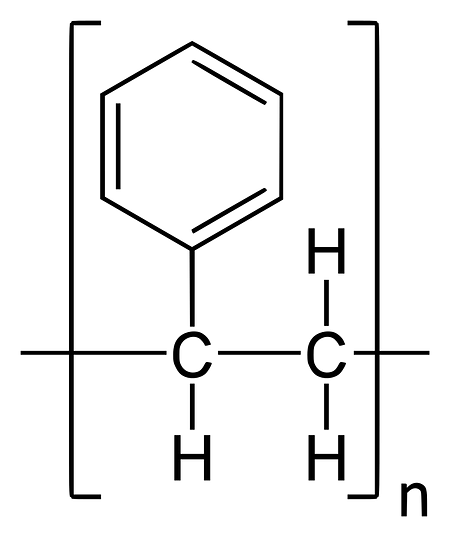
Structure of Polystyrene
Preparation of Polystyrene
[Click Here for Sample Questions]
The preparation of Polystyrene is a three-step synthesis process which involves the following steps:
- Bromination of Styrene
The styrene is formed by the bromination of ethylbenzene. The process takes place in a large excess of acetate and nitrate (gives only two products in each case ie,0,8-dibromide and acetoxy-8-bromide OR a-nitrato-b-bromide respectively).
- Elimination
Elimination of 1-Bromo-ethyl benzene undergoes takes by the E1 mechanism which is identical to the Sn1 mechanism also, this reaction is proceeded by carbocation when the departure of the poor leaving group takes place.
- Polymerization
In the presence of Benzoyl peroxide as a catalyst, the preparation of polystyrene from styrene takes place by free radical addition polymerization.
Read More: Condensation Polymerization
Properties of Polystyrene
[Click Here for Sample Questions]
The properties of Polystyrene are as follows:
| Chemical Formula | (C8H8)n |
|---|---|
| Molecular Weight / Molar Mass | 104.1 g/mol |
| Density | 1.04 g/cm³ |
| Solubility in water | Insoluble |
| Melting Point | Approx 240 °C |
Uses of Polystyrene
[Click Here for Sample Questions]
The important uses of Polystyrene are:
- As it provides thermal insulation, Polystyrene is widely used in everyday household appliances such as refrigerators, Air conditioners, freezers, DVD cases, microwaves etc.
- It's used in making toys, small jars, cups, bottle caps, etc.
- Polystyrene plays a really important role in food packing items as it stores the food for a long period without affecting its quality.
- It is also used in car parts like instrument panels, knobs, energy-absorbing door panels, sound dampening foam etc.
- It's used in making talcum powder.
- Polystyrene is also used for many medical purposes like test tubes, Petri dishes, culture trays, tissues, housing and medical test kits.

Uses of Polystyrene
Read More: Conductors and Insulators
Pros and Cons of Polystyrene
[Click Here for Sample Questions]
The pros and cons of Polystyrene are as follows:
Pros of Polystyrene
- It is Cheap and affordable.
- It works as a great insulator.
- Easily available in nearby shops.
- Water-resistant and light-weighted.
- It resists bacteria.
- It resists water and moisture from the surface.
Cons of Polystyrene
- Poor chemical resistance.
- Breaks easily.
- Inflammable.
- Mainly non-biodegradable hence polluting and harming the environment.
Also Read:
EPS and XPS
[Click Here for Sample Questions]
EPS (Expanded polystyrene) and XPS (Extruded polystyrene) are two common Polystyrene foams that exist in nature.
- EPS is a rigid thermoplastic, formed by small solid beads of polystyrene, while XPS is produced by polystyrene crystals.
- EPS is versatile in nature, light-weighted, Moisture resistant, stable, and can be made in any shape or size.
- XPS is suitable in any climate, biostable, chemical resistant, minimal water absorption, etc.
Read More: Difference Between Thermoplastic and Thermosetting Plastic
Things to Remember
- Styrene is a monomer which is generally used to make polystyrene and on the other side, polystyrene is made from the polymerization of styrene. Styrene exists in a liquid state while polystyrene exists in a solid-state or foamed.
- The chemical formula of styrene is C8H8 and the chemical formula of polystyrene is (C8H8)n, The 'n' in the chemical formula represents 'any number' starting from 2 which means many monomers are linked to form copolymers.
- The preparation of Polystyrene involves three steps namely Bromination of Styrene, Elimination and Polymerization.
- EPS is a rigid thermoplastic, formed by small solid beads of polystyrene, while XPS is produced by polystyrene crystals.
- Polystyrene is widely used in household items such as refrigerators, air conditioners, freezers, DVD cases, microwaves, toys, small jars, cups, bottle caps, etc.
Sample Questions
Ques. Give the preparation of Polystyrene. (3 Marks)
Ans. The preparation of Polystyrene involves the following steps:
- Bromination of Styrene: In the first step, styrene is formed by radical bromination of ethylbenzene and the process takes place in a large excess of acetate and nitrate.
- Elimination: Elimination of 1-Bromo-ethyl benzene undergoes takes by the E1 mechanism which is identical to the Sn1 mechanism also, this reaction is proceeded by carbocation when the departure of the poor leaving group takes place.
- Polymerization: The preparation of polystyrene from styrene takes place by free radical addition polymerization in the presence of Benzoyl peroxide as a catalyst.
Ques. What is polymerization? (3 Marks)
Ans. Polymerization is defined as a chemical reaction in which monomer molecules, in a large number, combine to produce a polymer. Thus, the process through which monomers combine to generate the macromolecules that make up polymers is known as polymerization.
Ques. Is polystyrene polar or Non-polar? Why does polystyrene exist in an amorphous state? (3 Marks)
Ans. As polystyrene contains only carbon-hydrogen bonds, it is Non-polar in nature and only dissolves in non-polar solvents as much as it can.
It exists in the amorphous state because of the presence of bulky phenyl groups, as the phenyl group comes on any side, it's hard to pack well.
Ques. Give five chemical properties of polystyrene. (3 Marks)
Ans. The chemical properties of polystyrene are shown in the given table.
| Melting Point | Approx 240 degrees celsius |
|---|---|
| Boiling Point | 430 degrees celsius |
| Specific Gravity | 1.054 |
| Thermal Conductivity | 0.003W/m-K |
| Refractive Index | 1.6 |
Ques. How styrene and polystyrene are different? Explain with an example. (3 Marks)
Ans. Some differences are as follows:
- Styrene is liquid petroleum while polystyrene is a hard/solid plastic/foam insulating material.
- Styrene is a monomer used to make polystyrene, while polystyrene is made by the polymerization of styrene.
- Styrene is produced by dehydrogenation of ethylbenzene and polystyrene is produced by polymerization of styrene monomer.
- Styrene is used for making elastomers, polystyrene, thermosetting resins, etc and polystyrene is used for making insulation, medical, automotive, and electrical appliances.
Ques. Where extruded polystyrene is mainly used? What happens when expanded polystyrene gets wet? (3 Marks)
Ans. Extruded polystyrene(XPS) is one of the great insulation materials used in basements, floors, roofs, railways, roads, etc.
As polystyrene is an insulating material, hence the expanded polystyrene (EPS) plays its role and it will resist water and moisture from the outside environment.
Ques. What are the reasons to stop using styrofoam? (3 Marks)
Ans. The reasons are as follows:
- It's not recyclable.
- It is hazardous waste and will affect the environment.
- Styrofoam is a trading name used for polystyrene made by the Dow Chemical Company.
- When it came in contact with warm food it leaches the styrene and benzene and absorbs the toxins into the human body's bloodstream and tissues and hence dysfunctions your body.
- You can feel Eye, skin or lung irritation when comes in contact with styrofoam. This irritation can also lead to further chronic exposure in your body and might cause cancer too.
For Latest Updates on Upcoming Board Exams, Click Here: https://t.me/class_10_12_board_updates
Check-Out:



Comments