



Content Curator
Real gas can be termed as the gas that does not act as an ideal gas. The interactions between the gaseous molecules help explain their behavior. Real gases do not follow the ideal gas law because of these intermolecular interactions between gas particles. As a result, real gases can be characterized as non-ideal gases having molecules that occupy a specific amount of space and can interact with one another.
| Table of Contents |
Keyterms: Real gas, Gas, Law, Ideal gas, gaseous molecules, non-ideal gases, velocity, mass
What is Real Gas?
[Click Here for Sample Questions]
A real gas is usually referred to as a gas that does not behave like an ideal gas. The behavior of gaseous molecules can be explained by their interactions. The ideal gas law does not apply to real gases because of such intermolecular interactions between gas particles. A real gas can thus be defined as a non-ideal gas having molecules that occupy a specific amount of space and can interact with one another.
Here are some features of a real gas-
- A real gas does not obey gas laws under all conventional pressure and temperature conditions.
- As the gas grows larger and more voluminous, it deviates from its optimal behavior.
- The velocity, mass, and volume of true gases are all present.
- When cooled to their boiling point, they liquefy.
- When compared to the overall volume of gas, the space filled by gas is quite large.
- It's worth noting that the behavior of a real gas is almost identical to that of an ideal gas in most circumstances. As a result, a detailed investigation of the divergence of real gases from ideal behavior is unnecessary in many applications.
- Applying the ideal gas equation to these real gases allows for rather accurate estimates.
- It is vital to remember that when a gas is approaching its condensation point, it must be treated as a true gas. Furthermore, as they approach their critical points, practically all gases must be treated as genuine gases.
Other conditions in which gases can be regarded as actual gases are when the pressure applied to the gas is extremely high, and when the Joule-Thomson effect is explained. It's also worth noting that the compressibility factor (also known as the gas deviation factor or the compression factor; generally indicated by the sign "Z") can be used to express the divergence of a real gas from the behavior of an ideal gas.
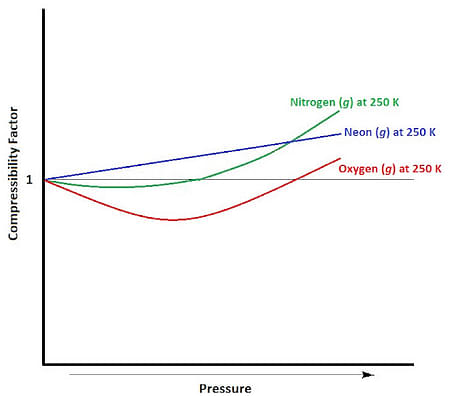
Real Gas
Also, Read- Properties of Gases
Real Gas Law
[Click Here for Sample Questions]
The ideal gas law was amended by Dutch physicist Johannes van der Waals to explain the behavior of real gases by explicitly incorporating the effects of molecular size and intermolecular interactions. Below is the Van der Waal real gas equation:
Real gas law equation = (P+an2/V2) (V-nb)=nRT
Here a and b are the representation of the empirical constant which is unique for each gas.
- n2/V2 represents the concentration of gas.
- P represents the pressure
- R is the universal gas constant and T is the temperature

Also Read- Gas Pressure Formula
Factors to be Considered while Working with Real Gases
[Click Here for Sample Questions]
Several elements must be examined to comprehend how real gases behave. The various considerations that must be made while dealing with actual gases are outlined below.
- Effects of compressibility on the actual gas
- Various actual gases have different specific heat capacities.
- Van der Waals forces affect the interactions between molecules in a real gas.
- The system's potential for non-equilibrium thermodynamic effects.
- The gas's varied composition and changes in composition as a result of molecular dissociation, as well as any elementary processes that may occur.
Read more: Charles Law Important Notes
Examples of Real Gases
[Click Here for Sample Questions]
It's vital to remember that, under the right circumstances, practically any gas can behave like a true gas.
- The ideal gas law, for example, can be used to estimate the behavior of air at standard temperature and pressure circumstances (commonly shortened to STP). This is because air acts as an ideal gas at ordinary temperature and pressure conditions. When the pressure on the air is increased to a very high level, however, the same air begins to deviate significantly from the ideal gas law and exhibit behavior more akin to that of a real gas.
- In addition, any rise in the gas's absolute temperature can have a comparable impact. This is because when the absolute temperature of the gas rises, so does the average kinetic energy of the gas molecules. This, in turn, leads to an increase in the number of interactions between the gas's molecules. As a result, increasing the absolute temperature of the air can cause significant deviations from ideal behavior, thereby turning it into a Real gas.
-
As the result, practically any gas can behave both like ideal and real gases. When the conditions are close to optimal, most gases are known to behave virtually perfectly. Most gases will deviate from ideal behavior and become real gases under relatively extreme conditions in which the temperature of the gas is raised to a very high value, the pressure on the gas is raised to a very high value, or both the temperature and the pressure associated with the gas are raised to extremely high values.
Also Read- Atoms and Molecules
Ideal and Real Gas Equation
[Click Here for Sample Questions]
A gas that obeys gas laws at all pressures and temperatures is referred to as an ideal gas. Ideal gases have both mass and velocity. They are devoid of volume. When compared to the whole volume of the gas, the volume taken up by the gas is tiny. It does not condense, therefore there is no such thing as a triple-point.
The ideal gas law, often known as the universal gas equation, is an equation that describes the state of a hypothetical ideal gas. It is a reasonable approximation of the behavior of various gases under many conditions, but it has significant drawbacks. In the year 1834 Benoît Paul Émile Clapeyron characterized it as an amalgamation of the Boyle's empirical law, Charles' law, Avogadro's law, and Gay law. Lussac's The ideal gas law is also written in an empirical form:
pV=nRT
Also Read:
| Related Articles | ||
|---|---|---|
| Three States of Matter | Critical Temperature | Mass Spectrometry |
| Vaporization | Collision Theory of Chemical Reaction | Intermolecular Forces |
Difference between Ideal and Real Gas
[Click Here for Sample Questions]
The contrast below depicts the attributes of real and ideal gases, as well as the behavior of ideal and real gases.
| Ideal Gas | Real Gas |
|---|---|
| No definite volume | Definite volume |
| Elastic Collision of particles | Non-elastic collisions between particles |
| No intermolecular attraction force | Intermolecular attraction force |
| It is a hypothetical gas and does not actually exists in the environment | It really exists in the environment |
| High pressure | The pressure in real gas is less than the Ideal gas |
| Independent | Interacts with others |
| Obeys PV = nRT | Obeys p + ((n2a )/V2) (V – nb ) = nRT |
Also Read- Differences Between Real Gas and Ideal Gas
Things to Remember
- Almost all gases are known to be real gases because they deviate from ideal behavior when exposed to extremely high temperatures and/or pressures
- Real gases defy the ideal gas law, although all ideal gases must obey the ideal gas equation.
- Furthermore, while an ideal gas must respect all gas laws in all circumstances, a real gas may not obey individual gas laws in some circumstances (that are relatively extreme).
- It's also worth noting that when genuine gases are cooled to temperatures below their boiling points, they tend to liquefy.
- Real gas law equation = (P+an2/V2) (V-nb)=nRT
Sample Questions
Ques 1. What is an example of a Real Gas? (2 marks)
Ans: Oxygen, hydrogen, carbon dioxide, helium, and other gases are examples of real gas. Real gases exhibit modest attraction and repulsive forces between particles, but ideal gases do not. True gas particles have a volume, but ideal gas particles do not.
Ques 2. What are the Assumptions of an Ideal Gas? (2 marks)
Ans: The ideal gas law assumes that gases behave optimally, which means they meet the following criteria:
(1) Molecule collisions are elastic, and their motion is frictionless, meaning the molecules do not lose energy;
(2) the overall volume of the individual molecules is smaller.
Ques 3. What is Charle's Gas Law? (1 mark)
Ans: The physics notion known as Charle's law asserts that the volume of gas equals a constant value multiplied by its temperature on the Kelvin scale (zero Kelvin corresponds to -273.15 degrees Celsius).
Ques 4. How can the ideal gas equation be modified to apply to real gases? (2 marks)
Ans: To account for the reasons why real gases do not behave in an ideal fashion, the ideal gas equation can be changed into the Van der Waals equation. This equation takes into account the volume occupied by the real gas molecules as well as the interactions between the real gas molecules (the attractive and repulsive forces that arise between them).
Ques 5. What is the temperature known as where a real gas obeys Boyle’s law or as an ideal gas? (2 marks)
Ans: The temperature where a real gas obeys Boyle’s law or as an ideal gas at a particular pressure range is known as Boyle temperature or Boyle point. It is different for every gas and is dependent upon its nature.
Ques 6. Which of the following conditions do you think a real gas behaves as an ideal gas? (1 mark)
(a) high pressure
(b) low pressure
(c) intermediate pressure
(d) at any pressure
Ans: b, low pressure
Ques 7. What kind of deviation does the real gas show from the ideal gas above Boyle's temperature? (1 mark)
Ans: Above the Boyle temperature the compressibility value is more than 1, hence the gases show a positive deviation from the ideal gases as the attraction force between the two gas molecules is very little.
Ques 8. A gas that is of 2 moles occupies a volume of about 500 ml at 300 Kelvin and 50 atmospheric pressure, calculate the compressibility factor of the gas. (1 mark)
(a) 1.863
(b) 0.7357
(c) 0.5081
(d) 1.8754
Ans: c, 0.5081
Ques 9. For an ideal gas, the compressibility factor is (1 mark)
(a) 0.5
(b) 1.0
(c) 1.5
(d) 2.0
Ans: b, 1.0
Ques 10. The plot PV vs v at constant temperature is a straight line for real gases. (1 mark)
(a) true
(b) false
Ans: b, false.
For Latest Updates on Upcoming Board Exams, Click Here: https://t.me/class_10_12_board_updates
Check-Out:



Comments