



Content Writer
Thermoregulation is the mechanism through which the body maintains its internal temperature within a certain degree, irrespective of the external temperature. All thermoregulation systems work to restore the body's equilibrium.
- The thermoregulation system includes the sweat gland, skin and circulatory system.
- Regulating the temperature of the body is a form of homeostasis.
- It is a way of maintaining a balanced body temperature for survival.
- The Hypothalamus acts as a thermostat, which is crucial for maintaining the temperature.
- Hyperthermia is a condition when the body is unable to maintain a normal temperature.
- If the body temperature becomes too low or high, then it can lead to death.
- Thermoregulation uses efferent responses, afferent sensing and central control for working.
Read More: ATP (Adenosine Triphosphate)
Key Terms: Thermoregulation, Temperature, Equilibrium, Homeostasis, Celsius, Hypothalmus, Hyperthermia, Hypothermia, Enzyme, Nervous System
Thermoregulation
[Click Here for Sample Questions]
Thermoregulation is the biological mechanism that is responsible for maintaining the body internal temperatures. Body temperature has an impact on bodily functions. In general, when body temperature rises, so does enzyme activity.
- Enzyme activity doubles with every 10 degrees Celsius increase in temperature.
- With high heat, body proteins, including enzymes, begin to denature and lose their activity.
- The process takes at a temperature of 50 degrees Celsius for mammals.
- With a few exceptions, enzyme activity decreases by 50% for every 10-degree centigrade drop in temperature.
- The process continues until it reaches the point of freezing.
- Some fish can resist freezing solid and then defrost to normal.
Read More: Insulin
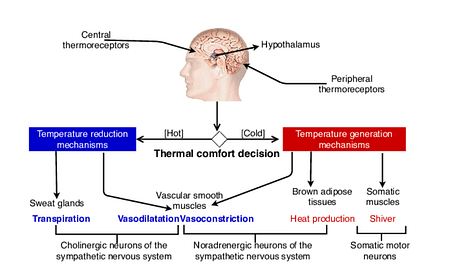
Thermoregulation
Importance of Thermoregulation in Human
In human beings, a healthy internal body temperature is contained within a restricted range. The typical person's body temperature ranges between 98°F (37°C) and 100°F (37.8°C).
- Temperature is something that your body can adjust to.
- However, reaching extremes of body temperature might impair your body's capacity to operate.
- For example, "hypothermia" occurs when your body temperature dips to 95°F (35°C) or below.
- This disease has the potential to cause cardiac arrest, brain damage, and even death.
- If your body temperature increases to 107.6°F (42 °C), you risk brain damage or death.
- The nervous system plays a very important role in thermoregulation.
Read More:
Mechanism of Thermoregulation
[Click Here for Sample Questions]
Sensors in your central nervous system (CNS) transmit information to your hypothalamus when your internal temperature changes. It responds by sending messages to numerous organs and systems throughout your body. They react through a number of methods.
If your body needs to cool down, the following methods can help:
Sweating
Sweating is produced by your sweat glands and evaporates to cool your skin. This aids in the reduction of your internal temperature.
Vasodilation
Vasodilation is the widening of the blood vessels under your skin. This boosts blood flow to your skin, which is colder, and away from your warm inside organs. This allows your body to shed heat via heat radiation.
Read More: Human Heart
If your body needs to warm up, the following methods can help:
Vasoconstriction
Vasoconstriction is a narrowing of the blood vessels beneath the skin. This reduces blood flow to your skin, causing heat to be retained near the heated interior body.
Thermogenesis
Heat is produced by your body's muscles, organs, and brain in a number of ways. Shivering, for example, causes muscles to generate heat.
Hormonal thermogenesis
Hormonal Thermogenesis occurs when your thyroid gland produces hormones that stimulate your metabolism. This increases the quantity of energy and heat produced by your body.

Thermoregulation
Read More: Cardiac Output
Types of Thermoregulation
[Click Here for Sample Questions]
Thermoregulation is divided into two categories, ectotherms and endotherms, which are discussed in detail below.
Ectotherms
Ectotherms regulate their body temperatures by using external temperature sources. They are popularly known as "cold-blooded" creatures despite the fact that their body temperatures frequently remain within the same temperature ranges as warm-blooded species.
- An ectotherm is derived from the Greek words (ektós) "outside" and (thermós) "hot. "
- It is a method in which internal physiological heat sources play an insignificant role in determining body temperature.
- Ectotherms can operate at low metabolic rates since they rely on external heat sources.
- It often dwells in settings with consistent temperatures, such as the tropics or the ocean.
- Ectotherms have evolved a number of behavioural thermoregulation strategies.
- Some strategies include basking in the sun to raise body temperature and seeking shade to lower body temperature.
Endotherms
Endotherms generate the majority of their heat through metabolic activities and are popularly known as "warm-blooded." It is, in contrast to ectotherms, regulate their body temperature by internal metabolic processes.
- Shivering generates extra heat for an endotherm in circumstances of extreme cold or low activity.
- Endotherms often have more mitochondria per cell than ectotherms.
- These mitochondria allow them to produce heat by boosting the pace at which fats and carbohydrates are metabolised.
- Endothermic creatures must maintain their greater metabolism by eating more food more frequently.
- A mouse (endotherm) must consume food on a daily basis in order to maintain a high metabolism.
Importance of Thermoregulation
[Click Here for Sample Questions]
Thermoregulation is the set of mechanisms that an organism uses to keep its internal temperature constant. We have already discussed how, in so many ways, thermoregulation regulates body temperature and functioning. We will discuss in detail the importance of thermoregulation in survival below:
- When the temperature outside changes, organisms must maintain homeostatic control over their bodies.
- A constant temperature is essential because the enzymes in our bodies only operate at about 37°C.
- Temperature fluctuations also have an effect on the fluidity of cell membranes.
- When an organism's body temperature is high or low, some physiological systems might shut down, resulting in death.
- Thermoregulation is a critical component of human homeostasis.
- Deep organs, including the liver, brain, and heart, produce the majority of body heat.
- It also depends upon the skeletal muscle contraction.
- Humans have adapted to a wide range of climates, including hot, humid and hot deserts.
- One of the most frequent reactions to hot temperatures is heat exhaustion.
- It is a disease that can occur when exposed to high temperatures.
- It results in symptoms such as dizziness, fainting, or a fast heartbeat.
Read More:
Things to Remember
- Thermoregulation is the process of maintaining the body's temperature at the required level.
- The hypothalamus regulates body temperature by triggering the reflexes.
- It produces vasodilation and sweating when the body is too warm.
- Vasoconstriction and shivering occur when the body is too cold.
- It reacts to substances produced by the body.
- Thermoregulation is of two types, namely Ectotherms and Endotherms.
- Warm blood from the body generally loses heat to the environment when it passes near the skin in endotherms.
- Some ectotherms can also function as homeotherms.
- Some tropical fish, for example, live in coral reefs with such steady ambient temperatures that their internal temperature remains constant.
Sample Questions
Ques. What is Social Thermoregulation. (3 marks)
Ans. The most fundamental purpose of social thermoregulation is to aid in the warming of another agent, either by contact or through a warming of the skin of the supporter, where skin warming might be a mediating effect while touching the agent. Many species, including humans, experience these impacts.
- Higher-order social cognitions and behaviours, including attachment, social-emotional functioning, and affect regulation.
- They are built on top of these more fundamental processes.
- Some empirical evidence suggests that social thermoregulation has larger implications for social cognition.
- It include attachment such as (mental models of self and others), emotional functioning, and the degree to which people can self-regulate (consciously or unconsciously).
Ques. What is the connection between thermoregulation and ageing. (4 marks)
Ans. Research shows that Low body temperature has been found in endotherms to increase life span by increasing resilience to external stresses and using metabolic pathways known to reduce autoimmunity in old age. Furthermore, low body temperature has been shown to influence immune function favourably. This link is not fully understood, and the connections between inflammation and/or immune function with low body temperature appear to depend on the severity of the stress imposed as well as the individual's acclimation level.
- Variations in body size and life-history characteristics – such as age at maturity and lifespan – are often extremely regionally varied and largely reliant on local climate in ectotherms.
- Ectothermic plants and animals develop slowly at low ambient temperatures and postpone sexual maturation long enough to reach maturity at greater sizes than at high ambient temperatures.
- Furthermore, bigger body size is preferred by natural selection to increase fertility.
- Living in hot locations and having longer activity seasons.
- On the other hand, allows ectotherms to spend more time at high Tb, resulting in rapid development and sexual maturity.
Ques. How is Thermoregulation Important for Survival. (2 marks)
Ans. It's critical to remember thermoregulation when you're outside, especially if you're in a survival scenario. If you are lost, your ultimate objective should be to be rescued, but if you want to be discovered alive, you must assist your body with the process of thermoregulation. If you're out in the Canadian Rockies (or at the same temperature places) in the dead of winter and you start shivering uncontrollably, remove a key from your body and quickly seek shelter, create a fire, or find another means to raise your core body temperature. If you're in the desert area and start feeling dizzy, go find some shade or soak your clothes in water.
Ques. What is the relation between temperature and thermoregulation for Ideal sleep. (4 marks)
Ans. Warming the skin or the brain has been shown in studies to enhance sleep inclination, sleep consolidation, and sleep length. According to anatomical and neurophysiological research, the preoptic-anterior-hypothalamus (POAH) is the primary integrator of sleep and thermoregulatory signals.
- It combines data on alertness states, body temperature, and ambient temperature and impacts vigilance states and body temperature.
- Animals that exhibit daily torpor may be a useful model for studying the connection between sleep and thermoregulation.
- During torpor, these animals appear to use comparable tactics and physiological processes as people do when entering sleep.
- It offer a good chance to study these processes in greater depth.
- More systematic studies are needed to advance our understanding of the connection between sleep and thermoregulation.
- It may offer the foundation for treating sleep disorders using thermal methods.
Ques. What is Newborn Thermoregulation. (4 marks)
Ans. One of the most difficult physiological problems that a newborn has after birth is maintaining a neutral temperature environment. Thermal care is critical in lowering morbidity and death in neonates.
- The capacity to regulate heat production and heat loss to keep body temperature within a normal range is referred to as thermoregulation.
- 37°C is considered the average "normal" axillary temperature (Leduc & Woods, 2013).
- The Canadian Paediatric Society advises taking a temperature via the axillary method to check low-risk babies between the ages of birth and two years (Leduc & Woods, 2013).
- There is a dearth of data on what constitutes a newborn's "normal" temperature range.
- Normal axillary temperatures are defined as being between 36.5°C to 37.5°C by the American Academy of Pediatrics (AAP).
- The American College of Obstetricians and Gynecologists (ACOG), and the World Health Organization (WHO) (1997; 2003).
Ques. Explain in detail about the Hibernating Animals. (2 marks)
Ans. Some animals hibernate during winter seasons to survive with limited food resources and low temperatures. To maintain "stasis" for extended periods of time, these animals accumulate brown fat stores and halt all bodily activities. True hibernators (such as groundhogs) maintain low body temperatures during hibernation, but the core temperature of fake hibernators (such as bears) fluctuates; the animal may periodically emerge from its burrow for brief durations. Some bats are genuine hibernators, relying on fast, non-shivering thermogenesis of their brown fat deposit to wake them up.
Ques. How much water is there in our bodies? Explain in Relation to thermoregulation. (2 marks)
Ans. Water accounts for around 60% of your overall body composition. Furthermore, water accounts for 73% of lean body mass or muscle. It is the most important nutrient for survival and is needed for all cell activities. Water is also an essential component in thermoregulation since it makes up a large portion of blood volume. It is mostly lost through perspiration, respiration, and faeces. When the body is dehydrated, the majority of the water loss comes from the blood.
Ques. Explain with the help of an example the three different ways by which organisms overcome their stressful conditions lasting for a short duration. (4 marks)
Ans. The three ways by which organisms overcome their stressful conditions lasting for a short duration include:
- Migration
- Hibernation
- Camouflage
Examples are:
- Caribou begin to migrate from cold surroundings to warmer places during winter to find food.
- Snakes, to avoid extreme conditions, hibernate during winters.
- The Viceroy butterfly camouflages into a monarch butterfly in order to escape from the predator's attack.
Ques. Write the normal body temperature of humans. How is it maintained during summers. (2 marks)
Ans. Humans continue to maintain their normal body temperature, which is 37ºC at all times, through homeostasis. During the summer season, when the external temperature is very high, we sweat profusely to regulate our body temperature, and when this sweat starts to evaporate, we cool down.
Ques. Why do we experience shivering during winter when the temperature is very low. (2 marks)
Ans. By the process of homeostasis, the body retains its normal temperature at 37ºC. When the external temperature is very high, the body starts to shiver as an exercise, which helps in raising the internal body temperature.
Ques. How does the hypothalamus affect the working of thermoregulation in the human body. (3 marks)
Ans. The hypothalamus regulates body temperature by triggering reflexes that produce vasodilation and sweating when the body is too warm or vasoconstriction and shivering when the body is too cold. It reacts to substances produced by the body. When phagocytic leukocytes kill a bacteria, substances known as endogenous pyrogens are released into the bloodstream, these pyrogens go to the hypothalamus, where they reset the thermostat. This permits the body's temperature to rise, resulting in what is generally referred to as a fever.
Ques. How does the temperature affect the process of thermoregulation. (2 marks)
Ans. The body's optimal temperature for enzymes in the process of thermoregulation is approximately 37ºC. If the body temperature goes below this level, enzymes will operate too slowly to allow physiological processes to occur quickly enough to keep the mammal alive. Body temperature must also be kept at 37ºC so that enzymes can function optimally and processes may be completed promptly.
Ques. What is the difference between ecotherms and endotherms. (3 marks)
Ans. The difference between ecotherms and endotherms are as follows:
| Ecotherms | Endotherms |
|---|---|
| Ecotherms belong to the category of cold-blooded organisms. | Endotherms belong to the category of warm-blooded organisms. |
| The temperature of these organisms varies with respect of surrounding. | They mainatain a constant temperature throughout their life cycle. |
| Reptiles and fish belong to the category of ecotherms | Birds and mammals belong to the category of endotherms. |
Ques. What is the difference between hypothermia and hyperthermia. (3 marks)
Ans. The difference between hypothermia and hyperthermia are as follows:
| Hypothermia | Hyperthermia |
|---|---|
| Hypothermia occurs when temperature of body falls below the required temperature. | Hyperthermia occurs when temperature of body rises above the required temperature. |
| It is caused by overextertion or exposure to cold water for a long period of time. | It is caused by dehydration or wearing tight clothes during hot weather. |
| Hypothermia symptoms includes shivering, pale skin and confusion. | Hyperthermia symptoms includes nausea, sweating and thirst. |
Ques. Explain the process of homeostasis. (2 marks)
Ans. Homeostasis is defined as a biological process that is responsible for maintaining steady internal, physical, chemical, and social conditions in the living body. It depends upon body temperature and fluid balance. It is brought to the state of equilibrium by the process of regulatory mechanisms. Homeostasis is used as a precursor for endocannabinoids.
Check-Out:



Comments