



Education Journalist | Study Abroad Lead
Malonic acid is a dicarboxylic acid with the chemical formula C3H4O4 and the structural formula CH2(COOH)2. The word 'malonic acid' comes from the Greek word ‘malon', which means 'apple.' Propanedioic acid is the IUPAC designation for Malonic acid. Malonic acid is also known as Methane Dicarboxylic acid. Malonates are the ester and salts of malonic acid.
The organic reactions of the Dicarboxylic acid are identical to those of the Monocarboxylic acid, with the formation of amide, ester, anhydride, and chloride derivatives. Malonic acid is the prototypical competitive inhibitor, acting against succinate dehydrogenase in the respiratory electron transport chain.
| Table of Content |
Key Terms: Propanedioic acid, Dicarboxymethane, Hydrolysis, Alcohol, Malonic acid, Pyridine, Crystal, Malic acid, Citrus, Glucose, Chloroacetic acid, Cyanoacetic acid, Monochloroacetic acid, Sodium cyanide, Potassium cyanide, Nitrile group
What is Malonic Acid?
[Click Here for Sample Questions]
Propanedioic acid, or Dicarboxymethane, is another name for malonic acid. The name Malon is taken from a Greek word that means apple. Malonates, as well as their esters and salts, are the ionized form of Malonic acid. It appears as a crystalline powder or a white crystal. Alcohol, pyridine, and ether dissolve in it.
By oxidizing Malic acid, the French scientist Victor Dessaignes created Malonic acid for the first time in 1858. Some fruits, such as citrus fruits, contain Malonic acid. The quantity of Malonic acid generated by organically cultivated fruits is higher than that produced by conventionally grown fruits. Glucose fermentation may be used to make Malonic acid.
Also Read:
| Related Articles | ||
|---|---|---|
| Sulphur Dioxide | pH Of Acids and Bases | Lewis Acid |
| Examples of Weak Acid | IUPAC Nomenclature of Organic Compounds | Class 12 Aldehydes, Ketones and Carboxylic |
Synthesis of Malonic acid
[Click Here for Sample Questions]
Chloroacetic acid is generally used to start the production of malonic acid. It can also be made from cyanoacetic acid or the acid saponification of malonates. It is made from monochloroacetic acid and sodium or potassium cyanide.
By the process of Nucleophilic Substitution, sodium carbonate breaks down to provide sodium salt, which combines with sodium cyanide to give sodium salt of cyanoacetic acid.
Furthermore, the nitrile group attaches to sodium malonate through hydrolysis, resulting in the formation of malonic acid.
Structure of Malonic acid
[Click Here for Sample Questions]
The X-ray crystallography technique was used to discover the Lewis structure of malonic acid. Malonic acid has two Carboxylic Acids in its structure CH2(COOH)2. Malonic acid salts and esters (malonates) have structures that are comparable to malonic acid.
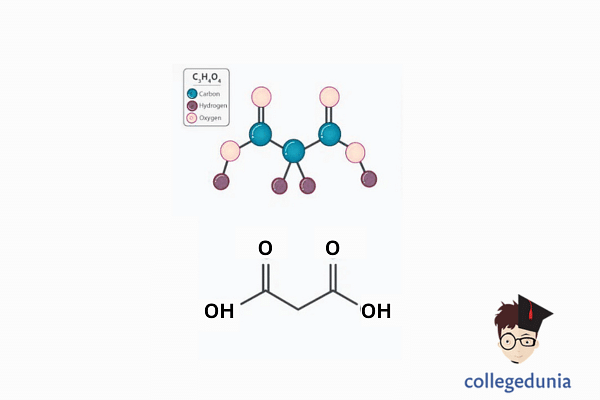
Malonic Acid Structure
Properties of Malonic acid
[Click Here for Sample Questions]
The properties of malonic acid are:
- The molecular weight of malonic acid is 104.061 g.mol-1.
- Malonic acid has a density of 1.619 g/cm3.
- It appears as a white or colorless crystalline powder.
- The chemical decomposes at temperatures over 140 degrees celsius. The melting point is between 135 and 137 degrees Celsius.
- It produces carbon dioxide fumes and bitter unpleasant smoke when heated to break down over the fire.
- At 25°C, acidity pKa = 2.85. 2.83 pKa1 and 5.69 pKa.
- 864 kJ/mol is the molar heat of combustion. The vaporisation heat is 92 kJ/mol.
- It is water-soluble. Its solubility is 763 g/L.
Uses of Malonic acid
[Click Here for Sample Questions]
The uses of malonic acid are:
- Malonic acid is utilized as a precursor for the conversion of 1,3-propanediol, a widely used chemical in polyesters and polymers.
- Malonic acid is used to make cinnamic acid, which is a chemical that is utilised to make the anti-inflammatory cin metacin. Malonates are used to make B1 and B6, barbiturates, and a variety of other useful chemicals.
- It's utilized as a buffering agent in cosmetics and as a flavoring ingredient in food items.
- Malonic acid is a component of alkyd resins, which are used to protect surfaces against UV radiation, oxidation, and corrosion.
Dangers of Malonic acid
[Click Here for Sample Questions]
Malonic acid can produce a variety of symptoms in the eyes, skin, and respiratory tract when exposed. It has the potential to irritate the eyes and skin. If inhaled, the chemical might irritate the respiratory tract. It has the potential to cause significant eye injury or discomfort. As a result, if eyes are exposed, they should be cleaned with plain water or a saline solution. If the afflicted skin shows signs of redness or irritation, it should be cleansed with water right away. It is necessary to remove the contaminated clothing.
It may induce gastrointestinal discomfort such as nausea, vomiting, and other symptoms if consumed. The mouth should be washed many times with water right away, and medical attention should be sought.
Things to Remember
- Malonic Acid has a chemical formula C3H4O4 and the structural formula CH2(COOH)2.
- Chloroacetic acid is generally used to start the production of malonic acid.
- The X-ray crystallography technique was used to discover the Lewis structure of malonic acid. It appears as a white or colorless crystalline powder.
- Malonic acid is quite a dangerous acid and should be handled with care. If inhaled, the chemical might irritate the respiratory tract.
- Malonic acid has the potential to cause significant eye injury or discomfort.
Also Read:
Sample Questions
Ques. Is malonic acid a powerful substance? What happens when it is heated? (2 marks)
Ans. A diprotic acid is malonic acid. The first loss of proton has a pKa value of 2.83, while the second loss proton has a pKa value of 5.69. The lower the pka number, the less acidic the substance. As a result, malonic acid is a moderately powerful acid.
Malonic acid generates acetic acid and carbon dioxide when heated.
Ques. Where does malonic acid come from? Is it soluble? (2 marks)
Ans. Many fruits and vegetables contain malonic acid. In beetroot, the calcium salt of malonic acid is found in significant amounts.
Malonic acid is a polar chemical that forms the H+ ion in an aqueous solution. It is also soluble in methyl alcohol but insoluble in hexane.
Ques. Is maleic acid a photoactive substance? What is its source? (2 marks)
Ans. Because maleic acid lacks a chiral centre, it does not show optical isomerism.
Malonic acid is found in many vegetables and fruits. Beetroot has high concentrations of the calcium salt of malonic acid.
Ques. What is Malonic Acid Knoevenagel Condensation? (2 marks)
Ans. Emil Knoevenagel is the name given to this condensation process. It's a process in which the nucleophile adds to the nucleophile. In this reaction, malonic acid or its diesters react with the carbonyl group of an aldehyde or ketone. A dehydration reaction occurs after this interaction.
When malonic acid is exposed to this reaction, it produces the desired product in a second phase that involves the removal or loss of carbon dioxide. Doebner modification is the name for this type of alteration. The reaction between malonic acid and acrolein is an example of this so-called Doebner reaction. This process produces trans-2,4-Pentadienoic acid as a reaction product.
Ques. Write about Malonic Acid's role as an inhibitor. (3 marks)
Ans: Malonic acid functions as a competitive inhibitor in biochemistry. It is the enzyme succinate dehydrogenase's competitive inhibitor. Malonic acid binds to the active site of the enzyme succinate dehydrogenase in the respiratory electron transport chain without causing a reaction. The competitive inhibitor looks like the real thing and attaches to the enzyme's active site.
This competitive inhibition is caused by the structural similarity of malonate and succinate. This prevents the normal response that occurs when the substrate succinate binds to it. Malonic acid lacks the -CH2CH2- group, which prevents the dehydrogenation process from taking place. The enzyme succinate dehydrogenase is inhibited, resulting in a reduction in cellular respiration.
For Latest Updates on Upcoming Board Exams, Click Here: https://t.me/class_10_12_board_updates
Check-Out:



Comments