



Education Journalist | Study Abroad Lead
Types of batteries can mainly be classified as Primary and Secondary batteries. A Battery refers to a device having one or more electrical cells that convert chemical energy into electrical. Redox Reactions between the two electrodes take place in every battery and act as the source of the chemical energy. On the basis of their applications, the batteries can be classified as household batteries, industrial batteries, and vehicle batteries.
| Table of Content |
Key Terms: Battery, Chemical energy, Electrical energy, Galvanic cell, Primary and Secondary cell, redox reactions, electrical cells, Electrodes, Electrons, electrolyte solution
What is a battery?
[Click Here for Sample Questions]
A battery is a device that is used to convert chemical energy into electrical energy by using one or more electrical cells.
- Charged ions pass through an electrolyte solution in contact with both electrodes of the batteries to balance the flow of electrons.
- Different electrodes and electrolytes are the ones that cause different chemical reactions in the battery, impacting how it works, how much energy it can store, and how much voltage it can produce.
A functional battery must have the following characteristics:
- It must be light in weight and tiny in size.
- A consistent voltage must be provided by the cell or battery. Furthermore, the battery or cell's voltage must not alter while in use.
Read More:
Types of Batteries
[Click Here for Previous Year Questions]
Batteries are basically categories into two categories:
- Primary batteries/cells
- Secondary batteries/cells
Other common types of batteries on the basis of their application are as follows –
Household Batteries
These types of batteries are used in a wide range of household appliances such as clocks, torches, and cameras. These batteries are further classified as:
- Rechargeable batteries – Examples: Lithium-Ion and Cadmium batteries
- Non-rechargeable batteries – Examples: Silver oxide, Alkaline & carbon-zinc batteries
Industrial Batteries
These batteries are used as backup power for big companies. Some examples of industrial batteries are Nickel Iron and Wet Nickel Cadmium (NiCd).
Vehicle Batteries
These types of batteries are user-friendly and less complicated than industrial batteries. They are designed to power boats, cars, motorcycles, and other vehicles. Example – Lead-acid battery.
Primary Battery
[Click Here for Sample Questions]
The primary batteries are designed to be used only once and are non-rechargeable. As the devices are not easily reversible, and active materials may not return to their original forms, these types of batteries cannot be recharged once they have been used.
- The common AA and AAA batteries found in wall clocks, television remotes, and other electrical devices are examples of these disposable batteries.
- Primary cells include the Daniell cell, Dry cell, and Mercury cell.
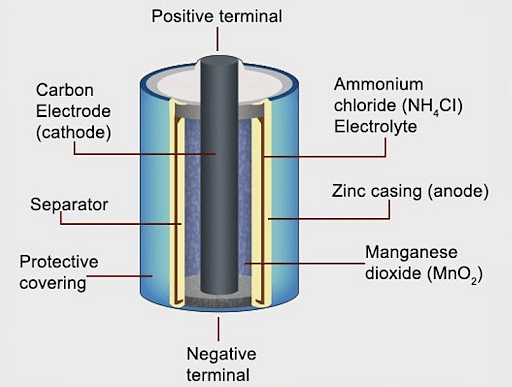
Primary Cell
Types of Primary Batteries
There are mainly two types of primary batteries.
- Alkaline Batteries
- Coin Cells Battery
1. Alkaline Batteries
In the 1950s, alkaline batteries were created to overcome some of the performance concerns with zinc-carbon dry cells. They're made to be exact substitutes for zinc-carbon dry cells. Alkaline electrolytes, such as potassium hydroxide, are used in these batteries.
Anode: Zn(s) + 2OH-(aq) → ZnO(s) + H2O(l) +2e-
Eº anode = −1.28V
Cathode: 2MnO2 (s) + H2O (l) + 2e- → Mn2O3 (s) + 2OH- (aq)
Eºcathode = + 0.15V
Overall: Zn (s) + 2MnO2(s) → ZnO (s) + Mn2O3(s)
Eºcell = +1.43V
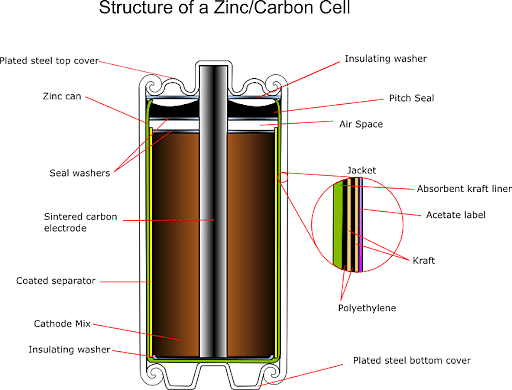
Zinc Carbon Cell
A zinc-carbon dry cell of comparable size can offer three to five times the energy of an alkaline battery. Alkaline batteries are prone to leaking potassium hydroxide, so they should be removed from devices before being stored for long periods.
2. Coin Cells Battery
Coin cell batteries contain alkaline electrolytes as well as lithium and silver oxide compounds. These primary batteries are extremely effective at maintaining a constant and stable voltage.

Coin cell battery
Secondary Battery
[Click Here for Previous Year Questions]
Secondary batteries are sometimes known as rechargeable batteries. These types of batteries can be utilized while also being recharged.
- Secondary batteries are usually made up of active ingredients that are released after use.
- Rechargeable batteries are recharged with electric current, which reverses the chemical reactions that occur during discharge.
- Chargers are electronic devices that supply the required current.
- Rechargeable batteries include those found in cell phones, MP3 players, and other electronic gadgets.
- Hearing aids and wristwatches generally need small batteries, as compared to phone exchanges and computer data centres which use larger batteries.
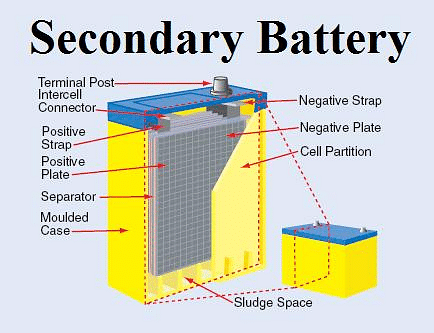
Secondary Battery
Types of Secondary Battery
The types of secondary batteries are as follows –
-
Lead – Acid Batteries
Lead-Acid batteries are by far the most popular and widely used rechargeable types of batteries. Small, sealed cells with a capacity of 1 Ah to huge, sealed cells with a capacity of 12,000 Ah are all available in lead-acid batteries. Lead-acid batteries are widely employed in the automobile industry, where they are typically used as SLI Batteries (Starting, Lighting, and Ignition). Other uses for lead-acid batteries include,
- Energy storage
- Backup power
- Electric cars (including hybrids)
- Communication systems
- Emergency lighting
-
Nickel – Cadmium Batteries
Along with lead-acid batteries, Nickel – Cadmium Batteries, or simply Ni-Cd Batteries, are some of the oldest batteries accessible today. They have a lengthy lifespan and are extremely dependable and durable.
- Ni-Cd batteries can withstand high discharge rates and function over a wide temperature range, which is one of its key advantages.
- Ni-Cd batteries also have a very long shelf life.
- On a per Watt-hour basis, these batteries are more expensive than lead-acid batteries, but they are less expensive than other types of alkaline batteries.
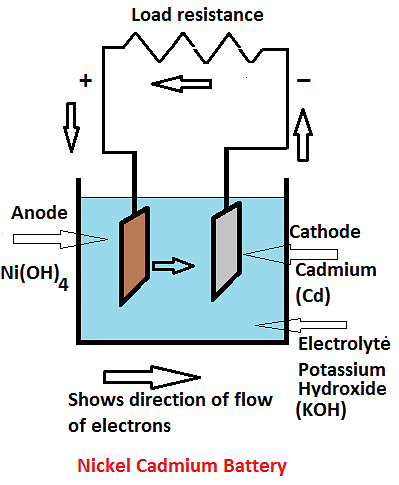
Nickel Cadmium Battery
-
Nickel–Metal Hydride Batteries
These types batteries are an advanced variant of nickel-hydrogen electrode batteries, which were previously only utilized in aerospace applications (satellites).
- Nickel Oxyhydroxide (NiOOH) serves as the positive electrode, while a metal alloy serves as the negative electrode, where hydrogen is stored reversibly.
- Nickel-metal hydride batteries have a higher specific energy and energy density than Ni-Cd batteries, which is one of their key advantages.
- Small cylindrical sealed nickel-metal hydride batteries are commercially available and are utilized in portable electronics.
-
Lithium-Ion Batteries
The development of lithium-ion batteries has been amazing in the previous few decades.
- Lithium-ion batteries have been embraced by more than half of the consumer market.
- Laptops, mobile phones, cameras, and other electronic devices are among the most common uses for lithium-ion batteries.

Lithium-Ion Batteries
How does a battery work?
[Click Here for Sample Questions]
A battery is a device that consists of several voltaic cells. A conductive electrolyte comprising anions and cations connects two half-cells in series to form a voltaic cell. The electrolyte and the electrode to which anions migrate, the anode or negative electrode, are in one half of the cell, while the electrolyte and the electrode to which cations move, the cathode or positive electrode, are in the other.
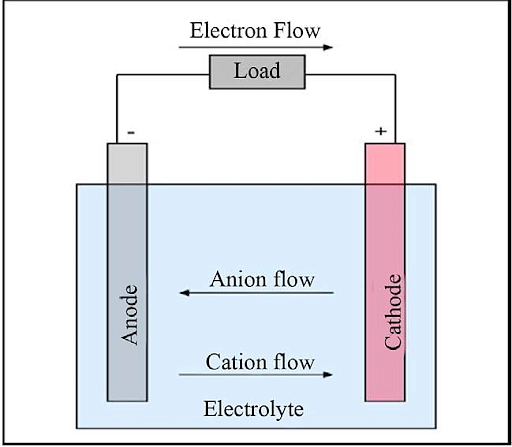
Working of a Battery
Cations are reduced at the cathode and anions are oxidized at the anode in the redox reaction that drives the battery. The electrodes are not in direct contact with one another, but the electrolyte connects them electrically. In most cases, the electrolytes in the half cells are different. Each half-cell is housed in a container, and mixing is prevented by a separator that is permeable to ions but not to the bulk of the electrolytes.
Uses of Battery
[Click Here for Sample Questions]
Batteries are utilized in a variety of ways. Below are some of the applications:
- Domestic uses
Disposable batteries are used to power goods such as remote controls, flashlights, and other similar devices. Digital cameras, handheld video game consoles, telephones, and a range of other devices, for example, require alkaline batteries. Advanced batteries, such as lithium batteries, are used to power high-power appliances like laptops and other electronics.

Uses of Batteries
- Medical Applications
Artificial limbs, hearing aids, insulin pumps, and valve support devices all need batteries. Photographic light meters, as well as electronic gadgets like real-time appliance clocks, can benefit from mercury batteries.
Importance of Battery
[Click Here for Previous Year Questions]
The importance of batteries are –
- Batteries serve as a backup supply of electricity in telecommunications, public transportation, and medical treatments, as well as delivering the initial power required to start automotive engines.
- By efficiently storing electricity supplied by both conventional and renewable energy sources and serving as a power source for electric vehicles, batteries can help cut greenhouse gas emissions.
Read More:
Things to Remember
- A battery is a device that is used to convert chemical energy into electrical energy.
- Batteries are used in all types of electrical and electronic devices.
- There are two types of batteries namely, primary and secondary batteries.
- Primary batteries are single-use or non-rechargeable batteries.
- Primary batteries are again classified into alkaline batteries and coin cell batteries.
- Secondary batteries are rechargeable or reusable batteries.
- Secondary batteries are again classified into Lead – Acid Batteries, Nickel – Cadmium Batteries, Nickel – Metal Hydride Batteries and Lithium-Ion Batteries.
Sample Questions
Ques. Give one major advantage and disadvantage of the Lead storage battery. (2 marks)
Ans. Advantages: It is affordable, has a high-power density (vehicle starter motor and lights), has a long shelf life, and is easily recharged, resulting in a longer operating life of many years.
Disadvantages: Lead must be recycled to minimize contamination of the environment, and during charging, it can produce hydrogen gas at the cathode, which might catch fire.
Ques. Describe one significant distinction between a primary and a secondary cell. (2 marks)
Ans. Primary cells are not rechargeable, however secondary cells are. When the electrolyte in a primary cell is depleted, the reaction stops, however in a secondary cell, the reaction can be reversed by turning it into an electrolytic cell. Mercury is used in the primary cell, and lead is used in the secondary cell.
Ques. Write down the cell reactions that occur in a lead storage battery I when it is in operation and (ii) when it is being charged. (2 marks)
Ans. At Anode: Pb (s) + SO42- (aq)→ PbSO4 (s) + 2e-.
At Cathode: PbO2 (s) + SO42- (aq) + 4H+ (aq) + 2e- → PbSO4 (s) + 2H2O(l)
The overall reaction is
Pb (s) + PbO2(s) + 4H+ (aq) + 2SO42-(aq) → 2PbSO4 (s) + 2H2O(l)
While charging:
At Cathode: PbSO4 (s)+ 2e- → Pb (s) + SO42- (aq)
At Anode: PbSO4 (s) + 2H2O(l) → PbO2(s) + SO42- (aq) + 4H+ (aq) + 2e-
Ques. What is the meaning of the term "dry cell"? (2 marks)
Ans. The cell is filled with a moist electrolytic paste of manganese dioxide (MnO2) and charcoal, followed by a layer of ammonium chloride (NH4Cl) and zinc chloride (ZnCl2). Because the electrolyte is a dry electrolyte paste rather than a solution, it is referred to as a Dry cell.
Ques. What exactly do you mean when you say, "dry cell corrosion"? (2 marks)
Ans. The exterior Zinc casing of a dry cell develops pits as ammonium chloride, an acidic salt, reacts with the metal to create salt, creating pits. Dry cell corrosion is the term for this.
Ques. What advantages does a fuel cell have over a mercury cell? (2 marks)
Ans. Because its product may be consumed, the fuel cell is the cleanest and most efficient cell. The Hydrogen-Oxygen Relationship Fuel Cells were widely employed in the Apollo space program, with the water produced being used for drinking by astronauts. It has a very high EMF, indicating that it can be used as an energy source. Although long-lasting, mercury cells contain mercury, which is a toxic chemical and a possible pollutant.
Ques. What exactly is the distinction between a cell and a battery? (2 marks)
Ans. A cell is a device that generates energy through an electrochemical process. It is utilized in situations where less electricity is required, such as wall clocks.
A battery is made up of two or more cells connected in series to generate more electricity. It is utilized in applications that require more electricity, such as lights, toys, UPS, and automobiles.
Ques. Why do batteries die when fuel cells don't? (2 marks)
Ans. Batteries are self-contained and have a finite amount of reagents before they die. Alternatively, byproducts of the battery reaction build up and obstruct the reaction. Because reactants are constantly replenished and products are ejected, a fuel cell can operate indefinitely if reagents are available.
Ques. List some of the factors that are often taken into account when choosing a battery for a new application. (2 marks)
Ans. The cost of the materials used in the battery, the toxicity of the various components (what constitutes proper disposal), whether it should be a primary or secondary battery, energy requirements (the “size” of the battery/how long should it last), whether a specific battery will leak when the new device is used according to directions, and its mass are all factors to consider (the total mass of the new device).
Ques. What is the name of the cell that is commonly used in inverters here? Write down the reactions that occur at the cell's anode and cathode. (2 marks)
Ans. The lead storage battery is the name of the cell that is commonly used in inverters.
Below is the reaction that occurs at the anode and cathode.
Anode: Pb (s) + SO42-(aq) → PbSO4(s) + 2e–
Cathode: PbO2 + SO42-(aq) + 4H+ + 2e– → PbSO4(s) + 2H2O(l)
For Latest Updates on Upcoming Board Exams, Click Here: https://t.me/class_10_12_board_updates
Do Check Out:



Comments