



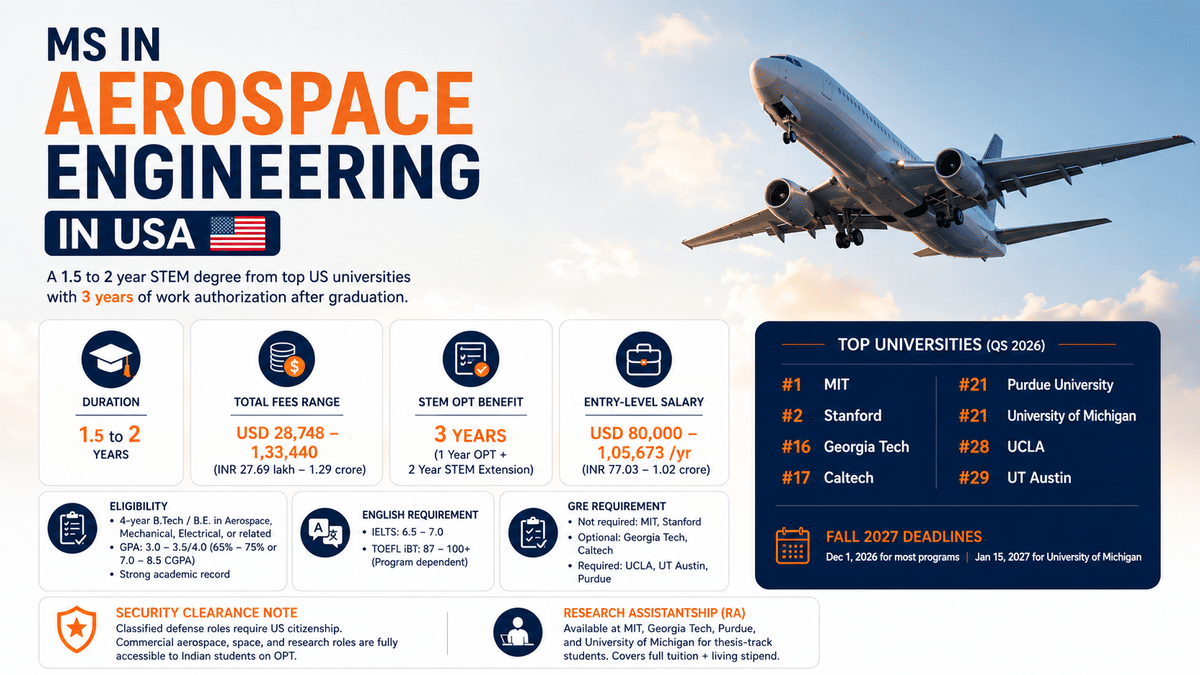
MS in Aerospace Engineering in USA is a 1.5 to 2 year graduate degree offered at some of the world's most prestigious engineering institutions, and it qualifies for STEM OPT — giving Indian graduates 3 years of work authorization after graduation. The MS in Aerospace Engineering in USA fees range from USD 19,165/yr (INR 18.45 lakh/yr) at UT Austin to USD 69,717/yr (INR 67.16 lakh/yr) at Stanford for international students. The MS in Aerospace Engineering in USA requirements include a 4-year B.Tech or B.E. in Aerospace, Mechanical, Electrical, or related engineering, a minimum GPA of 3.0 to 3.5/4.0 (equivalent to 65 to 75% or 7.0 to 8.5 CGPA), and TOEFL iBT 87 to 100+ or IELTS 7.0. The best aerospace engineering universities in USA are ranked by QS Mechanical, Aeronautical and Manufacturing Engineering 2026, with MIT (#1), Stanford (#2), and Georgia Tech (#16) leading the list. No GRE is required at MIT and Stanford, and it is optional at Georgia Tech and Caltech — significantly reducing application barriers for Indian students.
Here are the key facts Indian students must know before applying:
- Top programs: MIT (QS #1), Stanford (QS #2), Georgia Tech (QS #16), Caltech (QS #17), Purdue (QS #21), University of Michigan (QS #21), UCLA (QS #28), UT Austin (QS #29)
- Total program fees: USD 28,748 (INR 27.69 lakh) at UT Austin to USD 1,33,440 (INR 1.29 crore) at MIT
- Duration: 1 to 2 years depending on program and track
- GRE: Not required at MIT and Stanford; optional at Georgia Tech and Caltech; required at UCLA, UT Austin, and Purdue
- IELTS: 6.5 to 7.0 depending on program; TOEFL iBT 87 to 100+
- STEM OPT: 3 years at all 8 programs (1 year OPT + 2 year STEM extension)
- Research Assistantship (RA): Available at MIT, Georgia Tech, Purdue, and Michigan for thesis-track students; covers full tuition plus living stipend
- Entry-level salary: USD 80,000 to USD 1,05,673/yr (INR 77.03 to INR 1.02 crore) for MS Aerospace graduates
- Security clearance note: Classified defense roles require US citizenship; commercial aerospace, space, and research roles are fully accessible to Indian students on OPT
- Fall 2027 deadlines: December 1, 2026 for most programs; January 15, 2027 for University of Michigan
Latest Updates — August 2026
Indian students reading this in August 2026 are at the ideal starting point for Fall 2027 applications. Most MS Aerospace Engineering deadlines fall on December 1, 2026, and the most important action right now is contacting faculty for Research Assistantship opportunities — not preparing documents.
Key actions for August 2026:
- Email faculty for RA (start now): For thesis-track programs at MIT, Georgia Tech, Purdue, and Michigan, contact faculty directly in August to September 2026. A Research Assistantship covers full tuition plus a living stipend of USD 20,000 to USD 30,000/yr (INR 19.26 to INR 28.89 lakh/yr) — making the effective cost of the degree zero.
- GRE (book now): GRE is required at UCLA, UT Austin, and Purdue. Target Verbal 156, Quantitative 159, AW 4.0 for Purdue; combined 320+ for Michigan. Book your test for September to October 2026.
- TOEFL/IELTS (book now): Required at all 8 universities. Target TOEFL iBT 100 for MIT and Georgia Tech; TOEFL iBT 87 for UCLA. Book your test by November 2026 at the latest.
- SOP (draft now): Research-focused SOP for MIT, Stanford, Purdue, and Michigan; career-focused for Georgia Tech, UCLA, and UT Austin. 500 to 1,000 words.
- LORs (request now): All programs require 3 LORs. Give referees 8+ weeks. Academic references from professors who supervised your B.Tech project are preferred.
- December 1, 2026 deadline: MIT, Stanford, Georgia Tech, Purdue, UCLA, and UT Austin all have December 1, 2026 as their Fall 2027 deadline. This is the most critical date for Indian students.
- Knight-Hennessy Scholars (Stanford): Deadline is approximately October 8, 2026. This is the most prestigious scholarship at Stanford — full funding for up to 3 years. Apply before the MS application.
All fees and costs in this article are converted at USD 1 = INR 96.29 (August 2026).
- Why Study MS Aerospace Engineering in USA?
- Specializations in MS Aerospace Engineering in USA
- Best Aerospace Engineering Universities in USA
- MS in Aerospace Engineering in USA Requirements
- MS Aerospace Engineering in USA Intakes and Application Deadlines
- MS in Aerospace Engineering in USA Fees
- Cost of Living for MS Aerospace Students in USA
- Scholarships for MS Aerospace Engineering in USA
- Jobs and Salary After MS Aerospace Engineering in USA
- FAQs
Why Study MS Aerospace Engineering in USA?
The USA accounts for approximately 40% of global aerospace revenue and is home to the world's largest concentration of aerospace employers. Combined with 3-year STEM OPT, the world's top-ranked aerospace programs, and a commercial space boom unique to the USA in 2026, the USA offers the strongest career and financial ROI for Indian aerospace engineering graduates globally.
- World's largest aerospace industry: Boeing, Lockheed Martin, Northrop Grumman, GE Aerospace, SpaceX, Blue Origin, NASA, and hundreds of startups are all based in the USA. No other country comes close to this density of aerospace employers.
- 3-year STEM OPT: MS Aerospace Engineering qualifies for STEM OPT, giving Indian graduates 3 years of work authorization and 2 to 3 H-1B lottery attempts. The UK offers 2 years with no extension; Australia offers 2 to 4 years but has a minimal aerospace industry.
- QS top-5 programs: The USA holds 5 of the top 10 QS-ranked Mechanical, Aeronautical and Manufacturing Engineering programs globally. A US MS from MIT, Stanford, or Georgia Tech is recognised by aerospace employers worldwide including ISRO, HAL, Airbus, and Rolls-Royce.
- RA funding model: Thesis-track MS students at MIT, Georgia Tech, Purdue, and Michigan can secure Research Assistantships covering full tuition plus a living stipend of USD 20,000 to USD 30,000/yr (INR 19.26 to INR 28.89 lakh/yr) — making the effective cost of the degree zero.
- Commercial space boom: SpaceX is launching 100+ missions per year, Blue Origin has resumed New Glenn launches, and dozens of new space startups are hiring aggressively. This demand is unique to the USA and is not replicated in any other country.
- No GRE at top programs: MIT has permanently dropped GRE, Stanford does not require it, and Georgia Tech and Caltech have made it optional — significantly reducing application barriers for Indian students.
Student Insight
According to discussions on Reddit, Indian MS Aerospace graduates who compared programs in the USA, UK, Germany, and Australia consistently rank the USA first for the combination of program ranking, industry access, STEM OPT, and salary outcomes. Students note that the UK aerospace market is approximately 10% of the US size, Germany requires German language proficiency for most industry roles, and Australia has minimal commercial aerospace industry — making the USA the only viable destination for Indian students targeting top aerospace careers.
Specializations in MS Aerospace Engineering in USA
MS Aerospace Engineering programs in the USA offer 6 major specialization tracks. Interaction Design and UX Design are the highest-paying at USD 90,000 to USD 1,40,000/yr (INR 86.66 to INR 1.35 crore) for GNC and Systems Engineering roles. Space Systems Engineering and Urban Air Mobility are the fastest-growing specializations, driven by the commercial space boom and the eVTOL revolution respectively.
| Specialization | Best Universities | Target Roles |
|---|---|---|
| Space Systems Engineering and Spacecraft Design | MIT, Stanford, Georgia Tech, Caltech | Spacecraft Engineer, Mission Systems Engineer, Orbital Mechanics Engineer |
| Aerodynamics and CFD | Purdue, MIT, Georgia Tech, UT Austin | CFD Engineer, Aerodynamicist, Wind Tunnel Engineer |
| GNC and Autonomous Systems | Stanford, MIT, Georgia Tech, Michigan | GNC Engineer, Autonomy Engineer, Flight Controls Engineer |
| Propulsion and Energy Systems | Purdue (Zucrow Labs), MIT, Caltech, Georgia Tech | Propulsion Engineer, Rocket Engineer, Gas Turbine Engineer |
| Structures, Materials and Composites | Stanford, Michigan, Georgia Tech, Caltech | Structural Engineer, Composites Engineer, Stress Analyst |
| Urban Air Mobility and Advanced Air Mobility | Stanford, Georgia Tech, UCLA | eVTOL Engineer, UAM Systems Engineer, Drone Systems Engineer |
Student Insight
According to discussions on Quora, Indian students with a background in control systems and robotics from IIT Bombay and IIT Madras consistently highlight GNC and Autonomous Systems as the strongest specialization for H-1B sponsorship — as tech companies (Google, Amazon, Apple) working on autonomous systems actively sponsor H-1B visas, broadening the job market beyond traditional aerospace. Students targeting the commercial space sector recommend Space Systems Engineering at MIT, Stanford, or Georgia Tech for the strongest SpaceX and Blue Origin recruiting pipelines.
Best Aerospace Engineering Universities in USA
The USA holds 5 of the top 10 QS-ranked Mechanical, Aeronautical and Manufacturing Engineering programs globally. Only 8 US universities from the QS 2026 list offer a standalone MS in Aerospace Engineering open to Indian international students for Fall 2027. Harvard, UC Berkeley, Princeton, and Yale have been excluded as they do not offer a confirmed standalone MS in Aerospace Engineering for international students.
| University | Location | QS Rank (Mech/Aero/Mfg 2026) |
|---|---|---|
| MIT | Cambridge, MA | #1 |
| Stanford University | Stanford, CA | #2 |
| Georgia Tech | Atlanta, GA | #16 |
| Caltech | Pasadena, CA | #17 |
| Purdue University | West Lafayette, IN | #21 |
| University of Michigan | Ann Arbor, MI | #21 |
| UCLA | Los Angeles, CA | #28 |
| UT Austin | Austin, TX | #29 |
Student Insight
According to discussions on Reddit, Indian students from IITs and NITs consistently highlight that MIT and Stanford's permanent GRE waiver has significantly reduced the application barrier for Indian students. Students targeting thesis-track programs at Georgia Tech and Purdue recommend emailing faculty in August to September 2026 — 3 to 4 months before the December 1 deadline — as professors begin planning their lab intake for Fall 2027 during this period.
MS in Aerospace Engineering in USA Requirements
No GRE is required at MIT and Stanford, and it is optional at Georgia Tech and Caltech. Indian 4-year B.Tech or B.E. in Aerospace, Mechanical, Electrical, or related engineering is accepted as equivalent to a US 4-year BS degree at all 8 universities. Indian students with a CGPA of 7.5 to 8.5/10 (75 to 85%) and strong research or project experience are competitive applicants.
| University | Academic Eligibility | GRE | IELTS | TOEFL iBT |
|---|---|---|---|---|
| MIT | 4-year BS in engineering or science; strong math and physics background | Not accepted | 7.0+ | 100+ |
| Stanford | 4-year BS in engineering, physics, or comparable science; min. GPA 2.75 | Not required | Required if English not medium of instruction | Required if English not medium of instruction |
| Georgia Tech | 4-year BS in aerospace, mechanical, or related engineering | Optional | 7.0+ | 100+ |
| Caltech | 4-year BS equivalent; strong math, physics, engineering science background | Optional | Required | Required |
| Purdue | 4-year BS in aerospace, mechanical, or related; min. GPA 3.25 recommended | Required (V 156, Q 159, AW 4.0 competitive) | 6.5+ | 80+ |
| University of Michigan | 4-year BS in engineering; min. GPA 3.6 (recently admitted avg.); combined GRE 320+ (recently admitted avg.) | Considered | Required | Required |
| UCLA | 4-year BS in aerospace, mechanical, or related; min. GPA 3.0 (recently admitted avg. 3.67) | Required (V 79th%, Q 92nd%, AW 84th% competitive) | 7.0+ | 87+ |
| UT Austin | 4-year BS in aerospace engineering, engineering mechanics, or related; min. GPA 3.0 in junior and senior work | Required | Required | Required |
Documents Required
The Statement of Purpose is the most important differentiator in MS Aerospace Engineering applications. Research-focused SOPs that reference specific faculty and their work are significantly more effective at MIT, Stanford, Purdue, and Michigan than generic career-focused statements.
- Academic transcripts (B.Tech or B.E.; get official attested copies by October 2026)
- GRE scores (required at UCLA, UT Austin, Purdue; optional at Georgia Tech and Caltech; not accepted at MIT)
- IELTS or TOEFL scores
- Statement of Purpose (500 to 1,000 words; research-focused for MIT, Stanford, Purdue, Michigan)
- 3 Letters of Recommendation (academic references from B.Tech project supervisors preferred)
- Updated CV (publications, projects, internships, awards)
- Application fee (USD 75 to USD 125 per university)
Student Insight
According to discussions on Reddit, Indian students who got into Georgia Tech and Purdue MS Aerospace programs consistently highlight that a research-focused SOP referencing specific faculty and their recent publications — combined with a strong B.Tech project in aerodynamics, propulsion, or structures — is the most effective application strategy. Students from IIT Bombay, IIT Madras, and IIT Kharagpur with aerospace or mechanical engineering backgrounds report the highest acceptance rates at all 8 programs.
MS Aerospace Engineering in USA Intakes and Application Deadlines
All 8 MS Aerospace Engineering programs admit students for Fall (August/September) intake only. There is no Spring intake for any of these programs. December 1, 2026 is the most critical deadline — MIT, Stanford, Georgia Tech, Purdue, UCLA, and UT Austin all share this date for Fall 2027 entry.
| University | Fall 2027 Deadline | Notes | App Fee |
|---|---|---|---|
| MIT | December 1, 2026 | Research-based SM; faculty match strongly recommended before applying | USD 75 |
| Stanford | December 1, 2026 | Coursework-based MS; no thesis required | USD 125 |
| Georgia Tech | December 1, 2026 | Full consideration for funding; thesis or non-thesis track | USD 75 |
| Caltech | December 15, 2026 | 1-year program; 5 core courses; no thesis | USD 100 |
| Purdue | December 1, 2026 | Thesis or non-thesis; GRE required | USD 60 |
| University of Michigan | January 15, 2027 | Coursework-based MSE; GRE considered | USD 75 |
| UCLA | December 1, 2026 | GRE required; recently admitted avg. GPA 3.67 | USD 135 |
| UT Austin | December 1, 2026 | Thesis or report option; most affordable program | USD 65 |
F-1 Visa Note: The F-1 visa fee is USD 185 (INR 17,814) plus a SEVIS fee of USD 350 (INR 33,702). Processing takes 2 to 8 weeks at US Embassy/Consulate in India. Most programs send I-20s between March and May 2027. Apply for your visa by June to July 2027 to ensure arrival before the August/September 2027 start date.
Student Insight
According to discussions on Reddit, Indian students who applied to multiple MS Aerospace programs recommend treating December 1, 2026 as the universal deadline for all applications — including Michigan (January 15) — as earlier applications give faculty more time to review and advocate for RA funding. Students note that Georgia Tech and Purdue review applications on a rolling basis, meaning earlier submissions receive earlier decisions.
MS in Aerospace Engineering in USA Fees
Total program fees range from USD 28,748 (INR 27.69 lakh) at UT Austin to USD 1,33,440 (INR 1.29 crore) at MIT for international students. However, thesis-track students at MIT, Georgia Tech, Purdue, and Michigan who secure a Research Assistantship pay zero tuition and additionally receive a living stipend of USD 20,000 to USD 30,000/yr (INR 19.26 to INR 28.89 lakh/yr). UT Austin offers the lowest self-funded tuition at USD 19,165 to USD 22,000/yr (INR 18.45 to INR 21.18 lakh/yr) — significantly cheaper than MIT, Stanford, Michigan, or Caltech.
| University | Program | Duration | Annual Tuition (USD) | Annual Tuition (INR) |
|---|---|---|---|---|
| MIT | SM in Aeronautics and Astronautics | 2 years | USD 66,720/yr | INR 64.26 lakh/yr |
| Stanford | MS in Aeronautics and Astronautics | 1 to 1.5 years | USD 69,717/yr | INR 67.16 lakh/yr |
| Georgia Tech | MS in Aerospace Engineering | 1.5 to 2 years | USD 30,000 to USD 32,000/yr | INR 28.89 to INR 30.82 lakh/yr |
| Caltech | MS in Aeronautics | 1 year | USD 68,574/yr | INR 66.05 lakh/yr |
| Purdue | MS in Aeronautics and Astronautics | 1.5 to 2 years | USD 30,428/yr | INR 29.30 lakh/yr |
| University of Michigan | MSE in Aerospace Engineering | 1.5 to 2 years | USD 61,920/yr | INR 59.63 lakh/yr |
| UCLA | MS in Aerospace Engineering | 1 to 1.5 years | USD 36,297/yr | INR 34.96 lakh/yr |
| UT Austin | MS in Aerospace Engineering | 1.5 to 2 years | USD 19,165 to USD 22,000/yr | INR 18.45 to INR 21.18 lakh/yr |
Student Insight
According to discussions on Quora, Indian students who compared MS Aerospace programs highlight that Georgia Tech and Purdue offer the best combination of ranking, RA availability, and affordable tuition for self-funded students. Students note that MIT and Stanford's high tuition is offset by RA funding for research-track students — but coursework-track students at these programs are entirely self-funded.
Cost of Living for MS Aerospace Students in USA
Stanford and Palo Alto (Silicon Valley) is the most expensive location at USD 2,800 to USD 4,000/month (INR 2.70 to INR 3.85 lakh/month), while West Lafayette, IN (Purdue) is the most affordable at USD 1,200 to USD 1,800/month (INR 1.16 to INR 1.73 lakh/month). Purdue's low cost of living combined with strong RA availability makes it the most financially accessible top-ranked MS Aerospace program in the USA for Indian students.
| City | University | Monthly Cost (USD) | Monthly Cost (INR) |
|---|---|---|---|
| Cambridge/Boston, MA | MIT | USD 2,500 to USD 3,500 | INR 2.41 to INR 3.37 lakh |
| Stanford/Palo Alto, CA | Stanford | USD 2,800 to USD 4,000 | INR 2.70 to INR 3.85 lakh |
| Atlanta, GA | Georgia Tech | USD 1,500 to USD 2,200 | INR 1.44 to INR 2.12 lakh |
| Pasadena, CA | Caltech | USD 2,000 to USD 3,000 | INR 1.93 to INR 2.89 lakh |
| West Lafayette, IN | Purdue | USD 1,200 to USD 1,800 | INR 1.16 to INR 1.73 lakh |
| Ann Arbor, MI | University of Michigan | USD 1,500 to USD 2,200 | INR 1.44 to INR 2.12 lakh |
| Los Angeles, CA | UCLA | USD 2,200 to USD 3,200 | INR 2.12 to INR 3.08 lakh |
| Austin, TX | UT Austin | USD 1,500 to USD 2,200 | INR 1.44 to INR 2.12 lakh |
F-1 students can work 20 hours per week on campus during the academic semester and full-time during official breaks. On-campus roles (teaching assistant, lab assistant) pay USD 15 to USD 25/hr (INR 1,444 to INR 2,407/hr). UT Austin has no Texas state income tax, meaning Indian students on OPT keep significantly more of their salary compared to California-based programs (California state income tax up to 13.3%).
Student Insight
According to discussions on Quora, Indian students at Purdue consistently highlight West Lafayette as the most affordable college town for MS Aerospace students in the USA. Monthly costs of USD 1,200 to USD 1,800 (INR 1.16 to INR 1.73 lakh) are significantly lower than Boston, Silicon Valley, or Los Angeles. Students at UT Austin note that Austin's growing tech and aerospace ecosystem — combined with zero state income tax — makes it the best value location for Indian graduates on OPT.
Scholarships for MS Aerospace Engineering in USA
MS students at US universities are primarily self-funded unless they secure a Research Assistantship (RA) or Teaching Assistantship (TA). The most financially viable path for Indian students is to target thesis-track programs at Georgia Tech, Purdue, and Michigan and contact faculty directly before applying to secure an RA offer. Georgia Tech and Purdue have the highest RA availability for aerospace MS students among all 8 programs.
| Scholarship | University | Value (USD) | Value (INR) | Eligibility |
|---|---|---|---|---|
| Research Assistantship (RA) | MIT, Georgia Tech, Purdue, Michigan | Full tuition + stipend USD 20,000 to USD 30,000/yr | INR 19.26 to INR 28.89 lakh/yr | Thesis-track MS students; requires faculty match; contact faculty in August to September 2026 |
| Graduate Research Assistantship (GRA) | Georgia Tech | Full tuition waiver + stipend USD 24,000 to USD 30,000/yr | INR 23.11 to INR 28.89 lakh/yr | Thesis-track MS students; competitive; requires faculty match |
| Graduate Teaching Assistantship (GTA) | Georgia Tech | Full tuition waiver + stipend USD 18,000 to USD 22,000/yr | INR 17.33 to INR 21.18 lakh/yr | MS students; strong academic record required |
| Knight-Hennessy Scholars | Stanford | Full funding up to 3 years (tuition + stipend USD 74,000+/yr) | INR 71.26 lakh+/yr | All Stanford graduate students; any country; apply separately; deadline October 2026 |
| Rackham Merit Fellowship | University of Michigan | USD 2,000 to USD 10,000 | INR 1.93 to INR 9.63 lakh | All Rackham graduate students; merit-based; automatic consideration |
| Inlaks Shivdasani Foundation | All universities | Up to USD 1,00,000 total | Up to INR 96.29 lakh total | Indian nationals; highly competitive; top global programs |
| Narotam Sekhsaria Foundation | All universities | Up to INR 20 lakh | INR 20 lakh | Indian nationals; postgraduate abroad |
| KC Mahindra Scholarship | All universities | Up to INR 8 lakh | INR 8 lakh | Indian nationals; postgraduate abroad |
Note: NASA Space Technology Graduate Research Opportunities (NSTGRO) at USD 55,000/yr (INR 52.96 lakh/yr) is available to US citizens and permanent residents only and is not accessible to Indian international students on F-1 visas.
Student Insight
According to discussions on Reddit, Indian students who secured RA positions at Georgia Tech and Purdue consistently highlight that a personalized email to faculty in August to September 2026 — referencing their specific research and proposing a concrete contribution — receives a significantly higher response rate than generic inquiries. Students recommend targeting 5 to 8 faculty members per university whose research aligns with their B.Tech thesis or project work.
Jobs and Salary After MS Aerospace Engineering in USA
The US aerospace and defense industry is the largest in the world, employing over 2.1 million people and generating over USD 900 billion in annual revenue. Indian MS Aerospace Engineering graduates are actively hired by commercial aerospace companies, space startups, and research institutions. The key constraint is security clearance — classified defense roles require US citizenship. However, commercial aerospace (Boeing, GE Aerospace, Pratt and Whitney), commercial space (SpaceX, Blue Origin, Rocket Lab), and research roles (NASA contractor positions) are fully accessible to Indian students on OPT.
MS Aerospace Engineering Graduate Salaries
MS Aerospace Engineering graduates earn an average of USD 1,05,673/yr (INR 1.02 crore) according to PayScale 2026. GNC Engineers and Systems Engineers are the highest-paying entry-level roles at USD 90,000 to USD 1,40,000/yr (INR 86.66 to INR 1.35 crore), while Propulsion Engineers and CFD Engineers earn USD 85,000 to USD 1,30,000/yr (INR 81.85 to INR 1.25 crore).
| Job Role | Average Annual Salary (USD) | Average Annual Salary (INR) |
|---|---|---|
| Aerospace Engineer (MS, entry level) | USD 80,000 to USD 1,41,000 | INR 77.03 to INR 1.36 crore |
| Systems Engineer | USD 88,000 to USD 1,32,000 | INR 84.74 to INR 1.27 crore |
| Aeronautical Engineer | USD 71,000 to USD 1,47,000 | INR 68.37 to INR 1.42 crore |
| Propulsion Engineer | USD 85,000 to USD 1,30,000 | INR 81.85 to INR 1.25 crore |
| Structural and Stress Engineer | USD 80,000 to USD 1,20,000 | INR 77.03 to INR 1.16 crore |
| Avionics and Flight Systems Engineer | USD 85,000 to USD 1,25,000 | INR 81.85 to INR 1.20 crore |
| GNC Engineer | USD 90,000 to USD 1,40,000 | INR 86.66 to INR 1.35 crore |
| CFD Engineer | USD 85,000 to USD 1,30,000 | INR 81.85 to INR 1.25 crore |
| NASA Aerospace Engineer (Contractor) | USD 67,000 to USD 1,83,000 | INR 64.51 to INR 1.76 crore |
Top Recruiters for MS Aerospace Graduates
Commercial aerospace and space companies are the primary employers for Indian MS Aerospace graduates on OPT. SpaceX, Blue Origin, Rocket Lab, and most commercial space companies do not require security clearance for most engineering roles, making them fully accessible to Indian students on F-1/OPT/H-1B.
- Commercial Space: SpaceX, Blue Origin, Rocket Lab, Relativity Space, Firefly Aerospace
- Commercial Aviation: Boeing Commercial, Airbus Americas, GE Aerospace, Pratt and Whitney, Collins Aerospace
- Urban Air Mobility: Joby Aviation, Archer Aviation, Wisk, Overair
- Defense (non-classified divisions): Lockheed Martin commercial divisions, Northrop Grumman commercial divisions, Raytheon commercial divisions
- Research and Government: NASA contractor positions, SAIC, Leidos, Booz Allen Hamilton (non-classified divisions)
- Consulting and Tech: McKinsey (aerospace practice), Amazon (drone delivery), Google (autonomous systems)
STEM OPT and H-1B Pathway
MS Aerospace Engineering qualifies for STEM OPT under CIP code 14.0201, giving Indian graduates 3 years of work authorization (1 year OPT + 2 year STEM extension). This provides 2 to 3 H-1B lottery attempts — significantly improving the probability of securing long-term US work authorization. MS graduates from US universities qualify for the Advanced Degree Exemption (Master's cap) in the H-1B lottery, with an acceptance rate of approximately 50 to 55% versus 20 to 25% for bachelor's holders.
Student Insight
According to discussions on Reddit, Indian MS Aerospace graduates from Georgia Tech and Purdue consistently highlight that the commercial space boom — SpaceX launching 100+ missions per year, Blue Origin resuming New Glenn launches, and dozens of new space startups hiring aggressively — has created the strongest job market for aerospace engineers in US history. Students note that SpaceX, Joby Aviation, and Archer Aviation do not require security clearance for most engineering roles, making them the most accessible top employers for Indian graduates on OPT.
Also Read: STEM OPT Extension in USA
Indian students targeting Fall 2027 should begin emailing faculty for Research Assistantship opportunities in August to September 2026 — this is the single most important action and cannot be delayed. For the highest-ranked program with RA funding, target MIT (QS #1) or Georgia Tech (QS #16, highest RA availability). For the best value self-funded option, choose UT Austin (QS #29, total tuition USD 28,748 to USD 33,000 / INR 27.69 to INR 31.77 lakh). For propulsion research, choose Purdue (Zucrow Labs, the world's largest academic propulsion lab). For space systems and autonomous systems, choose MIT or Stanford. For Urban Air Mobility and proximity to Silicon Valley's aerospace startup ecosystem, choose Stanford or Caltech. All 8 programs qualify for 3-year STEM OPT and the H-1B Advanced Degree Exemption (Master's cap) — giving Indian graduates the strongest possible pathway to long-term US work authorization in the aerospace industry.
FAQs
Ques: Which are the best universities for MS in Aerospace Engineering in USA for Indian students?
Ans: The best universities are MIT (QS #1), Stanford (QS #2), Georgia Tech (QS #16), Caltech (QS #17), Purdue (QS #21), University of Michigan (QS #21), UCLA (QS #28), and UT Austin (QS #29). Georgia Tech and Purdue offer the best combination of ranking, RA availability, and affordable tuition. UT Austin is the most affordable self-funded option at USD 28,748 to USD 33,000 total (INR 27.69 to INR 31.77 lakh).
Ques: What are the fees for MS in Aerospace Engineering in USA for Indian students?
Ans: Total program fees range from USD 28,748 (INR 27.69 lakh) at UT Austin to USD 1,33,440 (INR 1.29 crore) at MIT. However, thesis-track students at MIT, Georgia Tech, Purdue, and Michigan who secure a Research Assistantship pay zero tuition and additionally receive a living stipend of USD 20,000 to USD 30,000/yr (INR 19.26 to INR 28.89 lakh/yr).
Ques: Is GRE required for MS in Aerospace Engineering in USA?
Ans: GRE is not accepted at MIT and not required at Stanford. It is optional at Georgia Tech and Caltech. GRE is required at UCLA (recently admitted avg. V 79th%, Q 92nd%), UT Austin, and Purdue (competitive: V 156, Q 159, AW 4.0). University of Michigan considers GRE but does not mandate it. Indian students should book their GRE by September to October 2026 for the December 1 deadline.
Ques: Does MS Aerospace Engineering in USA qualify for STEM OPT?
Ans: Yes. MS Aerospace Engineering qualifies for STEM OPT under CIP code 14.0201, giving Indian graduates 3 years of work authorization (1 year OPT + 2 year STEM extension). This provides 2 to 3 H-1B lottery attempts. MS graduates from US universities also qualify for the Advanced Degree Exemption (Master's cap) in the H-1B lottery, with an acceptance rate of approximately 50 to 55%.
Ques: What is the salary after MS Aerospace Engineering in USA for Indian students?
Ans: MS Aerospace Engineering graduates earn an average of USD 1,05,673/yr (INR 1.02 crore) according to PayScale 2026. GNC Engineers and Systems Engineers earn USD 90,000 to USD 1,40,000/yr (INR 86.66 to INR 1.35 crore). NASA Aerospace Engineers (contractors) earn USD 67,000 to USD 1,83,000/yr (INR 64.51 to INR 1.76 crore) depending on experience and role.
Ques: Can Indian students work at SpaceX or NASA after MS Aerospace Engineering in USA?
Ans: Yes, with important caveats. SpaceX, Blue Origin, Rocket Lab, and most commercial space companies do not require security clearance for most engineering roles and actively hire Indian graduates on OPT and H-1B. NASA contractor positions (through SAIC, Leidos, Jacobs Engineering) are also accessible. However, classified defense roles at Lockheed Martin, Northrop Grumman, and Raytheon require US citizenship and are not accessible to Indian nationals on F-1/OPT/H-1B.
Ques: What is the application deadline for MS Aerospace Engineering in USA for Fall 2027?
Ans: MIT, Stanford, Georgia Tech, Purdue, UCLA, and UT Austin all have a December 1, 2026 deadline for Fall 2027 entry. Caltech's deadline is December 15, 2026. University of Michigan's deadline is January 15, 2027. Indian students should treat December 1, 2026 as the universal target deadline for all applications.
Ques: How can Indian students get a Research Assistantship for MS Aerospace Engineering in USA?
Ans: Email faculty directly in August to September 2026 — 3 to 4 months before the December 1 deadline. Send a concise, personalized email (maximum 300 words) referencing a specific paper by the professor and proposing a concrete contribution to their research. Attach your CV and a 1-page research proposal. Georgia Tech and Purdue have the highest RA availability for aerospace MS students. A confirmed RA covers full tuition plus a living stipend of USD 20,000 to USD 30,000/yr (INR 19.26 to INR 28.89 lakh/yr).
Ques: Which MS Aerospace Engineering specialization is best for Indian students in USA?
Ans: GNC and Autonomous Systems is the strongest for H-1B sponsorship, as tech companies (Google, Amazon, Apple) working on autonomous systems actively sponsor H-1B visas — broadening the job market beyond traditional aerospace. Space Systems Engineering at MIT, Stanford, or Georgia Tech offers the strongest SpaceX and Blue Origin recruiting pipelines. Propulsion at Purdue (Zucrow Labs) is the best for rocket and gas turbine roles.








Found 57 universities
| Ranking | College Info | Top Courses | Fees & Cost of Living | ||||||||||||||||||||||||||||||||||||||||||||||||||||||||||||||||||||||||||||||||||||||||||||||||
|---|---|---|---|---|---|---|---|---|---|---|---|---|---|---|---|---|---|---|---|---|---|---|---|---|---|---|---|---|---|---|---|---|---|---|---|---|---|---|---|---|---|---|---|---|---|---|---|---|---|---|---|---|---|---|---|---|---|---|---|---|---|---|---|---|---|---|---|---|---|---|---|---|---|---|---|---|---|---|---|---|---|---|---|---|---|---|---|---|---|---|---|---|---|---|---|---|---|---|---|
 #41/532 QS Ranking 2024(Aerospace Engineering) |  Princeton University, PrincetonNew Jersey, USA5%Acceptance Rate | MSc Mechanical and Aerospace Engineering Course duration: 2 years Exams Accepted: Duolingo125TOEFL108 | Tuition: $32.6K/Yr Living: $21.2K/Yr | ||||||||||||||||||||||||||||||||||||||||||||||||||||||||||||||||||||||||||||||||||||||||||||||||
#27/532 QS Ranking 2024(Aerospace Engineering) |  UC-Los Angeles, Los AngelesCalifornia, USA9%Acceptance Rate | MS Aerospace Engineering Course duration: 2 years Exams Accepted: IELTS7 | Tuition: $14.9K/Yr Living: $27.4K/Yr | ||||||||||||||||||||||||||||||||||||||||||||||||||||||||||||||||||||||||||||||||||||||||||||||||
#79/532 QS Ranking 2024(Aerospace Engineering) |  UC-San Diego, San DiegoCalifornia, USA | M.S Mechanical and Aerospace Engineering Course duration: 2 years Exams Accepted: Duolingo120TOEFL85 | Tuition: $36.4K/Yr | ||||||||||||||||||||||||||||||||||||||||||||||||||||||||||||||||||||||||||||||||||||||||||||||||
#33/532 QS Ranking 2024(Aerospace Engineering) |  UI-Urbana, UrbanaIllinois, USA43.7%Acceptance Rate | MS Aerospace Engineering Course duration: 2 years Exams Accepted: Duolingo115TOEFL4 | Tuition: $39.3K/Yr Living: $14.5K/Yr | ||||||||||||||||||||||||||||||||||||||||||||||||||||||||||||||||||||||||||||||||||||||||||||||||
Partner Colleges

Best In Infrastructure
Arizona State University
Tempe, Arizona
$26.5K
1st Year Fees
MSc Computer Science
Apply Now


Best In Faculty
University of Illinois-Chicago
Chicago, Illinois
$42.5K
1st Year Fees
MS Business Analytics
Apply Now


Best In Social Life
California State University-Los Angeles
Los Angeles, California
$17.1K
1st Year Fees
MS Computer Science
Apply Now


Best In Infrastructure
Northeastern University
Boston, Massachusetts
$29.2K
1st Year Fees
MS Project Management
Apply Now


Best In Faculty
UA-Birmingham
Birmingham, Alabama
$26K
1st Year Fees
MS Computer Sciences
Apply Now


Best In Social Life
San Jose State University
San Jose, California
$10.5K
1st Year Fees
MS Computer Science
Apply Now


Best In Infrastructure
University of Arizona
Tucson, Arizona
$36K
1st Year Fees
MS Data Science
Apply Now


Best In Infrastructure
George Mason University
Fairfax, Virginia
$41.1K
1st Year Fees
MS Data Analytics Engineering
Apply Now

Best In Social Life
Oregon State University
Corvallis, Oregon
$36.8K
1st Year Fees
MS Computer Science
Apply Now


W. P. Carey School of Business
Tempe, Arizona
$119K
1st Year Fees
MBA
Apply Now
| |||||||||||||||||||||||||||||||||||||||||||||||||||||||||||||||||||||||||||||||||||||||||||||||||||
#34/532 QS Ranking 2024(Aerospace Engineering) |  UT-Austin, AustinTexas, USA27%Acceptance Rate | MS Aerospace Engineering Course duration: 2 years Exams Accepted: TOEFL79 | Tuition: $27.4K/Yr Living: $17.1K/Yr | ||||||||||||||||||||||||||||||||||||||||||||||||||||||||||||||||||||||||||||||||||||||||||||||||
#16/532 QS Ranking 2024(Aerospace Engineering) |  Purdue University, West LafayetteIndiana, USA50%Acceptance Rate | MSc Aviation and Aerospace Management Course duration: 2 years Exams Accepted: Duolingo115IELTS6.5 | Tuition: $29.8K/Yr Living: $13.7K/Yr | ||||||||||||||||||||||||||||||||||||||||||||||||||||||||||||||||||||||||||||||||||||||||||||||||
#14/532 QS Ranking 2024(Aerospace Engineering) |  Georgia Institute of Technology, AtlantaGeorgia, USA14%Acceptance Rate | MS Aerospace Engineering Course duration: 2 years Exams Accepted: TOEFL4.5 | Tuition: $33.1K/Yr Living: $17.7K/Yr | ||||||||||||||||||||||||||||||||||||||||||||||||||||||||||||||||||||||||||||||||||||||||||||||||
#201/532 QS Ranking 2024(Aerospace Engineering) |  UC-Davis, DavisCalifornia, USA42%Acceptance Rate | MS Mechanical and Aerospace Engineering Course duration: 2 years Exams Accepted: Duolingo115TOEFL80 | Tuition: $31.4K/Yr Living: $16.1K/Yr | ||||||||||||||||||||||||||||||||||||||||||||||||||||||||||||||||||||||||||||||||||||||||||||||||
#151/532 QS Ranking 2024(Aerospace Engineering) |  University of Southern California, Los AngelesCalifornia, USA10%Acceptance Rate | MS Aerospace Engineering Course duration: 2 years Exams Accepted: TOEFL4.5PTE61 | Tuition: $41.1K/Yr Living: $22.4K/Yr | ||||||||||||||||||||||||||||||||||||||||||||||||||||||||||||||||||||||||||||||||||||||||||||||||
#451/532 QS Ranking 2024(Aerospace Engineering) |  Washington University, St. LouisMissouri, USA12%Acceptance Rate | MS Aerospace Engineering Course duration: 2 years Exams Accepted: Duolingo125IELTS6.5 | Tuition: $66.8K/Yr Living: $15.5K/Yr | ||||||||||||||||||||||||||||||||||||||||||||||||||||||||||||||||||||||||||||||||||||||||||||||||
 | |||||||||||||||||||||||||||||||||||||||||||||||||||||||||||||||||||||||||||||||||||||||||||||||||||
#30/532 QS Ranking 2024(Aerospace Engineering) |  TAM University, College StationTexas, USA57%Acceptance Rate | MS Aerospace Engineering Course duration: 2 years Exams Accepted: IELTS6 | Tuition: $21.6K/Yr | ||||||||||||||||||||||||||||||||||||||||||||||||||||||||||||||||||||||||||||||||||||||||||||||||
#82/532 QS Ranking 2024(Aerospace Engineering) |  Ohio State University, ColumbusOhio, USA61%Acceptance Rate | MS Aerospace Engineering Course duration: 2 years Exams Accepted: Duolingo120TOEFL79 | Tuition: $14.3K/Yr Living: $15.2K/Yr | ||||||||||||||||||||||||||||||||||||||||||||||||||||||||||||||||||||||||||||||||||||||||||||||||
#103/532 QS Ranking 2024(Aerospace Engineering) |  UM-College Park, College ParkMaryland, USA45%Acceptance Rate | M.S Aerospace Engineering Course duration: 2 years Exams Accepted: GRE320TOEFL5PTE68 | Tuition: $18.3K/Yr Living: $17.4K/Yr | ||||||||||||||||||||||||||||||||||||||||||||||||||||||||||||||||||||||||||||||||||||||||||||||||
#151/532 QS Ranking 2024(Aerospace Engineering) |  University of Florida, GainesvilleFlorida, USA24%Acceptance Rate | MS Aerospace Engineering Course duration: 2 years Exams Accepted: TOEFL80 | Tuition: $31.9K/Yr | ||||||||||||||||||||||||||||||||||||||||||||||||||||||||||||||||||||||||||||||||||||||||||||||||
#301/532 QS Ranking 2024(Aerospace Engineering) |  University of Cincinnati, CincinnatiOhio, USA85%Acceptance Rate | MSc Aerospace Engineering Course duration: 2 years Exams Accepted: Duolingo110IELTS6.5PTE54 | Tuition: $27.7K/Yr | ||||||||||||||||||||||||||||||||||||||||||||||||||||||||||||||||||||||||||||||||||||||||||||||||
#151/532 QS Ranking 2024(Aerospace Engineering) |  Arizona State University, TempeArizona, USA90%Acceptance Rate | MSc Aerospace Engineering Course duration: 2 years Exams Accepted: Duolingo105IELTS6.5PTE60 | Tuition: $26.5K/Yr Living: $19K/Yr | ||||||||||||||||||||||||||||||||||||||||||||||||||||||||||||||||||||||||||||||||||||||||||||||||
#251/532 QS Ranking 2024(Aerospace Engineering) |  UC-Irvine, IrvineCalifornia, USA38.7%Acceptance Rate | MSc Mechanical and Aerospace Engineering Course duration: 2 years Exams Accepted: IELTS7 | -- | ||||||||||||||||||||||||||||||||||||||||||||||||||||||||||||||||||||||||||||||||||||||||||||||||
#251/532 QS Ranking 2024(Aerospace Engineering) |  University of Virginia, CharlottesvilleVirginia, USA17%Acceptance Rate | M.S Mechanical And Aerospace Engineering Course duration: 1 year | Tuition: $36.2K/Yr Living: $15.9K/Yr | ||||||||||||||||||||||||||||||||||||||||||||||||||||||||||||||||||||||||||||||||||||||||||||||||
#301/532 QS Ranking 2024(Aerospace Engineering) |  University of Arizona, TucsonArizona, USA86%Acceptance Rate | MS Aerospace Engineering Course duration: 2 years Exams Accepted: TOEFL4PTE60 | Tuition: $35.1K/Yr Living: $16.8K/Yr | ||||||||||||||||||||||||||||||||||||||||||||||||||||||||||||||||||||||||||||||||||||||||||||||||
#151/532 QS Ranking 2024(Aerospace Engineering) |  University of Colorado-Boulder, BoulderColorado, USA81%Acceptance Rate | MS Aerospace Engineering Sciences Course duration: 2 years Exams Accepted: Duolingo115TOEFL80PTE58 | Tuition: $38.9K/Yr Living: $14K/Yr | ||||||||||||||||||||||||||||||||||||||||||||||||||||||||||||||||||||||||||||||||||||||||||||||||
SUBSCRIBE TO OUR NEWS LETTER


