GMAT 2025 Practice Paper Set 3 Question Paper with Answer Key and Solutions PDF is available for download. GMAT lasts for a total of 2 hours and 15 minutes, with an optional 10-minute break. Throughout the test, candidates will be required to answer 64 questions, distributed as follows:
- Quantitative Reasoning: 21 questions, to be completed in 45 minutes.
- Verbal Reasoning: 23 questions, to be completed in 45 minutes.
- Data Insights: 20 questions, to be completed in 45 minutes.
GMAT 2025 Practice Paper Set 3 Question Paper with Solutions PDF
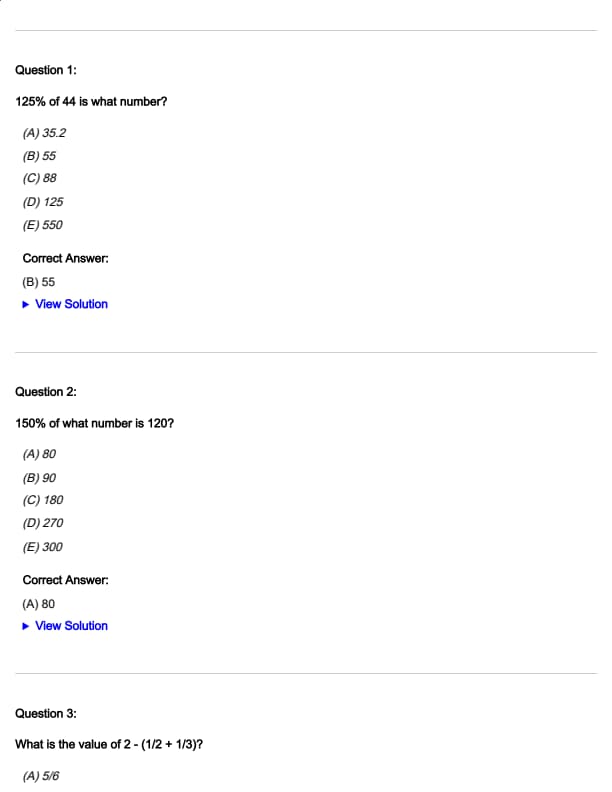
Question 1:
125% of 44 is what number?
- (A) 35.2
- (B) 55
- (C) 88
- (D) 125
- (E) 550
Question 2:
150% of what number is 120?
- (A) 80
- (B) 90
- (C) 180
- (D) 270
- (E) 300
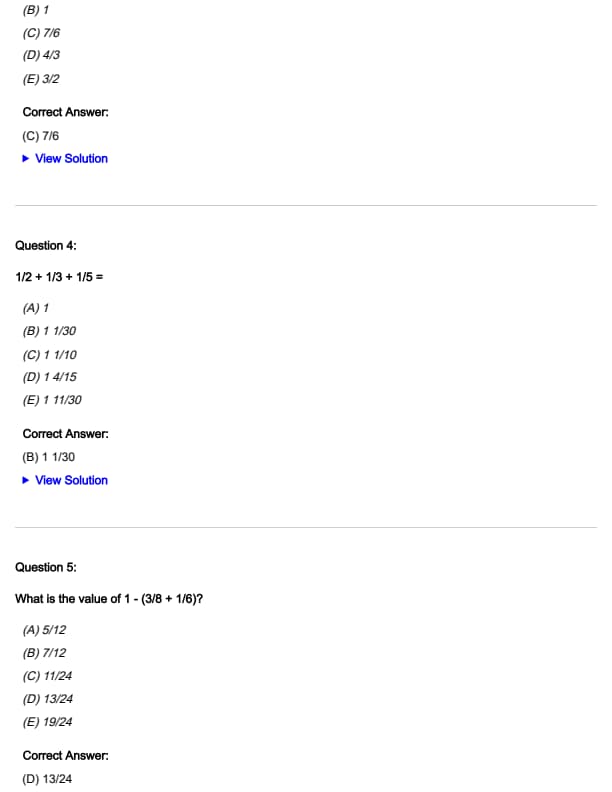
Question 3:
What is the value of 2 - (1/2 + 1/3)?
- (A) 5/6
- (B) 1
- (C) 7/6
- (D) 4/3
- (E) 3/2
Question 4:
1/2 + 1/3 + 1/5 =
- (A) 1
- (B) 1 1/30
- (C) 1 1/10
- (D) 1 4/15
- (E) 1 11/30
Question 5:
What is the value of 1 - (3/8 + 1/6)?
- (A) 5/12
- (B) 7/12
- (C) 11/24
- (D) 13/24
- (E) 19/24
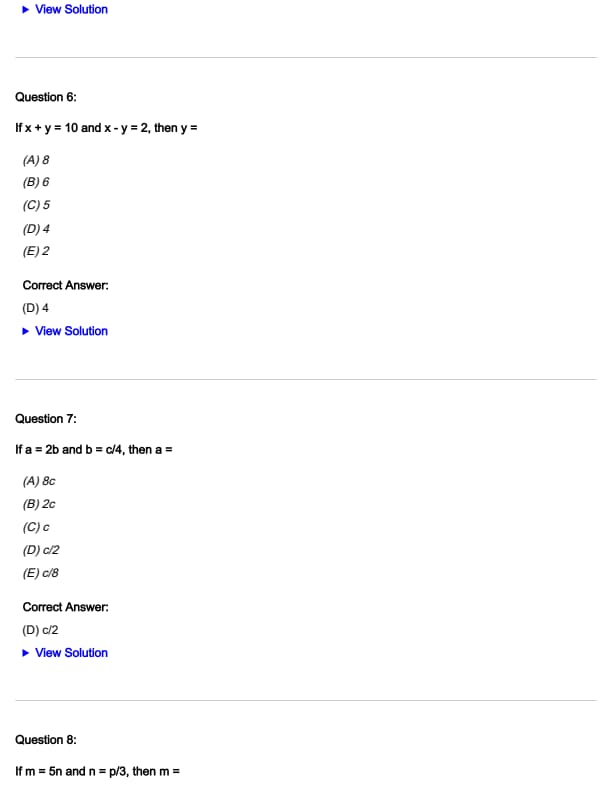
Question 6:
If x + y = 10 and x - y = 2, then y =
- (A) 8
- (B) 6
- (C) 5
- (D) 4
- (E) 2
Question 7:
If a = 2b and b = c/4, then a =
- (A) 8c
- (B) 2c
- (C) c
- (D) c/2
- (E) c/8
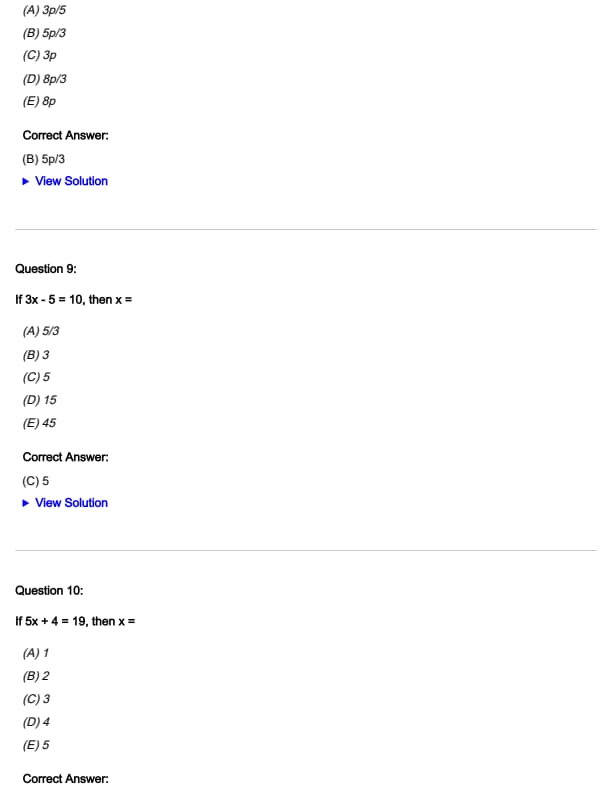
Question 8:
If m = 5n and n = p/3, then m =
- (A) 3p/5
- (B) 5p/3
- (C) 3p
- (D) 8p/3
- (E) 8p
Question 9:
If 3x - 5 = 10, then x =
- (A) 5/3
- (B) 3
- (C) 5
- (D) 15
- (E) 45
Question 10:
If 5x + 4 = 19, then x =
- (A) 1
- (B) 2
- (C) 3
- (D) 4
- (E) 5
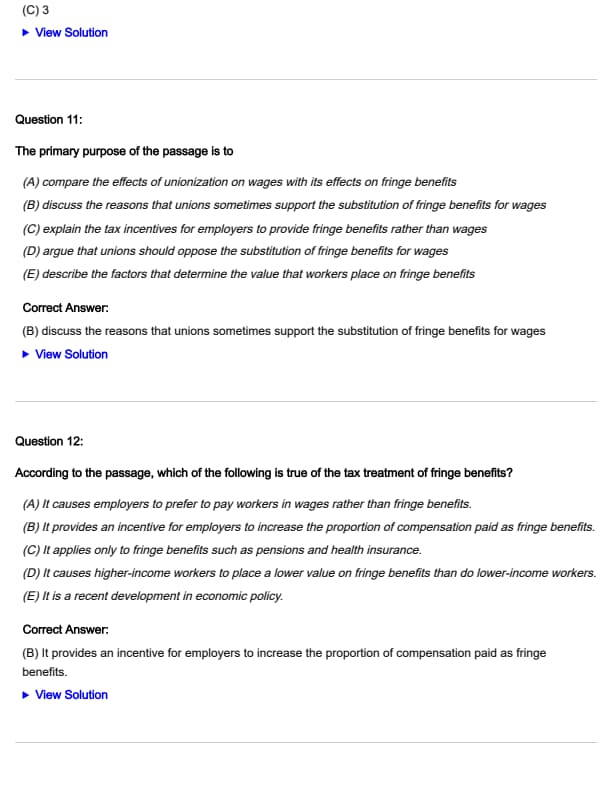
Question 11:
The primary purpose of the passage is to
- (A) compare the effects of unionization on wages with its effects on fringe benefits
- (B) discuss the reasons that unions sometimes support the substitution of fringe benefits for wages
- (C) explain the tax incentives for employers to provide fringe benefits rather than wages
- (D) argue that unions should oppose the substitution of fringe benefits for wages
- (E) describe the factors that determine the value that workers place on fringe benefits
Question 12:
According to the passage, which of the following is true of the tax treatment of fringe benefits?
- (A) It causes employers to prefer to pay workers in wages rather than fringe benefits.
- (B) It provides an incentive for employers to increase the proportion of compensation paid as fringe benefits.
- (C) It applies only to fringe benefits such as pensions and health insurance.
- (D) It causes higher-income workers to place a lower value on fringe benefits than do lower-income workers.
- (E) It is a recent development in economic policy.
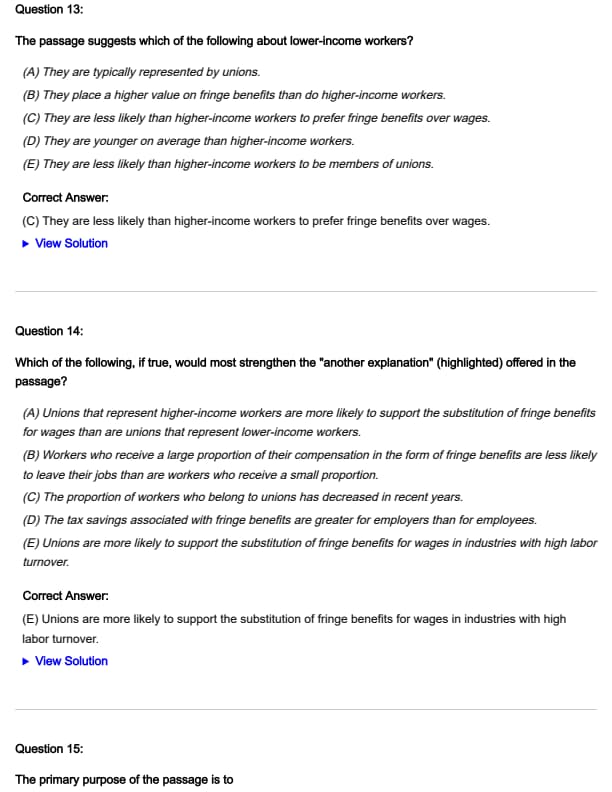
Question 13:
The passage suggests which of the following about lower-income workers?
- (A) They are typically represented by unions.
- (B) They place a higher value on fringe benefits than do higher-income workers.
- (C) They are less likely than higher-income workers to prefer fringe benefits over wages.
- (D) They are younger on average than higher-income workers.
- (E) They are less likely than higher-income workers to be members of unions.
Question 14:
Which of the following, if true, would most strengthen the "another explanation" (highlighted) offered in the passage?
- (A) Unions that represent higher-income workers are more likely to support the substitution of fringe benefits for wages than are unions that represent lower-income workers.
- (B) Workers who receive a large proportion of their compensation in the form of fringe benefits are less likely to leave their jobs than are workers who receive a small proportion.
- (C) The proportion of workers who belong to unions has decreased in recent years.
- (D) The tax savings associated with fringe benefits are greater for employers than for employees.
- (E) Unions are more likely to support the substitution of fringe benefits for wages in industries with high labor turnover.
Question 15:
The primary purpose of the passage is to
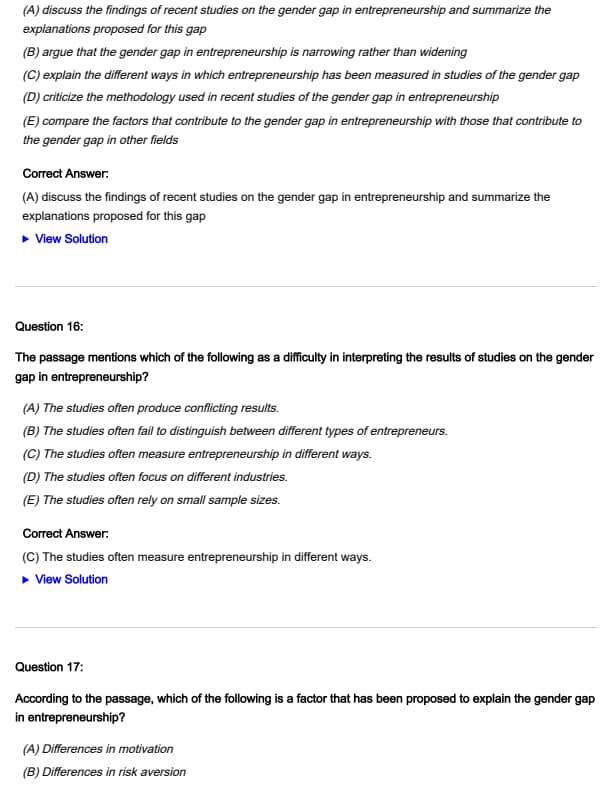
- (A) discuss the findings of recent studies on the gender gap in entrepreneurship and summarize the explanations proposed for this gap
- (B) argue that the gender gap in entrepreneurship is narrowing rather than widening
- (C) explain the different ways in which entrepreneurship has been measured in studies of the gender gap
- (D) criticize the methodology used in recent studies of the gender gap in entrepreneurship
- (E) compare the factors that contribute to the gender gap in entrepreneurship with those that contribute to the gender gap in other fields
Question 16:
The passage mentions which of the following as a difficulty in interpreting the results of studies on the gender gap in entrepreneurship?
- (A) The studies often produce conflicting results.
- (B) The studies often fail to distinguish between different types of entrepreneurs.
- (C) The studies often measure entrepreneurship in different ways.
- (D) The studies often focus on different industries.
- (E) The studies often rely on small sample sizes.
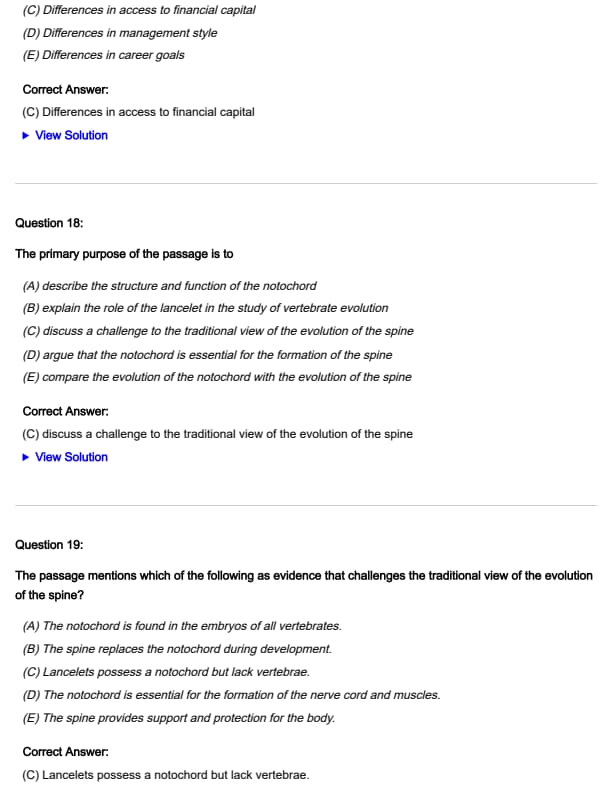
Question 17:
According to the passage, which of the following is a factor that has been proposed to explain the gender gap in entrepreneurship?
- (A) Differences in motivation
- (B) Differences in risk aversion
- (C) Differences in access to financial capital
- (D) Differences in management style
- (E) Differences in career goals
Question 18:
The primary purpose of the passage is to
- (A) describe the structure and function of the notochord
- (B) explain the role of the lancelet in the study of vertebrate evolution
- (C) discuss a challenge to the traditional view of the evolution of the spine
- (D) argue that the notochord is essential for the formation of the spine
- (E) compare the evolution of the notochord with the evolution of the spine
Question 19:
The passage mentions which of the following as evidence that challenges the traditional view of the evolution of the spine?
- (A) The notochord is found in the embryos of all vertebrates.
- (B) The spine replaces the notochord during development.
- (C) Lancelets possess a notochord but lack vertebrae.
- (D) The notochord is essential for the formation of the nerve cord and muscles.
- (E) The spine provides support and protection for the body.
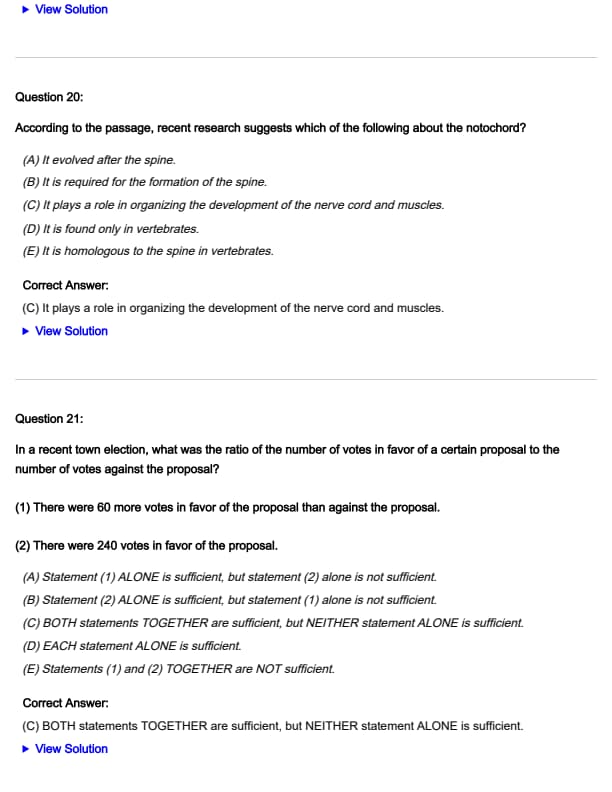
Question 20:
According to the passage, recent research suggests which of the following about the notochord?
- (A) It evolved after the spine.
- (B) It is required for the formation of the spine.
- (C) It plays a role in organizing the development of the nerve cord and muscles.
- (D) It is found only in vertebrates.
- (E) It is homologous to the spine in vertebrates.
Question 21:
In a recent town election, what was the ratio of the number of votes in favor of a certain proposal to the number of votes against the proposal?
(1) There were 60 more votes in favor of the proposal than against the proposal.
(2) There were 240 votes in favor of the proposal.
- (A) Statement (1) ALONE is sufficient, but statement (2) alone is not sufficient.
- (B) Statement (2) ALONE is sufficient, but statement (1) alone is not sufficient.
- (C) BOTH statements TOGETHER are sufficient, but NEITHER statement ALONE is sufficient.
- (D) EACH statement ALONE is sufficient.
- (E) Statements (1) and (2) TOGETHER are NOT sufficient.
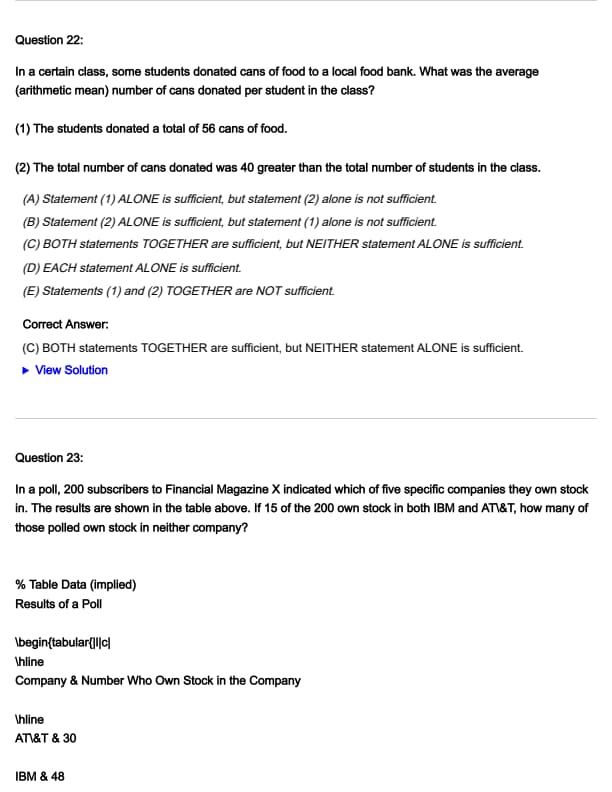
Question 22:
In a certain class, some students donated cans of food to a local food bank. What was the average (arithmetic mean) number of cans donated per student in the class?
(1) The students donated a total of 56 cans of food.
(2) The total number of cans donated was 40 greater than the total number of students in the class.
- (A) Statement (1) ALONE is sufficient, but statement (2) alone is not sufficient.
- (B) Statement (2) ALONE is sufficient, but statement (1) alone is not sufficient.
- (C) BOTH statements TOGETHER are sufficient, but NEITHER statement ALONE is sufficient.
- (D) EACH statement ALONE is sufficient.
- (E) Statements (1) and (2) TOGETHER are NOT sufficient.
Question 23:
In a poll, 200 subscribers to Financial Magazine X indicated which of five specific companies they own stock in. The results are shown in the table above. If 15 of the 200 own stock in both IBM and AT\&T, how many of those polled own stock in neither company?
% Table Data (implied)
Results of a Poll
\begin{tabular{|l|c|
\hline
Company & Number Who Own Stock in the Company
\hline
AT\&T & 30
IBM & 48
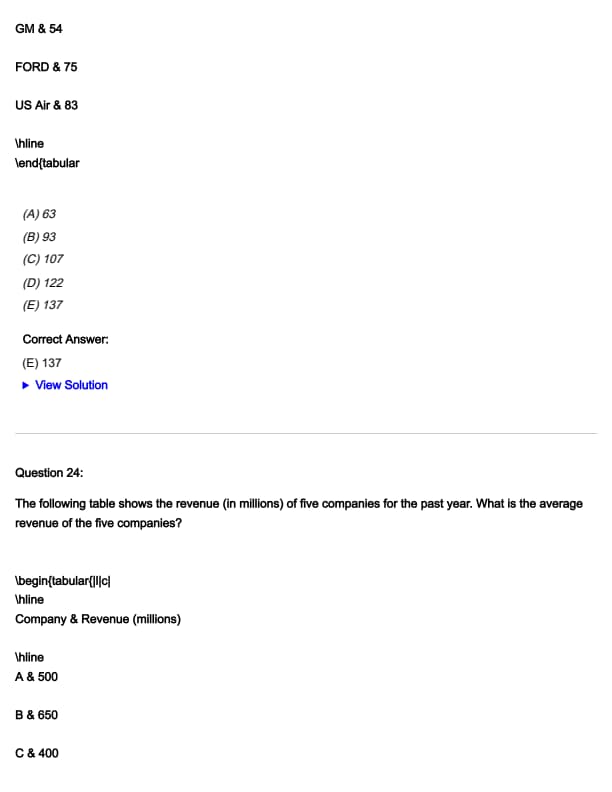
GM & 54
FORD & 75
US Air & 83
\hline
\end{tabular
- (A) 63
- (B) 93
- (C) 107
- (D) 122
- (E) 137
Question 24:
The following table shows the revenue (in millions) of five companies for the past year. What is the average revenue of the five companies?
\begin{tabular{|l|c|
\hline
Company & Revenue (millions)
\hline
A & 500
B & 650
C & 400
D & 700
E & 600
\hline
\end{tabular
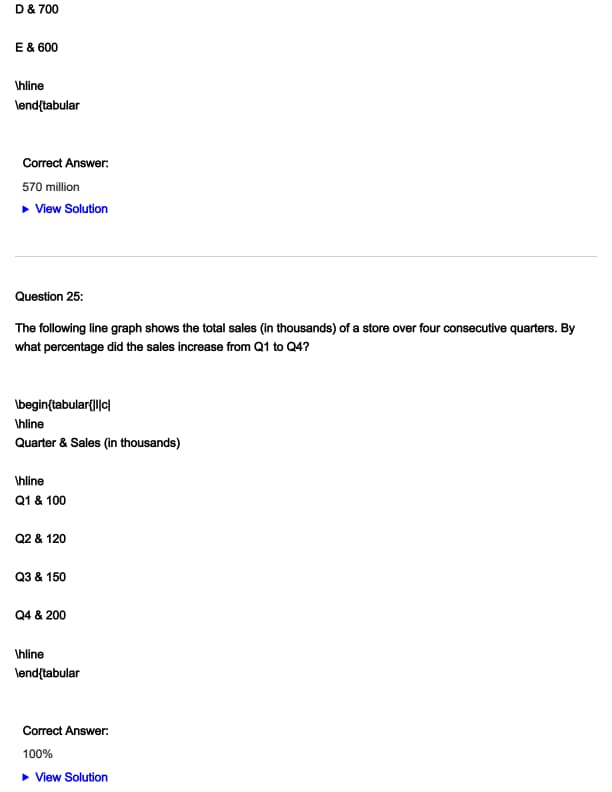
Question 25:
The following line graph shows the total sales (in thousands) of a store over four consecutive quarters. By what percentage did the sales increase from Q1 to Q4?
\begin{tabular{|l|c|
\hline
Quarter & Sales (in thousands)
\hline
Q1 & 100
Q2 & 120
Q3 & 150
Q4 & 200
\hline
\end{tabular
Question 26:
What is the value of m + n?
(1) The average of m, n, and p is 12.
(2) p = 18.
- (A) Statement (1) ALONE is sufficient, but statement (2) alone is not sufficient.
- (B) Statement (2) ALONE is sufficient, but statement (1) alone is not sufficient.
- (C) BOTH statements TOGETHER are sufficient, but NEITHER statement ALONE is sufficient.
- (D) EACH statement ALONE is sufficient.
- (E) Statements (1) and (2) TOGETHER are NOT sufficient.
Question 27:
A train travels at a speed of 80 km/h for the first 2 hours and then at a speed of 100 km/h for the next 3 hours. What is the average speed of the train for the entire journey?
- (A) 88 km/h
- (B) 90 km/h
- (C) 92 km/h
- (D) 94 km/h
- (E) 96 km/h





 Download



Comments