




These class 11 biology handwritten notes chapter 14 Breathing and Exchange of Gases pack all 38 pages into one fast revision pass for Boards, NEET and CUET in 2026-27. The partial pressure table, the volume sums and the oxygen dissociation curve are all boxed and drawn by hand.
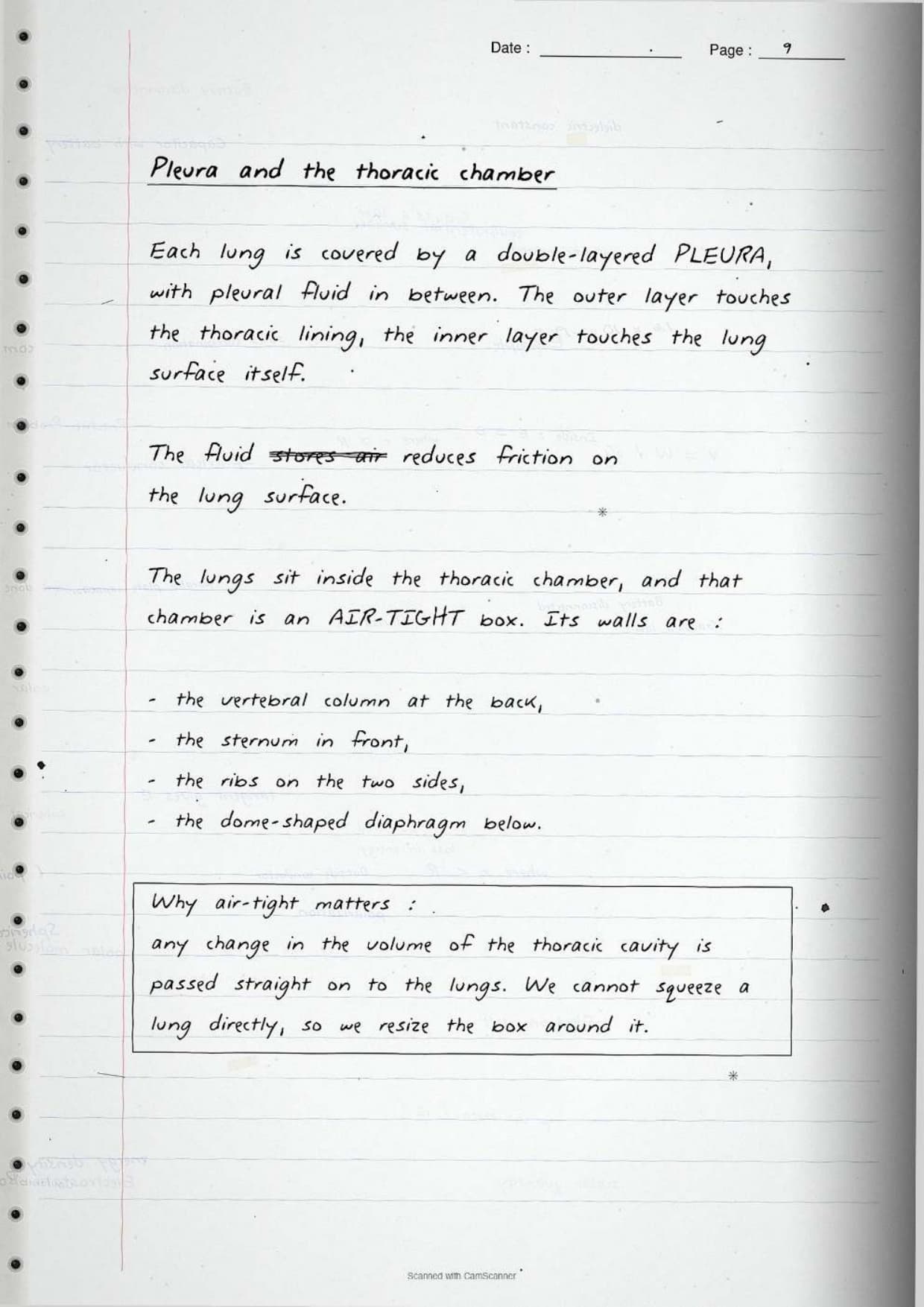
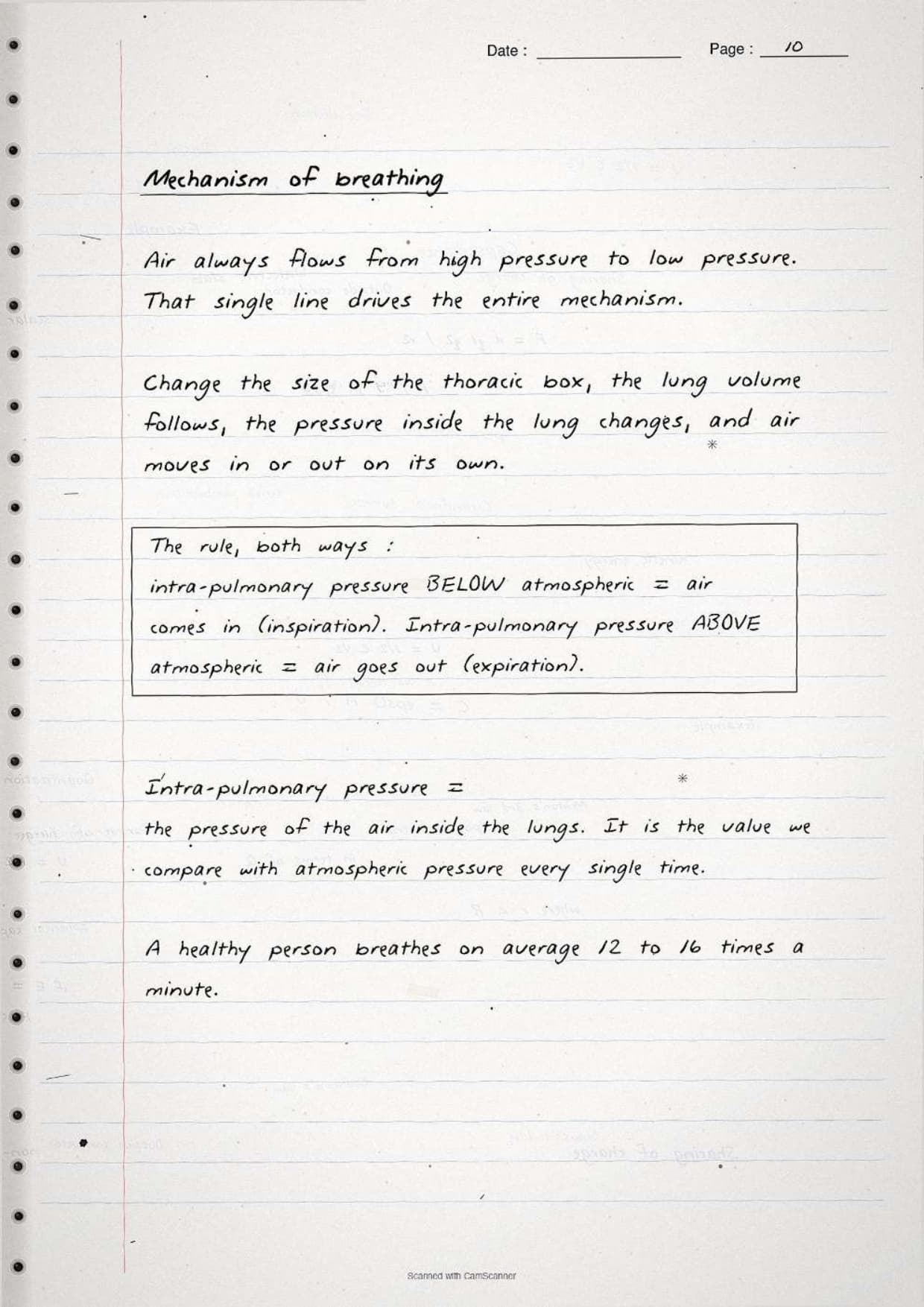
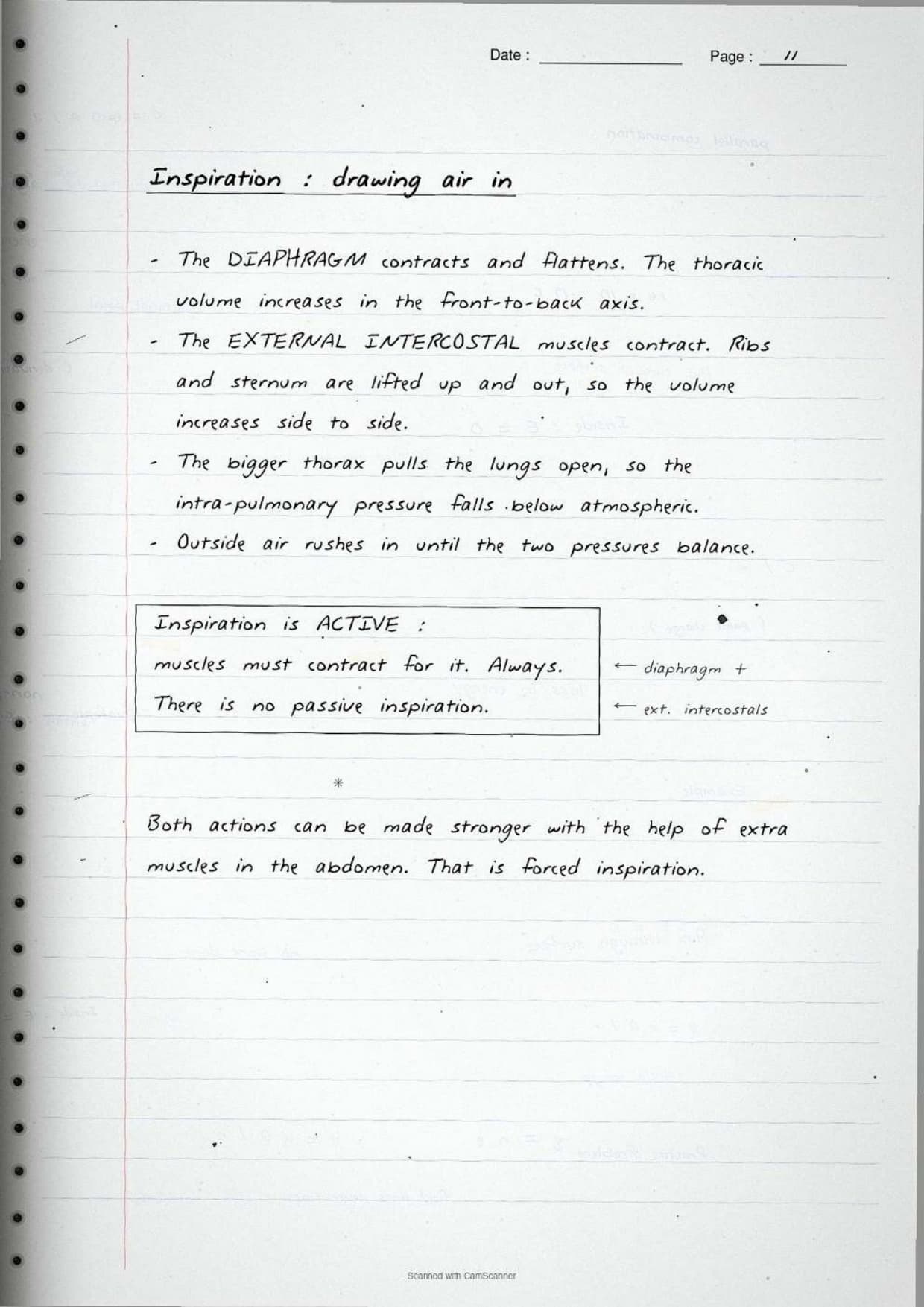
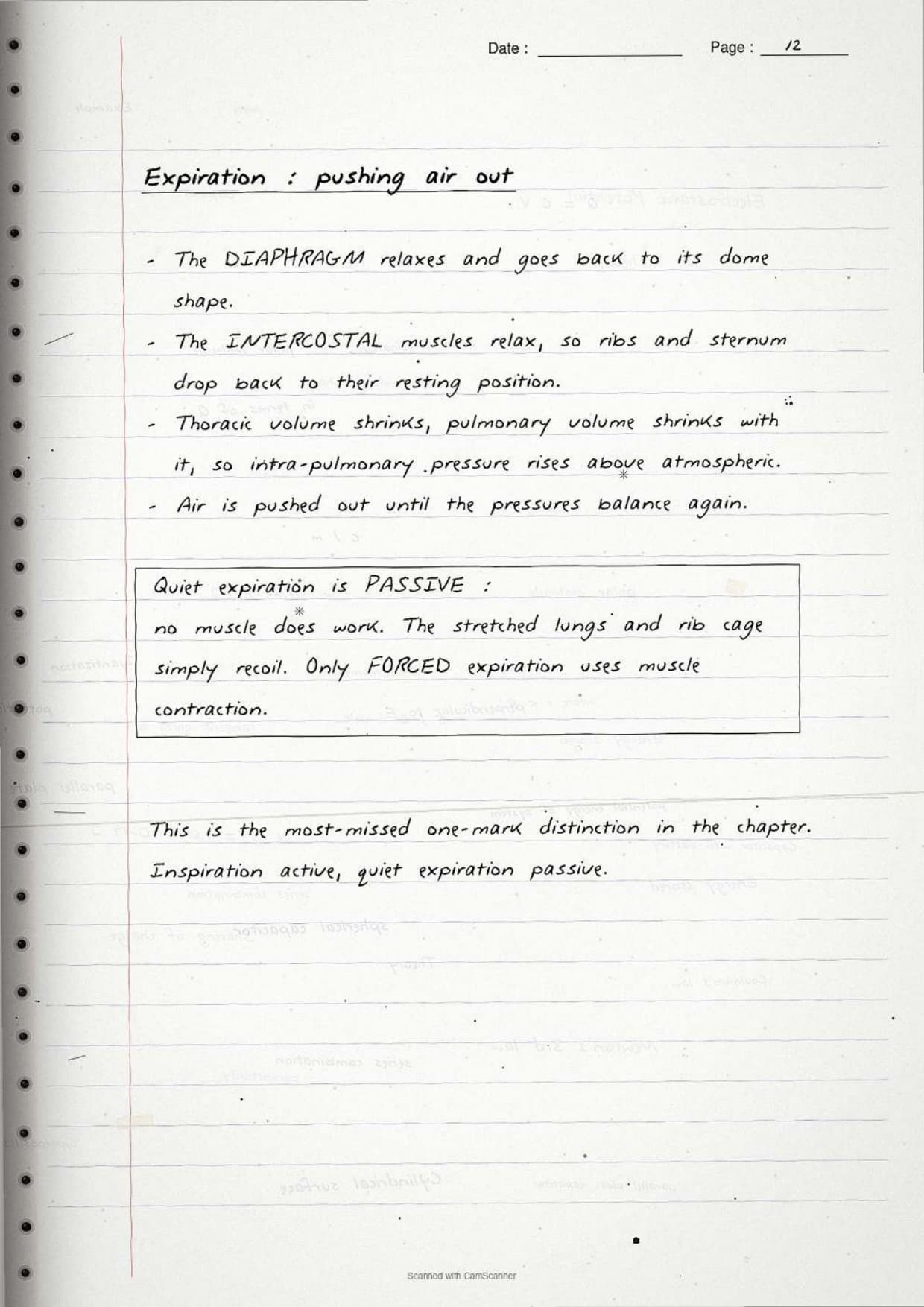
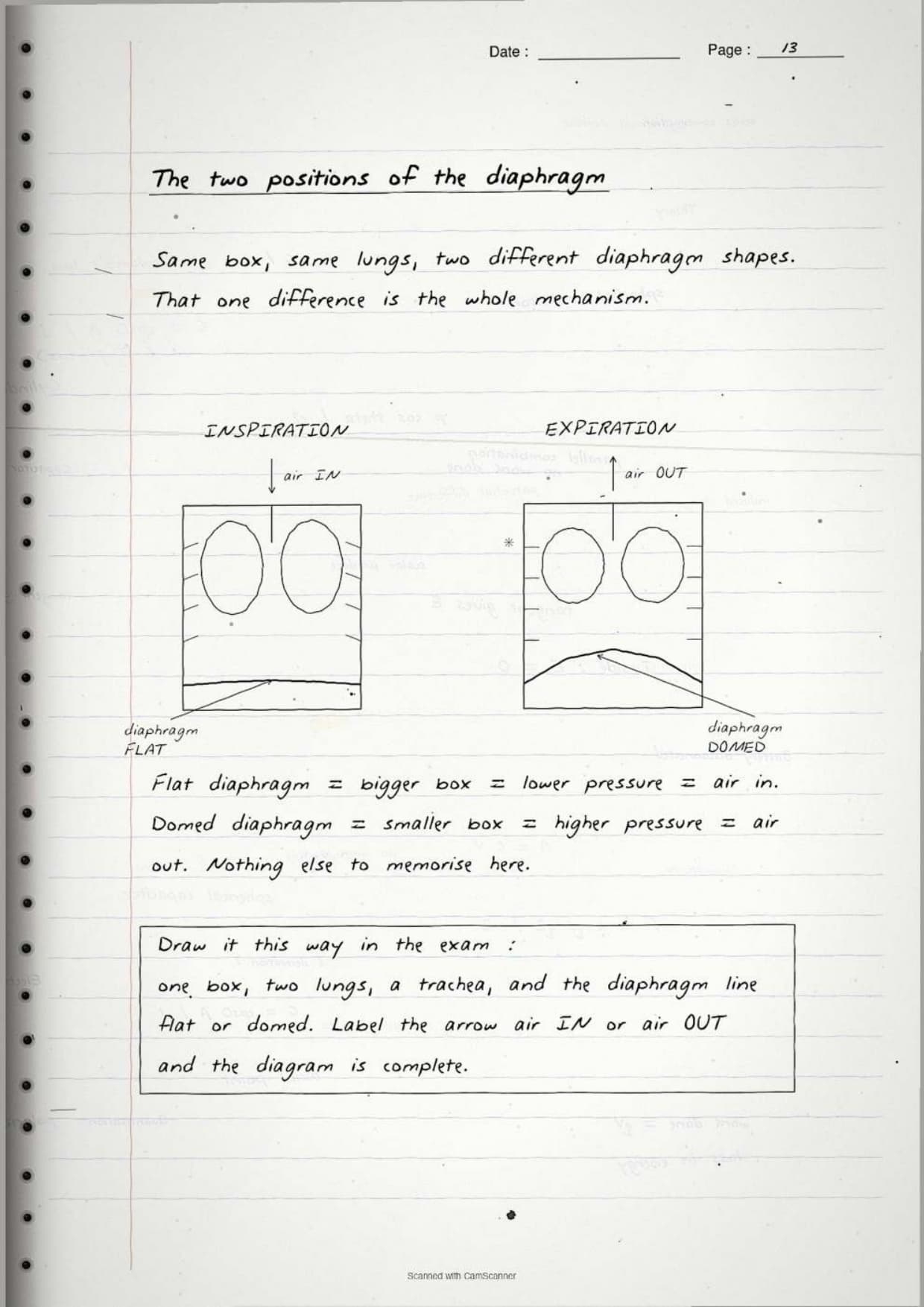
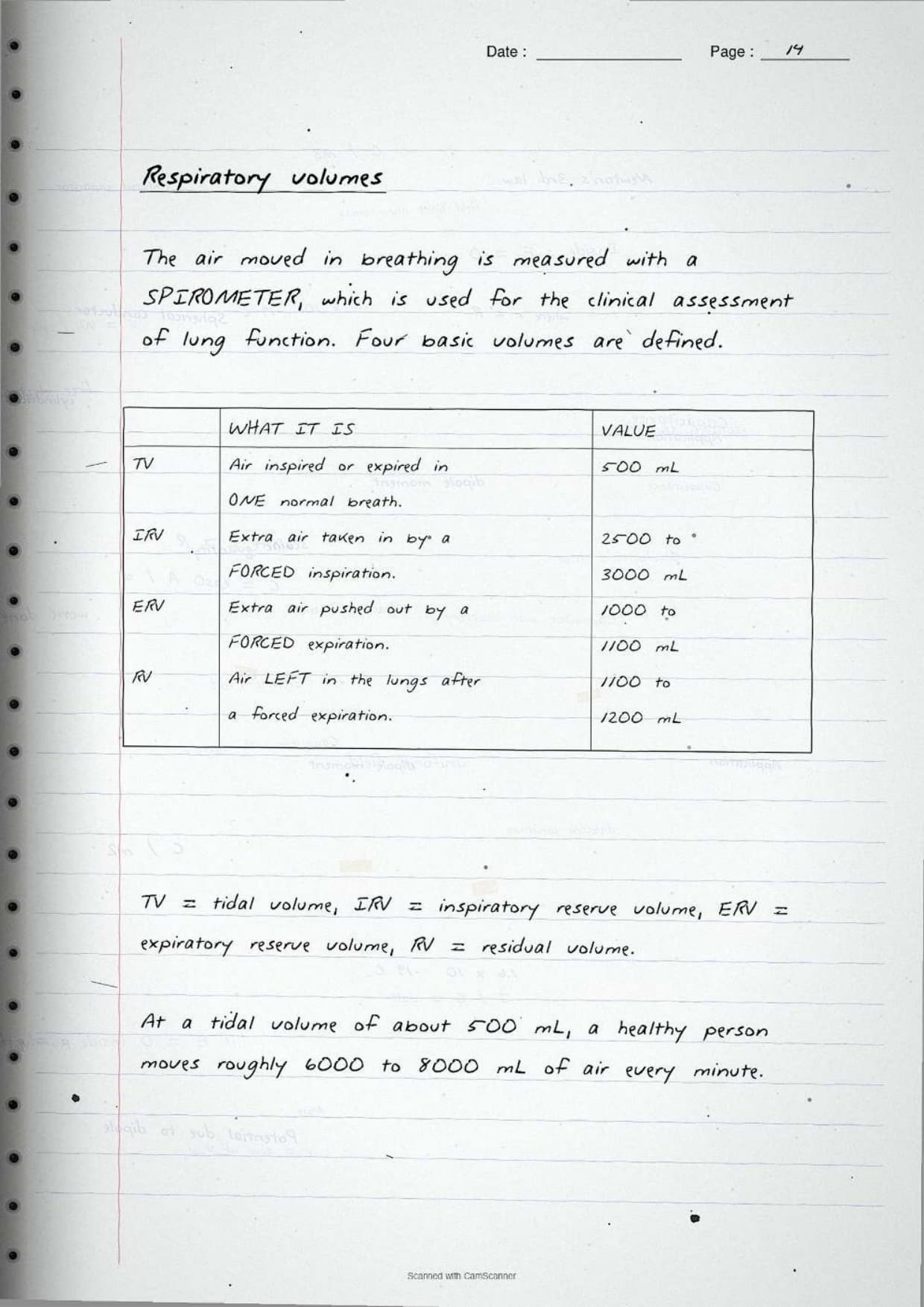
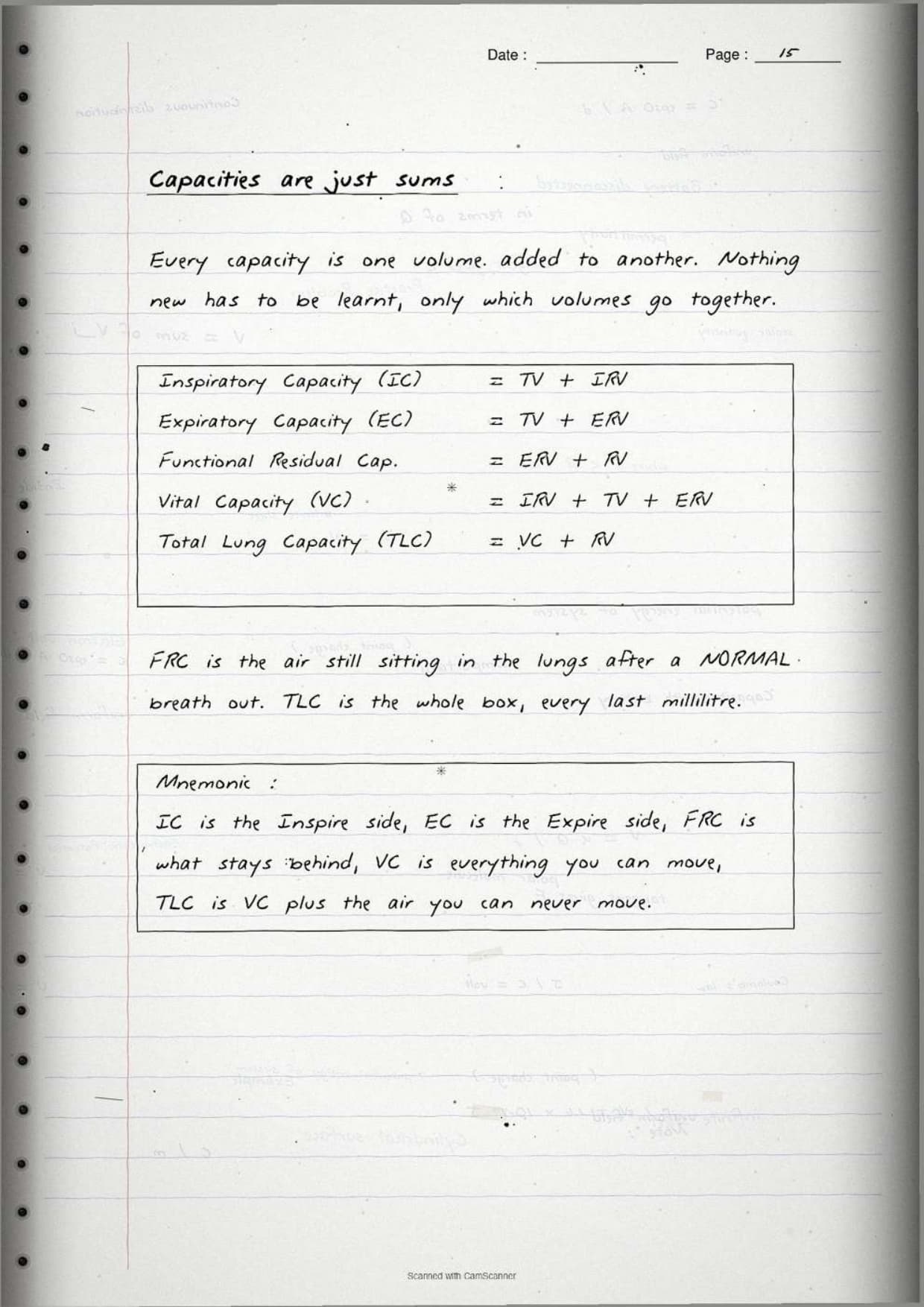
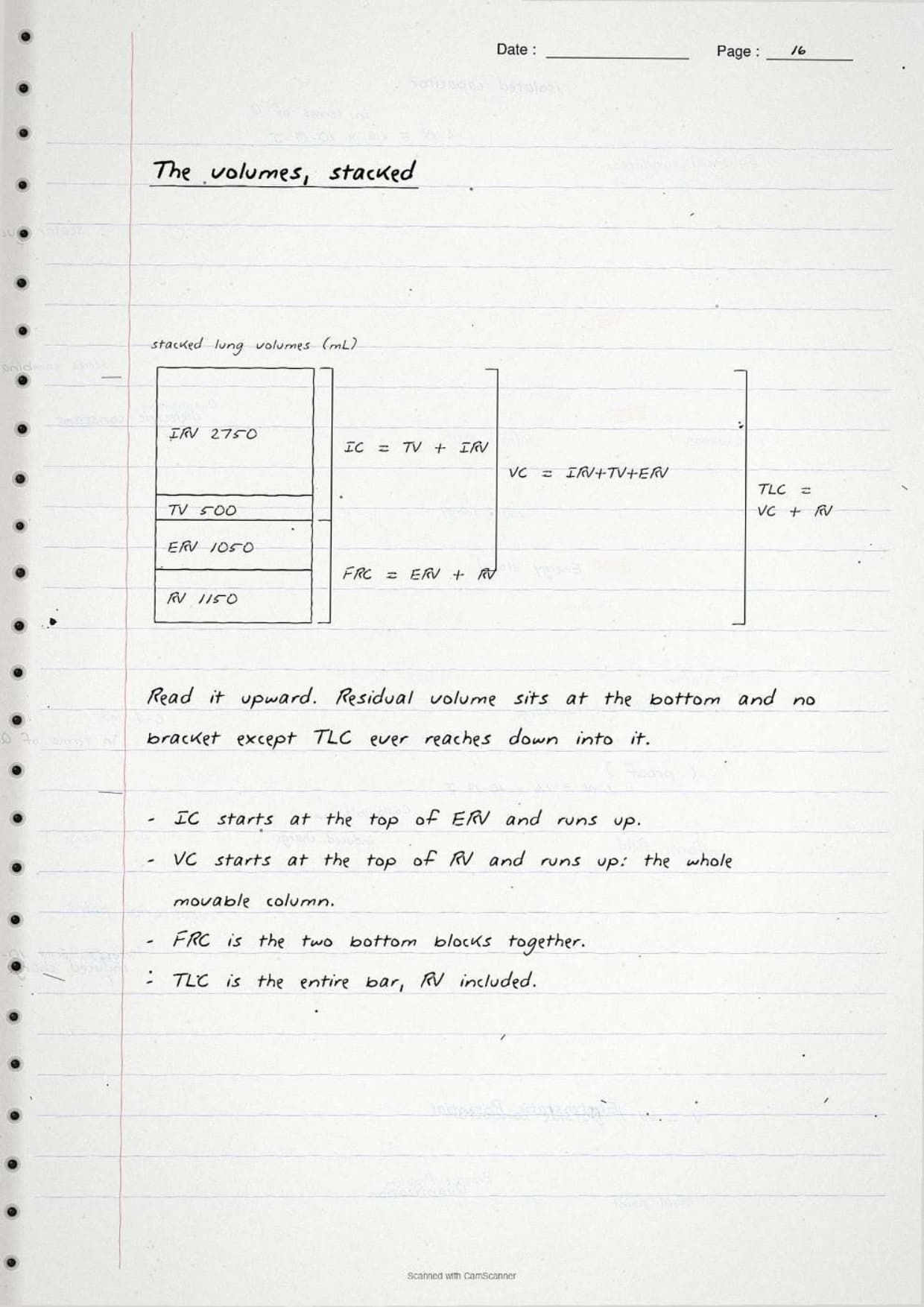
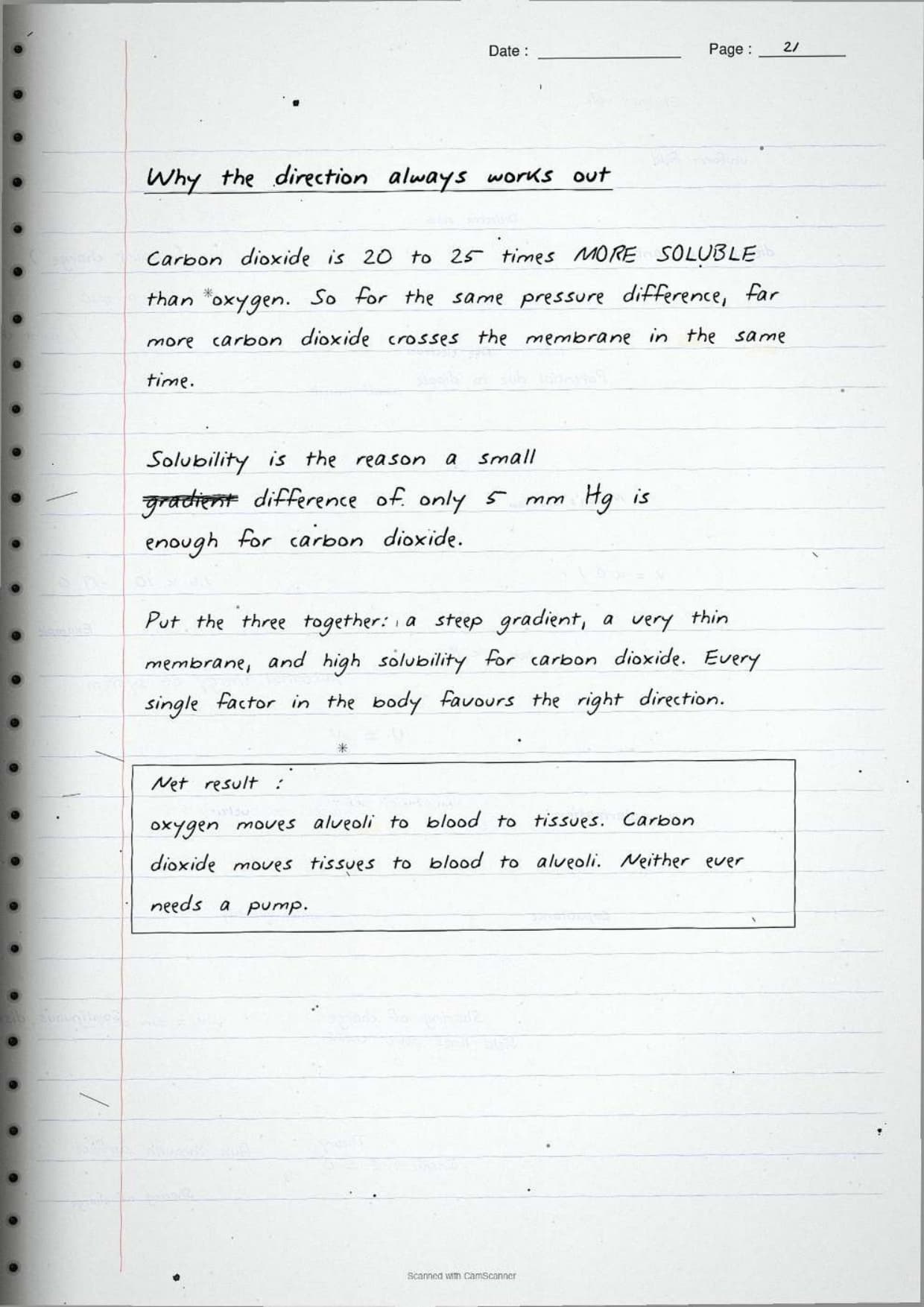
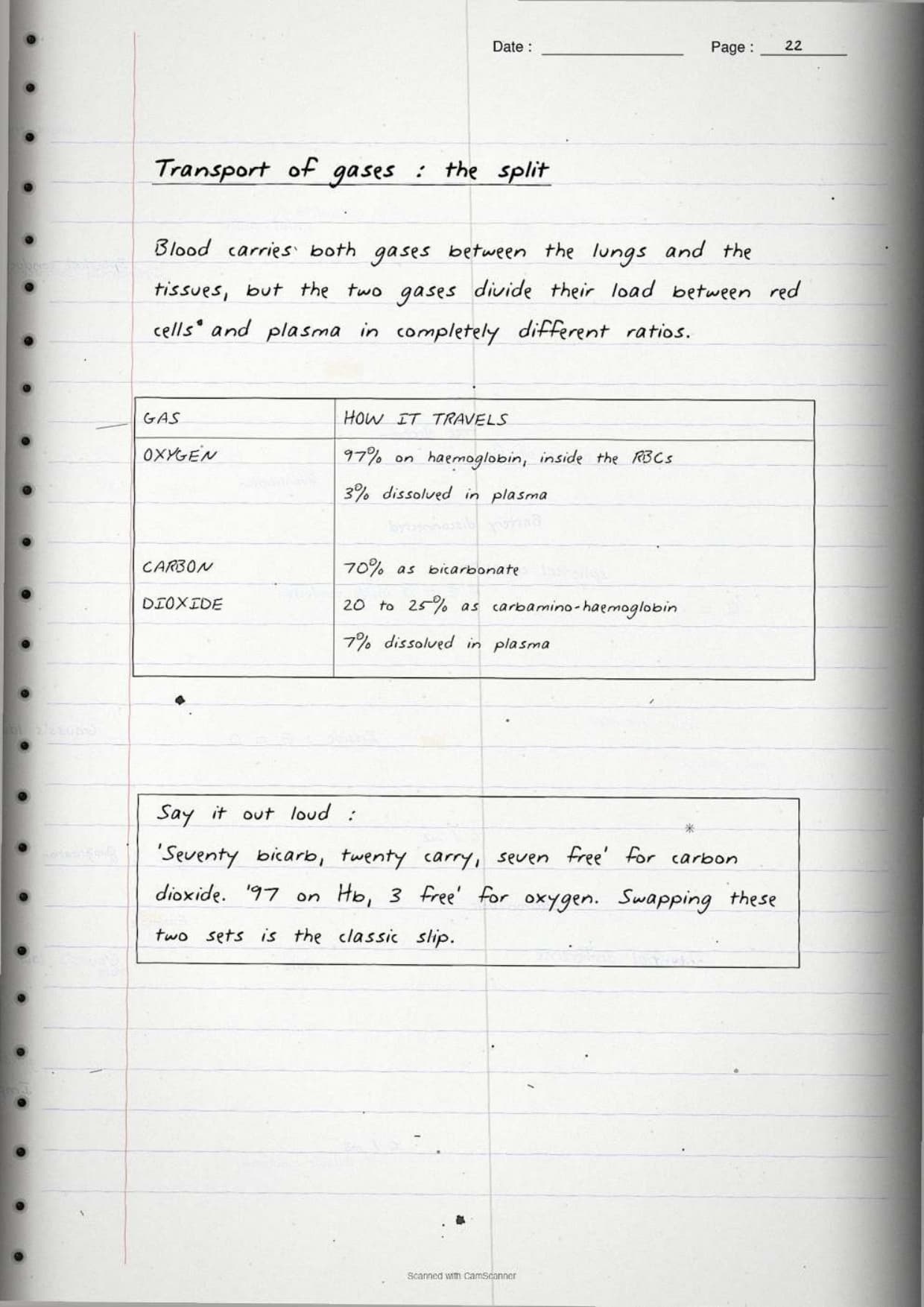
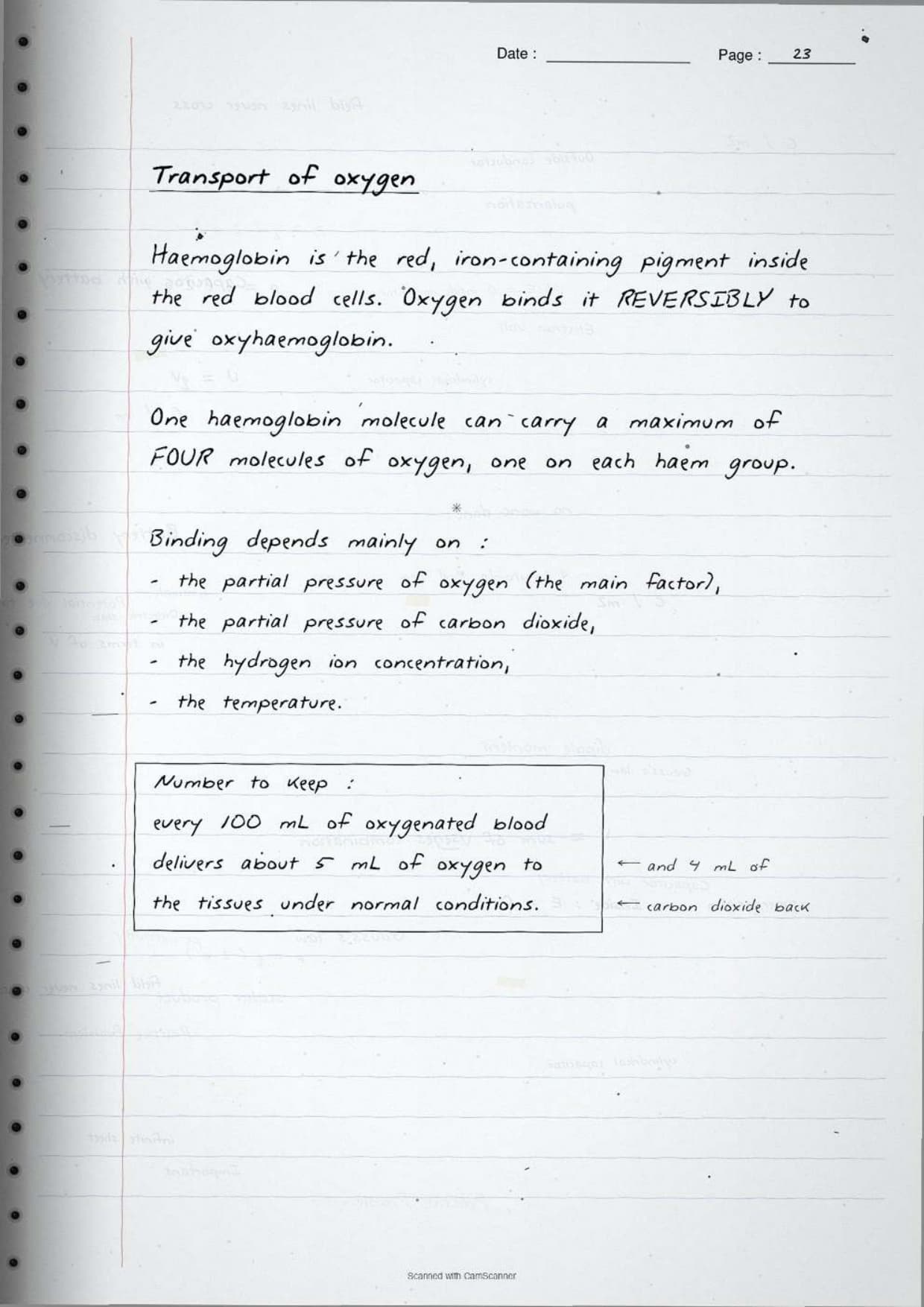
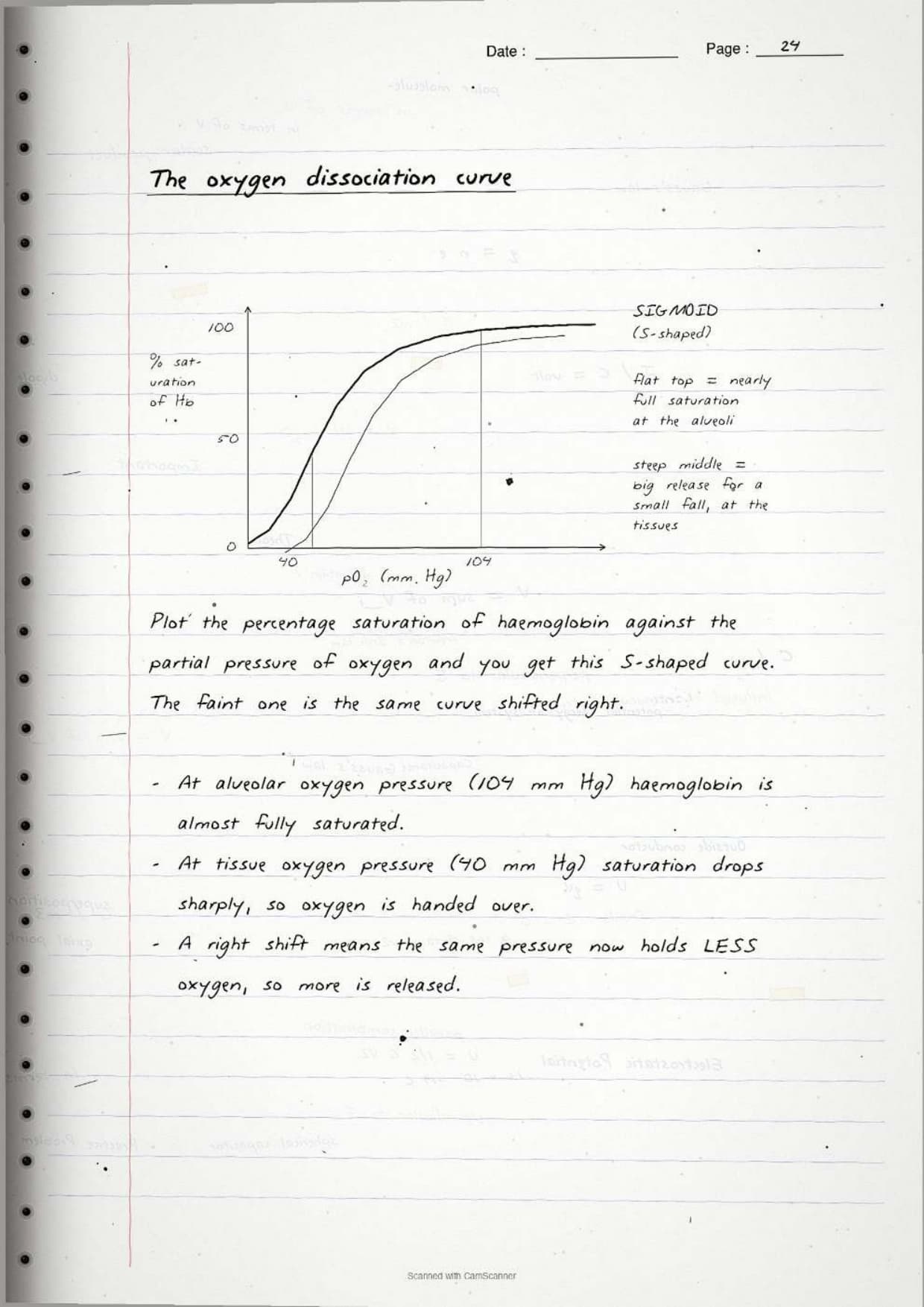
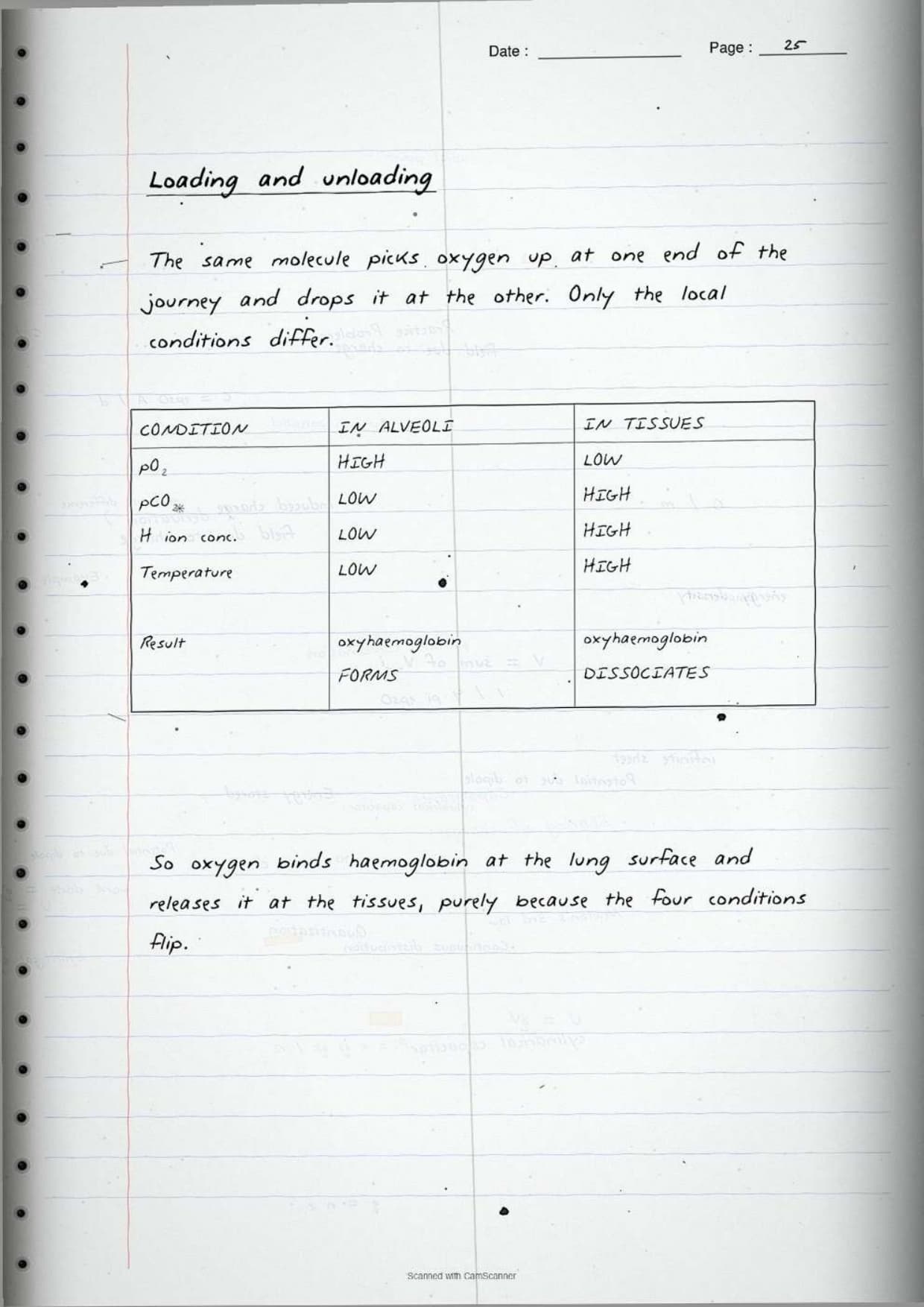
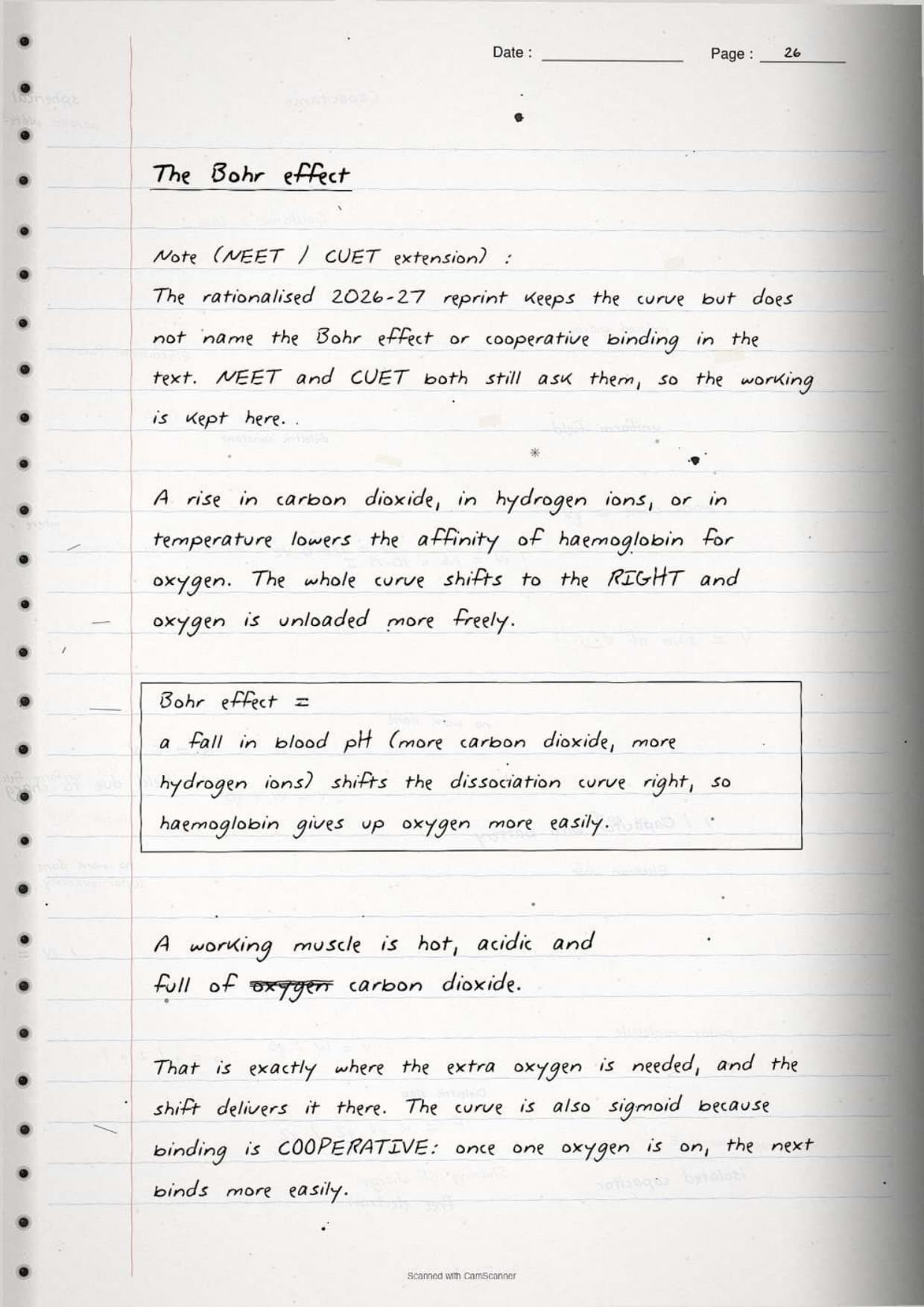
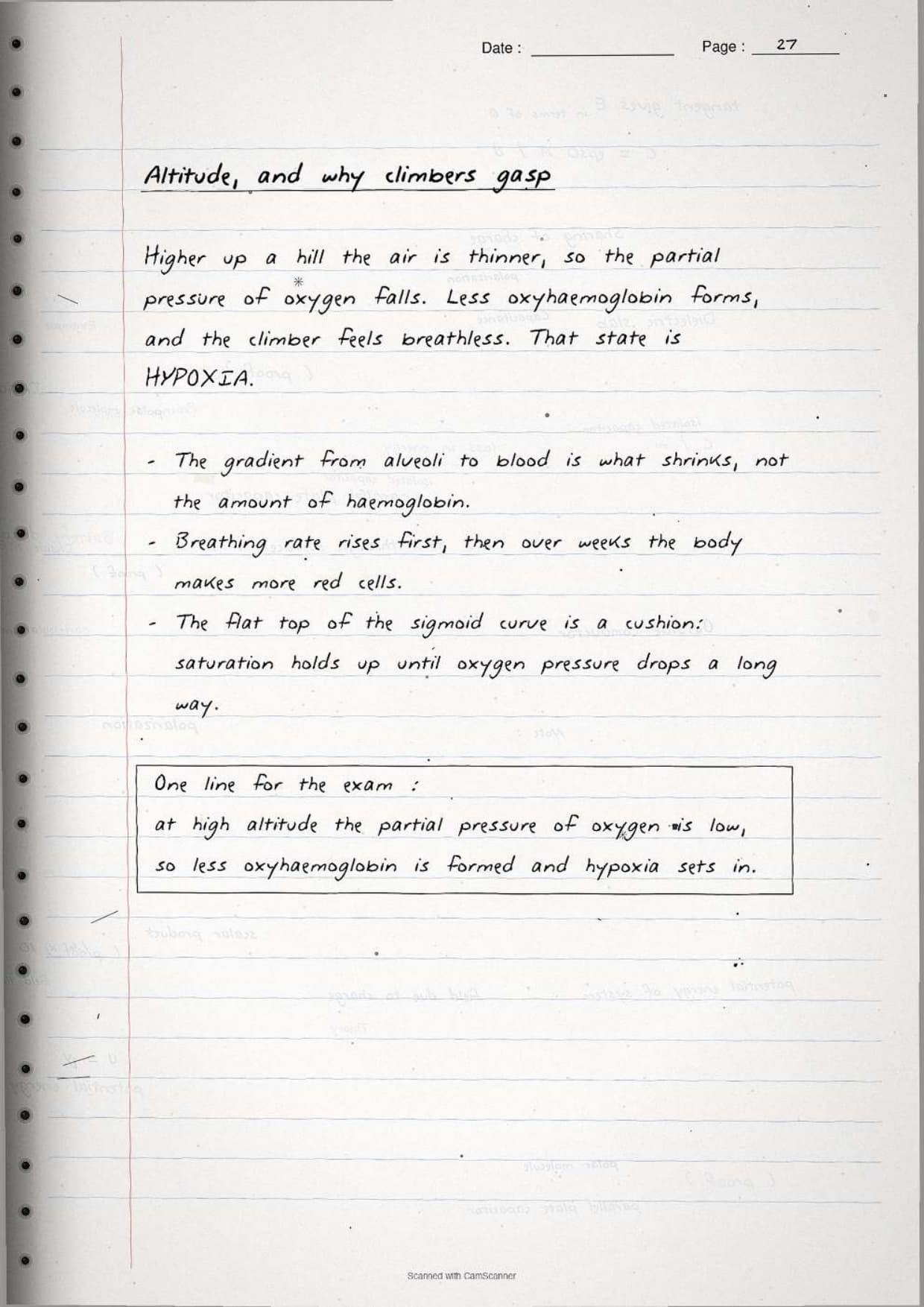
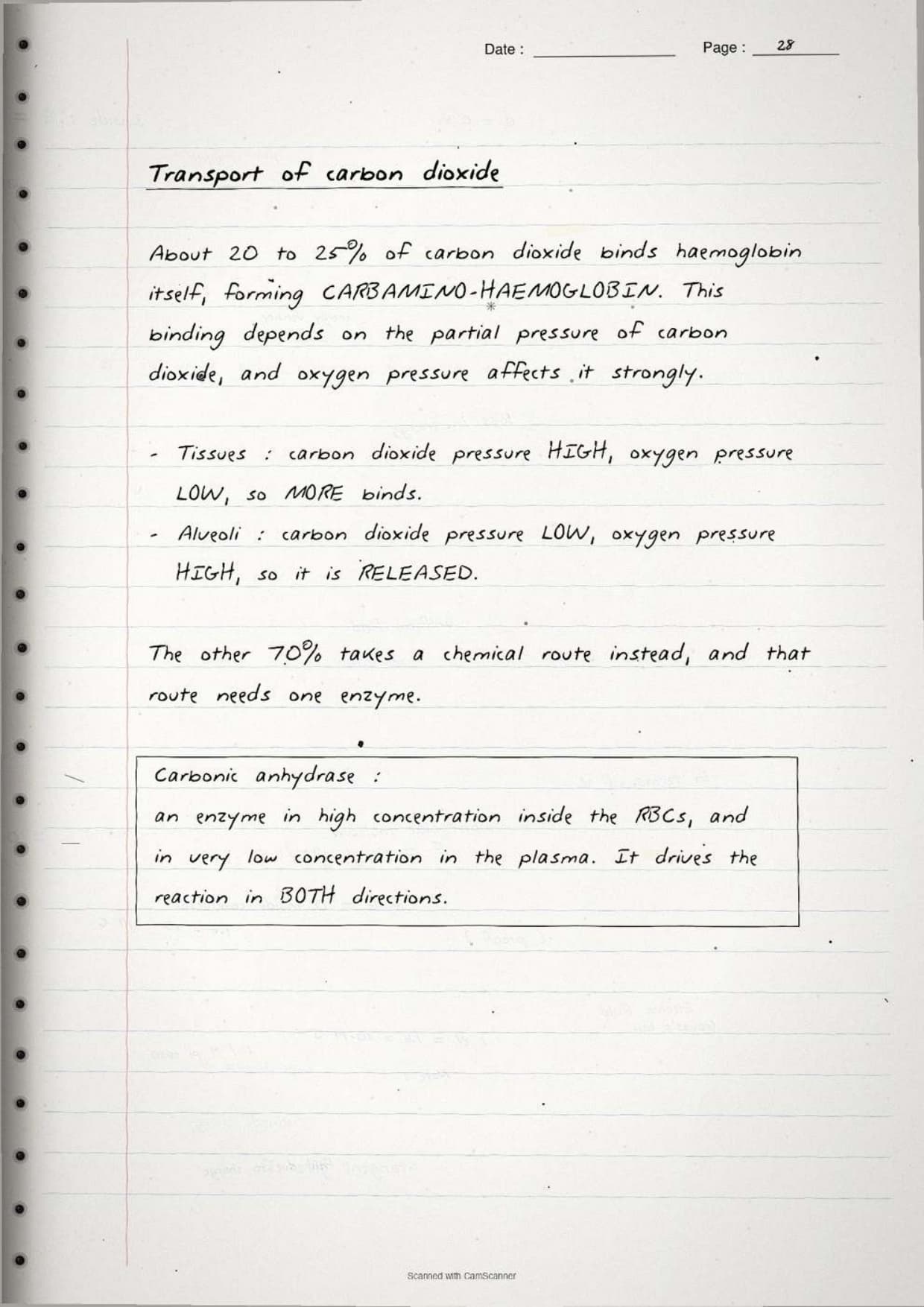
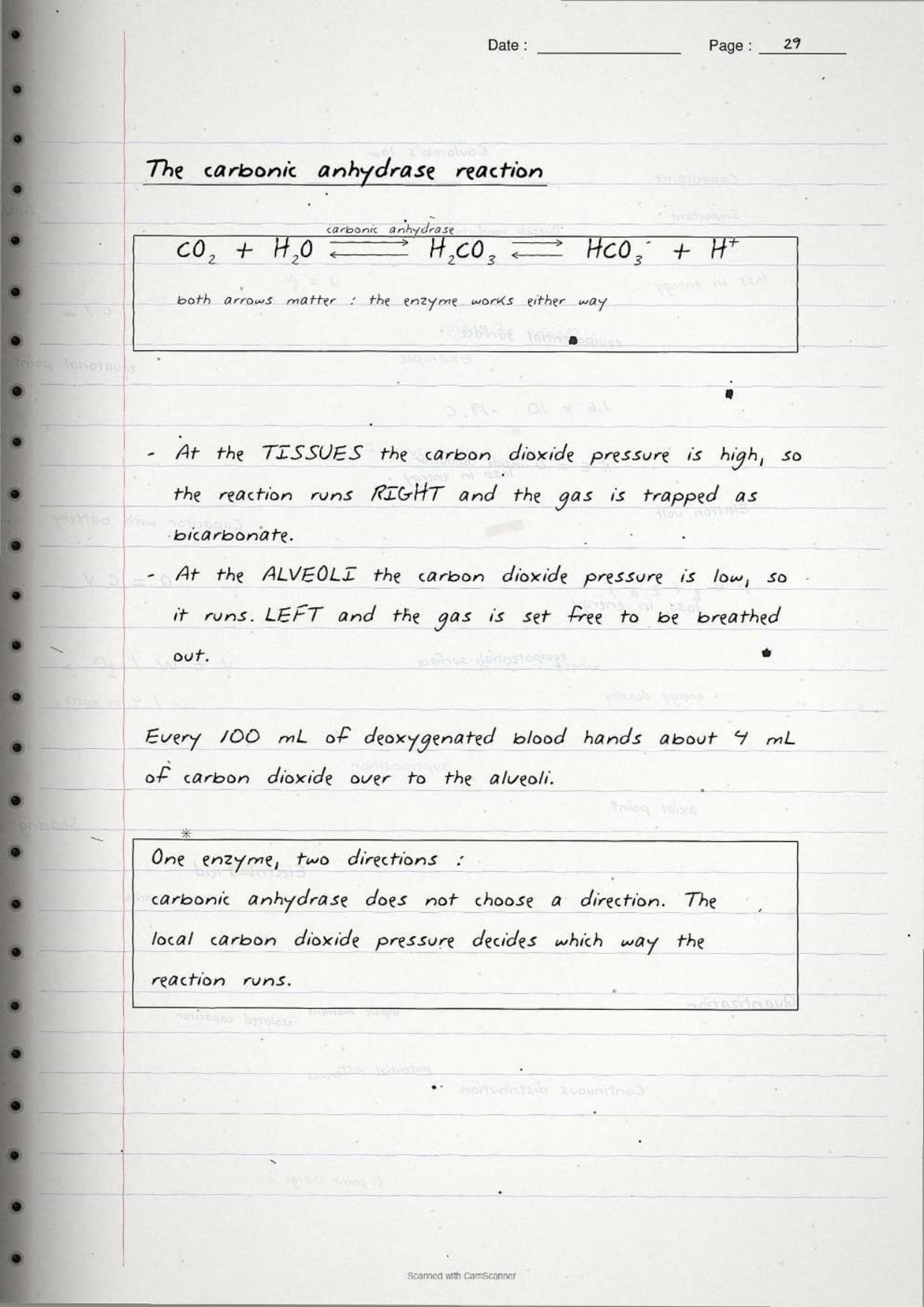
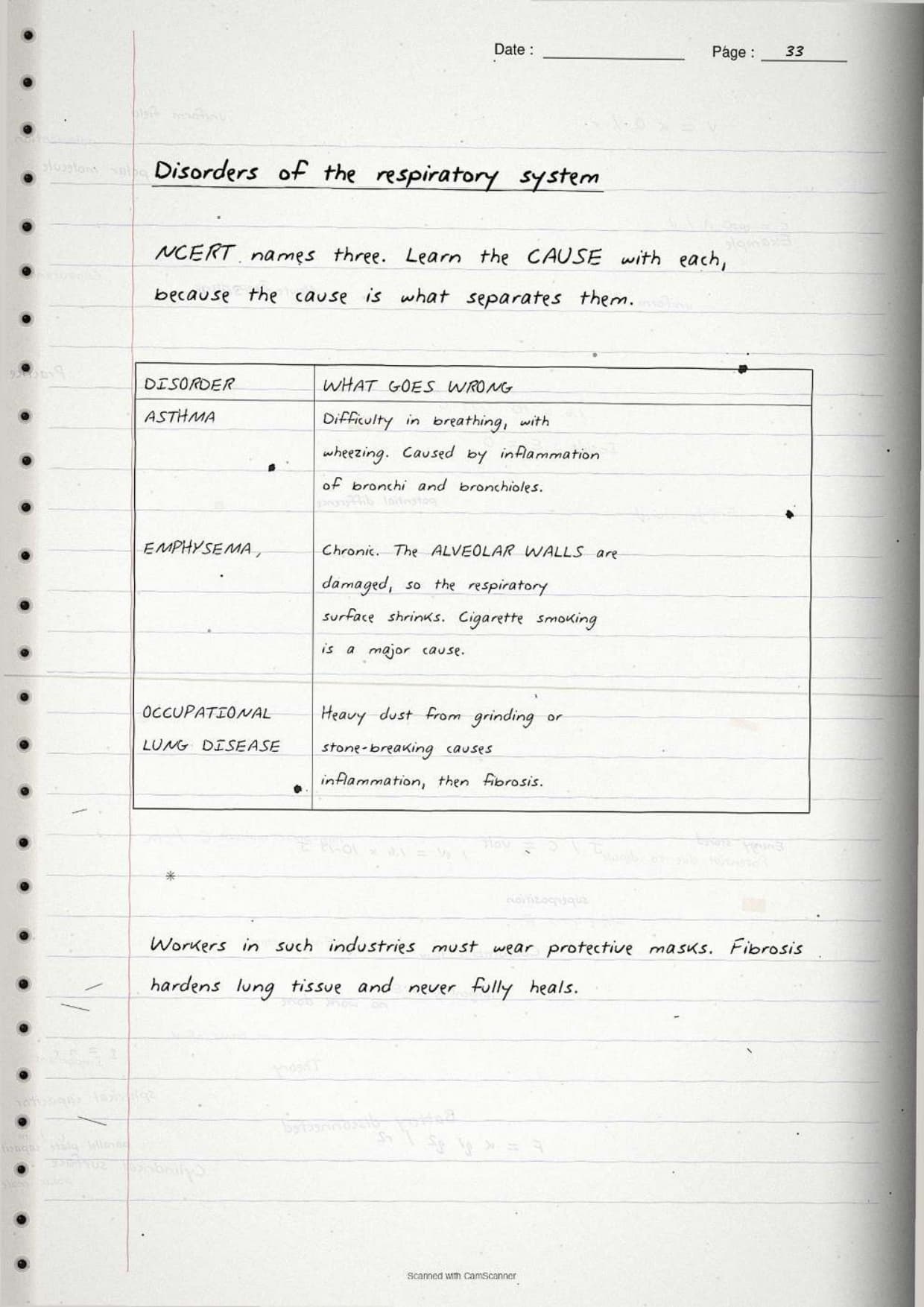
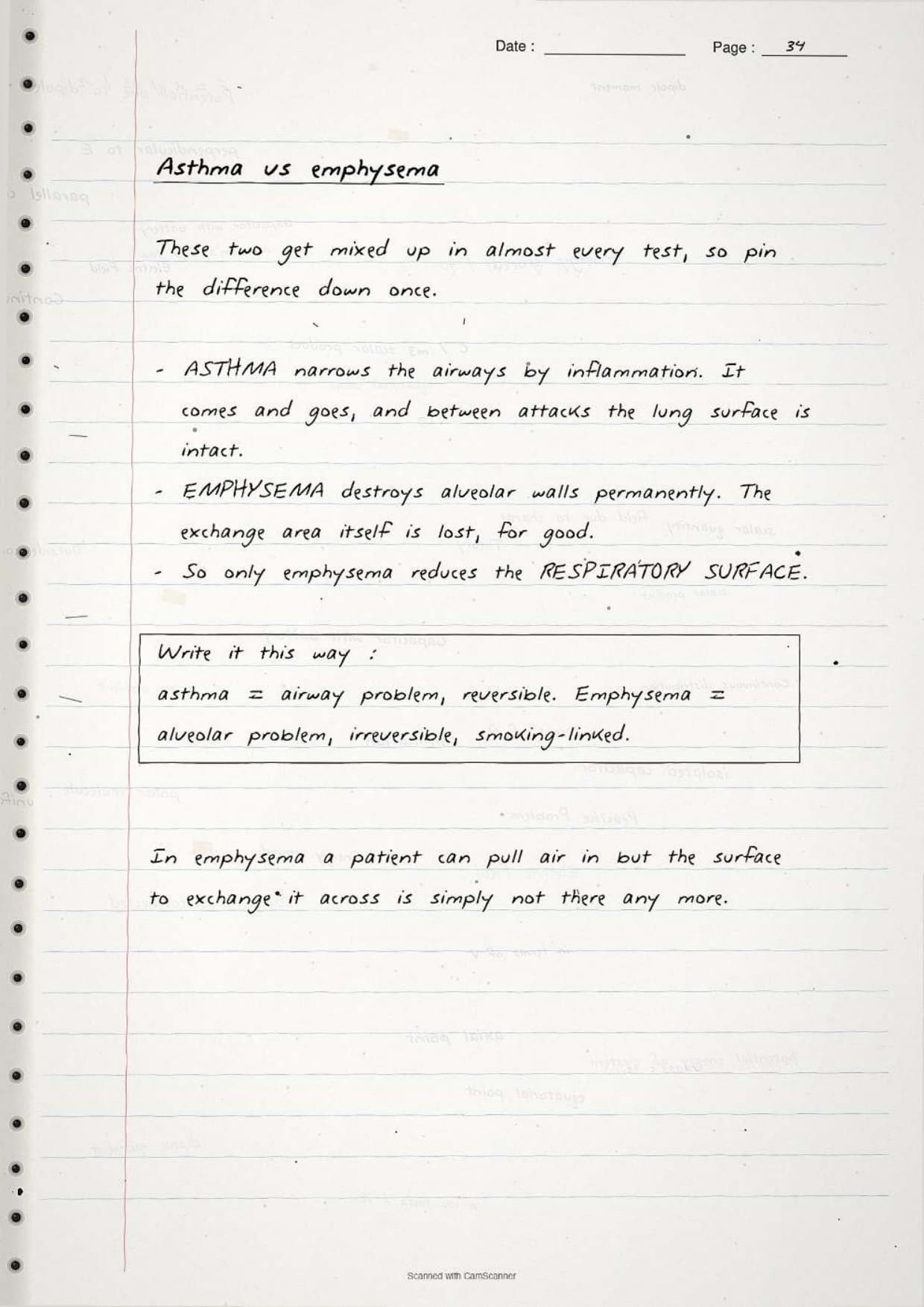
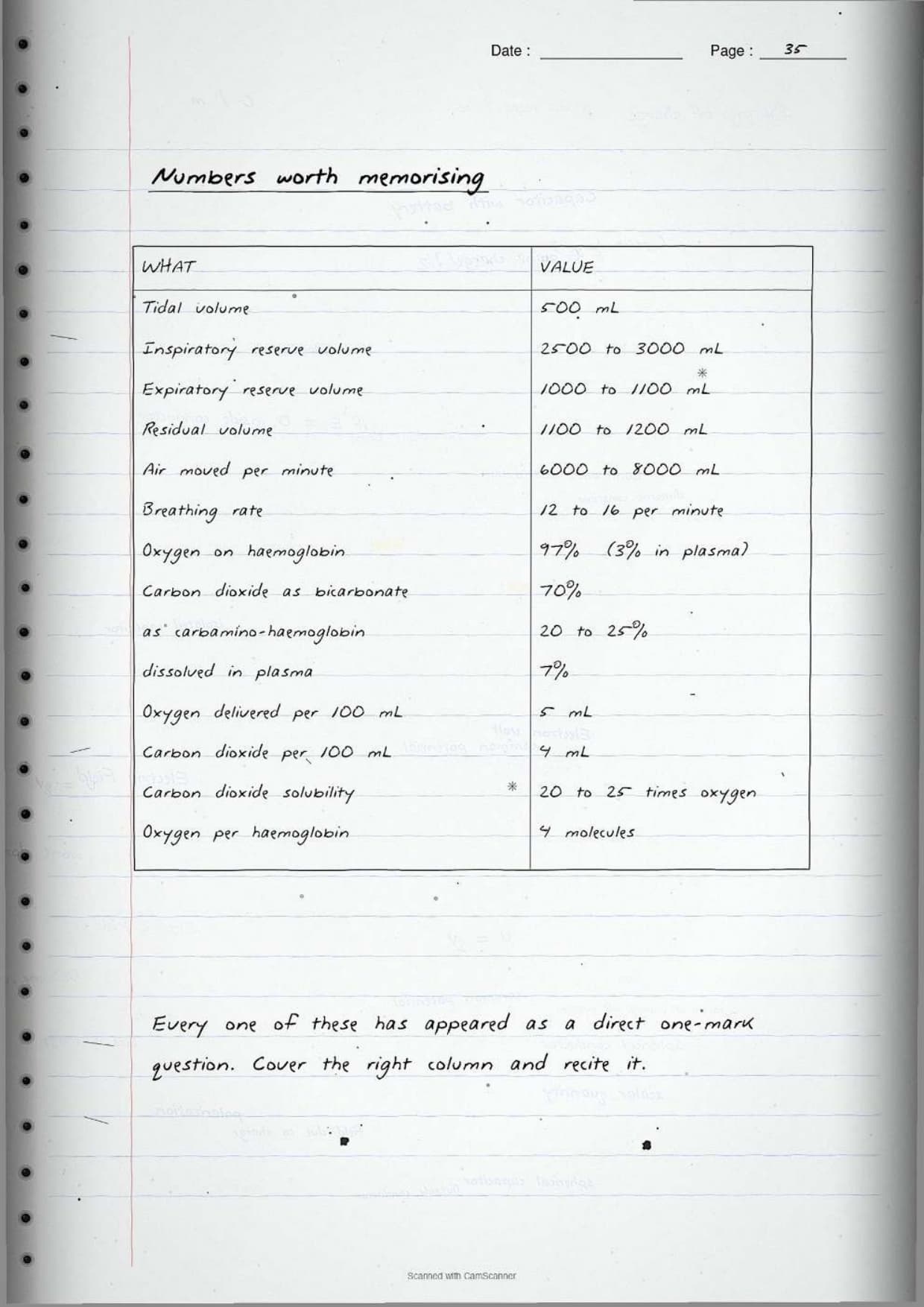
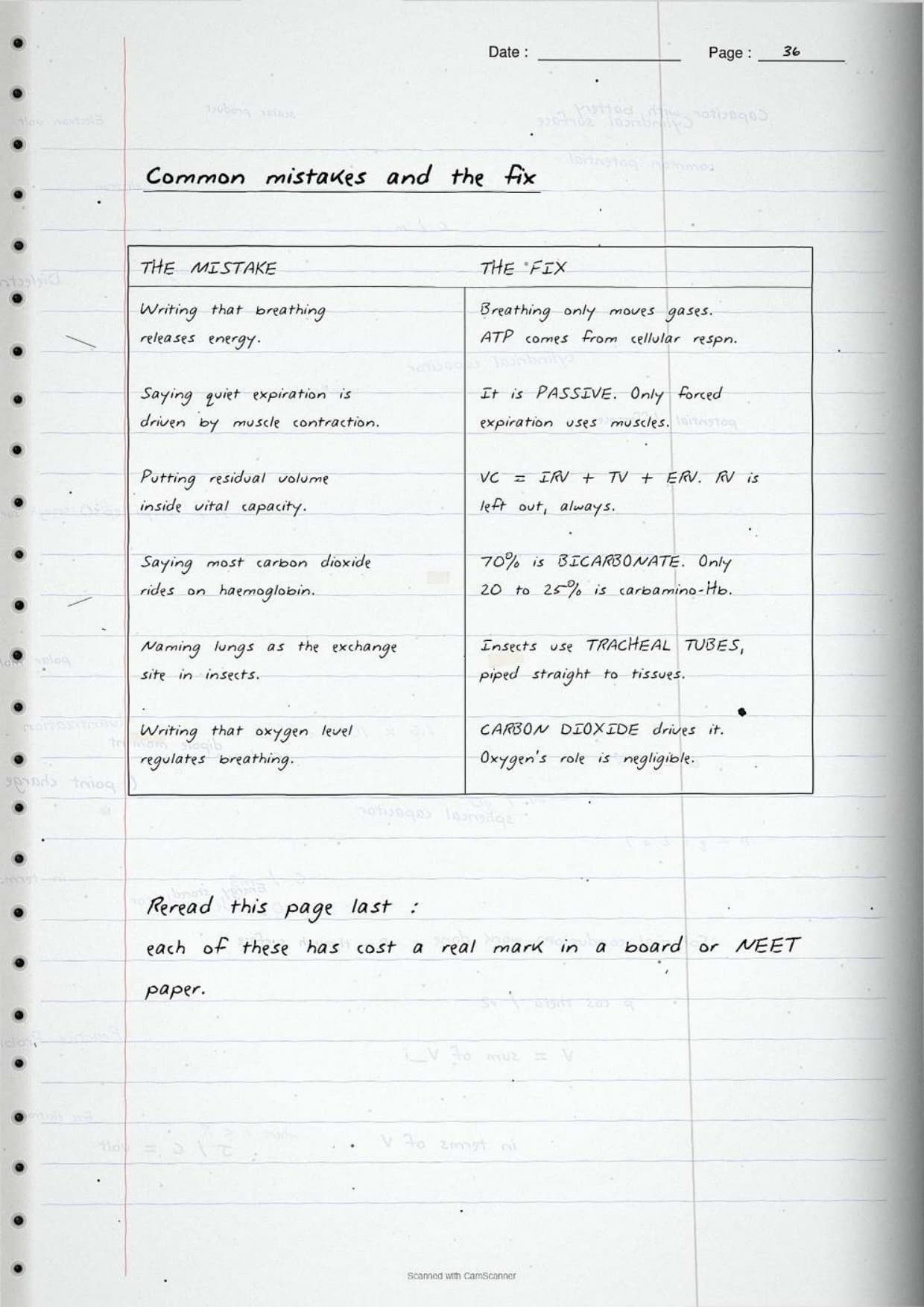
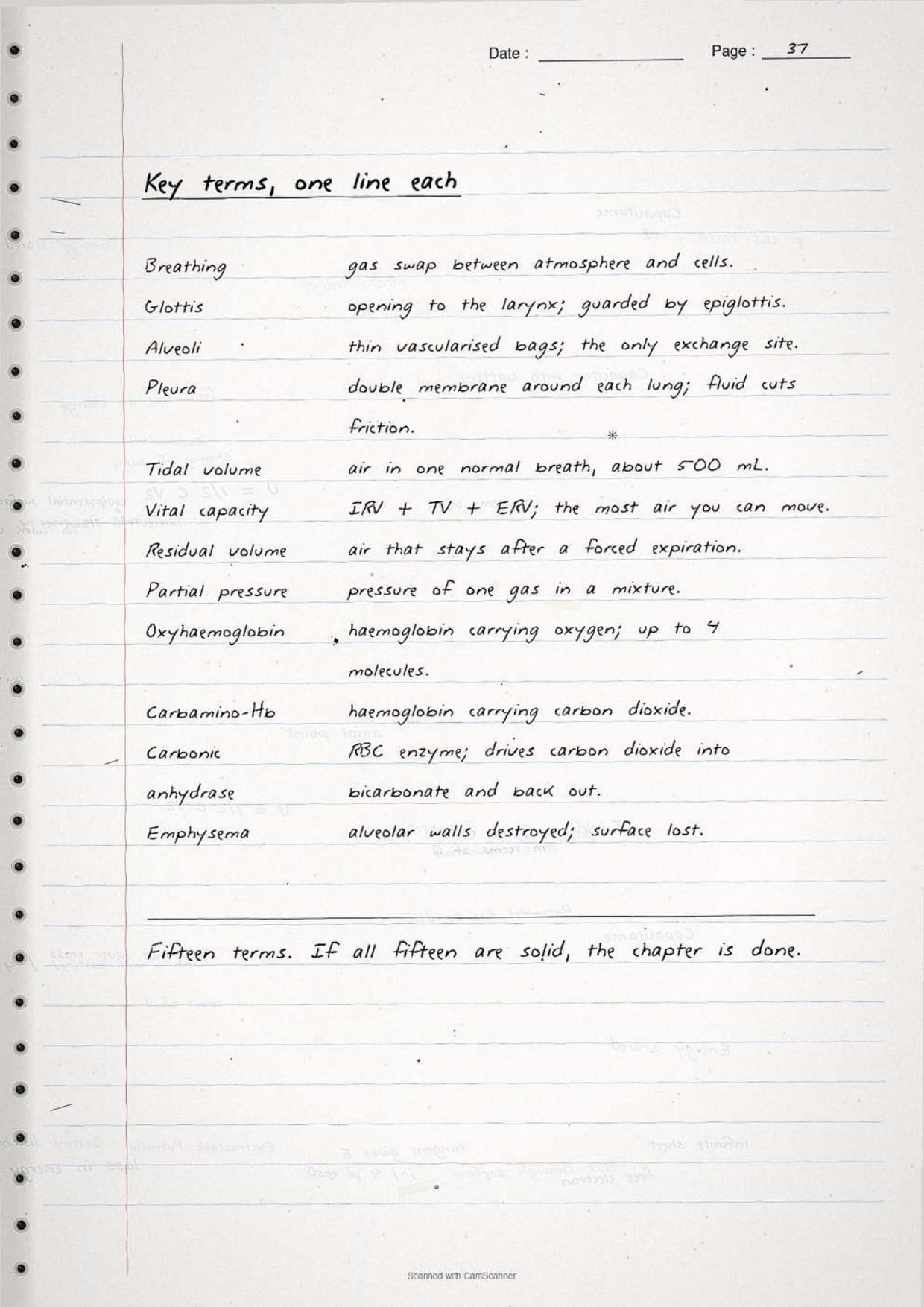
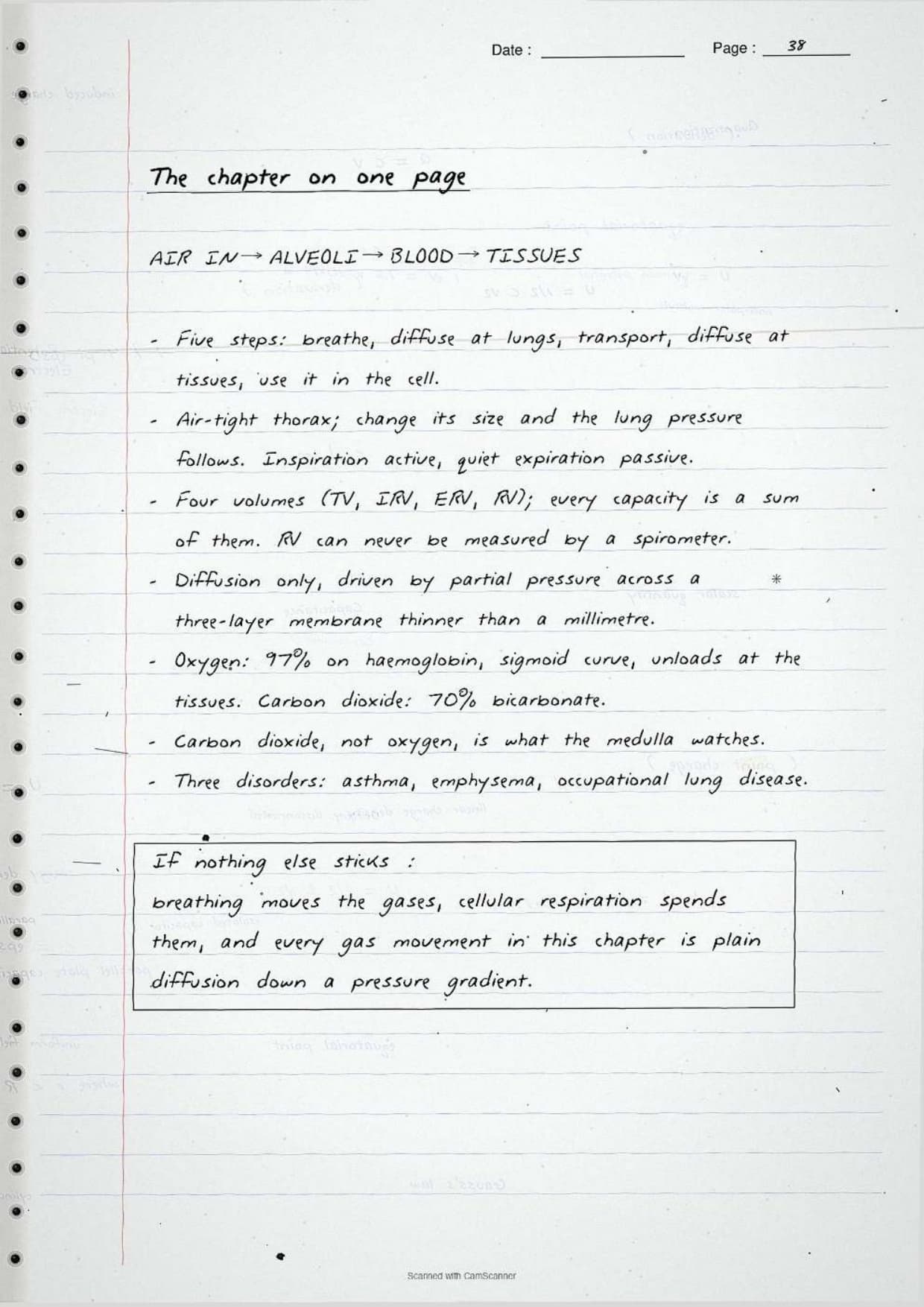
Chapter 14 is a numbers chapter. Two tables carry most of the marks, and both are boxed here in exam wording.
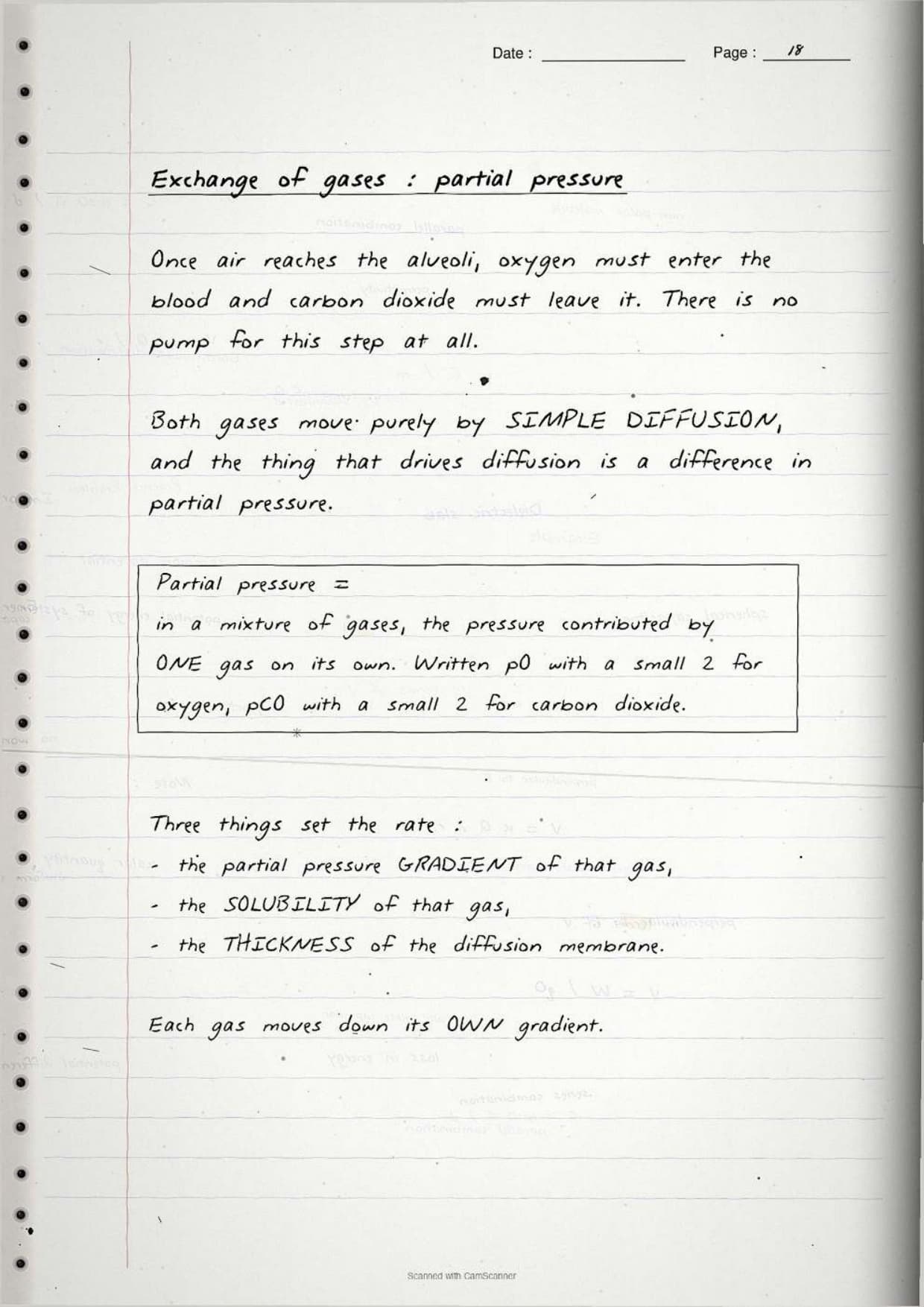
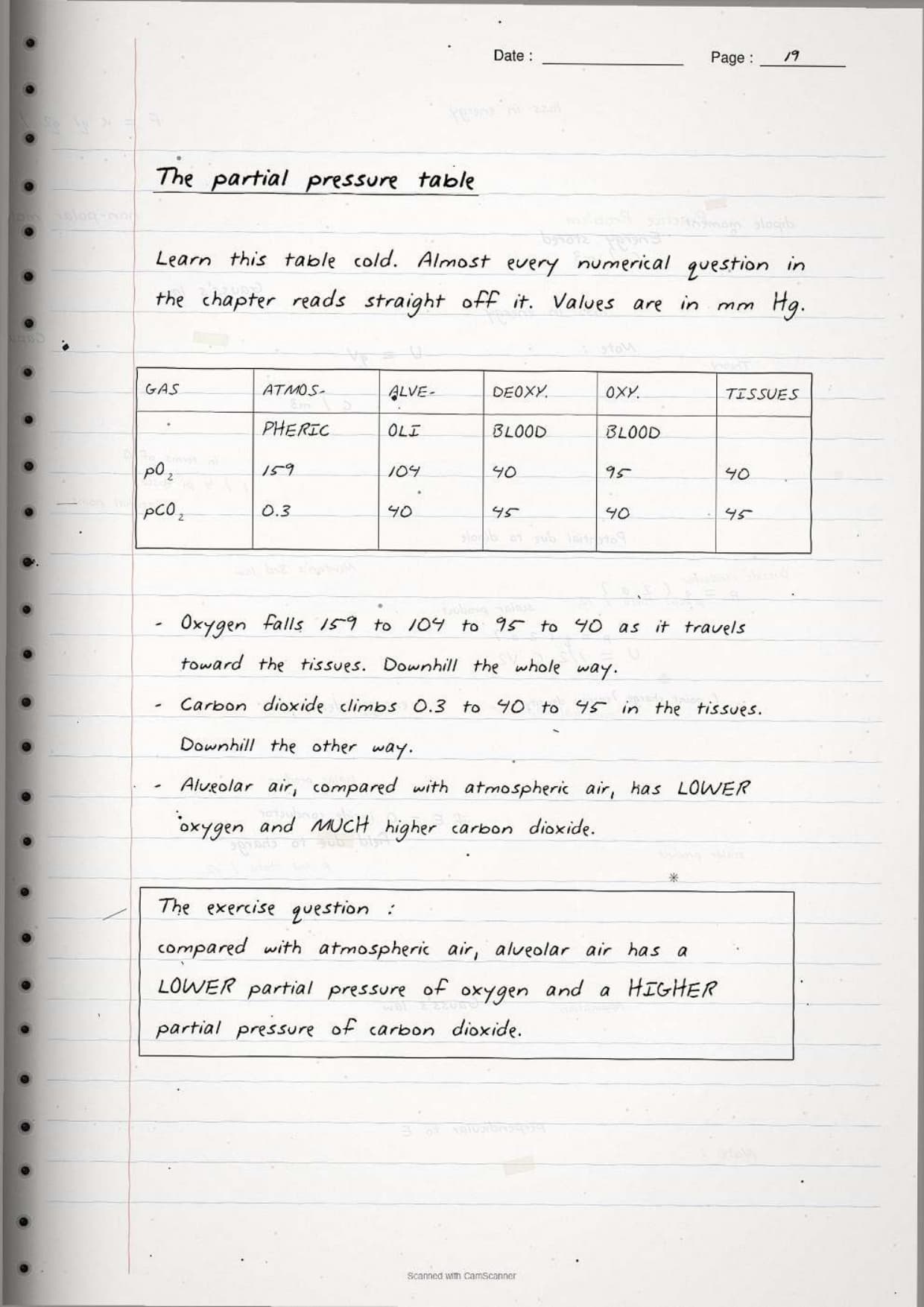
- The full partial pressure table, with pO2 falling 159 to 104 to 95 to 40 mm Hg.
- Hand-drawn stacked bar of TV, IRV, ERV and RV, with every capacity bracketed off it.
- The sigmoid oxygen dissociation curve, drawn twice to show the right shift.
What Breathing and Exchange of Gases Handwritten Notes Cover
The 38 pages follow the NCERT order. Each topic gets its own page, so students revise one idea at a time. New sub-topics are written in red, and every definition and formula sits inside a drawn box.
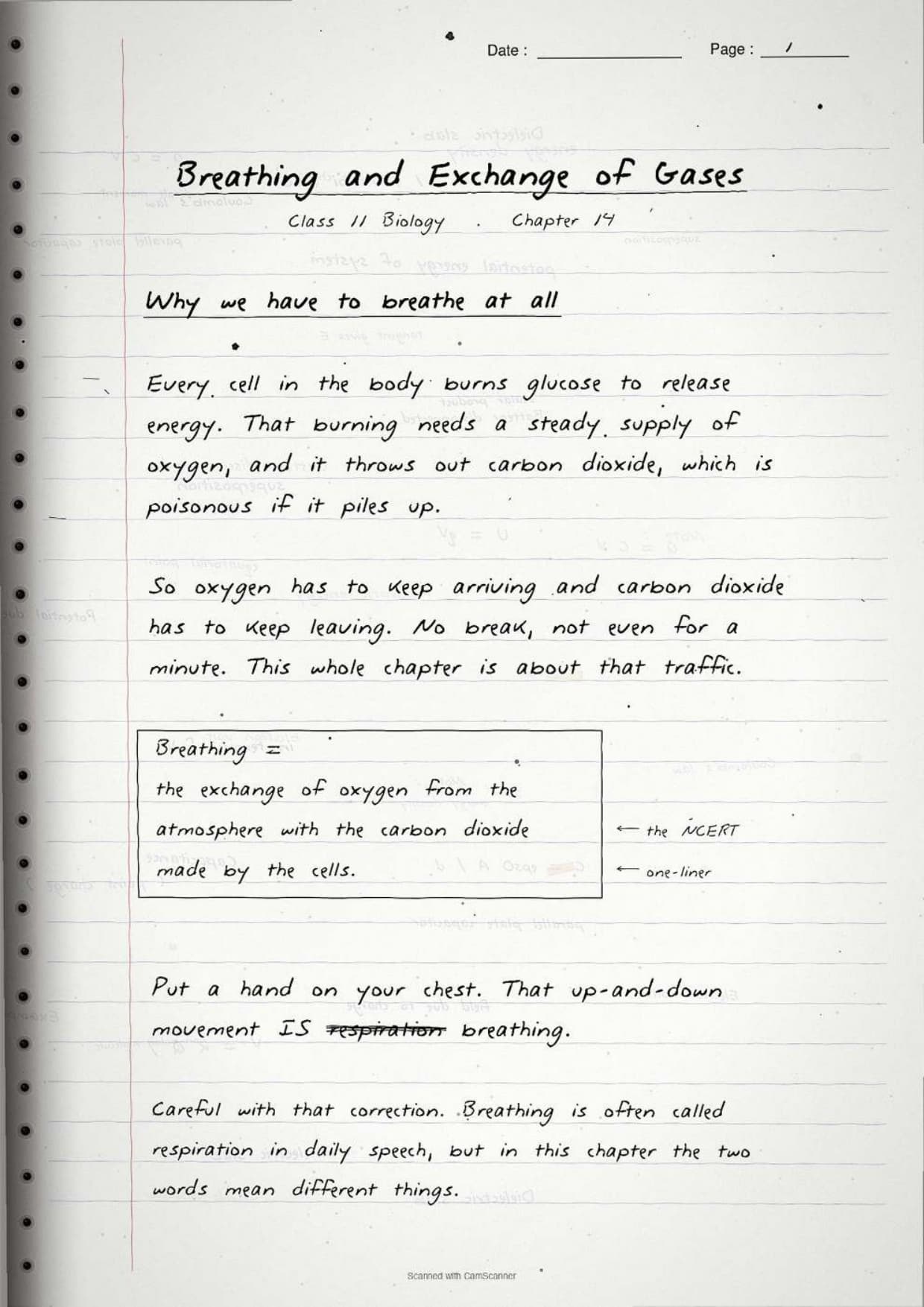
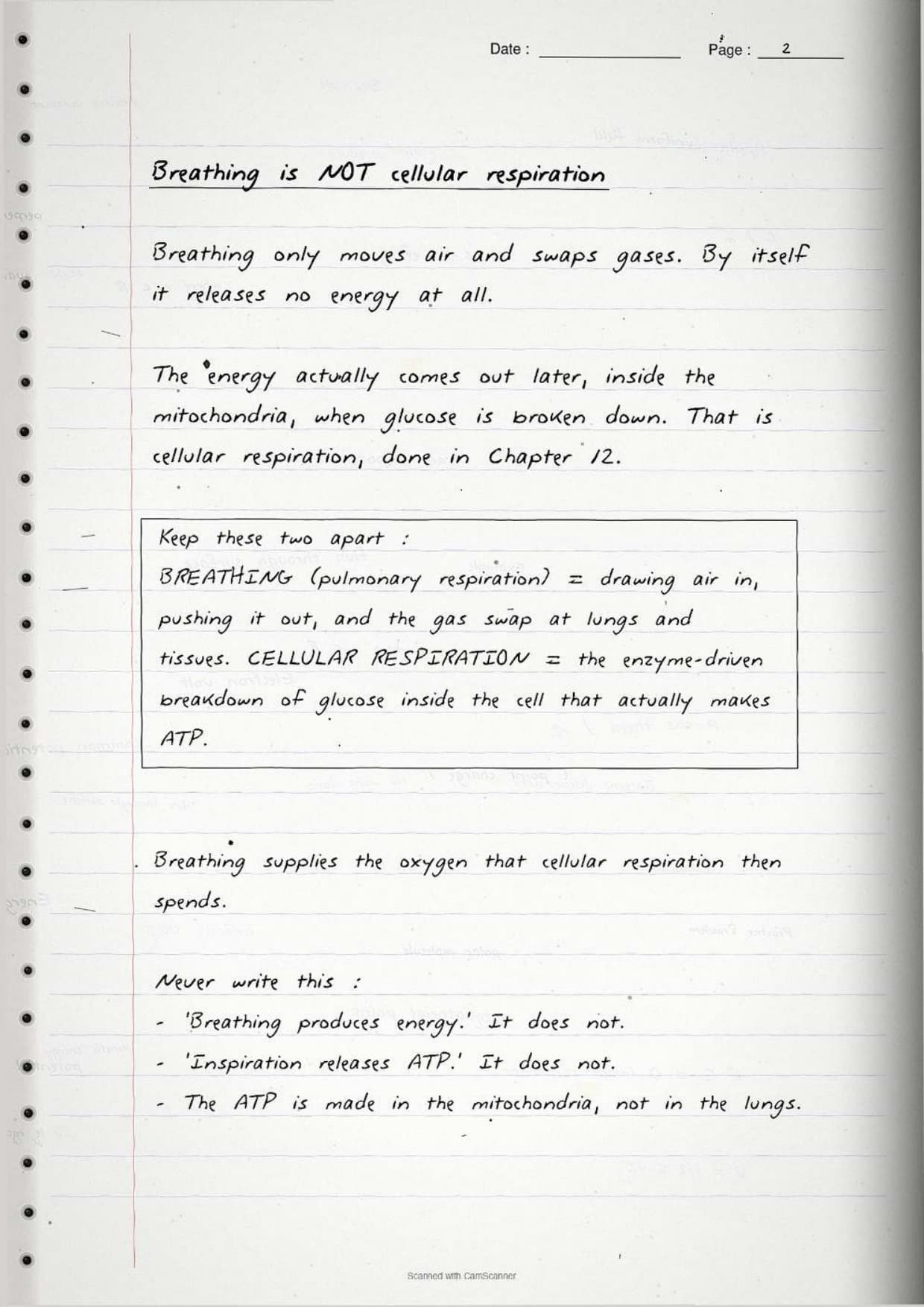
- Breathing against cellular respiration: why breathing alone releases no energy, and where the ATP is actually made.
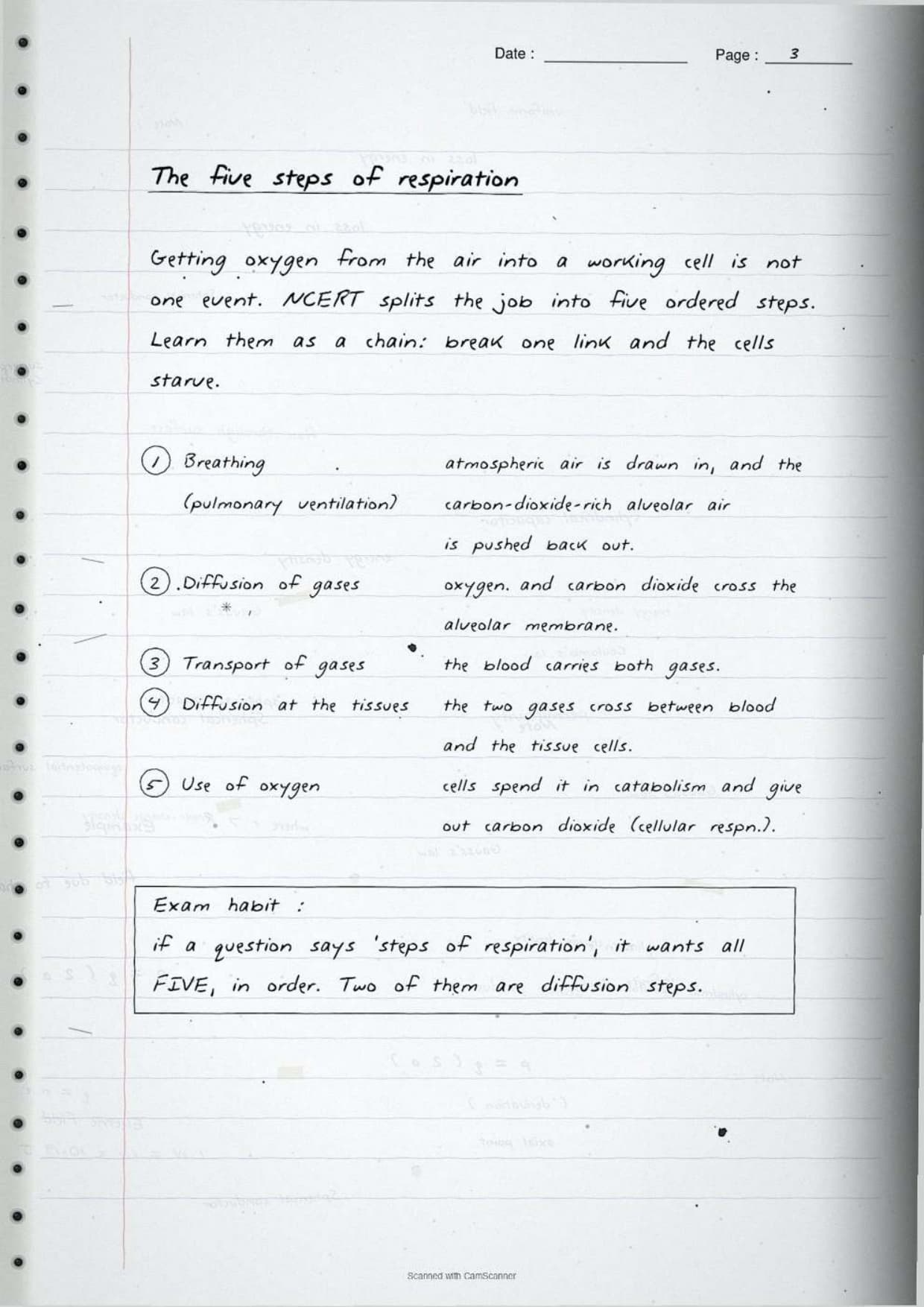
- The five steps of respiration: breathing, diffusion at the lungs, transport, diffusion at the tissues, use of oxygen.
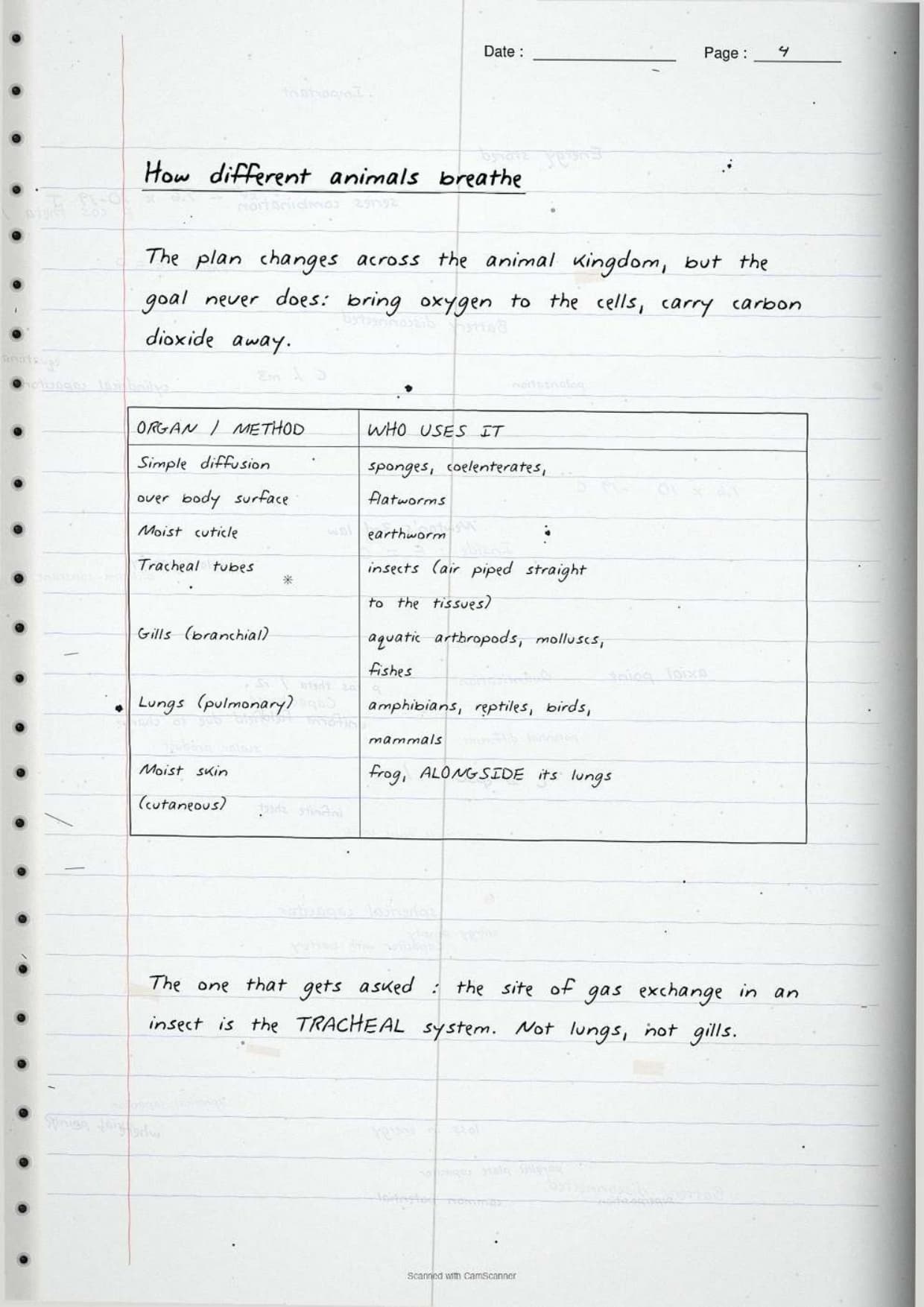
- Respiratory organs: simple diffusion in sponges, moist cuticle in earthworms, tracheal tubes in insects, gills in fishes, lungs in mammals.
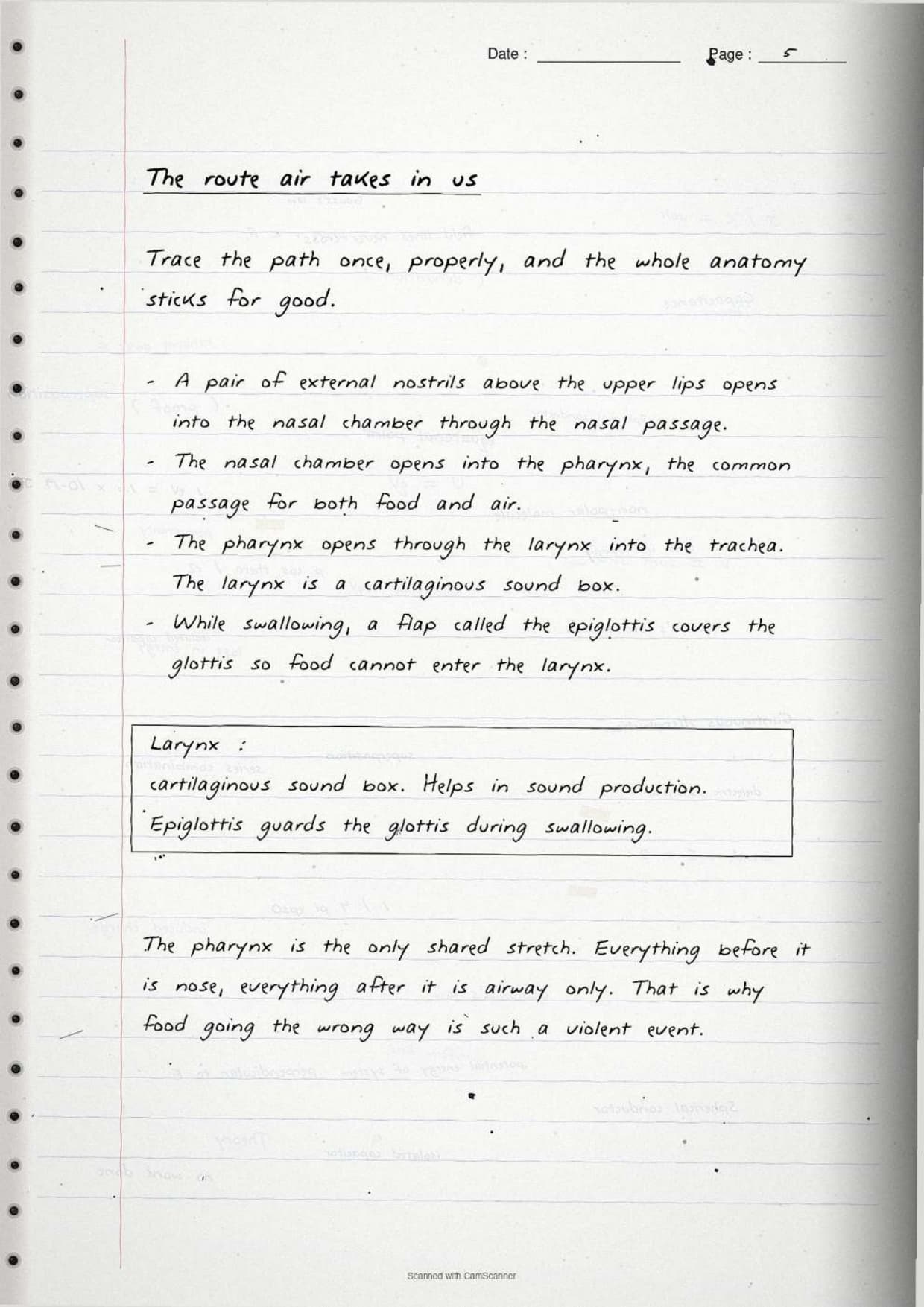
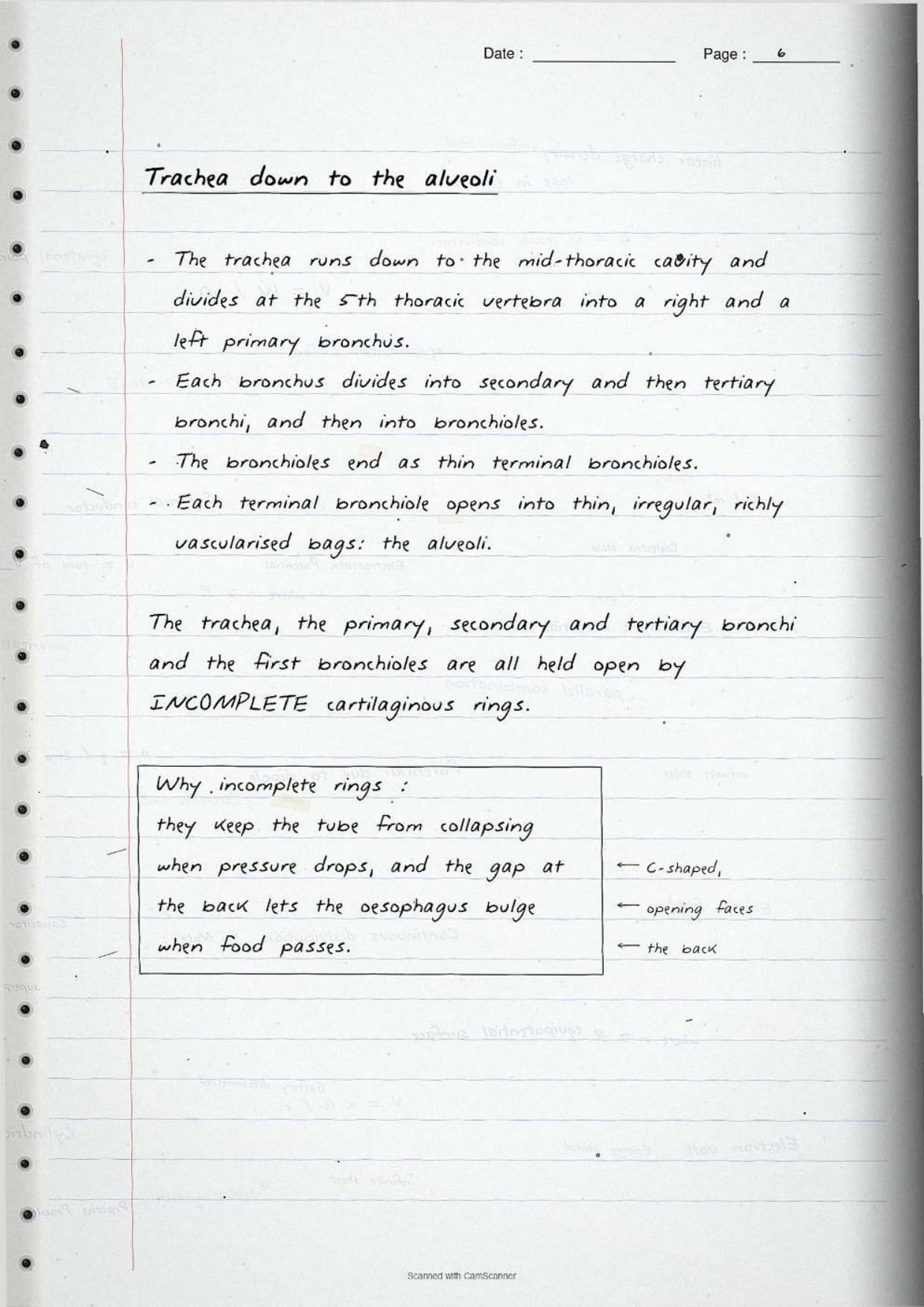
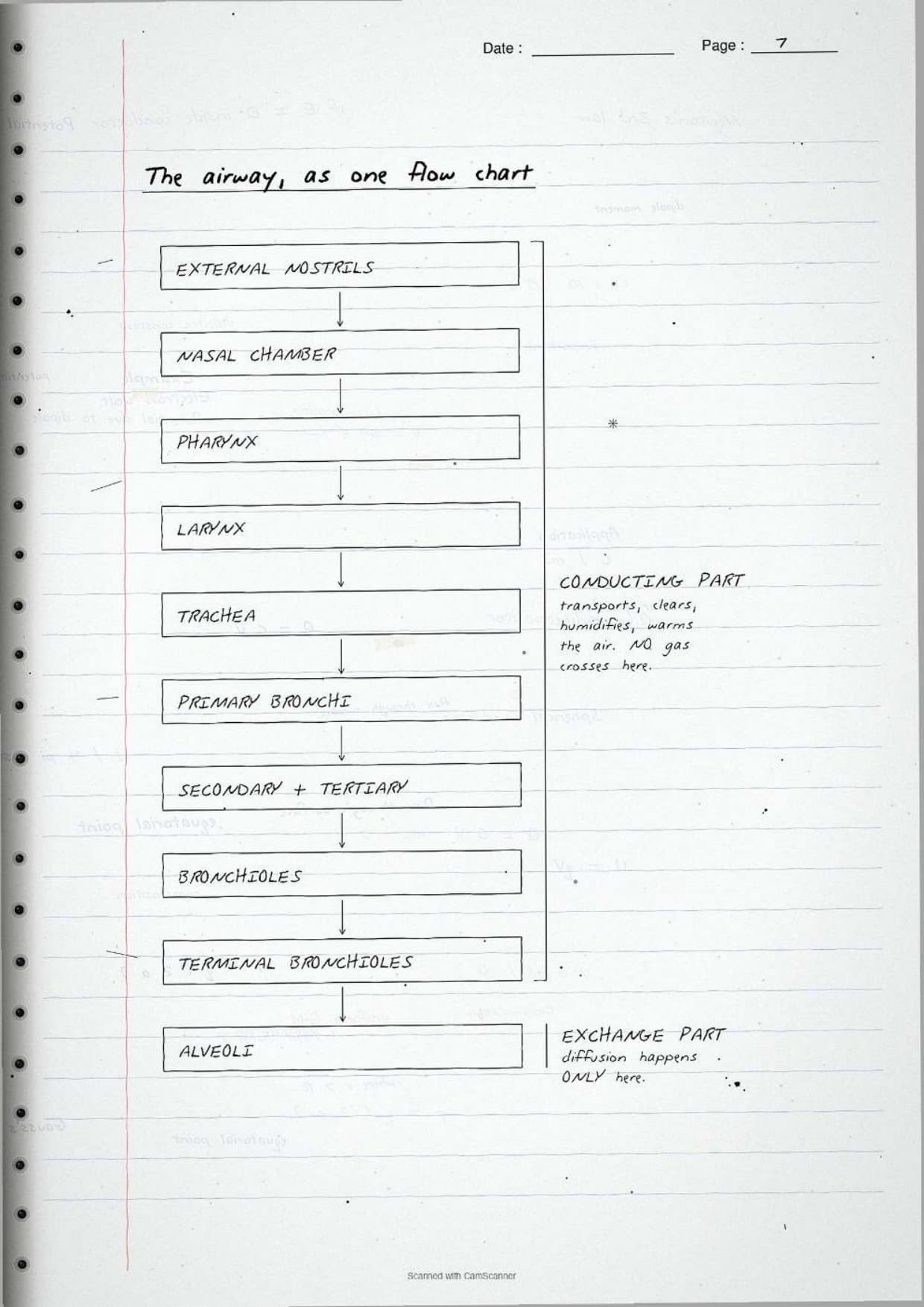
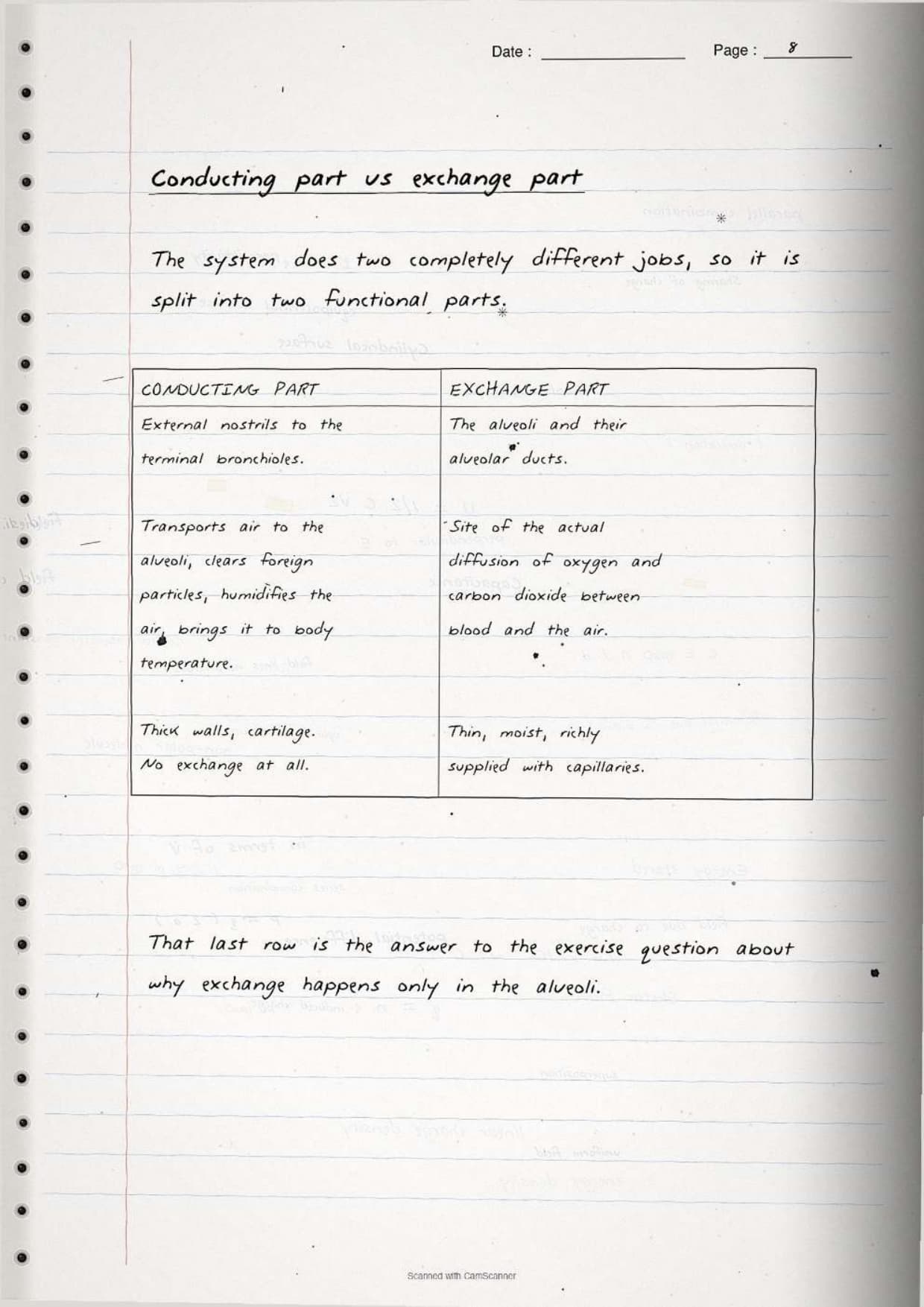
- Human respiratory system: nostrils to alveoli, plus the split between the conducting part and the exchange part.
- Mechanism of breathing: diaphragm and intercostal muscles, and how intra-pulmonary pressure drives air in or out.
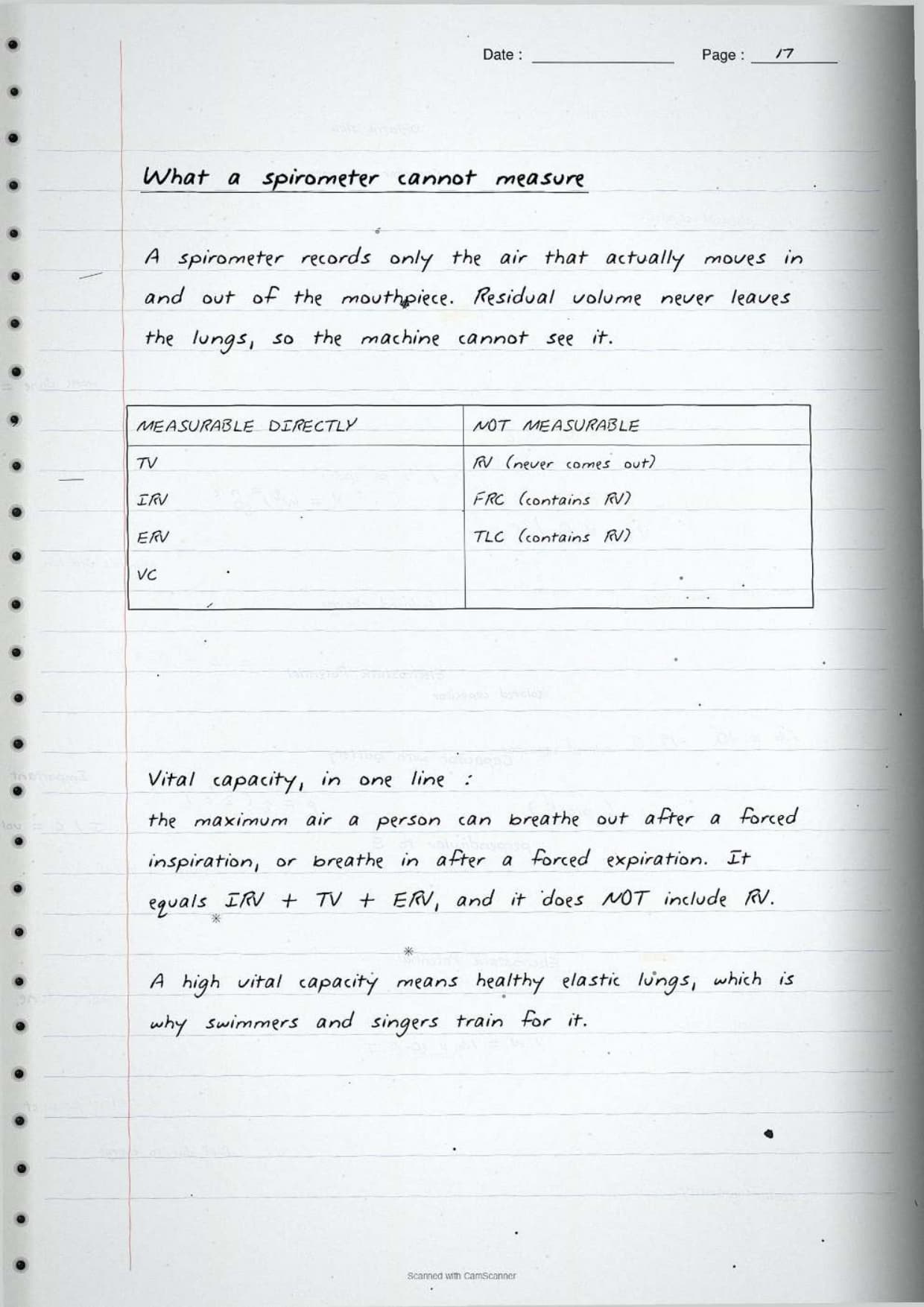
- Volumes and capacities: TV, IRV, ERV, RV, then IC, EC, FRC, VC and TLC as sums.
- Exchange and transport: partial pressures, the diffusion membrane, oxygen on haemoglobin, carbon dioxide as bicarbonate.
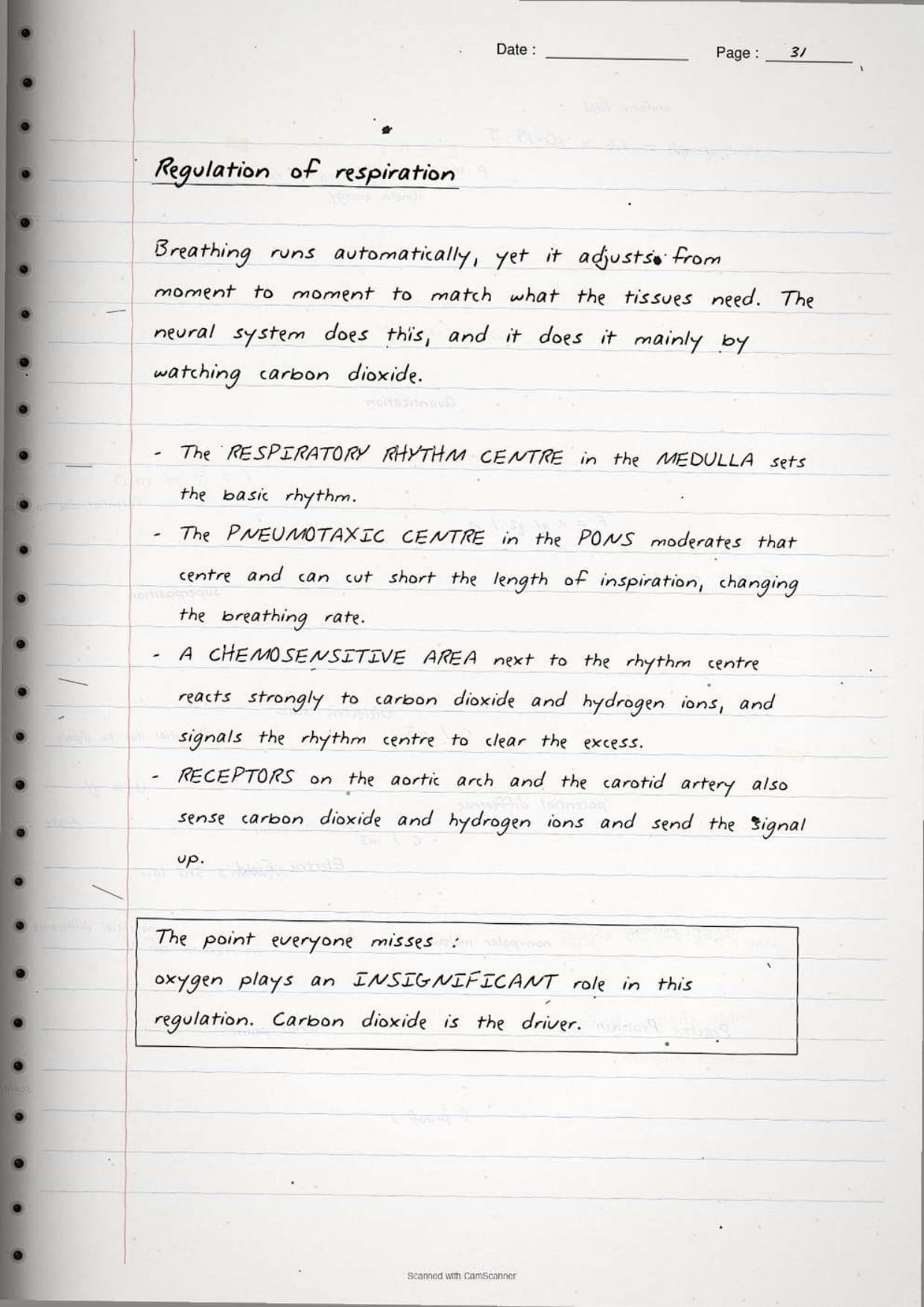
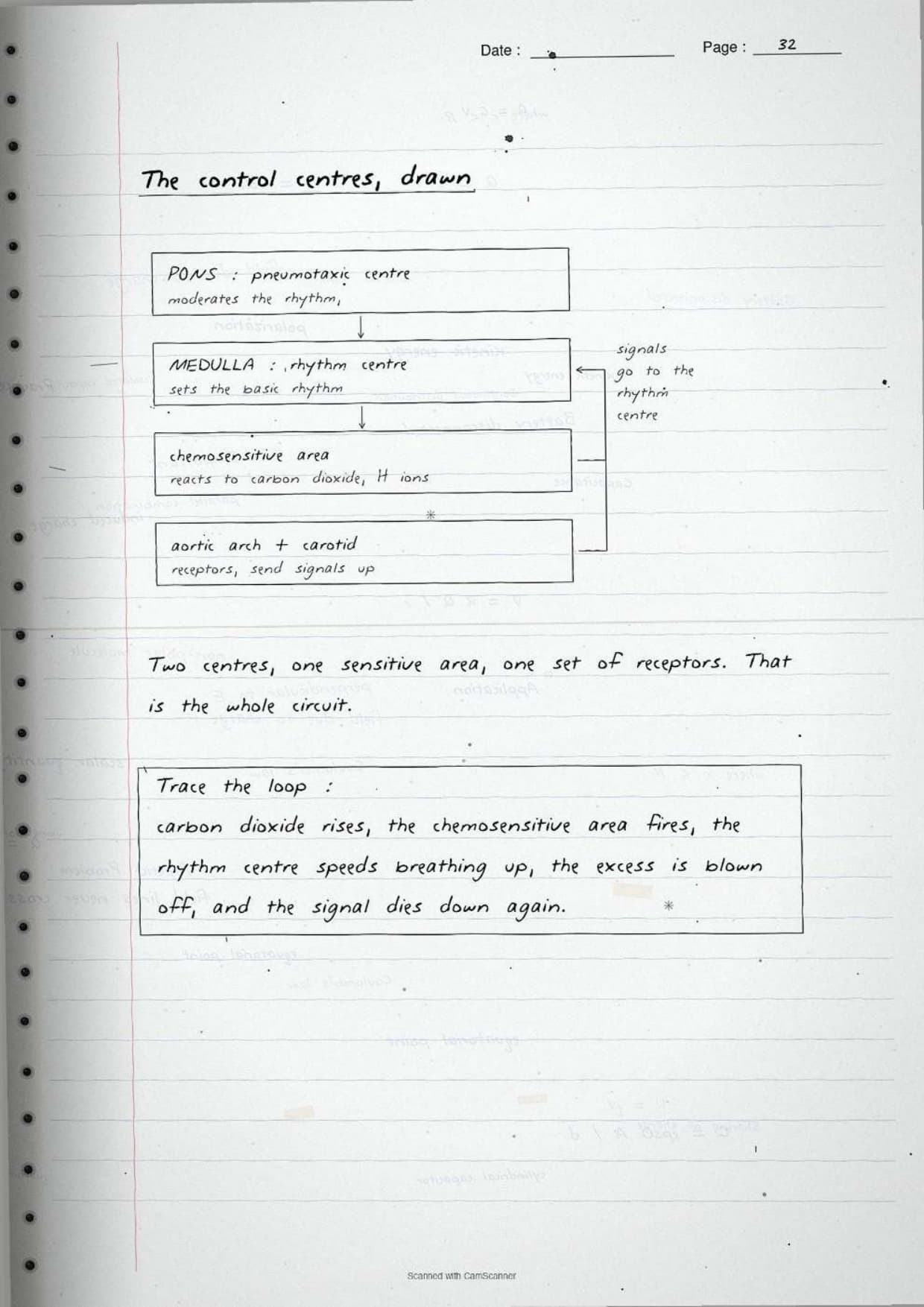
- Regulation and disorders: the medulla, the pneumotaxic centre, then asthma, emphysema and occupational lung disease.
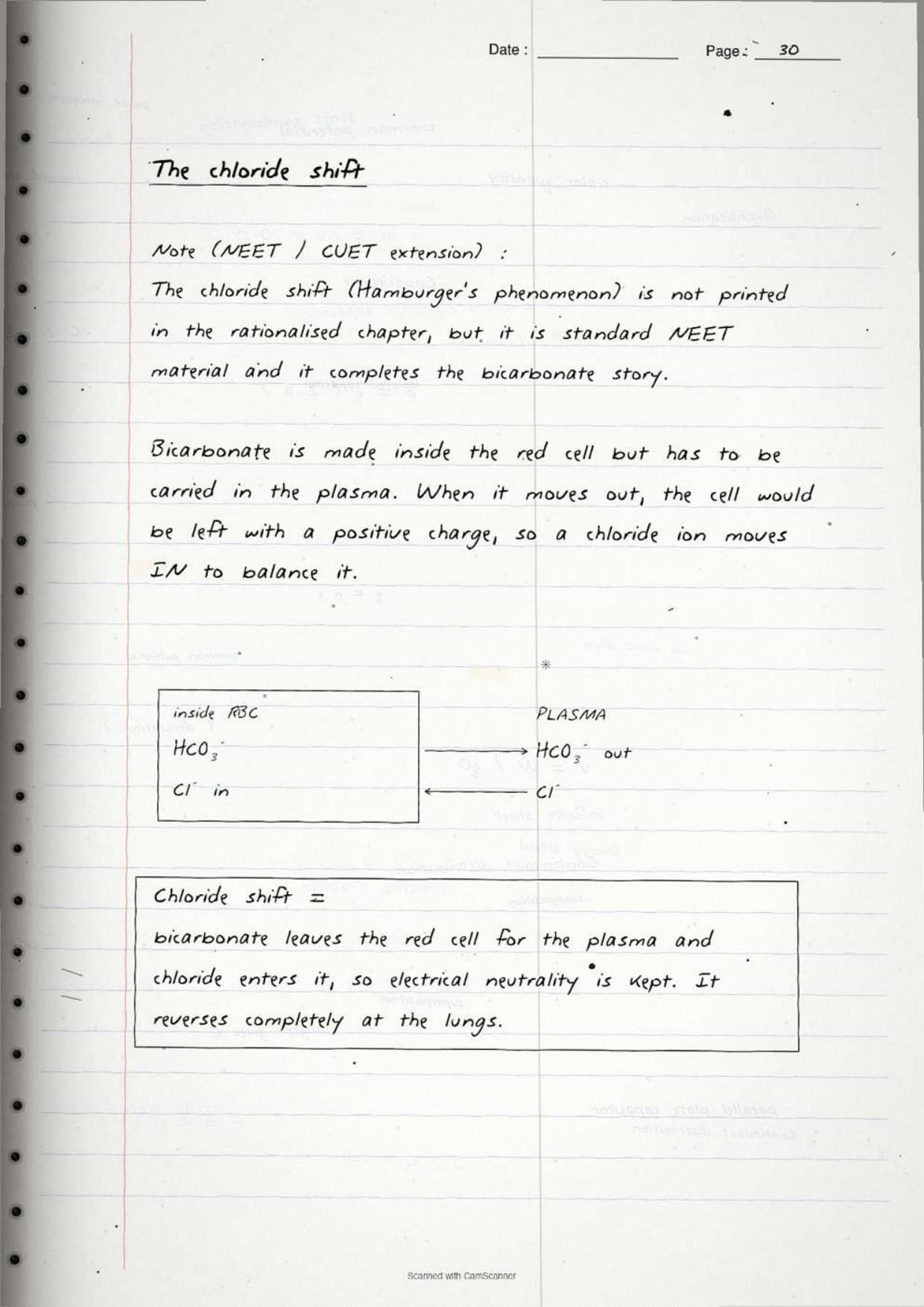
The chloride shift, also called Hamburger's phenomenon, is marked as a NEET and CUET extension because the current 2026-27 NCERT print leaves it out.
Key Diagrams and Terms in Breathing and Exchange of Gases Notes
Most marks here go to values students half remember. The boxed table below is the block examiners test most, because the four volumes look alike on paper.
| Term | How the notes define it |
|---|---|
| Tidal Volume (TV) | Air taken in or given out in one normal breath, about 500 mL |
| Inspiratory Reserve Volume (IRV) | Extra air taken in by a forced breath, 2500 to 3000 mL |
| Expiratory Reserve Volume (ERV) | Extra air pushed out by a forced breath, 1000 to 1100 mL |
| Residual Volume (RV) | Air left in the lungs after a forced breath out, 1100 to 1200 mL |
| Vital Capacity (VC) | IRV plus TV plus ERV, the whole movable column of air |
| Total Lung Capacity (TLC) | VC plus RV, the entire lung including air you can never move |
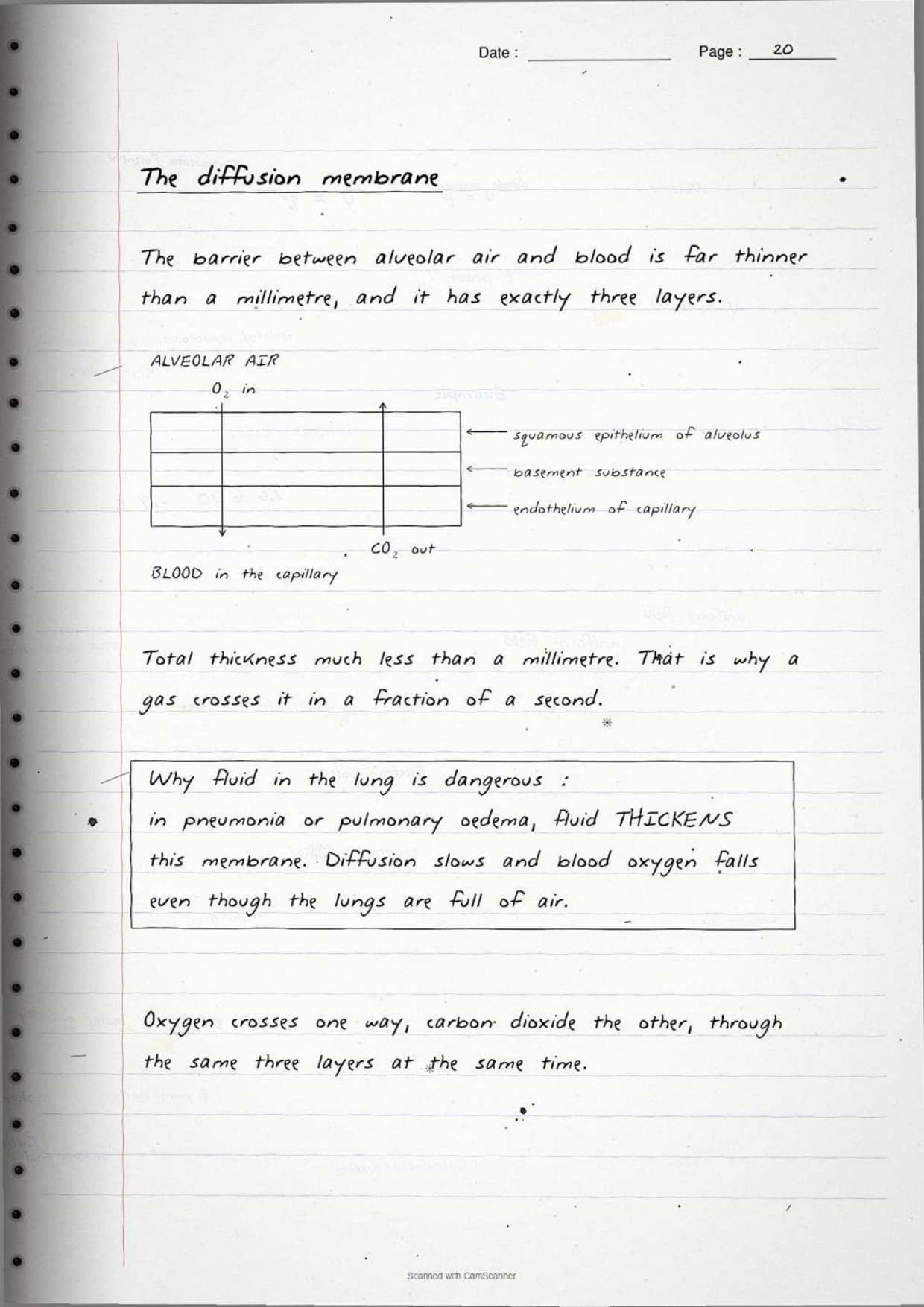
Two sketches carry this chapter. One shows the diaphragm flat for inspiration and domed for expiration, with the arrow labelled air IN or air OUT. The other shows the three layers of the diffusion membrane: alveolar squamous epithelium, basement substance and capillary endothelium.
How to Use These Handwritten Notes for Revision
Work the pages in three short passes. Read a topic page, cover the boxed value and say it back, then answer two NCERT questions on it. This fixes exact figures faster than re-reading the textbook.
- Learn the partial pressure table cold. Almost every numerical in the chapter is read from it.
- Redraw the stacked volume bar from memory and bracket each capacity off it.
- Say the transport split out loud: 97% of oxygen on haemoglobin, 70% of carbon dioxide as bicarbonate.
- Keep the class 11 biology handwritten notes chapter 14 Breathing and Exchange of Gases open beside the NCERT Solutions while practising.
- Read the common-mistakes page last, on page 36, before you shut the file.
Around 45 minutes covers one full pass, so the notes fit into the last week before an exam.
Student Feedback on Breathing and Exchange of Gases Handwritten Notes
Students rate the two data tables as the pages that save the most time. The figures below come from a Collegedunia poll run before the 2026 boards.
- In a Collegedunia survey of 10,860 students, 74% named the partial pressure table their most-used revision page.
- Most-confused pair before the poll: vital capacity against total lung capacity, mixed up by about 4 in 10 students.
Source: 2026-27 Class 11 Biology student poll. Sample of 10,860 students from CBSE schools across 12 states.
Where to Use These Notes Alongside Other Resources
These handwritten pages work best next to the step-wise Solutions, the summary Notes and the Exemplar Solutions for the same chapter. Read the notes first, then check the answers, and keep the Exemplar for extra practice.
| Resource | Best used for |
|---|---|
| Breathing and Exchange of Gases NCERT Solutions | Step-by-step answers to every back-exercise question |
| Breathing and Exchange of Gases Class 11 Notes | Quick chapter summary with all key values in one place |
| Breathing and Exchange of Gases Exemplar Solutions | Exemplar questions solved for NEET-level practice |
| Breathing and Exchange of Gases NCERT Book PDF | The original chapter text and exercises |
All Class 11 Biology Handwritten Notes by Chapter
The table links the handwritten notes for every Class 11 Biology chapter, so students can move across the course in one click. Breathing and Exchange of Gases is highlighted.
| Chapter | Handwritten Notes |
|---|---|
| Chapter 1 | The Living World |
| Chapter 2 | Biological Classification |
| Chapter 3 | Plant Kingdom |
| Chapter 4 | Animal Kingdom |
| Chapter 5 | Morphology of Flowering Plants |
| Chapter 6 | Anatomy of Flowering Plants |
| Chapter 7 | Structural Organisation in Animals |
| Chapter 8 | Cell The Unit of Life |
| Chapter 9 | Biomolecules |
| Chapter 10 | Cell Cycle and Cell Division |
| Chapter 11 | Photosynthesis in Higher Plants |
| Chapter 12 | Respiration in Plants |
| Chapter 13 | Plant Growth and Development |
| Chapter 14 | Breathing and Exchange of Gases |
| Chapter 15 | Body Fluids and Circulation |
| Chapter 16 | Excretory Products and their Elimination |
| Chapter 17 | Locomotion and Movement |
| Chapter 18 | Neural Control and Coordination |
| Chapter 19 | Chemical Coordination and Integration |
FAQs on Breathing and Exchange of Gases Handwritten Notes
Ques. Are these class 11 biology handwritten notes chapter 14 Breathing and Exchange of Gases free to download?
Ans. Yes. The Breathing and Exchange of Gases handwritten notes are free to download as a PDF from this page. All 38 pages follow the 2026-27 NCERT and cover the full chapter in clear handwriting for quick revision.
Ques. What topics do these handwritten notes cover?
Ans. They cover respiratory organs across animals, the human respiratory system, the mechanism of breathing, respiratory volumes and capacities, exchange of gases, transport of oxygen and carbon dioxide, regulation of respiration and the three disorders. Each topic sits on its own page with boxed values and hand-drawn diagrams.
Ques. What is the difference between breathing and cellular respiration?
Ans. Breathing only moves air and swaps gases, so it releases no energy on its own. Cellular respiration is the enzyme-driven breakdown of glucose inside the mitochondria, and that is what makes ATP. The notes box this pair, since writing that breathing produces energy loses a mark.
Ques. Why is residual volume left out of vital capacity?
Ans. Vital capacity is the air a person can actually move, so VC equals IRV plus TV plus ERV. Residual volume stays in the lungs even after a forced breath out and no spirometer can measure it. Only total lung capacity adds it back.
Ques. Are these notes useful for NEET, not just Boards?
Ans. Yes. NEET picks two to three questions a year from this chapter, mostly on partial pressures, the oxygen dissociation curve and carbon dioxide transport. The chloride shift pages are marked as a NEET and CUET extension, since the board syllabus no longer carries that section.



Comments