



Education Content Expert
Barium Sulfate is an inorganic compound made up of Barium cation and Sulphate anion. The chemical formula of Barium Sulfate is BaSO4.
- Barium Sulfate is found as a whitish crystalline solid which is odourless.
- It is soluble in concentrated acid but not in water and alcohol.
- It is widely used for various medical purposes and for producing oil and natural gas.
- Barium Sulfate is produced by mining and processing barite.
- Impurity-containing Barite must be heated with coke to form water-soluble Barium Sulphide, which is then separated from the impurities and allowed to react with sulfuric acid to obtain Barium Sulfate.
Read More: Amorphous and Crystalline Solids
Key Terms: Barium Sulfate, Metals, Acids, Inorganic Compound, Barium, Sulphate, Crystalline Solid, Barite
What is Barium Sulfate?
[Click Here for Sample Questions]
Barium Sulfate is a divalent alkaline metal. It is an inorganic compound having the chemical formula BaSO4.
- BaSO4 is a sulphate salt of barium that can be found in the mineral barite.
- Barium Sulfate is composed of a Barium cation and a Sulphate anion.
- Sulfur is linked to four oxygen atoms.
- It is a white crystalline substance that is soluble in concentrated acids but insoluble in water and alcohol.
- It has no odour.
- It is non-toxic and suitable for medical purposes.
- It is commonly utilised in the oil and gas industries to obtain high-density drilling fluids by keeping boreholes free of rock.
Barium Sulfate Structure
[Click Here for Sample Questions]
Barium Sulfate is chemically written as BaSO4. It possesses 1 barium atom and 4 oxygen atoms to which 1 sulfur atom is attached. The molar mass of BaSO4 is 233.38 g/mol. It is present in the +2-oxidation state.
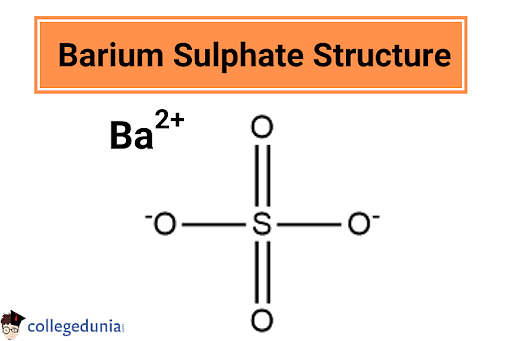
Barium Sulphate Structure
In the above structure, the Barium cation possesses +2 charge whereas the charge on SO4 is -2. It has two valence electrons, hence it’s a divalent metal.
Read More:
| Relevant Concepts | ||
|---|---|---|
| Barium Bromide | Barium Carbonate | Sulphates |
| Barium Iodide | Barium Chloride | Barium Hydroxide |
Barium Sulfate Properties
[Click Here for Sample Questions]
Barium Sulfate is said to be often entirely insoluble in the universal solvent, i.e. water. In addition, it is insoluble in alcohols yet soluble in concentrated acids. It has a strong reaction with aluminium powder. Because of its insolubility non-water and radio-opacity, Barium Sulfate has a wide range of medical and radio imaging uses.
Below mentioned are some of the common properties of Barium Sulfate:
| Properties of Barium Sulfate | |
|---|---|
| Chemical Formula | BaSO4 |
| Molecular Mass | 233.38 g/mol |
| Density | 4.5 g/cm3 |
| Melting Point | 1580 oC |
| Boiling Point | 1600 oC |
| Odour | Odourless |
| Appearance | White Crystalline |
| Crystal Structure | Orthorhombic |
| Flash Point | Noncombustible |
Barium Sulfate Production
[Click Here for Sample Questions]
Barium Sulfate can be produced in two ways as follows:
(I) Barium Sulfate is found in commercial amounts from the mineral barite, after mining and processing. To manufacture impure barite, heat it using coke or also known as carbon to form the water-soluble barium sulfide (BaS), which is then separated from the filths and reacted with sulfuric acid to give the product of pure Barium Sulfate product:
BaSO4 + 4C \(\to\) BaS + 4CO
(II) Pure form of Barium Sulfate can also be obtained by initiating a reaction between barium carbonate or barium chloride with sulphuric acid.
BaS + H2SO4 \(\to\) BaSO4 + H2S
This type of Barium Sulfate is known as blanc fixe, which translates to "permanent white" in French. Blanc fixe barium is the type of barium found in consumer items such as paints.
Barium Sulfate Uses
[Click Here for Sample Questions]
Below mentioned are some of the most common uses of Barium Sulfate:
- Diseases in the oesophagus, intestines or stomach can be diagnosed using Barium Sulfate as it is a radio-opaque agent.
- It is used to coat the inside of the stomach, oesophagus or intestines so that they can be visible on a CT scan or X-ray examination.
- Barium Sulfate is also used in concrete-based radiation shields and oil well drilling fluids.
- It enhances the density of the fluid hence the hydrostatic pressure is also increased and the chances of a blowout are reduced.
- Barium Sulfate is also used in root canal fillings, textiles, adhesives, rubber, paper coatings and catalyst support.
- Barium Sulfate reflects a lot of light, both visible and ultraviolet.
- It is employed as an ingredient in paint that reflects 98.1% of all solar energy, and cooling surfaces where it was applied.
- In vibrational mass damping applications, Barium Sulfate is widely employed as a filler in plastics to improve the density of the polymer.
- The vast majority of synthetic Barium Sulfate is utilised as a white pigment in paints.
- Barium Sulfate is practically transparent in oil paint and is used as a filler or to change the consistency.
Barium Sulfate Suspension
[Click Here for Sample Questions]
Barium Sulfate Suspension is often used in medicine as a radiocontrast specialist for X-ray imaging and other diagnostic procedures.
- It is commonly applied in imaging of the GI tract during what is casually called a "barium meal".
- It is given orally or by bowel purge as a suspension of fine particles in a thick milk-like solution (frequently with sweetening and seasoning agents added).
- Since Barium is a heavy metal and its water-solvent mixtures are normally deadly, the patient is protected from the metal's most destructive actions due to its low dissolvability.
- Similarly to Thorotrast, which it replaced, Barium Sulfate is quickly excreted from the body.
- Because of barium's high nuclear number (Z = 56), its compounds absorb X-rays more clearly than compounds generated from lighter nuclei.
Side Effects of Barium Sulfate
[Click Here for Sample Questions]
Some common side effects of Barium Sulfate are as follows:
- Terrible abdominal pain.
- Constipation, diarrhoea, and severe cramping.
- Ringing in the ears.
- Sweat, dizziness, and an increased heart rate.
- Pale skin, blue skin, and trembling are all symptoms of weakness.
- Mild stomach cramping, nausea, and vomiting.
- Stools that are loose or constipated.
Check More:
Things to Remember
- Barium Sulfate is an alkaline metal widely used in the production of oil and natural gas.
- It is composed of a barium cation and a sulphate anion.
- It is expressed by the chemical formula BaSO4.
- It occurs naturally as the mineral barite, which is a main source of barium and other barium compounds.
- It has poor solubility as it is insoluble in alcohols, and soluble in concentrated acids.
- It reacts vigorously with aluminium powder.
- Barium Sulfate produces a flashy green colour upon burst due to the presence of Barium Nitrate.
Sample Questions
Ques. What is Barium Sulfate? (3 Marks)
Ans. Barium Sulfate is an irnorganic compound with the chemical formula BaSO4.
- This salt is primarily constituted of the mineral barite and is regarded as the commercial emergence of barium.
- Barium Sulfate is insoluble in water however it is the most iconic salt that is insoluble in water that has a composition very close to hydrogen ions and creates more energy than hydrogen.
- It is the most crystalline salt that is widely utilised for the properties of insoluble water.
- The consumption of Barium Sulfate can also trigger excessive perspiration and nausea.
Ques. Mention some of the physical properties of Barium Sulfate. (3 Marks)
Ans. The physical properties of Barium Sulfate are as follows:
- Barium Sulfate is a white or yellowish powdery or small crystal-like substance.
- It has no odour.
- It has a density of 4.49 g/ml and has a 1580 oC temperature as its melting point and 1600 oC as its boiling point.
- It has a rhombic crystal structure.
Ques. Mention some chemical properties of Barium Sulfate. (3 Marks)
Ans. The chemical Properties of Barium Sulfate are as follows:
- Barium Sulfate is insoluble in water and alcohols and is soluble in concentrated acids like sulphuric acid.
- Barium Sulfate is used for various medical purposes and radio imaging since it is insoluble in water and has radio-opaque properties.
- When heated with aluminium, BaSO4 reacts aggressively, and when mixed with potassium, it explodes.
- Barium Sulfate is one of the highly insoluble alkaline earth metals. In the aqueous phase, it does not undergo double decomposition processes like its Mg homologue.
Ques. Is Barium Sulfate a base or an acid? (1 Mark)
Ans. Barium Sulfate is another name for BaSO4. It is neither an acid nor a base. It is a salt. The reaction between acids and bases reaction can result in the formation of salt. In BaSO4 development reaction, Ba2+ comes from the base and SO42- comes from the acid.
Ques. How is Barium Sulfate made? (2 Marks)
Ans. Barium Sulfate, BaSO4, is a translucent white pigment that is produced by combining barium hydroxide and other barium sources with sulfuric acid.
- Depending on the formulation state, particularly the supersaturation of its barium supply.
- It can be created in complex shapes such as planar, starry, or spherical structures, and the interior pore size also fluctuates.
Ques. Why is Barium Sulfate insoluble in water? (5 Marks)
Ans. A compound is soluble when its lattice enthalpy is low-sung and it is decreased more quickly than its hydration enthalpy. Barium Sulfate has high lattice enthalpy which is why it is insoluble in water.
- On dissolving in water, Barium Sulfate’s hydration enthalpy decreases more quickly than its lattice enthalpy. Also, Ba and SO4 are big and bigger hence they will stabilize bigger anions precisely.
- Chemical particle solubility increases as lattice energy decrease and hydration energy consumption increases. Barium Sulfate's solubility is reduced due to solid ionic reduction during hydrogen energy consumption, and chemical reactivity with Barium Sulfate increases the odds of solubility.
- The most essential component of Barium Sulfate is an alkaline and divalent metal, which offers an inorganic compound to this chemical element, resulting in its non-toxic properties.
- Barium Sulfate is insoluble in water due to its poor solubility in water, which is a universal solvent, and its lower lattice energy compared to hydrogen energy production.
Ques. What happens when impure Barite is heated with coke? (1 Mark)
Ans. When impure barite is heated with coke then water-soluble barium sulfide is produced. This barium sulphide is later separated from the impurities and is reacted with sulphuric acid hence producing Barium Sulfate.
Ques. How is Barium Sulfate used in paints? (3 Marks)
Ans. Barium Sulfate is extremely inert, insoluble, and light and heat stable. The mineral 'heavy spar' is obtained in its natural form. It is frequently micronized after being crushed, washed, and dried, lowering the particle size from 25 m to 2-10 m and thereby improving dispersibility.
- The synthetic form is created by combining readily available barium compounds with sulphuric acid or soluble sulphate salts, and it has a finer texture than natural grades, allowing for greater oil absorption.
- It has a greater refractive index (1.64) than other extenders, which provides it with pigmentary qualities. Its high density is especially useful for weight-based paints. It is used to harden the film in primers, undercoats, and industrial finishes.
Ques. What are the risks related to Barium Sulfate consumption? (5 Marks)
Ans. Health risks associated with the consumption of Barium Sulfate are as follows:
- Nausea, vomiting, diarrhoea, and abdominal cramping are all possible side effects. Acute Barium Sulfate exposure can irritate the eyes and respiratory tract.
- Inhalation or other forms of exposure might damage the neurological system and cause hypokalemia, which can contribute to irregular cardiovascular rhythms.
- More severe problems of the administration Can include hypersensitivity, gastrointestinal movement delay, blockage, aspiration pneumonitis, and systemic absorption of Barium Sulfate.
- Intra-abdominal leaking can occur during or after Barium Sulfate administration. Patients with a history of food aspiration and those with confirmed swallowing difficulties should exercise caution.
- Repeated or sustained exposure to dust particles can harm the lungs, leading to baritosis (a type of benign pneumoconiosis).
- Inhalation of Barium Sulfate dust may result in benign pneumoconiosis ("baritosis") with prominent radiographic features but no symptoms of pulmonary function impairment.
Ques. What are some uses of Barium Sulfate? (5 Marks)
Ans. Some uses of Barium Sulfate are:
- Soil testing makes use of Barium Sulfate. Coloured indicators are used in tests for soil pH and other soil properties, and tiny particles (typically clay) from the soil can cloud the test mixture and make it difficult to detect the colour of the indicator. When Barium Sulfate is added to the mixture, it bonds with these particles, making them heavier and causing them to settle to the bottom, resulting in a cleaner solution.
- To prevent molten metal from bonding with the mould in metal casting, the moulds are frequently coated with Barium Sulfate.
- It can also be found in brake linings, acoustic foams, powdered coatings, and root canal filling.
- To boost the reflectiveness of the image, a thin layer of Barium Sulfate called baryta is initially deposited on the base surface of most photographic paper.
- Due to its high melting point and insoluble in water, Barium Sulfate is employed as a release material in the casting of copper anode plates.
Check-Out:



Comments