



Content Writer
Calculus is a branch of mathematics that deals with the study of the “rate of change”. It is applied in solving equations. Calculus is also referred to as infinitesimal calculus or infinite calculus. The two major branches of calculus are differential calculus and integral calculus. Differential calculus is concerned with rates of change and slopes of curves, whereas Integral calculus is the branch dealing with the accumulation of quantities and the areas under and between curves. Using differential calculus, it is possible to determine velocity and acceleration in mechanics from the position function.
Read More: Integration
| Table of Content |
Key Terms: Calculus, Calculus Formula, Differential Calculus, Integral Calculus, Limits, Derivatives, Integration, Differentiation, Function, Integration
What is Calculus Formula?
[Click Here for Sample Questions]
Basic calculus consists of rules and differentiation formulas. This is the method that is used to calculate the derivative of a function. Integration is the method used to calculate the anti-derivative of a function. Calculus formulas describe the rate of change of a function for the given input value using the derivative of a function or differentiation formula. The process of finding the derivative of any given function is called differentiation.
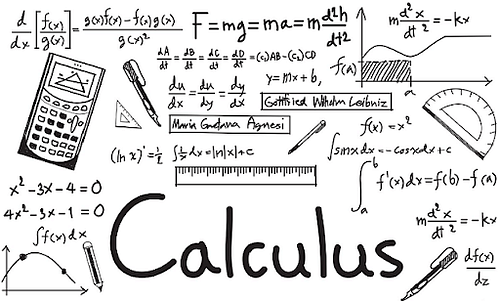
Calculus
Read More: Double Integral
Integrals Detailed Video Explanation
Limits Formula
[Click Here for Previous Year Questions]
Limits of functions at a point are the common and coincidence value of the left and right-handed limits. It is denoted as:
| \(\lim_{x \to a} f(x) = A\) |
This formula means that,
If at a point x = a the function f(x) takes an indeterminate form, then the values of f(x) which is close to a are considered. If the value tends to a definite value as x tends to a, then the value obtained is called the Minit of f(x) at x=a.
- The expected value of the function f(x) shown by the points to the left of point ‘a’ is the left-hand limit of the function at that point. It is denoted as:
| \(\lim_{x \to a_-} f(x) = A\) |
- The point to the right of the point, that is, ‘a’, which generally shows the value of the function is the right-hand limit of the function at that point. It can be denoted as:
| \(\lim_{x \to a_+} f(x) = A\) |
Note: The value of a limit of a function f(x) at a point, that is, f(a) may vary from the value of f(x) at the point ‘a’.
Given below is the list of formulae for calculating limits:
- \(\lim\limits_{x \to 0}\)\(\frac{sinx}{x}\) = \(\lim\limits_{x \to 0}\)\(\frac{tanx}{x}\) = 1
- \(\lim\limits_{x \to 0}\)\(\frac{sin^{-1}x}{x}\)= \(\lim\limits_{x \to 0}\)\(\frac{tan^{-1}x}{x}\)= 1
- \(\lim\limits_{x \to 0}\)\(\frac{1n(1+x)}{x}\)= 1
- \(\lim\limits_{x \to 0}\) \(\frac{a^x -1}{x}\)= 1na
- \(\lim\limits_{x \to 0}\)\(\frac{e^x -1}{x}\)= 1
- \(\lim\limits_{x \to 0}\)\(\frac{x^n - a^n}{(x-a)} = n.a^{n-1}\)
- \(\lim\limits_{x \to 0}\)(1 + x)\(^{\frac{1}{x}}\)= \(\lim\limits_{x \to 0}\)\((1 + \frac{1}{x})^x\)= c
- \(\lim\limits_{x \to 0}\)\(\frac{(1+x)^m -1}{x} = m\)
Read More:
Properties of Limits
[Click Here for Sample Questions]
The following figure summarises the properties of limits used for calculations:
If \(\lim\limits_{x \to a}\) f(x) = m and \(\lim\limits_{x \to a}\) g(x) = n
where ‘m’ and ’n’ are real and finite the
(i) \(\lim\limits_{x \to a}\) [f(x) = g(x)] = \(\lim\limits_{x \to a}\) f(x) = \(\lim\limits_{x \to a}\) g(x) = m ± n
(ii) \(\lim\limits_{x \to a}\) [cf(x)] = c . \(\lim\limits_{x \to a}\) f(x) = c.m
(iii) \(\lim\limits_{x \to a}\) (f(x) . g(x)) = \(\lim\limits_{x \to a}\) f(x) . \(\lim\limits_{x \to a}\) g(x) = m . n
(iv) \(\lim\limits_{x \to a}\)\(\frac{f(x)}{g(x)}\) = \(\frac{ \lim\limits_{x \to a} f(x)}{\lim\limits_{x \to a} g(x)}\) = \(\frac{m}{n}\), provided n ≠ 0
In the figure, f(x), and g(x) are functions, and ‘m’ and ‘n’ is real and finite constants. Properties of multiplication, division, addition or subtraction, and multiplication by a constant are provided above.
Read More: Increasing & Decreasing Functions
Differential Calculus Formula
[Click Here for Previous Year Questions]
Differential calculus can be defined as the study of the definition, properties, and applications of the derivative of a function. The process of finding the derivative is called differentiation. This involves the derivative equation that describes the rate at which a change occurs in a given function. Minimum or maximum values of given functions for optimization problems are one the prominent applications of differential calculus.
Given below is the list of differential calculus formulae that can be used to find the derivation of a function:
- \(\frac{d}{dx}\)xn = nxn-1
- \(\frac{d}{dx}\) (fg) = fg’ + gf’
- \(\frac{d}{dx}\)\((\frac{f}{g}) = \frac{gf'-fg'}{g^2}\)
- \(\frac{d}{dx}\)f(g(x)) = f’ (g(x))g’(x)
- \(\frac{d}{dx}\)(sin x) = cos x
- \(\frac{d}{dx}\)(cos x) = – sin x
- \(\frac{d}{dx}\)(tan x) = sec2x
- \(\frac{d}{dx}\) (cot x) = – csc2x
- \(\frac{d}{dx}\) (sec x) = sec x tan x
- \(\frac{d}{dx}\) (csc x) = – csc x cot x
- \(\frac{d}{dx}\) (ex) = ex
- \(\frac{d}{dx}\)(ax) = ax 1n a
- \(\frac{d}{dx}\) 1n x = \(\frac{1}{x}\)
- \(\frac{d}{dx}\) (arc sin x) = \(\frac{1}{\sqrt{1 - x^2}}\)
- \(\frac{d}{dx}\) (arc tan x) =\(\frac{1}{1 + x^2}\)
Read More: Multivariable Calculus
Integral Calculus Formula
[Click Here for Sample Questions]
Integral Calculus can be defined as the branch of calculus that is concerned with Integrals, the accumulation of quantities, and the areas under and between curves and their properties and their properties.
Given below is a list of Integral Calculus Formulae that can be used to find the integral of a function:
| Function | Formula |
|---|---|
| ∫ xn dx | (xn+1/n+1) + C, where n ≠ -1 |
| ∫ sin x dx | - cos x + C |
| ∫ cos x dx | sin x + C |
| ∫ sec2 x dx | tan x + C |
| ∫ cosec2 x dx | -cot x + C |
| ∫ sec x tan x dx | sec x + C |
| ∫ cosec x cot x dx | -cosec x +C |
| ∫ ex dx | ex + C |
| ∫ 1/x dx | ln x+ C |
| ∫11+x211+x2 dx | tan x +C |
| ∫ ax dx | ln(ax) a + C |
Read More: Properties of Definite Integral
Differential Calculus vs Integral Calculus
[Click Here for Previous Year Questions]
Differential calculus utilizes differentiation to find the derivative of the function whereas integral calculus employs integration to find the integral of the function. Integration is the reverse of differentiation. It is also known as anti-derivative. Some of the differences between differential calculus and integral calculus are tabulated below:
| Differential Calculus | Integral Calculus |
|---|---|
| The instantaneous rate of change of a function is determined in differential calculus using derivatives. | The area under a curve is determined using integral calculus using integrals. |
| Differentiation is the method of dividing complex functions into smaller pieces to monitor changes. | The integration adds up infinitesimal components to determine the total area under a curve. |
| It helps determine whether the function is increasing or decreasing. | It helps determine volume, area, and central point. |
| It is the opposite of integration | It is the opposite of differentiation. |
Read More:
Things to Remember
- Calculus formulae describe the rate of change of a function for the given input value using the derivative of a function or differentiation formula.
- The process of finding the derivative of any given function is known as differentiation.
- Rules and differentiation formulas help to calculate the derivative of a function and integration.
- Calculus is a branch of mathematics that focuses on limits, functions, derivatives, integrals, and mainly infinite series.
- Integration is also known as anti-derivative.
- Integration determines volume, area, and central point.
Previous Year Questions
- The value of sin2 51∘+ sin2 39∘ is… [KCET – 2020]
- If cos x = |sin x| then, the general solution is… [KCET – 2019]
- If 0≤ x< π/2, then the number of values of x… [JEE Main – 2019]
- A vertical lamp-post at the midpoint D… [JEE Main – 2019]
- If tanA+cotA=2, then the value of… [KCET – 2020]
- The value of cos245∘−sin215∘ is… [KCET – 2017]
- A, B and C are the angles opposite to the corresponding sides of lengths… [JKCET – 2017]
- The value of tan 8/π is equal to… [KCET – 2016]
- The value of tan10∘ tan20∘ tan30∘ tan40∘ tan50∘ tan60∘… [COMEDK UGET – 2012]
- A value of θ satisfying sin5θ−sin3θ+sinθ… [KCET – 2011]
Sample Questions
Ques. Solve the Following Definite Integral ∫42 x2 dx : (2 Marks)
Ans. ∫4 2 x2 dx
∫42 x2 dx = [x3/3]42
= 64/3 – 8/3
= 56/3
= 18.66
Ques. What is the instantaneous velocity at time t = π/2 of a particle whose positional equation is represented by s(t) = 12tan(t/2 + π)? (5 Marks)
Ans. The instantaneous velocity is represented by the first derivative of the positional equation.
v(t) = s'(t) = 12 * (1/2) sec2(t/2 + π)
= 6sec2(t/2 + π) = 6/cos2(t/2 + π)
= 6/((–1)2 cos2(t/2)) = 6/cos2(t/2)
Based on the nature of the cosine, know that
6/cos2(t/2 + π) = 6/((–1)2 cos2(t/2)) = 6/cos2(t/2)
v(π/2) = 6/cos2(t/2)
= 6/((1/√2)2)
= 6/(1/2)
= 12
Ques. What is the instantaneous velocity at time t=π/2 of a particle whose positional equation is represented by s(t) = 12cos2(t/2 + π)? (5 Marks)
Ans. The instantaneous velocity is represented by the first derivative of the positional equation. This is found by using the chain rule both on the square of the cosine function and the function itself.
v(t) = s'(t) = 12 * 2 cos(t/2 + π) * (–sin(t/2 + π)) * (1/2)
= –12cos(t/2 + π)sin(t/2 + π)
Given,
cos(t/2 + π) = –cos(t/2) and sin(t/2 + π) = –sin(t/2)
Therefore, v(t) = –12(–sin(t/2))(–cos(t/2)) = –12sin(t/2)cos(t/2)
v(π/2) = –12sin(π/4)cos(π/4)
= –12(1/√2)(1/√2)
= –12 x (1/2)
= –6
Ques. The position s of a particle at time t is given by s(t)=3t2−2t. What is the particle's velocity at time t=3. (1 mark)
Ans. The velocity function is given by the derivative of the position function. So here v=6t−2. Plugging 3 in for t gives 16.
Ques. Find the velocity function if the position function is given as: s(t)=3t2+3t+1. (3 Marks)
Ans. There are three terms in this problem that has to be derived. The derivative of the position function, or the velocity function, represents the slope of the position function.
The derivative of 3x2 can be solved by using the power rule, which is:
2⋅3x(2−1)
Therefore. the derivative of 3x2 is 6x.
The derivative of 3x is 3 by using the constant multiple rules.
The derivative of 1 is 0 since the derivatives of constants are equal to zero.
v(t)=6t+3
Ques. Find the velocity of a function if the acceleration is: a(t)=4t+6. (2 Marks)
Ans. To find the velocity given the acceleration function, we will need to integrate the acceleration function.
∫a(t)dt=∫(4t+6)dt=2t2+6t
Ques. Find the velocity at t=2 if the acceleration function is: a(t)=1. (2 Marks)
Ans. The velocity function can be obtained by integrating the acceleration function.
v(t)=∫a(t)dt=∫1dt=t
Since we are finding the velocity at t=2, substitute this into the velocity function.
v(2)=2
Ques. Find the derivative of x(sin x) using differential calculus. (2 Marks)
Ans. y = x(sin x)
dy / dx = f'(x)g(x) + f(x) g'(x)
f(x) = x, g(x) = sin x
dy / dx = sin x + xcos x
Derivative of x(sin x) is sin x + x(cos x)
Ques. Mention the basic calculus. (1 Mark)
Ans. There are two main branches of calculus. They are Differential Calculus and Integral Calculus.
Ques. What are the applications of differential calculus? (2 Marks)
Ans. Differential calculus has many diverse applications. Differential calculus is used in the majority of quantitative disciplines, including differential geometry, functional analysis, abstract algebra, and complex analysis. Differential calculus is used in biology to analyze the temporal evolution of the population of predators and prey.
For Latest Updates on Upcoming Board Exams, Click Here: https://t.me/class_10_12_board_updates
Check Out:



Comments