



Education Content Expert
Crystallization is a technique that is used for the purification of substances. It is a process that involves the solidification of atoms and molecules into a highly structured form called a crystal.
- It is a process by which the atoms and molecules of a substance arrange themselves into a well-defined three-dimensional lattice.
- It, thus, reduces the overall energy of the system.
- When a substance crystallizes, its atoms or molecules stick to one another through well-defined angles.
Crystallization can be carried out by a physical change, such as a change in temperature, or a chemical change such as acidity. It depends upon the size and shape of the molecules involved along with their chemical properties.
| Table of Content |
Key Terms: Crystallization, Atoms, Molecules, Purification, Solution, Evaporative Crystallization, Cooling Crystallisation
What is Crystallization?
[Click Here for Sample Questions]
Crystallization is a process in which materials solidify from a liquid or solution and precipitate.
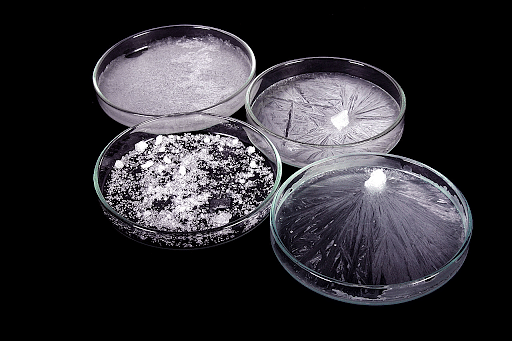
Crystallization
- Crystallization can occur due to both physical and chemical changes.
- The chemical properties, size, and shapes of the molecules affect the process of crystallization.
- It is a technique for purifying chemicals or removing solids from a solution.
- Crystals are made out of one species of an atom, different species of ions, or huge molecules like proteins.
The video below explains this:
Crystallization Detailed Video Explanation:
Read More:
| Relevant Concepts | ||
|---|---|---|
| Classification of Crystalline Solids | Amorphous and Crystalline Solids | Supersaturated Solution |
| Crystal Lattices and Unit Cells | Surface Chemistry | Imperfections in Solids |
Crystallisation Process
[Click Here for Previous Year Questions]
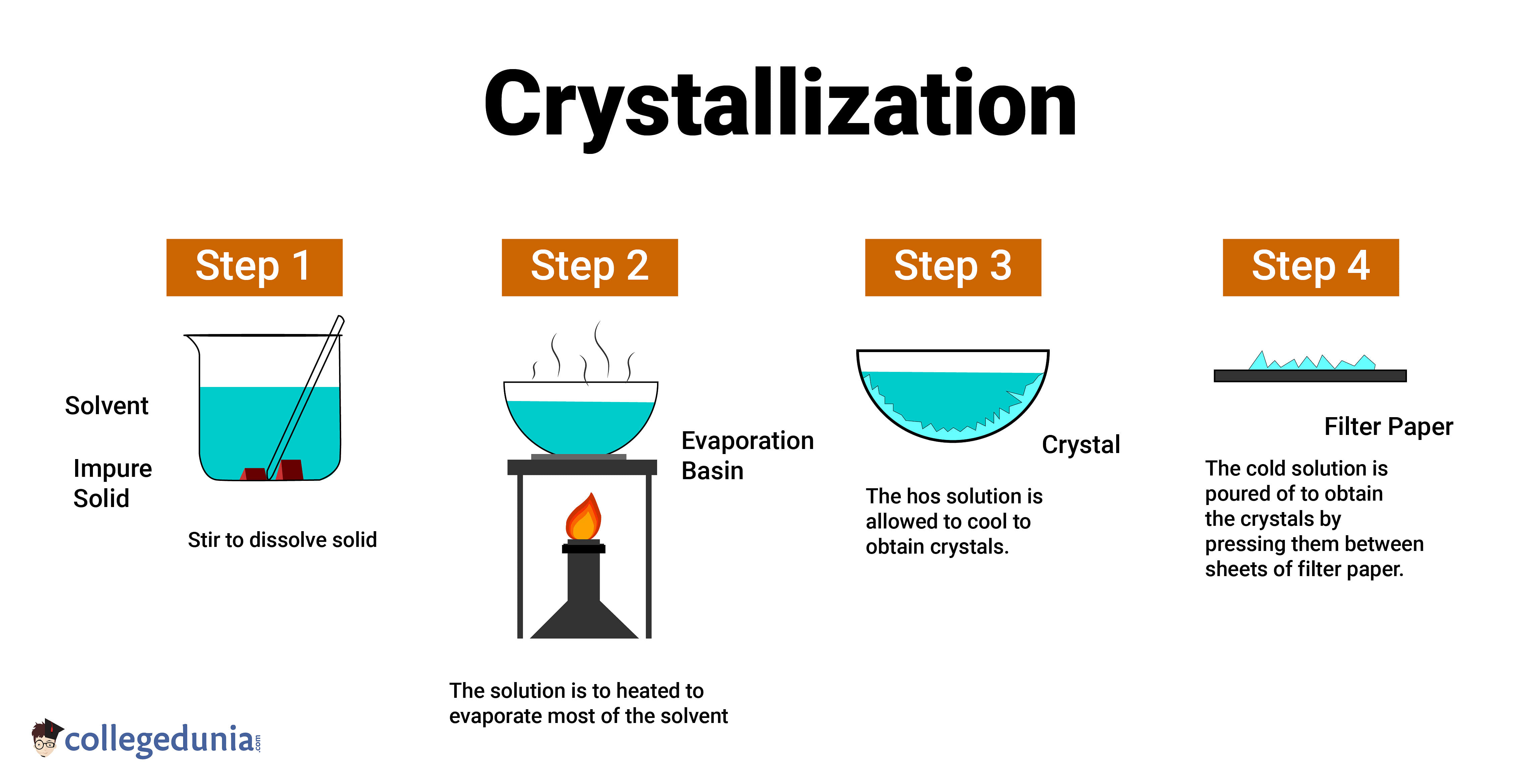
Crsyatllization is a purification technique that involves the following steps:
- The solution is first heated in an open container.
- The solutes are left behind as the solvent molecules begin to evaporate.
- As the solution cools, crystals of the solute start to form on its surface.
- The collection and drying of crystals take place in accordance with the material requirements.
- Undissolved particles in the liquid are removed using filtration.
- The size of the crystals formed during this process depends on the speed of cooling.
- Rapid cooling of the solution will cause a large number of tiny crystals to form.
- Slow cooling rates lead to the formation of large crystals.
Crystallization Process
Crystallisation Types
[Click Here for Sample Questions]
There are three different types of crystallization, and each type is determined by how crystals are formed.
Crystallization is categorized into three major types:
Evaporative Crystallization
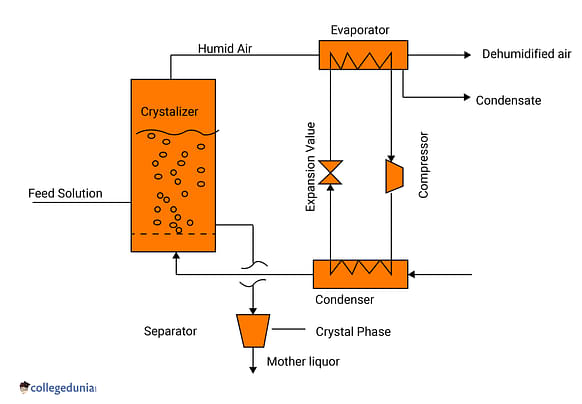
Evaporative Crystallization is the process of extracting crystallization from the evaporation of the solvent. In this type of crystallization, the solvent, and soluble components are present in a solution that is heated to produce crystals. It is one of the most popular techniques for crystallizing inorganic salts, sucrose, and other substances.
- The equilibrium product concentration will still be present in the main liquid.
- By recycling the primary liquid, the remaining product can be collected.
- The contaminants may prevent the main liquid from recycling.
- At some point, the impurity concentration will increase to the point where it can affect the product's purity or crystallization.
- The residual liquid must then be released by a purge stream because the main liquid stream can no longer be regenerated.
Evaporative Crystallization
Cooling Crystallization
In this type of crystallization, the liquid that needs to solidify is cooled to a temperature that is below its equilibrium solubility. Typically, as the temperature rises, a liquid's solubility rises as well. As a result, it crystallizes when chilled to a temperature below the solubility of equilibrium.
- The product is cooled in a heat exchanger, which may be included within the crystallizer or a separate loop.
- Although the heat exchanger can be built within the crystallizer in the form of cooling tubes or plates, the wall of the crystallizer can also be used as an internal heat exchanger.
- When the liquid is cooled to a temperature below the equilibrium solubility, crystallization can continue.
- The heat exchanger's bottom has the lowest temperature in the system, which will cause encrustation.
Reactive Crystallization/Precipitation
- In this type of crystallization, a solute is generated when its reactants react and transform into crystals.
- Due to the rapid reaction, this crystallization process is quicker than any other type of crystallization.
Nucleation
[Click Here for Previous Year Questions]
Nucleation is the first stage of the crystallization process. More atoms cluster around the nucleus, which forms when the first atom in the mass crystallizes. More unit cells gather around the nucleus during this step, creating a tiny seed crystal.
- Since a crystal's nucleus determines the structure of the entire crystal, the nucleation process is crucial to crystallization.
- Extreme rearrangements can result from flaws in the nucleus and the seed crystal as the crystal grows.
- In a supercooled liquid or a supersaturated solvent, nucleation takes place.
- A liquid that is nearly solid is referred to as a supercooled liquid.
- The transformation of the liquid into the solid requires the formation of an initial nucleus.
- The crystallization process will proceed everywhere around this nucleus.
- When atoms or molecules in a cooling liquid no longer have the kinetic energy to bounce off one another, the nucleus will form.
- Instead, they begin to interact and create solid crystal formations.
- Larger molecules may be challenging to crystallize at standard temperature and pressure, in contrast to pure elements, which essentially form a crystal structure.
- The solvent that carries the desired crystal is at its maximum storage level in a supersaturated solution.
- The solubility of the atoms or molecules in the solutions changes when the temperature cools or the acidity changes, and the solvent can carry less of them.
- As a result, they stumble and collide with one another and leading to nucleation.
Separating Substances in Crystallization
[Click Here for Sample Questions]
Crystallization can be understood with the help of the given activity:
- Step 1: Fill a beaker with 50 ml of water.
- Step 2: Add sugar and whisk the mixture.
- Step 3: Now warm the mixture
- Step 4: Continue the process without stopping.
- Step 5: After a while, the amount of sugar that can dissolve in water will run out. The solution is referred to as a saturated solution at this point, which is the saturation point.
- Step 6: Using filter paper, filter the sugar at this point.
- Step 7: Gather the filtrate and chill it in a glass basin.
- Step 8: In the basin, we'll see that some tiny crystals are forming.
- Step 9: These crystals can be separated by the filtration procedure. Mother Liquor are the liquid that remains after crystals are removed.
Crystallization Examples
[Click Here for Previous Year Questions]
"Water of Crystallisation" refers to the constant number of water molecules that make up one salt formula unit. For instance, the chemical name for hydrated copper sulphate is CuSO4.5H2O. With the help of 5 molecules of water, copper sulphate goes through the process of crystallization.
- The most practical application of crystallisation is the production of salt, which is also the most economical method.
- The method can also be used for crystal production and compound purification.
- An alternative definition of water of crystallisation would be the water molecules that make up a crystal.
- They create and cause crystals to form.
- Copper sulphate, often known as CuSO4.5H2O is a topical antibacterial and antifungal agent.
Applications of Crystallization
[Click Here for Sample Questions]
The important applications of crystallization are as follows:
- It is used for the separation of Alum Crystals from Impure Samples.
- Crystallisation is used as a separation and purification method in the pharmaceutical industry.
- It is used for the synthesis and isolation of co-crystals, pure active pharmaceutical ingredients (API), controlled release pulmonary drug delivery, and the separation of chiral isomers.
- Purification of seawater.
Things to Remember
- Crystallization is the transformation of a liquid, solution, or gas to a crystal.
- A crystal is a solid with a well-defined internal arrangement of molecules, ions, or atoms.
- Evaporative Crystallization, Cooling Crystallization, and Reactive Crystallization are the types of crystallization.
- Water of Crystallization is the number of water molecules that are present inside crystals.
- Crystallization is used for seawater purification, purification of alum crystals, separation and purification of co-crystals, etc.
Check More:
Previous Year Questions
- A compound formed by elements X and Y crystallizes in the cubic… (WBJEE - 2018)
- Potassium crystallizes with a…
- A given metal crystallizes out with a cubic structure having edge length… (NEET)
- Sodium crystallizes in bcc arrangement with the interfacial… (AIIMS - 2009)
- Schottky defect in crystals is observed when… (COMEDK UGET - 2014)
- Which type of crystals contains more than one Bravais lattice… (UP CPMT - 2014)
- Crystals can be classified into basic crystal habits equal to… (MU OET - 2010)
- In crystals of which of the following ionic compounds would… (NEET - 1998)
- Monoclinic crystal has dimension… (JIPMER - 2015)
- Most crystals show good cleavage because of their atoms, ions… (VITEEE - 2010)
Sample Questions
Ques. What are the benefits of Crystallization? (3 Marks)
Ans. The benefits of crystallization are as follows:
- The process of crystallization allows for the production of a high-purity product in a single stage.
- Dry materials that result from crystallization can be packaged and stored right away.
- It has comparatively low energy needs and operating temperatures.
Ques. What is the purpose of Crystallisation? (3 Marks)
Ans. The primary use of Crystallization is as a separation process to separate pure crystals of a chemical from an impure mixture.
- The process of crystallization is used to extract pure salt from seawater, which is another significant use.
- It is used to create pure alum crystals from impure alum.
- Since it also gets rid of soluble contaminants, crystallization is believed to be more efficient in such circumstances than evaporation.
Ques. What is Crystallization? (2 Marks)
Ans. Crystallization is the process of turning a liquid substance into a highly structured solid whose atoms or molecules are arranged in a well-defined three-dimensional crystal lattice. In simpler terms, it is a technique to purify substances from impure samples.
Ques. What are the two main crystallization processes? (1 Mark)
Ans. Crystallization can be categorized into two major types which are as follows:
- Evaporative Crystallization
- Cooling Crystallization
Ques. Give some examples of Crystallisation. (3 Marks)
Ans. Some examples of crystallization are as follows:
- Water freezes into ice cubes and snow.
- Crystallization of honey after being put in a jar and given the right conditions.
- Stalactite and Stalagmite formation (especially in caves).
- Crystallisation of gemstones.
Ques. What factors influence the crystallization rate? (2 Marks)
Ans. The crystallization rate is influenced by a number of variables, including temperature, concentration, the type of substance crystallizing, contaminants in the solution, and agitation.
Ques. What happens when each crystal of benzoic acid is heated separately? (1 Mark)
Ans. The crystals of benzoic acid will sublimate when they are heated one at a time.
Ques. What is the difference between Crystalline and Amorphous Solids? (3 Marks)
Ans. The difference between Crystalline and Amorphous Solids is as follows:
| Crystalline Solids | Amorphous Solids |
|---|---|
| They have a distinct, recognizable geometric shape. | They arrange their constituent particles in a short-range, predictable way. |
| They are inherently anisotropic. | They possess an isotropic character. |
| They actually are solids. | They are either super-cooled liquids or fictitious solids. |
| They have a long-range orderly, consistent pattern of particle arrangement. | They do not possess distinct fusion heat. |
Ques. What is Water of Crystallization? (1 Mark)
Ans. The specific quantity of water molecules present in the compound's formula unit is referred to as the water of crystallization.
Ques. What occurs when each blue vitriol crystal is burned separately? (1 Mark)
Ans. When the blue vitriol crystals are heated separately, the water molecules are lost, turning the crystals into white powder.
Ques. Why is crystallization a crucial method of separation? (1 Mark)
Ans. Since crystallization enables us to separate chemicals of the highest purity, it is a crucial separatory technique.
For Latest Updates on Upcoming Board Exams, Click Here: https://t.me/class_10_12_board_updates
Check-Out:



Comments