



Education Journalist | Study Abroad Lead
Magnetic field starts from the north pole and ends at the south pole.They are formed by electric currents and magnets. The imaginary lines represent the direction on the field.
An electric field is a physical region that surrounds each electric charge and exerts a force on all other charges in the region, either by attraction or repulsion. In the electrical current the electrons flow in the wire but are equal and opposite charges, that is the same number of protons and there in that wire which does not flow.
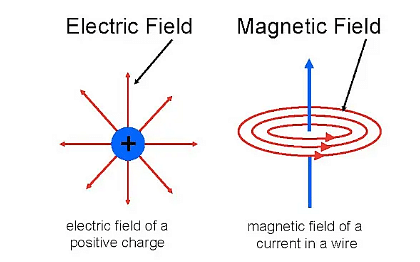
Electric and Magnetic Field
Very Short Answer Questions [1 Marks Questions]
Ques. What is the unit of the electric field?
Ans. The unit is newton per coulomb, volt per meter.
Ques. What is the unit of the magnetic field?
Ans. It is measured as gauss or tesla.
Ques. What is the magnetic field proportional to?
Ans. The magnetic field is proportional to the charge.
Also check:
Short Answer Questions [2 Marks Questions]
Ques. In which direction do Magnetic field and Electric Field lines point?
Ans. Magnetic field lines point in the direction of the force that is experienced by a north pole whereas the electric field lines point in the direction of the force that is experienced by a positive charge.
Ques. What is the purpose of Fleming’s right-hand rule?
Ans. Fleming's right-hand rule purpose is to find the direction of induced current when a conductor moves in a magnetic field.
Ques. What are the similarities between electric and magnetic fields?
Ans. Similarities between electric and magnetic fields are as follows:
- Unlike poles attract just like, like poles repel.
- The electric and magnetic fields are produced by two kinds of magnetic poles- Positive and Negative in the case of electric fields and north and south poles in the case of magnetic poles although the latter is produced by moving charges.
Long Answer Questions [3 Marks Questions]
Ques. What is the difference between an Electric field and Magnetic Field?
Ans. Electric field or electric field intensity refers to the force that surrounds an electrically charged particle. The Magnetic field refers to the area around the magnet where the attractive and repulsive forces are exhibited by the poles of the magnet. Here are the differences between these two-
| Electric Field | Magnetic Field |
|---|---|
| It creates an electric charge in surrounding | It creates an electric charge around the moving magnets |
| It is measured as Newton per coulomb, volt per meter | It is measured as gauss or tesla (after Nikola Tesla) |
| It is proportional to the electric charge | It refers to how fast an electric charge is moving |
| It is perpendicular to the magnetic field | It is perpendicular to the electric field |
| The instrument used is an electrometer | The instrument used is a magnetometer |
Ques. Explain Fleming's Left-Hand Rule.
Ans. Fleming's left-hand rule is that when a current-carrying conductor is placed in an external magnetic field, the conductor experiences a force perpendicular to both the field and to the direction of the current flow. The current-carrying conductor is placed under a magnetic field, a force acts on the conductor. The direction of this force can be identified using Fleming's Left Hand Rule. When a moving conductor is brought under a magnetic field, an electric current will be induced in that conductor. The direction of the induced current can be found using Fleming's Left Hand Rule.
- If we arrange the thumb, the center finger, and the forefinger of the left hand at right angles to each other, the thumb will point towards the direction of the magnetic force, the center finger will give the direction of the current, and the Forefinger will point in the direction of a magnetic field.
- It is used in Electric motors.
- This rule helps to find the direction of motion in an electric motor.

Fleming's Left-Hand Rule
Also check:
Very Long Answer Questions [4 to 5 Marks Questions]
Ques. What is Maxwell's unified theory of electromagnetism?
Ans. The last advances in merging power and magnetism into one logical framework have been finished by means of Maxwell. He was strongly influenced by Faraday's paintings, having started his studies of the phenomenon by changing Faraday’s experimental discoveries into arithmetic.
- In 1856 Maxwell supplied the speculation that the electricity of the electromagnetic wave originated inside the surroundings around the lines which include inside the connections themselves.
- By 1864 he already formulated his proposed electromagnetic principle of mild.
- He stated that each light and radio waves are electric powered and magnetic.
- Maxwell emphasized that the communication modifications in electric-powered fields cause magnetic fields even in the lack of electric flows.
- Maxwell anticipated that electromagnetic waves flowing through an empty area have electric and magnetic fields at proper angles to each other and that each field is perpendicular to the route of the Wave.
- He reasoned that the waves tour at a constant pace equal to the pace and that light is one kind of electromagnetic wave.
- Maxwell's bold theories were recognized by a few outsiders, in England until 1886, when the German scientist Heinrich Hertz established the reality of electromagnetic waves traveling at the speed of light; the waves he found are known now as radio waves.
Ques. A series LCR circuit is connected to an ac voltage source. When L is removed from the circuit, the phase difference between current and voltage is 3, If instead C is removed from the circuit the phase difference is again 3 between current and voltage. The power factor of the circuit is?
Ans. When L is removed,
\(Tant \phi = \frac{|Xc|}{R}\)
\(\implies tan {\pi}{3}=\frac{Xc}{R}...(i)\)
When C is removed,
\(Tan \phi = \frac{XL}{R}...(ii)\)
Now from (i) and (ii),
Since, XL= XC, the circuit is in resonance
Z=R
Power factor = \(cos \phi=\frac{R}{z} = 1\)
Ques. What are the properties of Electric and Magnetic fields?
Ans. The properties of Electric fields are-
- The magnetic field's direction is perpendicular to the field line which means that the electric field line would be indicated by a little compass.
- The closer the lines are together, the stronger the electric field is. The ratio of the number of lines to the area perpendicular to the electric lines is precise (called the areal density).
- Since magnetic field lines can never intersect, the field exists exclusively at each location in space.
- Continuous magnetic field lines produce closed loops with no beginning or end.
For Latest Updates on Upcoming Board Exams, Click Here: https://t.me/class_10_12_board_updates
Check-Out:



Comments