



Content Curator
MCQ on Difference Between Electric Field And Magnetic Field along with a detailed explanation of concepts is given in this article.
- Magnetic field is a vector field that describes the magnetic influence on moving electric charges, electric currents, and magnetic materials.
- An electric field is a physical region that surrounds each electric charge and exerts a force on all other charges in the region, either by attraction or repulsion.
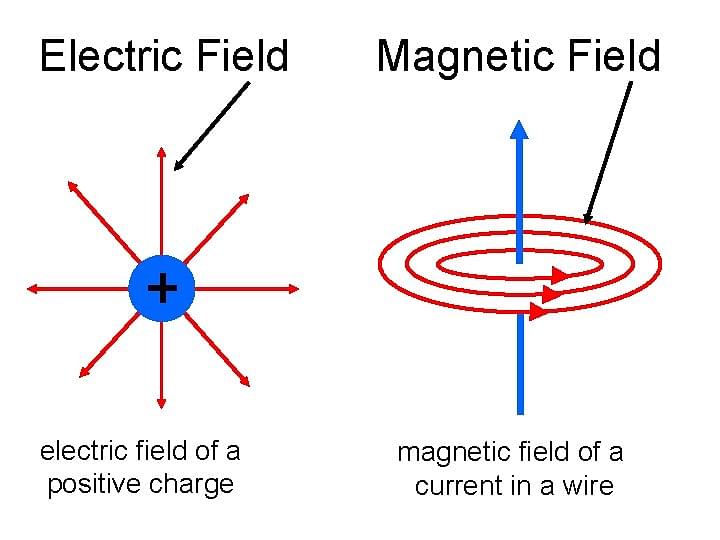
Electric Field and Magnetic Field
Discover about the Chapter video:
Current Electricity Detailed Video Explanation:
Read More:
Ques. Which of the following is not true for magnetic field lines?
- Magnetic field lines orient from the north to the south pole of the magnet.
- Magnetic field lines are closed and cautious
- Two field lines can intersect each other
- None of the above
Click here for the answer
Ans. c) Two field lines can intersect each other
Explanation- Magnetic field lines can be represented with the help of set lines or curves called magnetic loans of force or magnetic lines. The properties of magnetic field lines are-
- Magnetic field lines never intersect with each other.
- Magnetic field lines are closed and cautious
- The magnetic field line is directed from the north pole to the south pole outside and south to the north inside the magnet.
- Magnetic lines are never closed and cautious.
Ques. An electromagnet is –
- A temporary magnet
- A permanent magnet
- Not a strong magnet
- Neither temporary nor permanent magnet
Click here for the answer
Ans. a) A temporary magnet
Explanation- An electromagnet behaves as a magnet when the switch is on and loses magnetism when the switch is off. This makes the electromagnet a temporary magnet.
Ques. Which one of the statements is correct regarding the magnetic field inside a current-carrying solenoid?
- The magnetic field inside the solenoid is zero
- The magnetic field inside the solenoid is uniform at all the points
- The magnetic field inside the solenoid increases as we move forward toward the ends
- The magnetic field inside the solenoid decreases as we move to end
Click here for the answer
Ans. b) The magnetic field inside the solenoid is uniform at all the points
Explanation- A solenoid is a device consisting of a coil of wire. The field inside a solenoid is uniform, and also very strong because of its shape.
- The field just outside the coils is nearly zero.
- The magnetic field inside of a current-carrying solenoid is very uniform in direction and it begins to weaken and change direction near the ends.
- Solenoids are used in inductors, electromagnets, antennas, valves, etc.
- A solenoid also converts electrical energy into mechanical work.
Ques. Which one of the following statements regarding the Fleming rule is correct?
- Fleming's left-hand rules give the direction of the force on a current-carrying conductor in a magnetic field.
- Fleming's right-hand rule gives the direction of the force on a current-carrying conductor in a magnetic field.
- Fleming's rules have nothing to do with the magnetic field
Click here for the answer
Ans. a) Fleming's left-hand rule gives the direction of the force on a current-carrying conductor in a magnetic field.
Explanation- When a current-carrying conductor is placed in an external magnetic field, the conductor experiences a force perpendicular to both the field and the direction of the current flow. When a current-carrying conductor is placed under a magnetic field, a force acts on the conductor. The direction of this force can be identified using Fleming's Left Hand Rule. When a moving conductor is brought under a magnetic field, an electric current will be induced in that conductor. The direction of the induced current can be found using Fleming's Right Hand Rule.
Fleming's Left-Hand Rule:-
- If we arrange the thumb, the center finger, and the forefinger of the left hand at right angles to each other, then the thumb points towards the direction of the magnetic force, the center finger gives the direction of the current, and the forefinger points in the direction of a magnetic field.
- It is used for electric motors.
- The purpose of the rule is to find the direction of motion in an electric motor.
Ques. Magnetic field lines being more crowded towards the pole of the magnet indicates that the magnetic field due to the magnet in that region is
- Weakest
- The outcome of a property of a ferromagnetic substance
- Aligned with the magnetic field of the earth
- The strongest
Click here for the answer
Ans. d) strongest
Explanation- Magnetic field strength:
The space or region around the current-carrying wire/moving electric charge or around the magnetic material in which force of magnetism can be experienced by another magnetic material is called a magnetic field by that material. The value of this magnetic field is called the magnetic field strength of that magnetic material.
Properties of Magnetic Field Lines:
- A magnetic field line is directed from the north pole to the south pole outside the magnet.
- A magnetic field line is a closed and continuous curve. (Magnetic field lines inside the magnet where these are directed from the south pole to the north pole).
- The magnetic field lines are crowded near the pole where the magnetic field is strong and are far apart near the middle of the magnet and far from the magnet where the magnetic field is weak.
- The magnetic field lines never intersect each other because if they do so, there would be two directions of the magnetic field at that point which is absurd.
- In case the field lines are parallel and equidistant, these represent a uniform magnetic field. The Earth's magnetic field is uniform in a limited space.
Ques. Which of the following statements is NOT true?
- The magnetic field produced by a given current in the conductor decreases as the distance from it increases
- The pattern of the magnetic field lines around a current-carrying solenoid is different from that of a bar magnet.
- Maxwell cork screw rule gives the direction of the magnetic field
- A solenoid is used to produce an electromagnet.
Click here for the answer
Ans. The pattern of the magnetic field lines around a current-carrying solenoid is different from that of a bar magnet.
Explanation- The magnetic field produced by a given current in the conductor decreases as the distance from it increases and vice versa.
- The pattern of the magnetic field lines around a current-carrying solenoid is the same as that of a bar magnet. Therefore option b is incorrect.
- From the above, it is clear that Maxwell's corkscrew rule gives the direction of the magnetic field.
- An electromagnet is a temporary magnet that should ideally have the property to behave as a magnet when current passes through a solenoid and lose magnetism as soon as the current is stopped.
Ques. The relation between a non-SI unit of magnetic field gauss and SI unit tesla is 2 tesla = ______ gauss.
- 10-4
- 102
- 104
- 103
Click here for the answer
Ans. c) 104
Explanation- The CGS unit of magnetic field (B) is gauss where 1 gauss = 10-4tesla.
Magnetic field strength or magnetic field induction or flux density of the magnetic field is equal to the force experienced by a unit positive charge moving with unit velocity in a direction perpendicular to the magnetic field.
Ques. Which of the following is not a source of magnetic field?
- Electric current
- Static charges
- A rotating magnet
- A galvanometer carrying current
Click here for the answer
Ans. b) Static charges
Explanation- Magnetic field line starts from the North pole and ends at the South pole, it always makes a closed loop, It is formed by electric currents and magnets.
- An electric current produces magnetic fief.
- Static charge can't create a magnetic field. So option 2 is correct.
- A rotating magnet can produce a magnetic field.
- A galvanometer carrying current can produce a magnetic field.
Ques. Two parallel plates having potential -10 volt and +30 volt respectively are separated by a distance of 2 cm. What is the value of the electric field between the plates?
- 2000 V/m
- 3000 V/m
- 2500 V/m
- 500 V/m
Click here for the answer
Ans. a) 2000 V/m
Explanation- Given V1 = -10 V, V2 = +30 V, and d = 2 cm = 2 x 10⁻² m
The electric field between the plates is given by
E = ΔV/d = (V2 – V1)/d
E = 30 – (-10)/2 x 10-2 = 40/2 x 10-2
E = 20 x 102 = 2000 V/m
For Latest Updates on Upcoming Board Exams, Click Here: https://t.me/class_10_12_board_updates
Check-Out:



Comments