



Content Curator
Dinitrogen Pentoxide is an important chemical compound of nitrogen consisting of 2 (di) nitrogen atoms and 5 (Pent) oxygen atoms.
- The chemical formula of dinitrogen pentoxide is N2O5.
- It is also known as nitrogen pentoxide or nitric anhydride.
- It occurs as colorless crystals that vaporize just above room temperature, producing a colorless gas.
- Dinitrogen Pentoxide is used as a solvent, and nitrating agent and is also indirectly involved in ozone layer depletion due to its small presence in the stratosphere.
- It was first reported by Deville in 1840 and first prepared by treating silver nitrate (AgNO3) with chlorine.
| Table of Content |
Key Terms: Dinitrogen Pentoxide, Nitrogen, Oxygen, Nitrogen oxide, N2O5, Nitric acid, Chemical formula, Density, Melting point, Solubility, Nitrogen dioxide
What is Dinitrogen Pentoxide?
[Click Here for Sample Questions]
Dinitrogen Pentoxide is the anhydride form of nitric acid and can be obtained as white crystals by carefully dehydrating nitric acid with diphosphorus pentoxide or oxidizing nitrogen dioxide with ozone.
- It is an unstable compound that decomposes spontaneously at room temperature into nitrogen dioxide and oxygen.
- Dinitrogen pentoxide is extensively dissociated in nitric acid, resulting in a large concentration of nitronium cations.
- Dinitrogen pentoxide is an unstable, moderately explosive compound with no present economic value.
| Dinitrogen Pentoxide | |
|---|---|
| Chemical Formula | N2O5 |
| Density | 1.64 g/cm3 |
| Boiling Point | 47 ∘C |
| Molecular Weight/ Molar Mass | 108.01 g/mol |
| Melting Point | 41 ∘C |
| Other names | Nitrogen pentoxide and Nitro nitrate |
Also check:
| Related Concepts | ||
|---|---|---|
| Oxidation and Reduction | Oxides of nitrogen | Aromaticity |
| Relation between Molarity and Molality | Phosphorus Pentachloride | Nitrous Oxide |
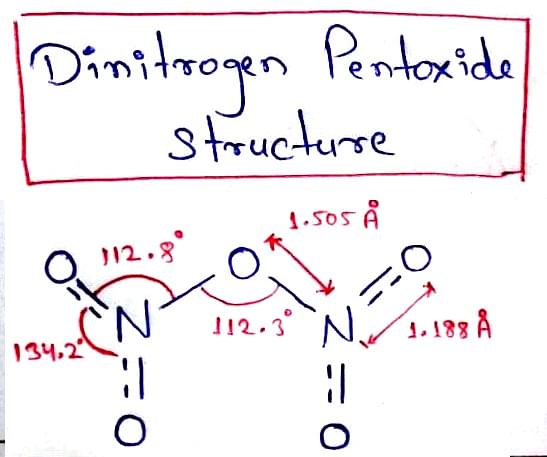
Dinitrogen Pentoxide Structure
[Click Here for Sample Questions]
Dinitrogen Pentoxide consists of two nitrogen atoms and five oxygen atoms in its structure.
- In terms of drawing the Lewis structure of N2O5, we have to first calculate the number of valence electrons of both elements.
- Two nitrogen atoms contain 10 valence electrons and 5 oxygen atoms contain 30 valence electrons.
- Hence, we will get a total of 40 valence electrons in the compound N2O5.
Physical Properties of Dinitrogen Pentoxide
[Click Here for Sample Questions]
The following are the physical properties of dinitrogen pentoxide
| Physical Properties of Dinitrogen Pentoxide | |
|---|---|
| Appearance | White solid |
| Odour | Odourless |
| Hydrogen Bond Acceptor | 5 |
| Covalently-Bonded Unit | 1 |
| Solubility | Soluble in alcohol and ether |
| Complexity | 71.2 |
| Crystal structure | Hexagonal, hP14 |
| Dipole moment | 1.39 D |
| Magnetic susceptibility | −35.6 × 10⁻⁶ cm3 mol−1 (aq) |
Chemical Properties of Dinitrogen Pentoxide
[Click Here for Sample Questions]
The following are the chemical properties of dinitrogen pentoxide
Reaction with Water
Dinitrogen Pentoxide (N2O5) reacts with water and forms nitric acid which proves that it is acidic in nature. The chemical equation used for representing the reaction is-
N2O5 + H2O → 2HNO3
Reaction with Sodium hydroxide
Dinitrogen Pentoxide (N2O5) reacts with a strong base like sodium hydroxide to form sodium nitrate and water. The chemical equation is -
N2O5 + 2NaOH → 2NaNO3 + H3O
Decomposition of Dinitrogen Pentoxide at high temperature
Dinitrogen Pentoxide is decomposed into NO2 and O2 between high temperatures of 600 K - 1100 K. In the first step at shock wave N2O5 is decomposed stoichiometrically into nitrogen dioxide and nitrogen trioxide. At a temperature of 600 K and higher it finally gets converted into nitrogen dioxide and oxygen.
- N2O5 → NO2 + NO3
- 2 NO3 → 2NO2 + O2
Dinitrogen Pentoxide also gets decomposed in Carbon tetrachloride at 30 degrees Celsius. Both N2O5 and NO2 are soluble in carbon tetrachloride and oxygen is insoluble which escapes out from the solution.
Dinitrogen Pentoxide Preparation
[Click Here for Sample Questions]
The following are the preparation methods for Dinitrogen Pentoxide
- Dinitrogen Pentoxide is prepared by dehydrating nitric acid with Phosphorus Pentoxide, the chemical reaction is given below-
P4O10 + 12HNO3 → 4H3PO4 + 6N2O5
- The ionic form of sodium dinitrogen pentoxide is nitronium nitrate which is demonstrated with the following reaction.
N2O5 + NaCl → NaNO3 + NO2Cl
Here the sodium atom has a +1 charge while the NO3 atom has a -1 charge.
- Dinitrogen Pentoxide can be created in the gas phase by reacting nitrogen dioxide NO2 or N2O4 with Ozone.
2NO2 + O3 → N2O5 + O2
- The reaction of Phosphorus Chloride (POCl3) or nitryl chloride (NO2Cl) with silver nitrate is also used as the formation of dinitrogen pentoxide.
Dinitrogen Pentoxide Uses
[Click Here for Sample Questions]
Nitrogen is one of the important elements in the Universe and is mostly used in the formation of different organic compounds. Dinitrogen Pentoxide forms different compounds like nitrous oxides (N2O), Ammonium nitrate (NH4NO3), Nitramide (NH2NO2), and ammonium dinitramide (NH4N(NO2)2 after reacting with ammonia in different reaction conditions.
- Dinitrogen Pentoxide is used as an oxidizer in high-fuel Rockets.
- It is used as a solvent so that molecules sensitive to water get easily nitrated.
- N2O5 is a strong nitrating agent that combines with HNO3 and acts as a strong nitrating agent in modern organic chemistry.
- Due to the unstable nature of Dinitrogen Pentoxide, Nitronium Tetrafluoroborate is used instead of N2O5 nowadays.
Also check:
| Relevant Topics | ||
|---|---|---|
| Lewis acids | Schottky Defect | Carboxylic Acids |
| Gatterman reaction | Reimer Tiemann reaction | Combined Gas Law |
Things to Remember
- Dinitrogen Pentoxide is the anhydride form of nitric acid.
- The chemical formula of dinitrogen pentoxide is N2O5.
- The total no. of valence electrons in N2O5 is 40. Two nitrogen atoms contain 10 valence electrons and five oxygen atoms contain 30 valence electrons.
- Oxygen is electronegative in nature which must be remembered while drawing the chemical Lewis dot structure of N2O5.
- Since dinitrogen pentoxide does not contain water, it is known as anhydride, it can turn into nitric acid when water gets added to it.
- Dinitrogen Pentoxide remains solid at 303 K, it starts melting above it.
Sample Questions
Ques. Is dinitrogen pentoxide acidic or basic? (1 Mark)
Ans. Dinitrogen pentoxide is an Acidic Anhydride.
Ques. What is the chemical formula of dinitrogen pentoxide? (1 Mark)
Ans. The chemical formula of dinitrogen pentoxide is N2O5.
Ques. Is N2O5 Colourless? (1 Mark)
Ans. N2O5 occurs as colorless crystals that sublime slightly above room temperature, releasing a colorless gas.
Ques. Is Dinitrogen Pentoxide Ionic or Covalent? (2 Marks)
Ans. Dinitrogen Pentoxide is made up of two non-metals nitrogen and oxygen. Ionic bonds are formed between metals or ions having opposite charges, it is formed due to the transfer of complete electrons from an anion to a cation.
The bond formed between two non-metals by sharing electrons is known as a covalent bonds. In Dinitrogen Pentoxide the valence electrons of nitrogen and oxygen are shared with each other to complete its octet irrespective of complete transfer of electrons. Hence proves that Dinitrogen Pentoxide is a Covalent Compound.
Ques. Is Dinitrogen Pentoxide a binary compound? (2 Marks)
Ans. Yes, Dinitrogen Pentoxide is a binary compound. We can define the nature of compounds after calculating how many types of different elements are present in them. In the case of Dinitrogen Pentoxide (N2O5), two elements are involved in the formation of its structure Nitrogen and Oxygen. The two different elements involved in the formation of binary compounds are non-metals and bonded together with the help of the sharing of electrons due to the formation of covalent bonds between them.
Ques. Is dinitrogen Pentoxide found in the atmosphere? (2 Marks)
Ans. Yes, In the atmosphere dinitrogen pentoxide is a reservoir of NOx species which are mainly responsible for Ozone Depletion. Dinitrogen Pentoxide is observed in the stratosphere and troposphere, variation in its reactivity in aerosols results in significant loss of tropospheric ozone, hydroxyl radicals and NOx Concentrations.
Two important reactions of dinitrogen pentoxide in atmospheric aerosols prove the existence of the compound in the atmosphere. N2O5 performs hydrolysis to form nitric acid and the second one is a reaction with halide ions Cl- to form ClNO2 molecules.
Ques. How does Dinitrogen Pentoxide help in the nitration of Organic Compounds? (3 Marks)
Ans. Dinitrogen Pentoxide is sometimes used as a reagent to introduce the -NO2 group in organic compounds. The nitration reaction of the introduction of the -NO2 group is represented as follows-
N2O5 + Ar-H → HNO3 + Ar-NO2
Here Ar denotes an aerene.
In this reaction, dinitrogen Pentoxide is replaced by nitronium tetrafluoroborate. In which NO2+ is present in a highly reactive state which replaces hydrogen atoms in the aerenes. Due to the property of performing nitration of organic compounds, dinitrogen pentoxide is used for the preparation of explosives.
Ques. Does Dinitrogen Pentoxide react with water and hydrochloric acid? (3 Marks)
Ans. Dinitrogen pentoxide hydrolyses (reacts with water) to produce nitric acid, this reaction also proves that dinitrogen pentoxide is the anhydride of nitric acid.
N2O5 + H2O → 2HNO3
Dinitrogen Pentoxide solution in nitric acid can be seen as nitric acid with more than 100% concentration.
Dinitrogen pentoxide reacts with hydrogen chloride HCl to give nitric acid and nitryl chloride NO2Cl.
N2O5 + HCl → HNO3 + NO2Cl.
The reaction of solid dinitrogen pentoxide is negligible if it occurs in inert containers.
Ques. Does N2O5 undergo decomposition? What are the products it formed in reaction with ammonia? (3 Marks)
Ans. Decomposition of N2O5 takes place at 40 degrees Celsius or more. Dinitrogen pentoxide gets converted into NO2 and O2 when heated. Decomposition of dinitrogen pentoxide is negligible if it occurs in solid form at ) degrees Celsius in suitably inert containers.
2 N2O5 → 4 NO2 + O2
Dinitrogen Pentoxide forms different compounds like nitrous oxides (N2O), Ammonium nitrate (NH4NO3), Nitramide (NH2NO2), and ammonium dinitramide (NH4N(NO2)2 after reacting with ammonia (NH3) in different reaction conditions.
Ques. What are the uses of Dinitrogen Pentoxide? (3 Marks)
Ans. Dinitrogen Pentoxide is a strong nitrating agent, It generates NO2+ electrophiles which attack organic compounds and replace hydrogen atoms to perform nitration.
Due to its strong nitrating and oxidizing properties, dinitrogen Pentoxide is used in making explosives with organic compounds and ammonium salts. Its decomposition produces a highly toxic gas nitrogen dioxide so it is used for the production of NO2 as well.
It is used as a strong oxidizer in high-fuel rockets. It acts as an important reservoir of NOx species in the stratosphere which are responsible for ozone depletion which shows the hazardous effect of Dinitrogen Pentoxide.
For Latest Updates on Upcoming Board Exams, Click Here: https://t.me/class_10_12_board_updates
Also Read:



Comments