


Draw a circuit diagram to verify Ohm's law.

Ohm’s law states that voltage across a conductor is directly proportional to the current that flows through it, provided the temperature and all physical conditions remain constant.

V = IR

Circuit Diagram for Ohm’s Law
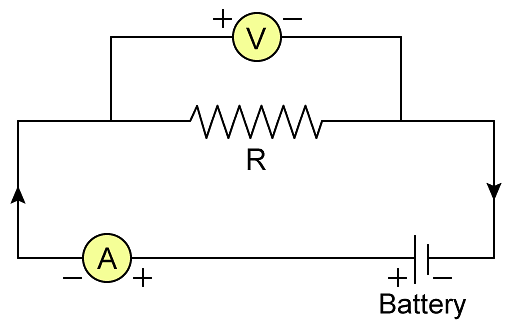
Ohm's Law Circuit Diagram

Related Questions

  1. What is the necessary condition for a conductor to obey Ohm's Law?
  2. Why is the curve representing Ohm's law linear?
  3. What are the limitations of Ohm's Law?
  4. State Ohms law. How can it be verified experimentally?
  5. How do you find the resistance to Ohm's law?
  6. What are the 3 forms of Ohm's law?
  7. State Ohms Law. Express It Mathematically. Define Si Unit Of Resistance.
  8. Is resistance constant in Ohm's law?

Read More:

CBSE CLASS XII Related Questions

  • 1.
    Draw a circuit diagram of a full-wave rectifier using p-n junction diodes. Explain its working and show the input-output waveforms.


      • 2.
        Assertion (A) : All atoms have a net magnetic moment. Reason (R) : A current loop does not always behave as a magnetic dipole.

          • Both Assertion (A) and Reason (R) are true and Reason (R) is the correct explanation of the Assertion (A).
          • Both Assertion (A) and Reason (R) are true, but Reason (R) is not the correct explanation of the Assertion (A).
          • Assertion (A) is true, but Reason (R) is false.
          • Both Assertion (A) and Reason (R) are false.

        • 3.
          If Bohr’s quantization postulate (angular momentum \( = \frac{nh}{2\pi} \)) is a basic law of nature, it should be equally valid for the case of planetary motion also. Why, then, do we never speak of quantization of orbits of planets around the Sun? Explain.


            • 4.
              The figure shows three point charges kept at the vertices of triangle ABC. The net electric field, due to this system of charges, at the midpoint M of base BC will be:

                • \( \frac{q}{4 \pi \epsilon_0 l^2} \) pointing along MA
                • \( \frac{q}{\pi \epsilon_0 l^2} \) pointing along AM
                • \( \frac{q}{2 \pi \epsilon_0 l^2} \) pointing along AM
                • Zero

              • 5.
                Photoemission of electrons occurs from a metal (\( \phi_0 = 1.96 \, \text{eV} \)) when light of frequency \( 6.4 \times 10^{14} \, \text{Hz} \) is incident on it. Calculate: Energy of a photon in the incident light, The maximum kinetic energy of the emitted electrons, and The stopping potential.


                  • 6.
                    Write any two features of nuclear forces.

                      CBSE CLASS XII Previous Year Papers

                      Comments


                      No Comments To Show
