



Education Journalist | Study Abroad Lead
Ecology pyramid is a graphical depiction of various living organisms at various trophic levels. Raymond Lindman and G. Evelyn Hutchinson first made the Ecology Pyramid.
- These pyramids are shaped like real pyramids, with broad bases that narrow at the apex.
- The first trophic level is producers, followed by primary consumers, and so on.
- Ecological pyramids also describe how organisms in ecosystems interact with one another.
- In these pyramids, energy flows from bottom to top, implying that energy is transferred from autotrophs to primary producers rather than primary consumers, and so on.
- A species can exist on multiple trophic levels.
- A sparrow, for example, is a primary consumer of fruits, seeds, and other foods.
- When it eats worms and insects, it falls into the category of a secondary consumer.
- Producers outnumber herbivores in both number and biomass.
- Herbivores outnumber carnivores, and lower trophic level energy is greater than higher trophic level energy.
Read More: What is biomass?
| Table of Content |
Key terms: Ecological Pyramid, Biomass, Ecosystems, Trophic level, Food chain, Consumer, Carnivores, Sparrow, Energy
What is Ecological Pyramid?
[Click Here for Sample Questions]
An ecological pyramid is a graphical representation of the relationships between various living organisms at various trophic levels.
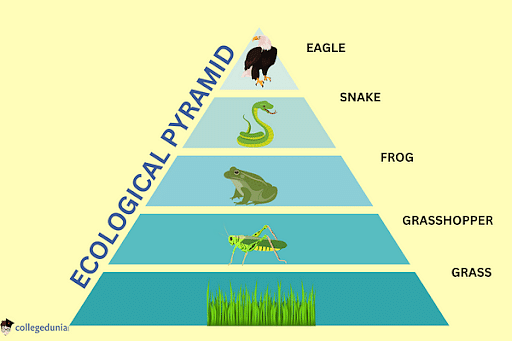
Ecology Pyramid
- These pyramids have the shape of actual pyramids, with the base being the broadest and being covered by the lowest trophic level, i.e., producers.
- The next trophic level, i.e., the primary consumers, occupies the next level, and so on.
- All calculations for the construction of these types of ecological pyramids must take all organisms in a specific trophic level.
- This is because a sample space of a few numbers or a few species will result in a large level of error.
The theory of the ecological pyramid was suggested by Raymond Linderman and G.Evylen Hutchinson. The ecological pyramid is also often known as the energy pyramid.
Also Read:
| Related Articles | ||
|---|---|---|
| Biodiversity and Conservation | Endemic Diseases | Conservation of Plants & Animals |
| List of Biosphere Reserves in India | Loss of Biodiversity | Biodiversity in Plants and Animals |
Types of Ecological Pyramid
[Click Here for Sample Questions]
The many types of Ecological Pyramids include:
Pyramid of Number
It denotes the number of organisms found in each trophic level.
- The number pyramid is always upright, but in situations such as the detritus food chain, it does not show an upright position.
- The number of organisms decreases as one moves up the pyramid.
- Because there are a lot of producers, it's at the bottom.
Pyramid of Biomass
The amount of biomass produced by each trophic level is depicted in this ecological pyramid.
- Except in the oceans, where large numbers of zooplankton rely on phytoplankton, the biomass pyramid is always upright.
- In this pyramid, producers have the most biomass, followed by primary consumers, who have less biomass than producers.
- Similarly, secondary consumers have less biomass than primary consumers, and at the top of the pyramid, biomass is present.
- The biomass pyramid in a sea is also inverted because fish biomass exceeds phytoplankton biomass.
Pyramid of Energy
The energy pyramid is always upright because energy flow in a food chain is unidirectional and some energy is lost in the environment as trophic levels increase. This energy pyramid depicts the flow of energy from consumers to producers.
Ecological Pyramid Importance
[Click Here for Sample Questions]
The significance of the ecological pyramid can be explained as follows:
- They depict the feeding of various organisms in various ecosystems.
- It demonstrates the effectiveness of energy transfer.
- The state of the ecosystem can be monitored, and further damage can be avoided.
Read Also: Energy Flow in Ecosystem
Ecological Pyramid Limitations
[Click Here for Sample Questions]
Some of the limitations of Ecological Pyramids include:
- As with food web, multiple species may occupy multiple trophic levels. As a result, this system disregards food webs.
- Even though saprophytes are an important part of many ecosystems, they are not included in any of the pyramids.
- These pyramids are only applicable to simple food chains, which rarely occur naturally.
- These pyramids provide no information about seasonal and climatic variations.
- They do not consider the possibility of the same species existing at different levels.

Food Chain Diagram
Things to Remember
- An ecological pyramid is a graphical representation of the relationship between various living beings at various trophic levels within a food chain.
- The pyramid is formed on the basis of the number of organisms, energy, and biomass, all of which are shaped in the shape of a pyramid, as the name suggests.
- The bottom of the pyramid, which is also the broadest part, is occupied by the producers, who are at the first trophic level.
- Primary consumers occupy the next level of the pyramid. This is followed by the pyramid's next level, which represents secondary and tertiary consumers.
Also Read:
| Related Articles | ||
|---|---|---|
| Pyramid of Biomass | Ecology and Environment | Respiration |
| Metabolism | Food chains | Food web |
Sample Questions
Ques: What are the three different kinds of ecological pyramids? (2 marks)
Ans: The three types of ecological pyramids are as follows:
- Number Pyramid
- Biomass Pyramid
- Energy Pyramid
Ques. What exactly do you mean by an ecological pyramid? (2 marks)
Ans: An ecological pyramid is a graphical representation of the interdependence of organisms in an ecosystem. It depicts the flow of energy in an ecosystem at various trophic levels.
Ques: What is the 10% rule? (2 marks)
Ans: Raymond Lindeman established the 10% rule. According to this law, when energy is transferred from one trophic level to the next, only 10% of the energy from organic matter is passed on.
Ques: Why is the energy pyramid always upright? (2 marks)
Ans: The energy pyramid is a type of ecological pyramid that is always upright. This is due to the fact that some energy is always lost as heat during the flow of energy from one trophic level to the next.
Ques: Why is it that there are fewer organisms at the top of the ecological pyramid? (2 marks)
Ans: Because there is very little food left for secondary consumers compared to primary consumers, there are fewer organisms at the top of the pyramid. In the same way, there are fewer consumers than producers.
Ques: What are the ecological pyramids alternatively called? (1 mark)
Ans: Charles Elton is credited with the development of ecological pyramids, which are also sometimes referred to as Eltonian pyramids.
Ques: Which pyramid represent the total dry weight of the total amount of living matter at each level? (2 marks)
Ans: Pyramid of biomass represents the total dry weight of the total amount of living matter at every level. Biomass is the amount of living things in an ecosystem at a certain point in time.
The biomass pyramid is a picture of how much living matter there is at each trophic level of a food chain. The numbers in the pyramid show how many people are in each trophic level of a food chain. The pyramid of energy shows how much energy there is at each level of a food chain.
Ques. Which pyramid(s) may be upright or inverted? (1 mark)
Ans: Pyramid of Biomass can physically be seen as upright or inverted.
Ques. In a forest ecosystem, how is the pyramid of numbers depicted? (5 marks)
Ans: In an Upright direction. A trophic pyramid demonstrates the link between biomass, productivity, and energy.
- Primary producers are at the bottom, apex predators at the top.
- Ecosystem-specific pyramids vary.
- The number pyramid displays creatures at successive trophic levels.
- In a forest environment, huge trees form the Pyramid.
- Herbivores like fruit-eating birds, deer, elephants, etc. are primary consumers, not producers. Each level after that decreases.
- A Forest Ecosystem number pyramid is half upright or spindle-shaped.
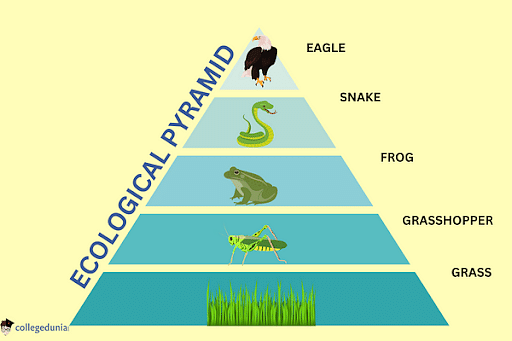
Ecological Pyramid
Ques. What do you understand about an ecological pyramid? (2 marks)
Ans: A graphical representation that shows the hierarchy of relationships between the various organisms that make up an ecosystem is called an ecological pyramid. It illustrates the transfer of energy between the many trophic levels that make up an ecosystem.
For Latest Updates on Upcoming Board Exams, Click Here:https://t.me/class_10_12_board_updates
Check Out:



Comments