



Content Curator
Energy flow is the movement of energy through living organisms in a given environment. All living organisms can be classified as producers or consumers, and those producers and consumers can then be classified as part of a food chain. Each trophic level in the food chain is referred to as a trophic level. Energy Flow is based on the two laws of thermodynamics.
| Table of Content |
Key Terms: Energy Flow, Biogeochemical Cycle, Thermodynamics, Ecological Pyramid, Food Web, Ecosystem, Environment, Energy
Energy Flow in Ecosystem
[Click Here for Sample Questions]
Enegy flow in ecosystem is the amount of energy that passes through a food chain. Energy flow is measured In Joules or calories, the energy input, or energy that enters the environment. As a result, the energy flow is sometimes referred to as calorific flow.

| Important Elements of Ecosystem Important elements of ecosystem are:
|
Ecological Pyramid
[Click Here for Previous Year Questions]
Ecological Pyramid is a graphical representation of energy flowing through each trophic level of a food chain across a defined portion of the natural environment. Any energy lost at one trophic level is transferred to the next. The energy pyramid, also known as the trophic pyramid or ecological pyramid, is a tool for calculating how much energy is transferred from one creature to the next in the food chain.
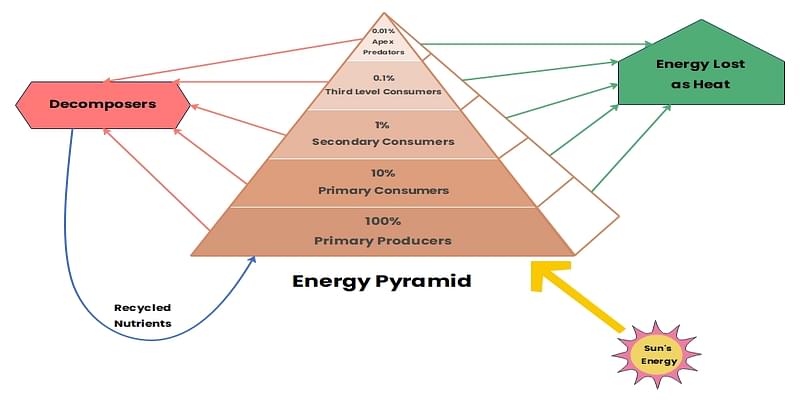
The cycling of energy and nutrients obtained from many external sources keeps our environment alive.
Read More:
| Related Topics | ||
|---|---|---|
| Microbes in Human Welfare | Marine Biology | Biomass |
| Terrestrial Ecosystem | Ecosystem - What are its components? | Productivity in Ecosystem |
| Biomass | Carbon Cycle | Importance of Ecosystem |
Trophic Levels Definition
[Click Here for Sample Questions]
Primary producers utilise solar energy to produce organic material through photosynthesis at the first trophic level. Plants are used as food by herbivores at the second trophic level, which provides them with energy. The metabolic operations of these creatures, such as breathing, digesting food, supporting tissue growth, maintaining blood circulation, and maintaining body temperature, consume a considerable portion of this energy.
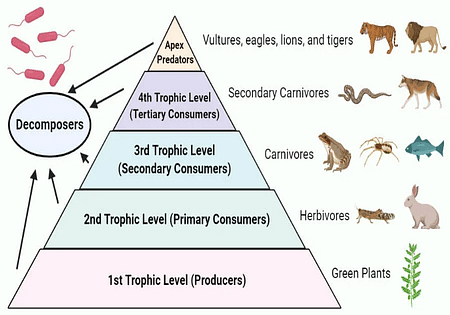
At the next trophic level, carnivores eat on herbivores to obtain energy for their survival and growth. If huge predators are present, they represent a higher trophic level, and they obtain energy by feeding on carnivores. As a result, diverse plant and animal species are connected through food chains.
Also Read: Ecology
What is a Biogeochemical Cycle?
[Click Here for Previous Year Questions]
Biogeochemical cycles are the flow of chemical elements and compounds between organisms and the physical environment. Chemicals ingested by creatures make their way up the food chain, eventually returning to the soil, air, and water by mechanisms like respiration, excretion, and decomposition.

As an element progresses through this cycle, it frequently forms compounds with other elements as a result of metabolic processes in living tissues as well as natural reactions in the atmosphere, hydrosphere, and lithosphere.
Read More:
| Important Chapter Topics | ||
|---|---|---|
| Pelagic Zone | Benthic Zone | Productivity in Ecosystem |
| Biome Vs Ecosystem | Food Chains and Webs | Decomposers |
| Microbes in Human Welfare | Diversity in Living Organisms | Biomes |
Food Chain
[Click Here for Sample Questions]
Food chains are used to depict the flow of energy from one organism to the other in a linear pattern. Food chains are grouped into trophic pyramids to more efficiently represent the abundance of species at each trophic level. The arrows in the food chain illustrate that energy flow is unidirectional, with the heads of the arrows indicating the direction in which energy is travelling, and that energy is lost as heat at each stage.

Understanding the differences in behaviour and food habits of warm-blooded and cold-blooded animals depends on the effectiveness of these transfers. Ecological pyramids of energy are optimal for modelling ecosystem energy and it provides important information about ecosystem structure.
| Significance of Food Chain
|
Read More:
Things to Remember
- The movement of energy across ecosystems is critical to the survival of life on Earth.
- Green plants, such as herbaceous and woody plants, are key producers in an ecosystem. Phytoplanktons, algae, and higher plants are the producers in an aquatic ecosystem.
- To resist the global tendency toward increased disorderliness, ecosystems require the second law of thermodynamics.
- Food web is the interwoven matrix of the food chain. For instance, a herbivore in one food chain may provide food for carnivores in another.
- When organic molecules from one organism's body are eaten by another organism, energy can be transferred from one trophic level to the next.
- Trophic levels give a framework for analysing food chains and the flow of energy in an ecosystem. The producers who produce their own food through photosynthesis are at the bottom of the pyramid.
Also Read: Solutions to Class 12 Biology Chapter 14 Ecosystem
Previous Year Questions
- Which of the following aquatic plant does not show pollination by water? … [KCET 2021]
- Aquatic reptiles are … [NEET 1999]
- Upper part of sea/aquatic ecosystem contains … [NEET 1988]
- An ecosystem which can be easily damaged but can recover … [NEET 2004]
- Energy transfer from one trophic level to other...[NEET 1999]
- the rate of production of organic matter by consumers….[NEET 2012]
- About 70% of total global carbon is found in...[NEET 2008]
- An ecosystem which can be easily damaged but can….[NEET 2004]
- The biomass available for consumption by the herbivores...[NEET 2010]
- Both hydrarch and xerarch successions lead to...[NEET 2011]
- During ecological succession...[NEET 2015]
- In a biotic community, the primary consumers are...[NEET 1995]
- In an ecosystem, which one shows one-way passage...[NEET 1988]
- Upper part of sea/aquatic ecosystem contains...[NEET 1988]
- Vertical distribution of different species occupying different...[NEET 2015]
- What is true of ecosystem?...[NEET 1988]
- Which ecosystem has the maximum biomass ?...[NEET 2017]
- Which of the following pairs is a sedimentary type….[NEET 1995]
- In a pyramid of numbers, in a grassland ecosystem….[KEAM]
- In autogenic succession….
Sample Questions
Ques: How does energy get from one trophic level to the next? (2 marks)
Ans: When organic molecules from one organism's body are eaten by another organism, energy can be transferred from one trophic level to the next.
Ques: What causes inefficient energy transfer? (2 marks)
Ans: There are numerous reasons for inefficient energy transfer. One is that the lower-trophic-level species are devoured by higher-trophic-level organisms. And the other one is that some chemicals in the bodies of organisms that are consumed are indigestible to predators and end up in their feces.
Ques: What makes up a detritus food chain and how do they get the energy and nutrients they need? (2 marks)
Ans: Food chain consists of decomposers, such as bacteria and fungi. They get their energy and nutrients by decomposing detritus, which is dead organic stuff.
Ques: What is the ten percent energy flow law? (2 marks)
Ans: The Ten percent law of energy flow states that when energy is transferred from one trophic level to another, only 10% of it is transferred to the next trophic level. The rest is lost in the form of heat.
Ques: In a food chain, what role do humans play? (2 marks)
Ans: Humans play many different roles in the food chain, depending on what they eat. Humans are classified as primary consumers if they only eat plants. If a human eats a plant-eating organism, the human is referred to as a secondary consumer so, they are known as omnivores.
Ques. What is a food chain? (2 marks)
Ans. A food chain, ecologically, is a line or sequence of energy transfer in the form of food from one organism to another. A food chain is responsible to show how organisms are interrelated to one another by the food they consume.
Ques. List the importance of food chain. (3 marks)
Ans. The importance of food chain is,
- Food chain research aids in understanding the feeding relationship and interactions among organisms in any ecosystem.
- They also assist us in appreciating the energy flow mechanism and matter circulation in ecosystems, as well as understanding harmful material migration.
- The study of the food chain aids in the comprehension of biomagnification issues.
Ques. Write a short note on Biogeochemical Cycle. (3 marks)
Ans. Biogeochemical cycles are the flow of chemical elements and compounds between organisms and the physical environment. It is a pathway via which chemical substances cycles both the biotic and abiotic compartments found on Earth. Biogeochemical cycles which are vital to organisms include water, carbon, nitrogen, phosphorus, and sulfur cycles.
Ques. What is an Ecological Pyramid? (2 marks)
Ans. Ecological Pyramid is a graphical representation of energy flowing through each trophic level of a food chain across a defined portion of the natural environment. Any energy lost at one trophic level is transferred to the next. The energy pyramid, also known as the trophic pyramid or ecological pyramid, is a tool for calculating how much energy is transferred from one creature to the next in the food chain.
Ques. What is the definition of Energy Flow? (3 marks)
Ans. Energy flow is the movement of energy through living organisms in a given environment. Energy flow is also known as calorific flow.
Example of Energy Flow in Ecosystem: Autotrophs take energy from the sun. Herbivores then feed on the autotrophs and change energy from the plant into energy that they can use. Carnivores feed on the herbivores and other carnivores prey on the carnivores.
For Latest Updates on Upcoming Board Exams, Click Here:https://t.me/class_10_12_board_updates
Do Check Out:



Comments