



Content Writer
ELISA Technique is a simple and efficient technique that is used to check the presence of antigens in the blood samples. It needs a solid stationary medium, a liquid medium, and a well plate to hold the solid stationary support.
- ELISA stands for Enzyme-Linked Immunosorbent Assay.
- It is used to determine the presence or concentration of antibodies, hormones, proteins, and peptides in the given sample.
- It relies on antibodies to check for antigens in the body.
- ELISA technique is used to detect the presence of ligands in a liquid sample.
- Assays are the basic procedures commonly used in chemical laboratories.
- It determines the sample's purity, constituents, environment, biology, etc.
- Another name for the ELISA technique is the EIA test.
- ELISA is most commonly used in plant pathology and biotechnology.
Read More: Recombinant DNA Technology
| Table of Content |
Key Terms: ELISA Technique, Antigen, Antibodies, Blood Samples, Hormones, Proteins, Ligand, Peptides
ELISA Technique Principle
[Click Here for Sample Questions]
ELISA Technique works on the principle of antigen-antibody binding. The principle requires two primary components, an analyte or ligand which is needed to be estimated quantitively and qualitatively.
- It require a liquid or solid support media, on which the analyte is adsorbed.
- The solid support media may act as an antigen, or an antibody, depending on the type of the ELISA method used.
- This solid support is coated on the surface of the wells as a uniform layer.
- In ELISA Technique, the analyte to be estimated is converted into a liquid sample using appropriate solvents.
- This liquid mixture is then poured onto the solid support media.
- The mixture is stored in 96 welled plates.
- This solid and liquid mixture is made to interact for a suitable period of time.
- The analyte binds with the solid support and separates on filtration, or any other separating procedure.
Read More: DNA Cloning
Types of ELISA Techniques
[Click Here for Sample Questions]
ELISA Technique can be broadly divided into three branches, which are as follows:
Indirect ELISA Technique
In the Indirect ELISA Technique, the antigen is poured into the wells of the plate. It is attached to walls of microtitre plate.
Process for Indirect ELISA Tecnique
The process is as follows:
- The antibodies are added to the wells precoated with antigen.
- The mixture is allowed to stand for some time.
- During this time period, the antigen and antibodies react to form a complex.
- These antibodies are called primary antibodies.
- The non-bonded primary antibodies are washed away.
- The antigen-antibody complex is then treated with a secondary antibody-enzyme conjugation.
- This enzyme then displaces the antigen and binds with the primary antibodies.
- Finally, a substrate is added which gives the enzyme-primary antibody complex a blue color.
Sandwich ELISA Technique
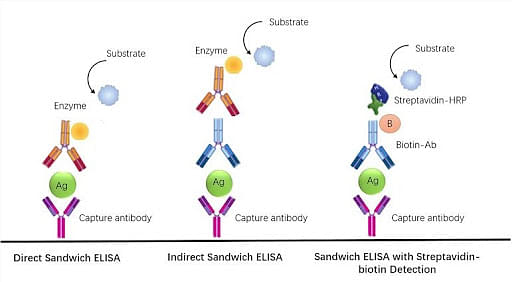
In the Sandwich ELISA Technique, the antibody is poured into the wells of the plate. In this microtitre plate is coated with antibody.
Process for Sandwich ELISA Tecnique
The process is as follows:
- The antigens are added to the wells precoated with antibodies.
- The mixture is allowed to stand for some time.
- During this time period, the antigen and antibodies react to form a complex.
- These antibodies, pre-coated on the wells, are called primary antibodies.
- The antigen-antibody complex is then treated with a secondary antibody-enzyme conjugation.
- This secondary then displaces the primary antibodies and binds with the antigen,
- Finally, a substrate is added which gives the enzyme-antibody-antigen complex a blue color.
Competitive ELISA Technique
In the Competitive ELISA Technique, the antigen is poured into the wells of the plate, and the coated wells are then treated with an antigen-antibody mixture.
Process for Competitive ELISA Tecnique
The process is as follows:
- The antibody-antigen complex is added to the wells precoated with antigen.
- The mixture is allowed to stand for some time.
- During this time period, the antigen and antibodies react to form a complex.
- These antibodies are called primary antibodies.
- The non-bonded primary antibodies are washed away.
- The antigen-antibody complex is then treated with a secondary antibody-enzyme conjugation.
- This enzyme then displaces the antigen and binds with the primary antibodies.
- Finally, a substrate is added which gives the enzyme-primary antibody complex a blue color.
Read More: DNA Polymerases
The table below showcase the difference between types of ELISA Techniques on different parameters along with the procedure followed for each type.
| Particulars | Indirect ELISA | Sandwich ELISA | Competitive ELISA |
|---|---|---|---|
| Analyte Detected | It detects the presence of antibodies in a sample. | It detects the presence of antigen in a sample. | It detects the presence of the concentration of antigen in a sample. |
| Support media used | The wells are coated by antigen. | The wells are coated by antibodies. | The wells are coated by antigen. |
| Analyte mixture used | The liquid mixture containing the antibodies is poured into the coated wells. | The liquid mixture containing the antigen is poured into the coated wells. | The liquid mixture containing the antigen-antibodies complexes is poured into the coated wells. |
| Measurements made | The blue color produced is measured using a spectrophotometer. | The blue color produced is measured using a spectrophotometer. | The blue color produced is measured using a spectrophotometer. |
ELISA Experiment
Read More: Comparison Articles in Biology
Material Required for ELISA Technique
[Click Here for Sample Questions]
The material required for ELISA Techniques are as follows:
- Coating Wells: In this process, 96 or higher well plates are used.
- Analyte to be Evaluated: It will evaluate the antigen, antibodies, peptides, and proteins
- Supporting Media: It includes polysaccharides, antigens, antibodies, etc.
- Colouring Agent: It is responsible for imparting the solution a blue color.
- Spectrophotometer: It is used to detect the concentration works on the principle of absorption of light rays by the sample.
Read More:
| Related Articles | ||
|---|---|---|
| Retrovirus | Prokaryotic and Eukaryotic cell | Birth Control |
| Carbohydrate Metabolism | Sexual Reproduction | Bones of the Wrist |
Advantages of ELISA Technique
[Click Here for Sample Questions]
The advantages of conducting an ELISA technique is as follows:
- It accurately detects a particular disease.
- ELISA Technique is a type of quick test whose results are available quickly.
- The test can easily be carried out for complex samples.
- ELISA Technique uses direct and indirect methods to give highly responsive results.
Read More: Open type Circulatory System
Applications of ELISA Technique
[Click Here for Sample Questions]
The various applications of ELISA Technique are as follows:
- ELISA Technique can be used to track the outspread of diseases in communities.
- It can easily determine whether an individual require a vaccine or not.
- The technique can easily detect for food allergies.
- ELISA Technique can easily be used to estimate hormone level in the body.
Read More:
| Related Articles | ||
|---|---|---|
| Binary Fission | Cell organelles | Mycobacterium Tuberculosis |
| Biofortification | Heart Attack Symptoms | Inbreeding Depression |
Things to Remember
- ELISA is abbreviated as Enzyme-Linked Immunosorbent Assay.
- It is one of the most common assay techniques used in science.
- ELISA Technique checks for the presence of antibodies, hormones, proteins, and peptides.
- It is broadly divided into three types, depending on their functioning.
- Direct ELISA, Indirect ELISA, and Sandwich ELISA are three types of Elisa Technique.
- ELISA is used to detect an antibody to HIV by using indirect or sandwich ELISA.
- It also can detect an antigen for human chorionic gonadotropin hormone (HCG).
- The component is excreted in the urine of a pregnant woman by using direct ELISA.
Read More:
Sample Questions
Ques. Write a note on ELISA and its principles? (5 marks)
Ans. ELISA is one of the most common scientific analytical procedures to check the presence or concentration of antibodies, hormones, proteins, and peptides in the given sample. ELISA is an assay method. It is easy, simple, and efficient to perform.
- ELISA works on the principle of antigen-antibody binding.
- The principle requires two primary components: an analyte, which is needed to be estimated quantitively and qualitatively.
- The second component is a solid support media, on which the analyte is adsorbed.
- The analyte to be estimated is converted into a liquid sample using appropriate solvents.
- This liquid mixture is then poured onto the solid support media, which is further separated and evaluated.
Ques. What are the different types of ELISA? (3 marks)
Answer: ELISA assay is a simple and efficient technique and is broadly divided into three branches, depending on their mechanism of functioning: Direct ELISA, Indirect ELISA, and Sandwich ELISA.
- Indirect ELISA: Here, the antigen is poured into the wells of the plate.
- Sandwich ELISA: Here, the antibody is poured into the wells of the plate.
- Competitive ELISA: Here, the antigen is poured into the wells of the plate, and the coated wells are then treated with an antigen-antibody mixture.
Ques. What are the applications of ELISA? (5 marks)
Ans. ELISA has a plethora of applications, ranging from the field of food, sciences, forensics to medicinal sciences.
- Cancer screening: ELISA is widely used to determine the presence of cancer biomarkers in the body. They can efficiently detect the presence of cancer cells, especially breast cancer and ovarian cancer in the early stages.
- Presence of drugs: The presence and concentrations of illegal drugs, like cannabinoids (morphine, heroin), amphetamines, opiates, cocaine, benzodiazepines (sedative drugs), and methadone, can be determined using ELISA in urine samples and in blood.
- Pharmaceutical Industry: ELISA is also used to monitor the levels and concentration of pharmaceutical drugs in patients or subjects undergoing the treatment regimen.
- Detection of antibodies for platelets: ELISA is commonly used for patients suffering from idiopathic thrombocytopenic purpura and systemic lupus erythematosus to determine the concentration of antibodies in their plasma and blood.
- Food impurities and allergens: ELISA is used by several regulatory bodies to determine the concentration of allergens and impurities in the food sample. These impurities are expressed in parts per million (ppm) concentrations.
Ques. What are the advantages of ELISA? (3 marks)
Ans. ELISA has the following advantages:
- Simple procedure
- Highly specific
- Highly sensitive and efficient
- Several analytes can be separated simultaneously
- Low chances of errors
- Suitable for complex samples
- Flexible method
Ques. Write the working principle of ELISA? (5 marks)
Ans. The working principle can be explained using the following procedure:
- The antibodies/antigens are added to the wells pre-coated with antigens/antibodies.
- The mixture is then allowed to stand for some time.
- During this time period, the antigen and antibodies react to form a complex.
- This material added initially is called primary antibodies/antigens.
- The non-bonded primary antibodies/antigens are washed away using a suitable solvent.
- The already-formed antigen-antibody complex is then treated with a secondary antibody-enzyme conjugation.
- This enzyme then displaces the antigen and binds with the primary antibodies.
- Finally, a substrate is added, which gives the enzyme-primary antibody complex a blue colour.
Ques. What is the material required to carry out ELISA? (3 marks)
Ans. The following requirements are needed to carry out the procedure efficiently:
- Coating wells: Higher well plates are used for this process.
- Analyte to be evaluated: It will evaluate antigens, antibodies, peptides, and proteins.
- Supporting media: Polysaccharides, antigens, and antibodies are used as supporting media.
- Colouring agent: It will impart the solution a blue colour.
- Spectrophotometer: It detects the concentration and works on the principle of absorption of light rays by the sample.
Ques. How is ELISA used in the detection of viruses? (3 Marks)
Ans. ELISA is widely used to determine the presence of viruses in the body. Here, the virus acts as the antigen to be determined, and its suitable antibody acts as the supporting media.
The different viruses which can be determined using ELISA are:
- HIV: Here the presence of cystamine C is determined
- Newcastle Delete Virus: It causes respiratory disorders
- West Nile virus: Here, IgM is determined
Ques. What are the disadvantages of ELISA? (3 marks)
Ans. ELISA has the following disadvantages:
- Sophisticated techniques and expensive cultural media are needed to carry out the procedure.
- There is a high possibility of false results due to insufficient blocking of immobilized antigens
- Labour intensive procedure
- Antibodies are often unstable
- Refrigeration is often needed.
Ques. What is the difference between Indirect ELISA Technique and Sandwich ELISA Technique? (3 marks)
Ans. The difference between Indirect ELISA Technique and Sandwich Elisa Technique are as follows:
| Indirect ELISA Technique | Sandwich ELISA Technique |
|---|---|
| In indirect technique coating wells are coated with antigens. | In sandwich technique coating wells are coated with antibodies. |
| The process is used for detection of antibodies in the sample. | The process is used for detection of antigens in the sample. |
| The process is highly flexible and simple. | The process is quite complex. |
Ques. What disease can be detected using ELISA Technique? (1 mark)
Ans. The diesese which can be detected using ELISA Technique are as follows:
- AIDS
- Ebola
- Rotavirus
- Zika Virus
- Pernicious Anaemia
- Syphilis
-
Toxoplasmosis
Ques. What is the difference between antigens and antibodies? (4 marks)
Ans. The difference between antigens and antibodies are as follows:
| Antigens | Antibodies |
|---|---|
| Antigens are basically lipids that can be protein and carbohydrates. | Antibodies are all proteins. |
| It can causes illness or allergic reaction to the body. | It will act as shield against antigens. |
| They originate outside the body. | They originate inside the body. |
| Antigens are also called Immunogens. | Antibodies are also called Immunogloblins. |
For Latest Updates on Upcoming Board Exams, Click Here:https://t.me/class_10_12_board_updates
Check-Out:



Comments