



Education Content Expert
Free Radicals are atoms, molecules, or ions that have at least one unpaired valence electron. They are said to be a set of impaired electrons that are present in every molecule and combine with other constituents.
- Free radicals are molecules that have unpaired electrons.
- They can combine easily with their respective components without getting affected by the outside atmosphere.
- There should be more presence of free radicals in human body as it plays a significant role in the proper functioning of the body.
- Free radicals are caused by the homolytic cleavage of a covalent bond.
Read More: NCERT Solutions For Class 11 Chemistry Organic Chemistry Some- Basic Principles and Techniques
Key Terms: Free Radicals, Electrons, Neutral Free Radicals, Charged Free Radicals, Carbohydrates, Inflammation
What are Free Radicals?
[Click Here for Sample Questions]
Free Radicals are defined as a molecular species that contain an unpaired electron in its atomic orbital. They can exist independently.
- They are unique and rare species and are present only under the limited and special conditions.
- They are very unstable and highly reactive.
- They mostly behave as oxidants or reductants because they can donate an electron or even accept an electron from other molecules.
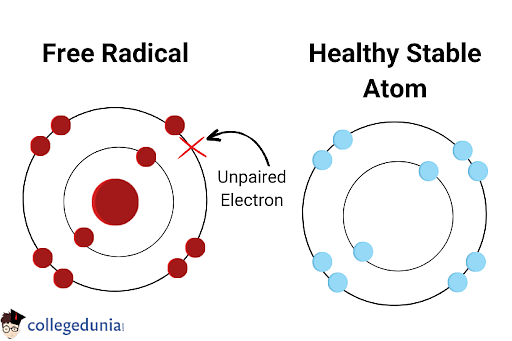
Free Radical
Types of Free Radicals
[Click Here for Previous Year Questions]
Free radical is divided into two major types:
- Neutral Free Radicals: Neutral Free Radicals do not charge them. That is why they have very little reactivity than the charged free radicals.
- Charged Free Radicals: Charged Free radicals have a great capacity to mix with other constituents and components. They are very strongly reactive. These charged free radicals can be either negative or positive.

Types of Free Radicals
Read More:
Properties of Free Radicals
[Click Here for Sample Questions]
The properties of Free Radicals are as folllws:
- Free radicals are very unstable and highly reactive which makes them open and available for other components to merge and come with them.
- Of the unstable nature, free radicals can combine and attract with any component freely and easily.
- Free radicals can accept or donate an electron from other molecules, and therefore they can behave as reactants or oxidants.
- They are rare species and are unique. They are present only under limited and special conditions.
- Nitrogen dioxide and Nitrogen monoxide are free radical species and are also stable.
- Moreover, oxygen-free radicals are the reactive species that are involved in immunity such as singlet molecular oxygen and superoxide anion radical.
- Molecular oxygen is a bi-radical and free radical species.
- Stable and standard molecular oxygen is in triple-state and has respectively the similar spin orientation in two orbitals, having a similar orbital energy that is based on Hund's rule.

Oxidative Stress
What Causes Free Radicals?
[Click Here for Previous Year Questions]
Free radicals are caused by metabolic processes in the body.
- These metabolic processes are the required and essential processes of the body.
- Free radicals can get into the body though external sources like cigarette smoke, x-rays, etc.
- They can cause quick combinations in the body of the living being with the other components and form a large chain reaction.
- With every molecule, these free radicals are very quick to react, and these reactions are known as 'oxidation reactions' in living beings.
Read More: Organic Chemistry: Basic Principles and Techniques
Examples of Free Radicals
[Click Here for Sample Questions]
Let us consider three reactive species i.e. methyl radical, methyl cation, and methyl anion.
- Ethane comprises two methyl groups which are connected by a very stable compound and covalent bond.
- Methyl carbon and methyl anion have an ionic bond between counter-ions and carbons. Though they are particularly not unstable but are some moisture-sensitive species.
- Methyl radical is however a reactive and unstable species because the octet rule is not filled on the carbon.
- The structure of the carbon atom in the methyl cation is planar and triangular and it adopts sp2 hybridization.
- The structure of the carbon atom in the metal anion is tetrahedral and it adopts sp3 hybridization.
- The carbon atom in the methyl radical accepts a mid structure between methyl anion and a methyl cation, and even at extremely low temperatures, its pyramidal inversion occurs rapidly.
Some of the important free radicals that comprise oxygen are:
- Hydroxyl Radical
- Hypochlorite
- Hydrogen Peroxide
- Superoxide Anion Radical
- Peroxynitrite Radical
- Nitric-oxide Radical
Sources of Free Radicals
[Click Here for Previous Year Questions]
Free radicals are generated internally with the help of given sources:
- Inflammation
- Mitochondria
- Exercise
- Peroxisomes
- Phagocytosis
The sources of free radicals generated externally are:
- Cigarette Smoke
- Environmental Pollution
- Pesticides and Drugs
- Radiation
- Ozone Layer
Uses of Free Radicals
[Click Here for Sample Questions]
Some of the uses of free radicals are as follows:
- Free radicals are used in the cell membranes of damaging biological molecules such as carbohydrates, proteins, and DNA.
- Free radicals attack the important macromolecules that lead to homeostatic disruption and cell damage like nucleic acids, proteins, etc.
- In general, alkyl halides or alkyl halides are used as radical precursors for Ar or R.
- Barton Mccombie reaction is used for radical reactions in peptides and sugar nucleosides.
- Other thiocarbonyl derivatives that are formed from alcohols with imidazole, phenyl this carbonyl, etc can be used instead of methyl xanthate.
Check More:
Things to Remember
- Free radical are a group or an atom that has an unpaired or odd electron.
- They are divided into two types namely Neutral Free Radicals and Charged Free Radicals.
- Free radicals are very unstable and highly reactive which makes them open and available for other components to merge and come with them.
- They are used in the cell membranes of damaging biological molecules like carbohydrates, lipids, proteins, and DNA.
- They can accept or donate an electron from other molecules, and therefore they can behave as reactants or oxidants.
Previous Years’ Questions
- Which of the free radical is most stable… (JEE Main - 2013)
- The least stable free radical is… (BHU UET - 2009)
- Which one of the following is a free- radical substitution reaction… (AIPMT - 2003)
- The most stable free radical among the following is…
- Due to the presence of an unpaired electron, free radicals are… (AIEEE - 2005)
- Stephen's reduction is used to prepare aldehyde from…
- Which of the following is process used for the preparation… (BITSAT - 2012)
- In the detection of III group basic radicals… (COMEDK UGET - 2009)
- The order of stability of free radical is…
- Which of the following statements, is not characteristic of free radical… (JIPMER - 1995)
Sample Questions
Ques. Mention three characteristics of free radicals. (2 Marks)
Ans. The characteristics of free radicals are:
- Free radicals are short-lived.
- They are highly reactive.
- Free radicals are unstable.
Ques. From where free radicals are derived? (2 Marks)
Ans. Free radicals are derived from essential and natural metabolic processes in the human body. They are also derived from external sources like Cigarette smoke. Environmental Pollution, Pesticides, Drugs, Radiation, and the Ozone layer.
Ques. What are the various functions of Free Radicals in the Human Body? (5 Marks)
Ans. Free radicals are often associated with cell damage and the development of diseases such as cancer and heart disease. They also play important roles in several essential processes in the human body. Some of the most important uses of free radicals in the human body include:
- Immune System: Free radicals are produced by white blood cells as a defense mechanism against invading pathogens, such as bacteria and viruses. They help to kill and destroy these harmful invaders.
- Cell Signaling: Free radicals can act as signaling molecules, transmitting messages between cells and initiating various cellular processes. For example, they may be involved in the regulation of blood pressure and in the process of inflammation.
- Cell Growth and Differentiation: Free radicals can play a role in the normal development and functioning of cells, including the process of cell division and the formation of new blood vessels.
- Hormone Production: Some hormones, such as thyroid hormones, are produced through a process that involves the generation of free radicals.
- Brain: Free radicals may be involved in the regulation of brain function, including learning and memory.
It is important to note that while free radicals can serve important functions in the body, an excess of free radicals can also be harmful. The body has a number of defense mechanisms in place to neutralize excess free radicals, such as the enzyme superoxide dismutase and antioxidants found in foods like fruits and vegetables.
Ques. What do free radicals do in the human body? (1 Mark)
Ans. In the human body, free radicals contribute to the etiology of chronic health problems like inflammatory and cardiovascular disease, cancer, and cataract.
Ques. What following food is to be avoided to save free radicals in the human body? (2 Marks)
Ans. The food that needs to be avoided to save free radicals in the human body is-
- Foods that have a richness of Lutein like green leafy vegetables
- Foods that are rich in beta carotene like spinach, sweet potato, carrot, etc.
- Lycopene-rich food.
Ques. Give some examples of free radicals. (1 Mark)
Ans. Some examples of free radicals are Hydrogen radicals (OH), Hydrogen Peroxide (H2O2), Nitric Acid (NO), etc.
Ques. What are the types of radicals? (2 Marks)
Ans. There are two main types of radicals: superoxide and hydroxyl. These radicals are formed in the presence of oxygen and under certain reducing conditions. However, their reactivity can also lead to unwanted side reactions that can cause damage to cells.
Ques. What are the diseases caused by the Free Radicals? ( 5 Marks)
Ans. Free radicals are highly reactive molecules that can damage cells and contribute to the development of a range of diseases. Some of the diseases that are thought to be caused or exacerbated by the presence of free radicals in the body include:
- Cancer: Free radicals can damage DNA and other genetic material, leading to the development of cancerous cells.
- Heart Disease: Free radicals can contribute to the development of plaque in the arteries, which can lead to heart attack and stroke.
- Aging: Free radical damage is thought to be one of the main causes of the aging process, leading to the breakdown of collagen and other tissues in the body.
- Neurological Disorders: Free radicals have been linked to the development of neurodegenerative diseases such as Alzheimer's and Parkinson's disease.
- Arthritis: Free radicals can cause inflammation in the joints, leading to the development of conditions such as osteoarthritis and rheumatoid arthritis.
- Diabetes: Free radicals have been linked to the development of insulin resistance, which can lead to the development of type 2 diabetes.
By minimizing the presence of free radicals in the body, it may be possible to reduce the risk of developing these and other diseases.
Ques. Where do free radicals come from? (2 Marks)
Ans. Free radicals and other reactive oxygen species can originate from within the body as a result of natural metabolic processes, or they can come from external sources such as radiation, ozone, tobacco smoke, pollution, and chemical substances.
Ques. Why are free radicals so reactive? (2 Marks)
Ans. Free radicals are highly reactive due to the presence of unpaired electrons, which require a large amount of energy to stabilize. This makes them prone to reacting with other molecules and leads to their instability. The reactivity of radicals can also be influenced by the exothermic abstraction of hydrogen atoms, which can make the reaction less stable and more prone to the formation of carbon-centered radicals.
Ques. How do free radicals affect the body? (2 Marks)
Ans. Free radicals can have detrimental effects on the body by causing damage to cell membranes, DNA, and mitochondria. This damage can make cells more susceptible to decline and infections and can lead to various health problems.
Ques. What diseases do free radicals cause? (2 Marks)
Ans. There is increasing evidence that many degenerative diseases are caused by harmful free radical reactions. These diseases include atherosclerosis, cancer, inflammatory joint disease, asthma, diabetes, senile dementia, and eye degeneration.
Ques. What types of foods should be avoided to have the presence of free radicals in the human body? (3 Marks)
Ans. There are several types of foods that should be avoided in order to minimize the presence of free radicals in the human body. Free radicals are highly reactive molecules that can damage cells and contribute to the development of diseases such as cancer and heart disease.
- Processed and Packaged Foods: These foods often contain artificial preservatives, flavorings, and colorings that can generate free radicals in the body. It is best to opt for fresh, whole foods instead.
- Sugar: It should be avoided due to its ability to generate free radicals. This includes added sugars found in sweets, baked goods, and sugary drinks, as well as natural sugars found in fruit and honey.
- Fried and Grilled Foods: It should also be avoided, as the high heat used in these cooking methods can create free radicals. Instead, try steaming, boiling, or baking foods.
By avoiding these types of foods and choosing a diet rich in fruits, vegetables, and whole grains, you can help to reduce the presence of free radicals in your body and promote overall health.
Check-Out:



Comments