



Education Content Expert
Fumaric Acid is an organic compound with the chemical formula C4H4O4. Fumaric Acid is also known as Allomaleic Acid and is a dicarboxylic acid. It is conjugate acid of fumarate. Fumaric acid is mostly found in its solid state and appears to be white in colour. It has a fruit-like taste. It is widely used as a food additive.
Fumaric Acid is produced by oxidizing succinic acid using succinate dehydrogenase. Fumaric Acid is also produced by human skin when exposed to sunlight. It is also a by-product of the urea cycle in human beings. Fumaric and maleic acid were discovered by Braconnet and Vauquelin separately during the dry distillation of malic acid in 1817.
Key Terms: Fumaric Acid, Organic Compound, Dicarboxylic Acid, Fumarate, Allomaleic Acid, Isomerization, Maleic Acid, Food Additive
What is Fumaric Acid?
[Click Here for Sample Questions]
Fumaric acid is a dicarboxylic acid and a conjugate acid of fumarate. The chemical or molecular formula of Fumaric Acid is C4H4O4.
- Fumaric Acid is also known as the Allomaleic Acid or Turmeric Acid.
- It is a precursor to L-malate in the TCA cycle (also known as Krebs Cycle).
- Fumaric Acid is produced through oxidizing succinic acid using succinate dehydrogenase.
- Fumarate is converted to malate by this process with the fumarate enzyme.
- Fumaric Acid is also present in high levels in bio-fluids surrounding tumours or inside the tumours of humans.
- Fumaric acid is expected to improve the quality of many food and beverage products.
Structure of Fumaric Acid
[Click Here for Previous Years' Questions]
The chemical formula of Fumaric Acid is C4H4O4. Fumaric Acid is composed of Carbon, Hydrogen, and Oxygen. (E)-Butenedioic Acid is the IUPAC name of Fumaric Acid. It is the trans-isomer of butenedioic acid. Fumaric Acid has a Carbon-carbon double bond and the geometry of this molecule is E.
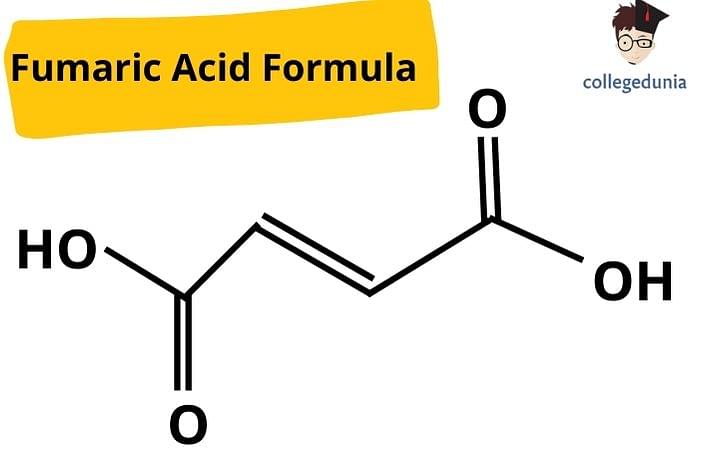
Structure of Fumaric Acid
Physical Properties of Fumaric Acid
[Click Here for Sample Questions]
The physical properties of Fumaric Acid are tabulated below:
| Appearance | White-Coloured Solid |
| Odour | Fruit-Like Odour |
| Molecular Weight | 116.072 g/mol |
| Density | 1.635 g/cm3 |
| Melting Point | 287 °C |
| Sublimation Point | 200 °C |
Chemical Properties of Fumaric Acid
[Click Here for Previous Years' Questions]
The chemical properties of fumaric acid are listed below:
- Fumaric acid is soluble in concentrated sulfuric acid and ethanol.
- Fumaric acid is soluble in alcohol but is insoluble in water, benzene, and chloroform.
- The capacity of fumaric acid to absorb moisture is very less.
- The pH level of Fumaric acid is 3.19.
- When heated in presence of Bayers reagent, fumaric acid produces Resimic Tartaric Acid.
- When heated in a closed container with water at 150 – 170°C, it produces DL-malic acid.
- On bromination, it produces 2,3-dibromosuccinic acid.
- When heated with methanol in the presence of Sulfuric acid, fumaric acid gives rise to Dimethyl fumarate.
Read More: Gluconic Acid Formula
Preparation of Fumaric Acid
[Click Here for Sample Questions]
Fumaric acid can be produced in a variety of ways which are listed below:
- Fumaric Acid can be produced by the isomerization of maleic acid. In this process, a catalyst such as mineral acid is used.
- It is prepared by heating dilute Bromo succinic acid in the presence of KOH.
- It can also be prepared by the reduction of tartaric acid in presence of iodine and phosphorus.
- It is prepared by heating bromosuccinic acid with water.
- Fumaric Acid can also be prepared by heating Maleic acid at a temperature of more than 200oC.
Read More: Chlorous Acid Formula
Uses of Fumaric Acid
[Click Here for Previous Years' Questions]
The major uses of fumaric acid are as follows:
- Fumaric acid is widely used as a food additive.
- Fumaric Acid helps preserve the taste and quality of the food items owing to the low moisture-retention capacity of the Fumaric acid.
- Due to the antioxidants and anti-inflammation properties, the esters of Fumaric acid are used to treat.
- It is also used in pharmacies to produce ferrous fumarate and alexipharmic.
- It is also brought into use to produce Tartaric acid.
Things to Remember
- Fumaric Acid is an organic compound which is also known as the Allomaleic Acid or Turmeric Acid.
- The chemical formula of fumaric acid is C4H4O4 .
- Fumaric acid is usually found in a solid state and appears to be white in colour.
- It is a dicarboxylic acid and is a trans-isomer of butenedioic acid.
- Fumaric acid is produced by human skin when exposed to sunlight and is also a by-product of the urea cycle in humans.
- It is used in the manufacturing of food, drinks, medicines, animal feed, and cleaning agents.
Previous Years’ Questions (PYQs)
- A pair of compounds which shows geometrical isomerism are…
- The second dissociation constant of fumaric acid…
- Lactic acid is produced by Rhizopus species…
- FAD participates in Krebs' cycle as electron acceptor during… (NEET 1997)
- In TCA cycle substrate level phosphorylation takes… (AMUEEE 2013)
- The first stable compound formed in Krebs' cycle is…
- Which of the two acids form anhydrides…
- Which of the following is a ketone body…
- Which one of the following acids does not exhibit optical… (JEE Main 2014)
- Which one of the following can exhibit cis-trans-isomerism… (NEET 1988)
Sample Questions
Ques. What is fumaric acid? (3 Marks)
Ans. Fumaric acid is an organic compound, i.e, it consists of carbon. Fumaric acid has the molecular formula C4H4O4 . The acid appears to be a white-coloured solid with a fruit-like taste and odour. Fumaric acid is also known as Allomaleic acid or Turmeric Acid.
Ques. What are the health hazards associated with fumaric acid? (3 Marks)
Ans. Even though fumaric acid is used in food items, it is not safe if it is taken in huge quantities. On direct contact with the eyes, it can cause irritation. When inhaled, it can cause irritation in the throat and the nose which eventually leads to a cough. Also, when exposed to fumaric acid continuously for a long period of time, it may damage the kidneys.
Ques. Mention some uses of Fumaric Acid. (3 Marks)
Ans. A few uses of fumaric acid are as follows:
- It is used as a food additive.
- It is also used in medicines, drinks, animal feed, and cleaning agents.
- Esters of Fumaric acid are used in the treatment of psoriasis because of their antioxidants and anti-inflammation properties.
- It is used to produce Tartaric acid.
Ques. List down a few items in which Fumaric Acid is used. (3 Marks)
Ans. Fumaric Acid is used in the following items:
- Unsaturated Polyester
- Alkyd Resins
- Paper Sizing
- Printing Inks
- Alginate Based Desserts
- Fruit Juice Drinks
- Bakery
Ques. What are the physical properties of Fumaric Acid? (3 Marks)
Ans. Fumaric acid s a crystalline white-coloured solid. It has a fruit-like odour and taste. The melting point of this acid is 287 oC. The density of fumaric acid is 1.635 grams per cubic cm.
Ques. Mention any three ways in which Fumaric acid can be produced. (3 Marks)
Ans. Three ways to produce fumaric acid are
- Fumaric acid can be produced by the isomerization of maleic acid with mineral acid acting as a catalyst.
- It is also prepared by heating dilute Bromo succinic Acid acid in the presence of KOH.
- Reduction of tartaric acid in presence of phosphorus and iodine also leads to the production of fumaric acid.
Ques. What are maleic acid and fumaric acid? (1 Mark)
Ans. Fumaric acid is the trans-isomer of butenedioic acid whereas Maleic acid is the cis-isomer of butenedioic acid.
Ques. How is fumaric acid used in food? (3 Marks)
Ans. Fumaric Acid is a non-toxic food additive that is usually used in beverages and baking powders for which requirements are based on purity. Fumaric acid is used as a substitute for tartaric acid and takes the place of citric acid, at a rate of 1.36 grams of citric acid to every 0.91 grams of Fumaric Acid for the same taste.
Ques. Where is fumaric acid usually found? (2 Marks)
Ans. Fumaric acid is mostly found in fumitory, bolete mushrooms, lichen, and Iceland moss. It acts as an intermediate in the citric acid cycle that is used by cells to produce energy in the form of ATP.
Check-Out:



Comments