



Education Journalist | Study Abroad Lead
Half wave rectifiers are used to convert AC voltage into DC voltage. It does so by passing only a single half of the alternating current voltage waveform while blocking the other half. Generally, a rectifier is a device that helps in the conversion of AC (alternating currents) to DC (direct current). A half wave rectifier circuit uses just one diode for this AC to DC voltage conversion process. A half-wave rectifier allows only a single-way flow of the current. Only passing half of the AC current leads to irregularities, therefore a capacitor is usually used to smooth out the rectified signal before it can be used. Half-wave rectifiers are less efficient compared to full-wave rectifiers.
| Table of Content |
Key Terms: Half Wave Rectifier, Rectifier, Diode, Alternating Current, Direct Current, Waveform, Voltage
Half Wave Rectifier
[Click Here for Sample Questions]
A half-wave rectifier is the simplest form of rectifier that make use of only one diode. The half wave rectifiers use just one diode to transform AC voltage to DC Voltage.
- The current can pass through a diode only when it is forward-biased.
- On applying an alternating voltage across a diode, the current only flows in one part of the cycle.
- This property of diodes is used to rectify alternating voltages and a rectifier that allows only one-half cycle of an AC voltage waveform to pass while blocking the other half cycle are called half wave rectifiers.
Circuit of Half Wave Rectifier
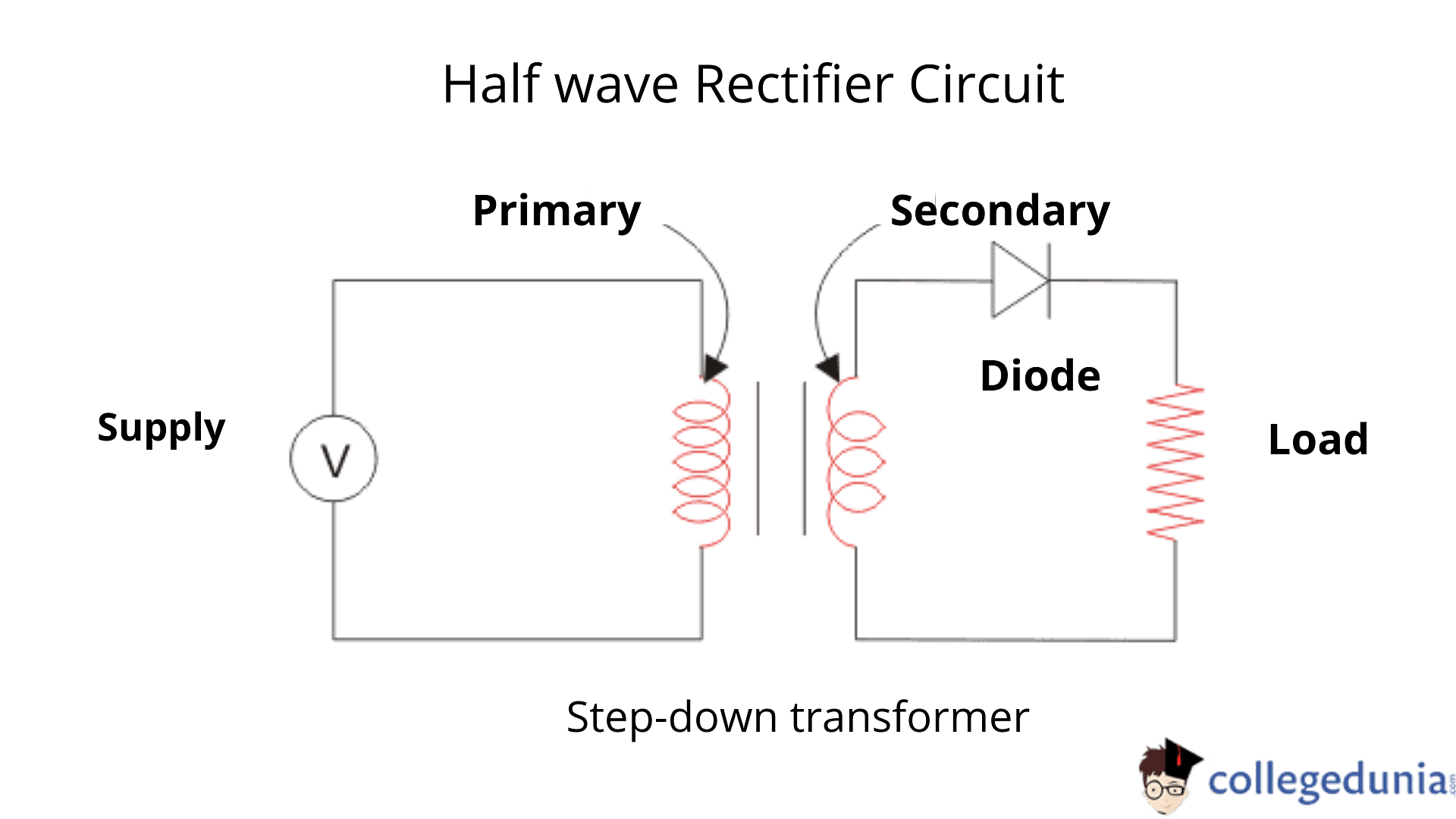
A half rectifier circuit consists of three main components:
- A diode
- A transformer
- A resistive load
Also Read:
| Important Topics Related to Half Wave Rectifiers | ||
|---|---|---|
| Digital Electronics and Logic Gates | Zener Diode | Extrinsic Semiconductors |
| Light Emitting Diodes | Diode Vs Rectifier | Semiconductor Diode |
| Intrinsic Semiconductors | Varactor Diode | Photodiodes |
| Zener Diode as a Voltage Regulator | Integrated Circuits | Transistor |
Working of Half Wave Rectifier
[Click Here for Previous Year Questions]
The working of the half-wave rectifier is as follows:
- Half wave rectifier works as a step-down transformer, the left side is the primary side and the right side is the secondary side.
- AC voltage is connected to the primary side and the secondary side is equipped with the diode and the load.
- A high AC voltage is applied to the primary side of the transformer. The secondary low voltage that is acquired is then applied to the diode.
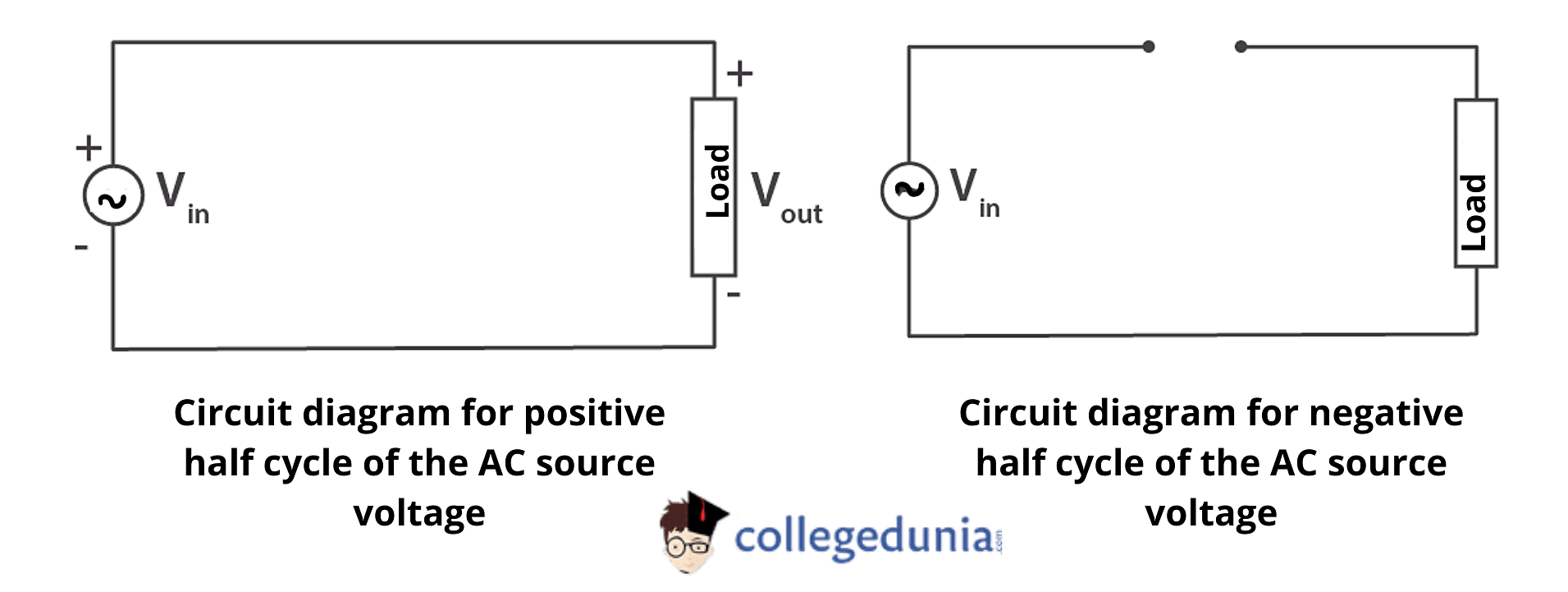
- The diode works in two ways, it is forward biased during the positive half cycle and reverse biased during the negative half cycle.
- When the diode is forward biased, it acts as a closed switch while in reverse biased it acts as an open switch.
- As a result, no current can flow to the load and the output voltage is equal to zero.
Half Wave Rectifier
Half Wave Rectifier Capacitor Filter
[Click Here for Sample Questions]
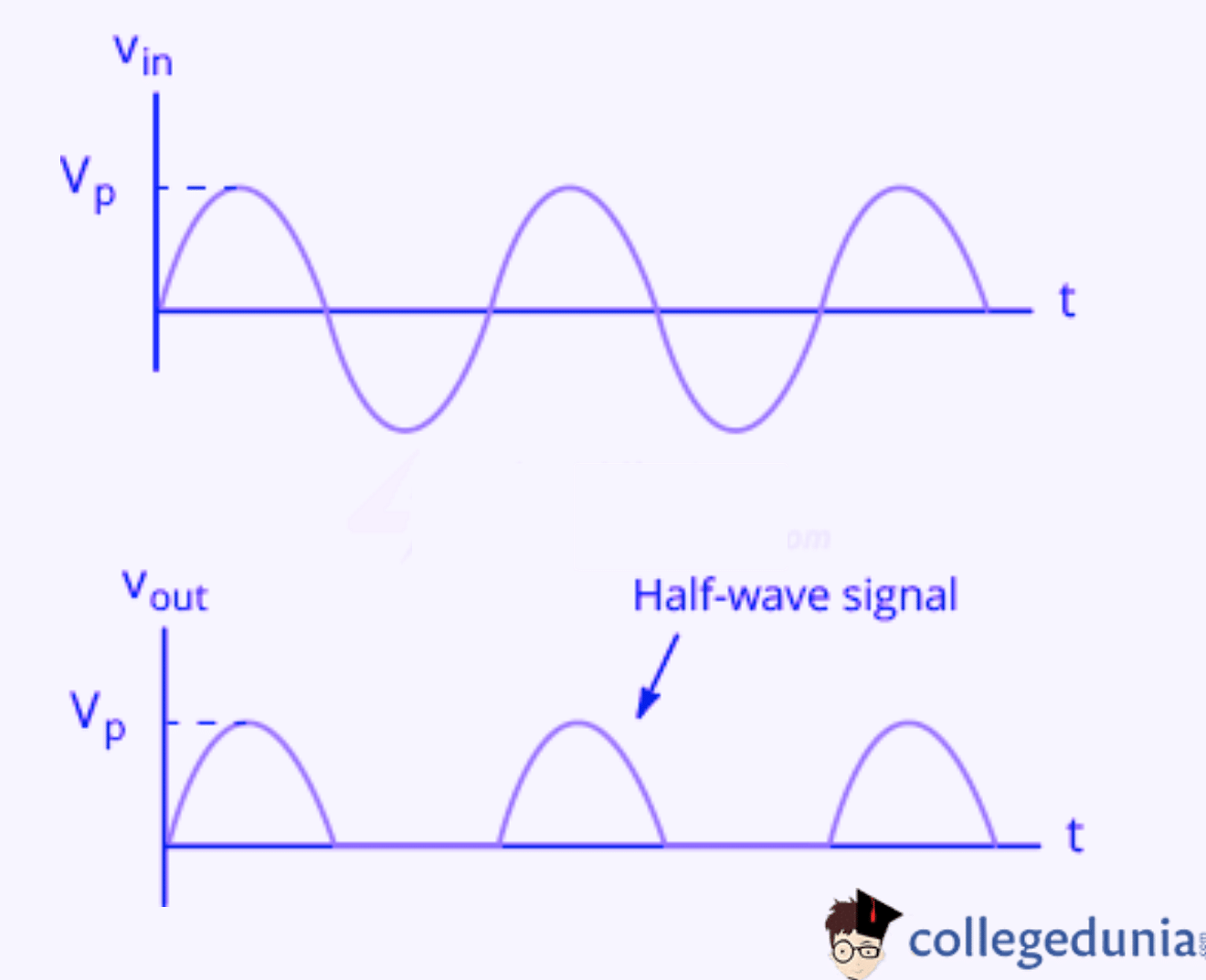
In a half-wave rectifier, a capacitor or an inductor can be used as a filter. The output waveform of the half wave rectifier is a pulsating DC waveform.
- The main function of filters is to transform the pulsating waveform into a constant DC waveform.
- The filter is an electronic device used to perform signal processing. There are three different types of filters:
- Low Pass Filter
- Band Pass Filter
- High Pass Filter
Half-Wave Rectifier Waveform
Half Wave Rectifier Formula
[Click Here for Previous Year Questions]
The different half wave rectifier formula are given as –
Ripple Factor of half wave rectifier
Ripple factor determines how well the given rectifier can convert AC voltage into DC voltage. The ripple factor of a halfwave rectifier is 1.21.
The ripple factor can be calculated using the following formula – \(\gamma =\sqrt{(\frac{\nu_{rms}}{\nu_{dc}}})^2 -1\)
Efficiency of half wave rectifier
The efficiency of a half wave rectifier is given as the ratio of output DC power to the input AC power.
The efficiency is given by the formula – η = \(\frac{P_{DC}}{P_{AC}}\)
RMS value of Half wave Rectifier
The RMS value for a half-wave rectifier is given by Irms=\(\frac{Im}{2}\)
Form Factor of a half wave rectifier
The form factor refers to the ratio of the RMS value to the average value
Form Factor =\(\frac{\text{RMS value}}{\text{Average value}}\)
Applications of Half Wave Rectifier
[Click Here for Sample Questions]
The half wave rectifier is commonly used for the following applications:
- Single demodulation purpose
- Rectification application
- Signal peak application
Disadvantages of Half Wave Rectifiers
[Click Here for Previous Year Questions]
The main disadvantages of half-wave rectifiers are as follows:
- Power loss
- Low output Voltage
- A lot of ripples
Things to Remember
- Half wave rectifiers allow only one part of the AC voltage to pass blocking the other.
- Half wave rectifiers are used to transform Alternating current input power into Direct current output power.
- During the first positive wave cycle, the diode in the AC voltage is forward biased.
- When the AC voltage is having a negative wave cycle the diode is reverse biased.
- Filters in the half wave rectifiers are used to stabilize the pulsating DC waveforms into constant DC waveforms.
Also Check Out:
Previous Year Questions
- Determine the type of gate. [JIPMER 2019]
- Which Logic gate is represented by the truth table? [JKCET 2012]
- Calculate ß when the emitter current is changed. [JEE Main 2021]
- What is the impurity atom to be doped for p type semiconductors? [JEE Advanced 1988]
- What is pure silicon. [JIPMER 2018]
- Device that acts as a complete electronic circuit. [NEET 2010]
- A p-n junction diode is also used as? [NEET 1999]
- What is an intrinsic semiconductor. [MET 2012]
- Determine the semiconductor device type. [NEET 1998]
- When is an npn transistor used as an amplifier. [NEET 1996]
- The electrical network is equivalent to? [NEET 2017]
- The value of photo electromotive force is proportional to? [NEET 2005]
- At absolute zero, Si acts as? [NEET 1988]
- Which have negative coefficient of resistance. [NEET 2020]
- Determine the logic gate? [NEET 2010]
- Which is p-type semiconductor? [NEET 2013]
- What causes increase in width of depletion region. [NEET 2020]
- Calculate the voltage gain and power of the amplifier. [NEET 2017]
- The pn junction is forward biased when? [NEET 1988]
- Calculate the power gain of the amplifier. [NEET 2010]
Sample Questions
Ques. What is a half wave rectifier? (3 marks)
The current can pass through a diode only when it is forward biased. On applying an alternating voltage across a diode, the current only flows in one part of the cycle. This property of diodes is used to rectify alternating voltages and a rectifier that allows only one-half cycle of an AC voltage waveform to pass while blocking the other half cycle are called half wave rectifiers.
Ques. Where half wave rectifiers are used? (2 marks)
- Circuits with low power are used to charge simple batteries.
- Circuits used in pulse generation.
- Circuits used for signal demodulation.
- Cementing iron circuit.
Ques. What is the use of a filter in a half wave rectifier? Which diode is used in a half wave rectifier? How many diodes are used in the half wave rectifier? (3 marks)
In a half wave rectifier, PN Junction is used to convert AC to DC. One diode is used in the half wave rectifier while the full wave rectifier uses two diodes.
Ques. Why is capacitor used in half wave rectifiers? (2 marks)
Ques. What are the different types of rectifiers? (4 marks)
- Single phase & three phase rectifiers
- Half wave & full wave rectifiers
- Bridge Rectifiers
- Uncontrolled & Controlled Rectifiers
Ques. What is the Ripple Factor of a half wave rectifier? Give its value. (3 marks)
The ripple factor of the half wave rectifier is 1.21.
Ques. Can you convert AC to DC? What is the maximum efficiency of a half wave rectifier? (2 marks)
The maximum efficiency of a half wave rectifier is 41%.
Ques. Explain with the help of a circuit diagram the working of a p-n junction diode as a half wave rectifier. [2013] (3 marks)
Ans. A half wave rectifier is a device that converts AC voltage into DC voltage allowing a single part of the current to flow and blocking the other half. The half wave rectifier consists of a diode as given in the circuit diagram.


The secondary transformer provides the required AC voltage throughout A and B. In the case of a positive half cycle of AC, the voltage present at A is positive in nature and the diode is forward biased conducting electricity.
Therefore we get the output throughout R while in the case of positive half cycles and the output varies but is unidirectional.
Ques. What happens to the width of the depletion layer of a p-n junction when it is :
1) Forward biased
2) Reverse biased [Delhi 2011] (2 Marks)
Ans.
- When the width depletion of a p-n junction is forward biased it decreases.
- When the width depletion of a p-n junction is reverse biased it increases.
For Latest Updates on Upcoming Board Exams, Click Here: https://t.me/class_10_12_board_updates
Do Check Out:



Comments