



Content Writer
A homogeneous Mixture is a type of mixture whose composition is uniform throughout the mixture. This makes the mixture uniformly distributed at the molecular or microscopic level.
- A homogeneous mixture is also known as a uniform mixture.
- These types of mixture have uniform appearance or only one visible phase.
- The solute-to-solvent ratio in the case of the homogeneous mixture can only reach a limited point.
- In these types of mixtures, the mixed components are evenly spread in the whole mixture.
For example, sugar and water are a homogeneous mixture. The taste of the water after dissolving sugar will be the same throughout, which shows that the sugar is distributed uniformly throughout the mixture.
Key Terms: Homogeneous Mixture, Heterogeneous Mixture, Mixtures, Colloids, Suspension, Emulsion, Composition, Solutions, Substances, Properties of Homogeneous Mixture
What is a Homogeneous Mixture?
[Click Here for Sample Questions]
A homogeneous mixture is a type of mixture that has the same proportions of its components in a given amount of sample. These mixtures can be solid, liquid, or gas.
- They have the same appearance and chemical composition throughout.
- The composition of a homogeneous mixture depends on the value of the solvent and solute.
- The nature of the solute and solvent affects the nature of this mixture.
- The separation methods used for homogeneous mixtures include Filtration, Distillation and Evaporation.
- In these types of mixtures, particles are very small and are not visible to the naked eye.
How to Identify Homogeneous Mixtures?
Different methods to identify homogeneous mixture are as follows:
- Visual Inspection: This process involves visual inspection of the mixture, which makes the mixture uniform and does not have visible boundaries.
- Clarity and Transparency: If you can easily see through the mixture, such as vinegar and salt water, it is considered homogeneous.
- No Settling: These types of mixtures do not separate components over time.
- Consistent Taste: A homogeneous mixture has a uniform taste throughout.
Example of Homogeneous MixturesSome examples are as follows:
|
Read More:
What is a Mixture?
[Click Here for Sample Questions]
A mixture is a combination of two or more substances that are not chemically united to each other. Everything we see around is a mixture as it has more than one substance.
- They are composed of smallest pure substances, known as elements.
- A mixture contain numerous impurities like dust and dirt, which changes its composition.
- The chemical properties of the compounds remain same.
- The enthalpy of mixing remains unchanged when a mixture is formed.
Types of Mixture
A mixture can be classified into two major types:
- Homogenous Mixture: A mixture in which the components are distributed consistently throughout the mixture. For instance, salt and water.
- Heterogenous Mixture: A mixture in which the components are unevenly distributed throughout the mixture. For instance, rice and pebbles.
Examples of MixtureSome examples of mixtures are:
|
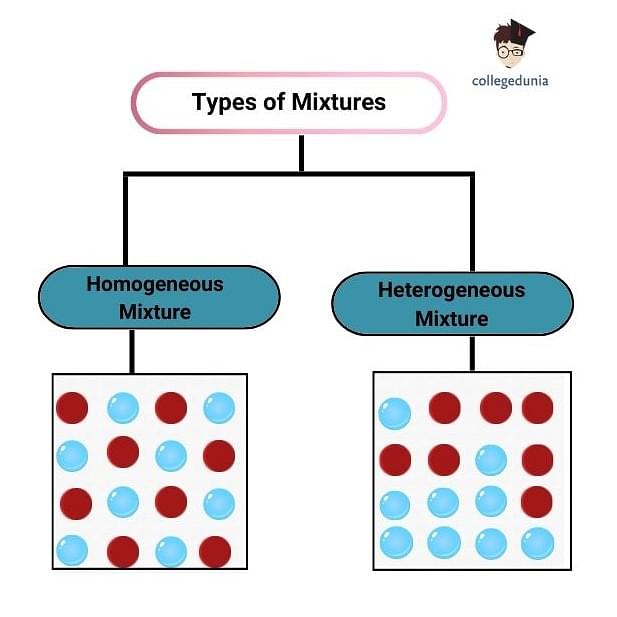
Types of Mixtures
Properties of Homogeneous Mixture
[Click Here for Sample Questions]
Listed below are some properties of homogenous mixtures:
- The components are distributed uniformly throughout a homogenous mixture.
- The components of this mixture can not be separated using a centrifugal force.
- The Tyndall effect (scattering of light by the particles in the medium) does not occur in this mixture.
- All solutions are examples of homogeneous mixtures.
- It involves the dissolution of a solute in a solvent.
- The molecular or atomic level of a substance indicates the homogeneity of substances.
Types of Homogeneous Mixture
[Click Here for Sample Questions]
Here are some important terms when dealing with the concept of mixtures:
Suspensions
A suspension is a heterogeneous mixture of two or more substances. In it, the particles are suspended throughout the solution in bulk and can be seen easily by our naked eyes if the particles are greater than 5 x 10 m in size. The suspension is unstoppable; the particles will either float or settle down.
Example SuspensionsExamples: Sand water, Flour, water, etc. |
Solutions
A solution can be defined as a homogeneous mixture if it has two or more components. The size of solute particles in the solutions is less than 1 nm in diameter.
Examples of SolutionsExamples: When sugar or salt dissolves in water. |
Components of Solutions
Two components of solutions are-
Solvent
A solvent is the component of a solution that dissolves the other component in itself. It is the larger component of the solution. For example, in a solution of sugar granules and water, sugar acts as a solute, and water is the solvent.
Solute
A solute is the component of the solution that completely gets dissolved in the solvent. It is the smaller component in the solution. E.g.: In the example discussed above, sugar acts as a solute; similarly, in soda water or cold drinks, carbon dioxide gas is the solute.
Colloids
Colloids are the mixtures in which small insoluble particles of one substance are suspended in another. The size of these mixtures varies from 1nm to 1000 nm. These types of mixture have suspended particles don’t settle down at the bottom but get evenly dispersed into another substance. Colloidal Solutions are divided into the following types:
- An emulsion is when the dispersed phase is liquid and the dispersion medium is another liquid. Example includes Milk, coffee, etc
- Foam is a colloidal solution in which the dispersed phase is gas, and the dispersion medium is either liquid or solid. Example includes Whipped cream etc.
- Aerosol is a colloidal system in which the dispersed phase is either a liquid or a solid particle, and the dispersion medium is gas. Example includes Mist, Fog, Deodorant, etc.
- A Gel is a colloidal system in which the dispersed phase is always solid and the dispersion medium is liquid. Example includes Cheese, Rubber, Toothpaste, etc.
Colloids are further classified into:
| Phase of Dispersion | Dispersion Medium | Type of Colloids | Examples |
|---|---|---|---|
| Solid | Solid | Solid Sol | Gemstones, Pearls |
| Liquid | Solid | Gel | Cheese, Jellies, Jam |
| Gas | Solid | Solid Sol | Pumice Stone |
| Solid | Liquid | Sols | Gum, Cell Fluids |
| Liquid | Liquid | Emulsion | Milk |
| Gas | Liquid | Foam | Froth, Whipped Cream |
| Solid | Gas | Aerosol | Smoke |
| Liquid | Gas | Aerosol | Fog, Clouds |
Read More:
Things to Remember
- Mixtures are a combination of two or more substances.
- A homogeneous mixture is a type of mixture that has the same proportions of its components in a solution.
- It has a uniform composition throughout the mixture.
- Examples of homogenous mixtures include salt and water, alcohol and water, etc.
- In a heterogeneous mixture, the separation of constituent elements is clearly visible.
Sample Questions
Ques. What are mixtures? (2 marks)
Ans. A mixture is a combination of two or more substances that are combined physically in a solution. Everything around us is a mixture of two or more substances. Examples of mixtures are:
- Gunpowder: A mixture of sulfur, potassium, carbon, and nitrate.
- Seawater: A mixture of various kinds of salts and water.
Ques. What are the types of mixtures? (2 marks)
Ans. There are two types of mixtures- Homogeneous and heterogeneous mixtures. The homogeneous mixture dilutes completely within the solution which cannot be differentiated with naked eyes whereas Heterogenous mixtures are the kind of mixtures that have different properties in different parts.
An example of a homogenous mixture would be salt and water, which has uniform composition throughout and an example of a heterogenous mixture would be sand and water, whose components are visible separately.
Ques. What is a homogeneous mixture? Give a few examples. (3 marks)
Ans. A homogeneous mixture is a mixture of either gas, liquid or solid that has the same proportions of its components throughout a given sample. It has a uniform composition throughout.
Examples of homogeneous mixtures are:-
- Vinegar
- Saltwater
- Rainwater
- Vinegar
- Dishwashing detergent
- Steel
- Cup of brewed Coffee
- Mouthwash
- Detergent
- Perfume
- Sugar water
Ques. Explain suspension, solutions, and colloids. (3 marks)
Ans. There are three types of classification of a homogeneous mixture are-
- Suspensions: Painters always mix the paint before using it because the paint is a kind of suspension. The particles here are greater than 5 x 10⁻⁷ m in size, which means that you can see the particles with the naked eye. Fine sand mixed in water is another example of a suspension. Over a period of time, the particles tend to settle (or float) and have to be mixed again to restore the suspended state.
- Solutions: Salt or sugar dissolved in water is an example of a solution. The particles are so small that you cannot distinguish between the solute (the thing being dissolved) and the solvent (the thing that dissolves the solute).
- Colloids: Colloids are the ones whose particle sizes range from 2 x 10⁻⁹ m to 5 x 10⁻⁷ m. Here the particles are small enough that they remain suspended. The intermolecular forces are strong enough to overcome the nature of particles to settle or float, owing to their small sizes. A few examples are given below which will help you better understand the nature of colloids.
Ques. What kind of mixture is Vinegar? (2 marks)
Ans. Vinegar is a homogeneous mixture of water and acetic acid. Through combining two or more chemical substances, a mixture of vinegar is formed. It's a solution because the mixture has created only one phase here.
Ques. What is the difference between Homogeneous and Heterogeneous Mixtures? (5 marks)
Ans. The difference between homogeneous and heterogeneous mixture is-
Homogeneous Mixture
- Homogeneous mixtures have uniform composition throughout the mixture.
- ‘Homo’ means the Same.
- Components are not visible to the naked eye.
- Components cannot be separated easily.
- Example: Sugar + Water= Sugar Solution.
Heterogeneous Mixture
- Heterogeneous Mixtures have a composition that may change from time to time.
- Hetero means different.
- Components of the heterogeneous mixture are visible to the naked eye.
- The components of this mixture can be easily separated.
- Example: Sand + Water= Sandwater
Ques. What are the different types of colloidal systems? (3 marks)
Ans. Colloids are the combinations in which small insoluble particles of a substance are suspended from other substances, Not all of the mixtures are colloids, The length of the colloids varies from 1nm to 1000 nm. Colloidal Solutions are divided into the following types:
- An emulsion is while the dispersed section is liquid and the dispersion medium is every other liquid. Eg: Salad dressing, Milk, etc
- Foam is a colloidal system wherein the dispersed phase is fuel, and the dispersion medium is either liquid or strong. Eg: Fire retardants etc.
- Aerosol is a colloidal system in which the dispersed segment is either a liquid or a strong particle, and the dispersion medium is gas. Eg: Hairspray etc.
- Gel is a colloidal system in which the dispersed segment is continually solid and the dispersion medium is liquid. Eg: Gelatin etc.
Ques. What is the difference between Suspension and Solution? (5 marks)
Ans. The difference between Suspension and Solution is-
| Characteristic | Solution | Suspension |
|---|---|---|
| Particle Size | Less than 1 nm | More than 100 nm |
| Appearance | Unclouded and clear | Cloudy and Opaque |
| Visibility | Not visible | Visible with the naked eye |
| Diffusion | Rapid Diffusion | No Diffusion takes place |
| Settling Down of the particle | Does not settle | Settle on their own |
| Example | Sugar and Salt Water | Muddy Water |
Ques. Is Air a type of heterogeneous or homogeneous mixture? (2 marks)
Ans. Air is considered a homogeneous mixture. It primarily comprises nitrogen (around 78%) and oxygen (around 21%), with smaller amounts of argon, carbon dioxide, and water vapor. While air is a mixture of various gases, the key point is that these gases are thoroughly mixed and cannot be easily distinguished by looking at them.
Ques. What is the difference between homogeneous and heterogeneous mixture? (5 marks)
Ans. The difference between homogeneous and heterogeneous mixture are as follows:
| Homogeneous Mixture | Heterogeneous Mixture |
|---|---|
| Homogeneous Mixtures have uniform composition throughout. | Heterogeneous Mixtures do not have a uniform composition throughout. |
| The separation of constituent elements cannot be seen. | The separation of constituent elements is clearly visible. |
| ‘Homo’ means the same. | ‘Hetero’ means different. |
| Homogeneous mixtures have uniform properties throughout. | Heterogeneous mixtures have different properties in different parts |
| Examples: Salt and water, Detergent, Alcohol, water, etc. | Example: Sugar and salt, Sand and water, etc. |
Ques. What is the role of solute and solvent in a homogeneous mixture? (3 marks)
Ans. Homogeneous mixtures consist of two key components: solutes and solvents. Their roles work in tandem to create a uniform and well-blended mixture.
- Solute: The solute is the component present in a smaller quantity. The substance undergoes dissolution at the molecular or atomic level within the solvent. Imagine the solute as the "flavor" being added.
- Solvent: The solvent is the component present in the larger quantity. It acts as the medium in which the solute disperses. Think of the solvent as the "base" that carries the flavour (solute).
Check-Out:



Comments