



Content Curator
Karl Fischer titration is a titration method that determines the quantity of water present in a given analyte using volumetric or coulometric titration.
- Karl Fischer, a German scientist, invented this method for quantitative chemical analysis in 1935.
- To perform such titrations, specialist titrators (known as Karl Fischer titrators) are presently available.
- Titration is the process of determining the volume of a substance by adding another measured substance with which the desired constituent reacts in a definite known proportion.
- Titration is an important tool in analytical chemistry.
| Table of Content |
Key Terms: Titration, Karl Fischer Titration, Acid-base Titration, Redox Titration, Oxidation-reduction, Anode, Cathode, KF reagent, Spectroscopy
Types of Titration
[Click Here for Sample Questions]
Titration can be done by a long glass tube with a scale called a burette.
- It can also be done by using a titration cell.
- There are two kinds of solutions in the process of titration a titrant and an analyte.
- The solution of a known concentration is called a titrant, whereas the solution which is going to be studied is called an analyte
- Titration can be done through two methods: the volumetric method and the colourimetric method.
- In the volumetric method, the titrant is directly added to the sample by a burette.
- In the coulometric method, the titrant is generated electrochemically in the titration cell.
In analytical chemistry, there are three types of titration. They are
- Simple Titration
- Back Titration
- Double titration.
Simple titration is of different types
- Acid-base Titration
- Redox Titration
- Precipitation Titration
- Complexometric Titration.
A redox titration is a titration in which the analyte and the titrant react through an oxidation-reduction reaction. Karl Fischer titration is a redox type of titration.
Also check:
| Related Concepts | ||
|---|---|---|
| Acid-Base Titration | Titration Formula | Precipitation Titration |
| Non-Aqueous Titration | Potentiometric Titration | Volhard Method |
Karl Fischer Titration (KF Titration)
[Click Here for Sample Questions]
Karl Fischer Titration is an important analytical method to determine the volume of a chemical constituent in analytical chemistry.
- In this titration method, either volumetric titration or coulometric titration is used to determine the quality of water in a given sample.
- Karl Fischer Titration is an oxidation-reduction type of titration.
Principle of Karl Fischer Titration
It is based on the oxidation reaction between sulphur dioxide (SO2) and iodine (I2).
- In the process, the given sample of water reacts with sulphur dioxide and iodine to form hydrogen iodide (HI) and sulphur trioxide (SO2).
- The reaction goes on till the entire quantity of water gets utilised.
- This is the endpoint of the reaction.
The Bunsen equation for the reaction is as follows:
2H2O + SO2 + I2 → 2HI + SO3
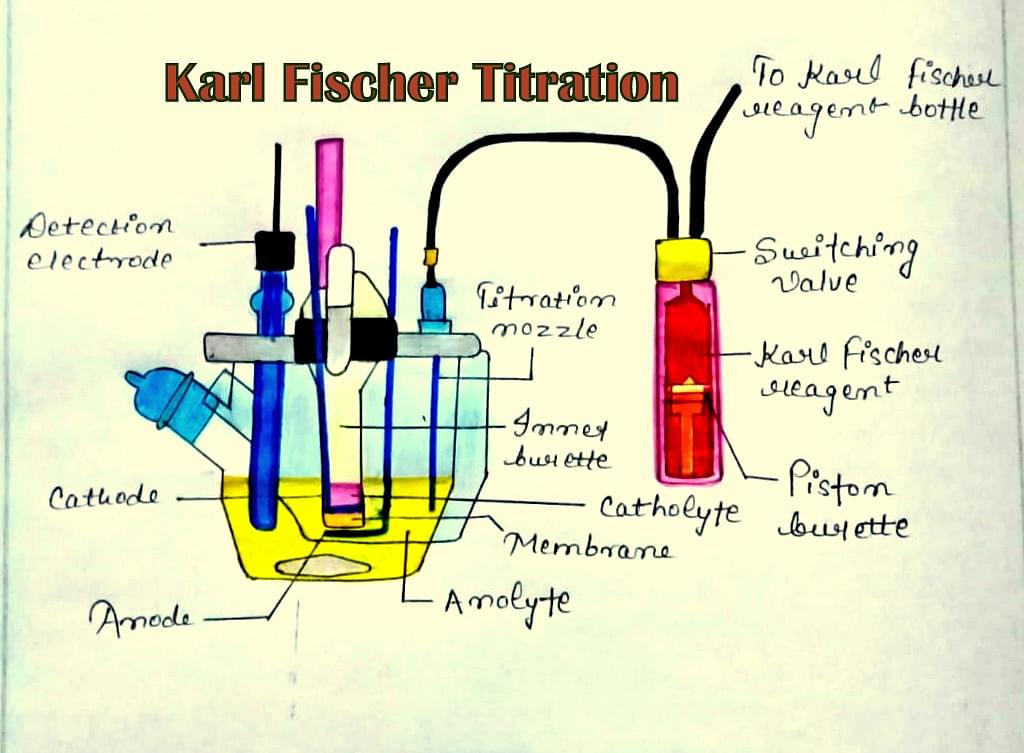
Apparatus for Karl Fischer Titration
[Click Here for Sample Questions]
The apparatus used for Karl Fischer Titration is as follows
- Drying tube
- Analytical electrode solution
- Detection electrode
- Sample injection cap
- Drain cook
- Anode chamber
- Cathode chamber
- Rotor
- KF reagent
KF Reagent Constituents
The following are the KF reagent constituents
- Iodine
- Solvent (methanol)
- Sulphur dioxide
- Buffer (Imidazole)
Preparation of the KF Reagent
- Step 1: A solution is prepared by adding 670 mL of methanol to 170 mL of pyridine (C5H5N)
- Step 2: Add 125 g of iodine to the above solution and cool the solution.
- Step 3: Add 100 mL solution to a 250 mL graduated cylinder. Keep the solution in an ice bath.
- Step 4: Pass dry sulphur dioxide into the cylinder till its volume reaches 200 mL.
Karl Fischer Titration Procedure
[Click Here for Sample Questions]
The Karl Fischer titration experiment can be carried out in two ways. They are as follows:
Volumetric Determination
Volumetric determination is done by using a burette in the laboratory.
- The given water sample is dissolved in KF methanol.
- Later iodine is added to the KF reagent.
- One mole of iodine is consumed for one mole of water.
- The titration reaction proceeds until the total utilization of the water sample.
- The endpoint is determined by the potentiometric method.
Coulometric Determination
Here a titration cell with two compartments is used.
- One compartment consists of the anode solution and an analyte.
- The anode solution consists of alcohol, sulphur dioxide and iodine.
- The second compartment is immersed with a cathode electrode.
- The two compartments are separated by an ion-permeable membrane.
- Oxidation of sulphur dioxide is done by iodine.
- One mole of iodine is consumed for each mole of water.
- Two moles of electrons are consumed for each mole of water.
- Here, the endpoint is determined by the potentiometric titration method.
- The iodine needed for the KF reaction is obtained by anodic oxidation of iodide from the solution.
Advantages of Karl Fischer Titration
[Click Here for Sample Questions]
The following are the advantages of Karl Fischer Titration
- It shows extreme accuracy as it is based on chemical reactions in KF titration.
- It does not detect the loss of volatile substances in the process.
- It has a wide range of determination of water quality and quality.
- KF titration can be used for smaller samples also.
- It is a quick method to determine the quality of water in different commercial substances.
- It can be equally employed to determine water quality in solids, liquids and gases.
- The coulometric titrator helps in detecting free water, dissolved water, and emulsified water.
- It is an automation technique.
- The spectrophotometer can be used to detect the endpoint by using coloured samples.
- It is done through UV-ViS spectroscopy (UV – ultraviolet and VIS – visible light).
Limitations of Karl Fischer Titration
[Click Here for Sample Questions]
The following are the disadvantages of Karl Fischer Titration
- Wastage of solvent due to manual volumetric KF titration.
- The margin of error is more in volumetric KF titration.
- Coulometric KF titration is applicable only to smaller samples.
- Water in chocolates cannot be determined without dissolving the chocolate.
- Water in some organic chemicals like aldehydes, ketones, etc. is not suitable for this method.
- KF is unsuitable for the solvents like LiCl (Lithium Chloride).
Applications of Karl Fischer Titration
[Click Here for Sample Questions]
The following are the applications of Karl Fischer Titration
- It is used to know the quality of water, used for different purposes.
- It is used in food, oil, pharmaceutical and semiconductor industries.
- In the food industry, it is used to determine water content in chips, cocoa powder, flour, fruit juices, honey, noodles, etc.
- In the cosmetic industry, it is used to know water content in creams, lipstick, shampoos, toothpaste, etc.
- In the pharmaceutical industry, it is used to know water content and quality in ointments and pills.
- In the petrochemical industry, it is used to determine water content in gasoline, kerosene, and petroleum.
- It is also used to know water content in silk, wool, wood, paper, cement, plastics, oils, gases, etc.
Also check:
| Acid and Base Reaction | Acids, Bases and Salts | Difference Between Acid and Base |
| Properties of Acids and Bases | Experiments on Properties of Acids and Bases | Acids, Bases and Salts Important Questions |
Things to Remember
- Titration is the process of determining the volume of a substance by adding another measured substance with which the desired constituent reacts in a definite known proportion.
- There are two kinds of solutions in the process of titration a titrant and an analyte.
- The different types of titration are Simple Titration, Back Titration, and Double titration.
- Simple titration is of different types: Acid-base Titration, Redox Titration, Precipitation Titration, and Complexometric Titration.
- In redox, titration is the titration of an analyte and a titrant reacts through an oxidation-reduction reaction.
- Karl Fischer titration is a redox type of titration.
- Karl Fischer titration is a titration method that uses volumetric or coulometric titration to determine the amount of water contained in a given analyte.
- Karl Fisher invented a titrator to make an accurate analysis of water in any sample.
- The solution of a known concentration is called a titrant, whereas the solution which is going to be studied is called an analyte.
Sample Questions
Ques. Who invented the KF titrator? (1 Mark)
Ans. Karl Fisher invented a titrator to make an accurate analysis of water in any sample.
Ques. What is analytical chemistry? (1 Mark)
Ans. Analytical chemistry deals with separating, identifying and quantifying chemical substances.
Ques. What is the difference between qualitative and quantitative analysis? (2 Marks)
Ans. Qualitative analysis is useful in determining the presence or absence of a chemical substance in a given sample. Quantitative analysis is useful in determining the quantity of a substance.
Ques. What is the difference between gravimetric and volumetric analysis? (1 Mark)
Ans. In gravimetric analysis, the mass of a substance is determined, whereas in volumetric analysis the volume of the substance is determined.
Ques. Which process is required to determine volumetric analysis? (1 Mark)
Ans. Volumetric analysis is done through a process called titration.
Ques. What is titration? (2 Marks)
Ans. Titration is the process of determining the volume of a substance by adding another measured substance with which the desired constituent reacts in a definite known proportion.
Ques. What kind of titration is Karl Fischer's titration? (1 Mark)
Ans. Karl Fischer titration is a redox type of titration.
Ques. What is the difference between a titrant and an analyte? (1 Mark)
Ans. The solution of a known concentration is called a titrant, whereas the solution which is going to be studied is called an analyte.
Ques. What is the difference between the volumetric method and the colourimetric method? (2 Marks)
Ans. In the volumetric method, the titrant is directly added to the sample by a burette. In the coulometric method, the titrant is generated electrochemically in the titration cell.
Ques. What are two ways of KF titration? (1 Mark)
Ans. In the KF titration method, either volumetric titration or coulometric titration is used.
Ques. What are the different applications of KF titration? (2 Marks)
Ans. The applications of KF titration are
- It is used to know the quality of water, used for different purposes.
- It is used in food, oil, pharmaceutical and semiconductor industries.
Ques. What is the Bunsen reaction for KF titration? (2 Marks)
Ans. The Bunsen equation for the reaction is as follows:
2H2O + SO2 + I2 → 2HI + SO3
Ques. What is the principle of Karl Fischer titration? (3 Marks)
Ans. Karl Fischer Titration is an oxidation-reduction type of titration. It is based on the oxidation reaction between sulphur dioxide (SO2) and iodine (I2). In the process, the given sample of water reacts with sulphur dioxide and iodine to form hydrogen iodide (HI) and sulphur trioxide (SO2). The reaction goes on till the entire quantity of water gets utilised. This is the endpoint of the reaction. The Bunsen equation for the reaction is as follows:
2H2O + SO2 + I2 → 2HI + SO3
Ques. Is it possible to determine the water quantity in chocolate? (1 Mark)
Ans. Yes, using the method of KF titration.
Ques. Why is DST used in KF titration? (1 Mark)
Ans. It is a primary standard and withstands up to 150 degrees Celsius.
Ques. How do you make Karl Fischer reagent? (2 Marks)
Ans. The reagents are solvent alcohol (ROH), a specified concentration of iodine (I2), a base (RN), and sulfur dioxide (SO2). In an aqueous environment, the Bunsen reaction between iodine and sulfur dioxide serves as the foundation for Karl Fischer Reagent reactions.
For Latest Updates on Upcoming Board Exams, Click Here: https://t.me/class_10_12_board_updates
Also Read:



Comments