



Education Journalist | Study Abroad Lead
Titration is a laboratory method of quantitative chemical analysis. It is used to find the unknown concentration of an analyte by the known concentration of a solution when an indicator is present. The solution that is used during titration with known accurate concentration is known as the titrant and the substance whose volume is to be found is said to be titrated. To identify the endpoint of titration for analysis, a calibrated concentration of titrant is added to an unknown concentration of analyte and when the endpoint is reached, the moles of titrant and analyte will be equal. The different types of titration are
- Acid-base titration
- Redox titration
- Precipitation titration
- Complexometric titration
| Table of Content |
Key Terms: Titration, Concentration of Solution, Acid Base Titration, Redox Titration, Precipitation Titration, Complexometric titration, volumetric analysis
Types of Titration
[Click Here for Sample Questions]
Titration can be classified into several types when considering goals and procedures. However, in quantitative chemical analysis, the most common types of titration are redox titration and acid-base titration.
| The different types of titration are:
|

Types of Titration
Also Read:
| Related Articles | ||
|---|---|---|
| Chemical Kinetics | Rate of Chemical Reaction | Integrated Rate Equation |
| Order of Reaction | First Order Reaction | Second Order Reaction |
1. Acid-Base Titration
[Click Here for Sample Questions]
Acid-base titrations are when an acidic or basic titrant reacts with a base or acid analyte. It is an analytical method for determining the concentration of an acid or base by accurately neutralizing them with a known concentration standard solution of either acid or base.
HA + BOH → BA + H2O
Acid + Alkali → Salt + Water
Or, H+ + A- + B+ + OH- → B+ + A- + H2O
Or, H+ + OH– → H2O
- The acid-base indicator is often known as a pH indicator, and the color indicator is used to determine the equivalent point of an acid-base reaction in titration.
- The most common pH indicators include phenolphthalein and methyl-orange.
Procedure for Acid-Base Titration
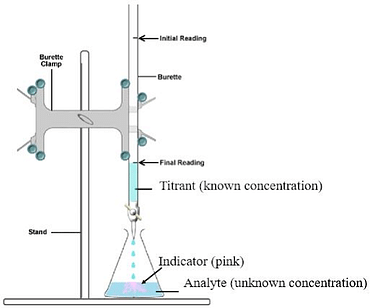
The procedure for conducting acid-base titration is as follows –
- Use the standard solution to rinse the burette, the unknown solution to rinse the pipette, and distilled water to rinse the conical flask.
- Using the pipette transfer an accurately measured volume of the analyte to the flask, along with a few drops of indicator.
- Fill the burette halfway with the standardized solution and record the volume in a worksheet.
- We need a reasonable estimate of the amount of known solution required to neutralize the unknown solution at this point.
- Allow the solution to drain from the burette until the indicator changes color, then note the value.
- This is the first titration, it's not very accurate; it should be left out of any calculations.
- Perform at least three further titrations, this time more precisely, taking into consideration the approximate endpoint.
- At the endpoint, record the initial and final readings on the burette. (The amount of titrant used to reach the endpoint can be calculated by subtracting the initial volume from the final volume.)
-
When the indicator permanently changes color, the endpoint has been achieved.
How to Select an Acid-Base Titration Indicator?
An acid-base titration is a technique for determining if a solution contains an acid or a base.
- The acid-base indicator is usually a weak acid or weak basic in its own right, similar to the chemicals that give flowers their colour.
- A known volume of acid is placed in a conical flask during the actual procedure.
- Two to four drops of an acid-base indicator are added, and then an alkali solution of unknown strength is added drop by drop from a burette in the acid solution.
- A sharp colour change at the equivalency point denotes the neutralization point.
- Indicators range of pH between 11 to 12 may be used.
- Phenolphthalein and Methyl orange are the most often used acid-base indicators.

2. Complexometric Titration
[Click Here for Sample Questions]
The development of a complex between the analyte and the titrant is the basis for complexometric titrations.
- A metal-ligand complexation reaction is used in complexometric titrations.
- EDTA (Ethylenediaminetetraacetic acid) is one of the most commonly used chelating agents in analytical chemistry for complexometric titrations.
Ag+ + 2CN– → [Ag(CN)2]–
Hg2+ + 2SCN– → Hg(SCN)2

3. Precipitation Titration
[Click Here for Sample Questions]
Precipitation Titration is the titration that is based on the formation of an insoluble precipitate when the two reacting substances are brought in close contact. For example, when the silver nitrate solution is used with an ammonium thiocyanate or sodium chloride solution, it reacts and forms a white precipitate of silver chloride or silver thiocyanate.
AgNO3 + NaCl → AgCl + NaNO3
AgNO3 + NH4CNS → AgCNS + NH4NO3

Also Read:
4. Redox Titration
[Click Here for Sample Questions]
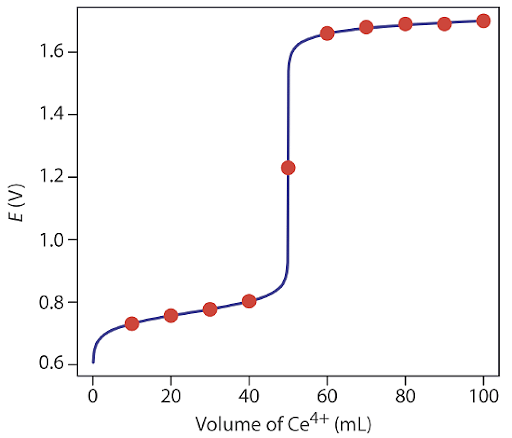
An oxidation-reduction process is also known as redox titration. The chemical reaction occurs in this form of titration when electrons are transferred between reacting ions in aqueous solutions. As the reaction involved is a redox reaction, the titration between oxalic acid solution and acidified KMnO4 solution is a redox titration. The redox indicator is the indicator used in redox titration.
Redox Titration
The concentration of the secondary standard (KMnO4) solution is determined by titration with the primary standard (oxalic acid solution), and the concentration of the primary standard (oxalic acid solution) is determined by titration with the secondary standard (KMnO4) solution.
KMnO4 + H2SO4 → K2SO4 + MnSO4 + H2O + CO2.
The titrations are named after the reagent that is used in are:
- Permanganate Titrations
- Dichromate Titrations
- Iodometric and Iodimetric Titrations
Permanganate Titration
Potassium permanganate is used as an oxidizing agent in such titration and it is maintained with the use of dilute sulphuric acid.
- The following is the equation:
2KMnO4 + 3H2SO4 → K2SO4 + 2MnSO4 + 3H2O + 5[O]
Or, MnO–4 + 8H+ + 5e– → Mn2++ 4H2O
- The solution remains colourless before the endpoint.
- The potassium permanganate is used to estimate oxalic acid, ferrous salts, hydrogen peroxide, oxalates, and so on whereas the solution of potassium permanganate is always standardized before it is used.
Dichromate Titration
Potassium dichromate is used as an oxidizing agent in an acetic medium.
- By the use of dilute sulphuric acid, the medium is maintained acidic.
- The solution of potassium dichromate can be used directly for titrations and is mainly used for the estimation of ferrous salts and iodides.
K2Cr2O7 + 4H2SO4 → K2SO4 + Cr2(SO4)3 + 4H2O + 3[O]
Or, Cr2O27- + 14H+ + 6e- → 2 Cr3+ + 7H2O
Iodometric and Iodimetric Titration
Iodometric titrations are conducted when an analyte (an oxidizing agent) is added to excess iodide to produce iodine, and the amount of iodine produced is evaluated by titration with sodium thiosulfate solution.
- When a given sample of an oxidizing agent oxidizes potassium iodide in an acidic solution, an equivalent amount of iodine is freed, as in the determination of copper sulfate (CuSO4):
2CuSO4 + 4 KI → 2CuI↓ + I2 + 2K2SO4
- Iodometric titrations are conducted when an analyte (a reducing agent) is titrated directly with a standard iodine solution.
- In iodimetry the Quantitative oxidation of reducing substances, such as arsenious acid (H2AsO3), can be accomplished by using common iodine solutions, as shown below:
H3AsO3 + H2O + I2 ? H3AsO4 + 2H+ + 2I-
Gravimetric Analysis
The process of measuring the amount of an analyte by its mass is known as gravimetric analysis.
- The desired liquid constituent is transformed to a solid form that can be easily separated and weighed to ascertain its amount, and that solid mass can be used for further examination.
- In the process of preparing a solution, the desired ingredient is separated from the solution and the number of constituents is counted.
- The gravimetric analysis includes precipitation of Ag+, Hg22+, and Pb+2 as halides, and precipitation of Ca2+ as calcium oxalate (CaC2O4).
Volumetric Analysis Titration
The procedure of volumetric analysis is used to calculate the amount of the desired ingredient based on its volume. As a result, it's a quantitative assessment. Titration is used to determine the volume of the ingredient (titrimetric analysis).
- A reagent that can react with the analyte is introduced in amounts to the analyte molecules until all of the analyte molecules react with the reagent molecules.
- When the sample and reagent are both colourless solutions, an indicator should be used to detect the reaction's endpoint.
- The analyte molecules reach their endpoint at the endpoint.
- When the endpoint has been reached, the indicator is a reagent that changes colour.
- When there is a change in the reaction mixture, the colour changes.
- An acid-base indicator, for example, is sensitive to changes in pH in the reaction mixture.
- When the pH is altered, the hue changes. Some reagents, on the other hand, act as self-indicators, for example, Potassium permanganate.
Things to Remember
- Titration is used to find the unknown concentration of an analyte by the known concentration of a solution when an indicator is present.
- The different types of titration are Acid-base titration, Complexometric titration, Precipitation titration and Redox titration.
- The endpoint, or equivalence point, is the point at which all of the titrants have reacted.
- The titrant is a chemical whose quantity is to be found out.
- Acid-base titrations are used to determine the concentration of an acid or base sample and are carried out with the help of a burette.
- The final result of the gravimetric analysis is usually given in gram(g) in milligrams(mg), whereas the final result of the volumetric analysis is given in millilitres (mL) or in microliters.
- When the endpoint has been reached, the indicator is a reagent that changes colour.
Also Read:
Sample Questions on Titration
Ques: What's the Difference Between Volumetric and Gravimetric Analysis? (2 marks)
Ans: The main difference between volumetric and gravimetric analysis is that gravimetric analysis determines the mass of the analyte, whereas volumetric analysis determines the volume of the analyte.
Ques: Why a titration flask should not be rinsed? (1 mark)
Ans: The titration flask should not be rinsed because during rinsing some liquid will remain to stick to the titration flask therefore the pipetted volume taken in the titration flask will increase.
Ques: What methods can we take to detect pH changes? (1 mark)
Ans: The pH can be measured in a variety of methods. Litmus paper is the oldest type of pH indicator and it is still in use today.
Ques: How is starch as an indicator used in titration? (2 marks)
Ans: Starch as an indicator used in titration Iodine interacts with starch, making it a useful indication.
Starch combines with iodine in the presence of iodine to form a blue chemical complex.
Ques: How frequently should I standardize my titrant? (3 marks)
Ans: Naturally, this is dependent on the titrant's stability and the precautions taken to protect it against common impurities that could cause a fall in concentration. The storage of light-sensitive titrants in dark bottles, such as a molecular sieve or silica gel, and the protection of some strong bases and sodium hydroxide against carbon dioxide absorption are the most common examples of this titrant protection.
Ques: What is the back titration? (4 marks)
Ans: We utilize two reagents in a back titration: one that reacts with the initial sample (A) and another that reacts with the first reagents (B). To begin, a specific amount of reagent A is added to the sample. The residual excess of reagent A is then back titrated with a second reagent B when the reaction is completed. The difference between the amounts of the first and second reagents is then used to calculate the analyte equivalent. Back titration is employed mostly when the direct titration response is excessively slow or when the direct signal of the equivalence point is poor. For example, EDTA reagents can be used to determine calcium content.
Ques: What's the difference between titration at the equivalence point and at the endpoint? (3 marks)
Ans: The endpoint mode simulates the traditional titration technique, in which the titrant is added until the reaction is completed, as shown by a color change in an indicator. The sample is titrated with an automatic titrator until a predetermined value is attained, such as pH = 8.2.
The equivalence point titration is defined as the point where the analyte and reagent are present in equal amounts. In most circumstances, it's almost identical to the titration curve's inflection point, such as titration curves generated from acid/base titrations.
Ques: What is the purpose of titration in Chemistry? (2 marks)
Ans: Titration may be used to determine its concentration while titrating a simple solution with a volume of a regular acid solution of a known concentration that needs to neutralize. The purpose of the titration is to find out the equivalence point, which is the point where chemically equivalent quantities of the reactants are combined.
Ques: What is the endpoint in titration? (3 marks)
Ans: An absolutely equivalent amount of titrant has been added to the sample at the equivalence point of a titration. The endpoint is the experimental moment at which the reaction is identified as complete by a signal. A change in the color of an indicator or a change in an electrical property detected during the titration could represent this signal. The titration error is the difference between the endpoint and its equivalence point which can be reduced by choosing a suitable end-point signal and a means for detecting it. The indicator for the coincidence should be chosen carefully after understanding the nature of the titration process. The titration is completed when the indicator color changes. The endpoint is used to compute the amount or concentration of the analyte using the known concentration of the titrant and the endpoint as an approximation of the equivalency point.
Ques: What is the main purpose of acid-base titration? (2 marks)
Ans: Acid-base titrations are when an acidic or basic titrant reacts with a base or acid analyte. The main purpose of acid-base titration is to determine the unknown concentration of a base or acid by neutralizing them with a base or n acid of a known concentration.
Ques: What is meant by redox titration? (4 marks)
Ans: An oxidation-reduction process is also known as redox titration. The chemical reaction occurs in this form of titration when electrons are transferred between reacting ions in aqueous solutions. Because the reaction involved is a redox reaction, the titration between oxalic acid solution and acidified KMnO4 solution is a redox titration. The redox indicator is the indicator used in redox titration.
The concentration of the secondary standard (KMnO4) solution is determined by titration with the primary standard (oxalic acid solution), and the concentration of the primary standard (oxalic acid solution) is determined by titration with the secondary standard (KMnO4) solution. The redox reaction is used in redox titration, like:- KMnO4 + H2SO4 → K2SO4 + MnSO4 + H2O + CO2.
Ques: What is iodometric titration? (4 marks)
Ans: Iodometric titrations are conducted when an analyte (an oxidizing agent) is added to excess iodide to produce iodine, and the amount of iodine produced is evaluated by titration with sodium thiosulfate solution. When a given sample of an oxidizing agent oxidizes potassium iodide in an acidic solution, an equivalent amount of iodine is freed, as in the determination of cupric sulfate (CuSO4):
2CuSO4 + 4KI → 2CuI↓ + I2 + 2K2SO4
Iodometric titrations are conducted when an analyte (a reducing agent) is titrated directly with a standard iodine solution. In iodimetry the Quantitative oxidation of reducing substances, such as arsenious acid (H2AsO3), can be accomplished by using common iodine solutions, as demonstrated below:
H3AsO3 + H2O + I2 → H3AsO4 + 2H+ + 2I-
For Latest Updates on Upcoming Board Exams, Click Here: https://t.me/class_10_12_board_updates
Also check:



Comments