



Exams Prep Master
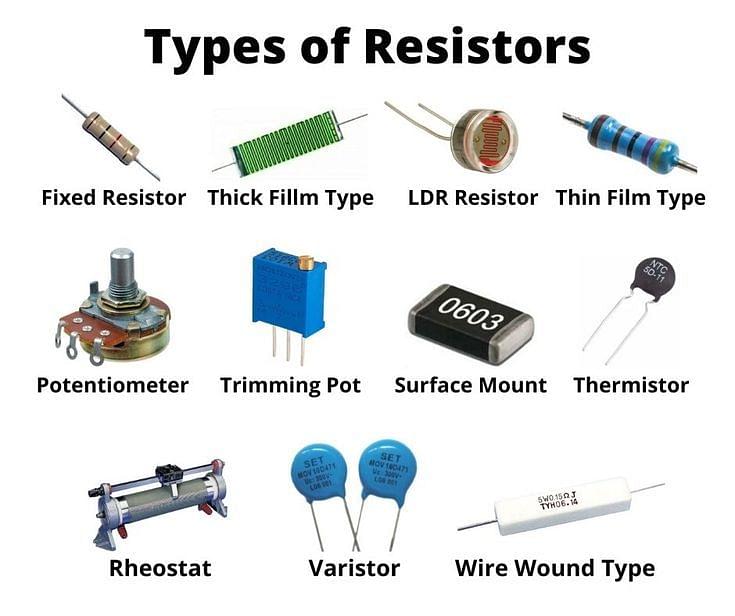
Resistors can be classified into two types namely linear and non-linear resistors. Linear resistors are those resistors, which values change with the applied voltage and temperature. In other words, in the linear resistors, the current value is directly proportional to the applied voltage. Nonlinear resistors are those resistors, where the current flowing through it does not change based on Ohm’s Law but, changes with a change in temperature or applied voltage. Resistors are the device that obstructs the flow of current and are available in different sizes, materials, and shapes. Some examples of resistive materials are Glass, Mica, Wood, Rubber, etc.
Discover about the Chapter video:
Current Electricity Detailed Video Explanation:
Also read: Current Electricity Ncert Solutions
Ques 1: The _____________ of a resistor is determined generally by its physical size.
- Resistance
- Current
- Power
- a & b are correct
Click here for the answer
Ans: The correct option is (2) Current.
Explanation: Every resistor possesses a maximum power rating which is determined by its physical size generally, and the greater its surface area the more power it can dissipate safely into the ambient air or into a heatsink. As long as its “Dissipating Power Rating” is not exceeded by the resistor power rating, a resistor can be used at any combination of voltage (within reason) and current, indicating how much power the resistor can convert into heat or absorb without any damage to itself.
Ques 2: The two main characteristics of a resistor are _______________________.
- Resistance and Power
- Current and Power
- Current and Voltage
- Resistance and Current
Click here for the answer
Ans: The correct answer is (1) Resistance and Power.
Explanation: The two main characteristics of a resistor are its resistance, R, in ohms, and its power rating, P, in Watts. The resistance provides the desired drop in voltage or the required reduction in current. The wattage rating determines the amount of power the resistor can safely dissipate as heat. The wattage rating, as a safety factor, is always more than the actual amount of power dissipated by the resistor.
Ques 3: Resistor is an _________________ component or device.
- Active
- Passive
Click here for the answer
Ans: The correct answer is (2) Passive.
Explanation: The resistor is a passive component as it opposes the flow of electrical current through it. Resistors don't need an external power source to function. They use some other property to control the electrical signal. As a result, they only require the current to travel through the connected circuit.
Ques 4: Mainly resistors are available in the maximum value of ______________ohm.
- Kilo (K Ω)
- Giga (G Ω)
- Mega (M Ω)
- Tera (T Ω)
Click here for the answer
Ans: The correct option is (3) Mega.
Explanation: The resistive value of a resistor, and its ability to limit current flow is measured in Ohm's ( Ω ) that range from less than one Ohm each to many millions of Ohm's, (Mega-Ohm's). Resistors can be of a fixed value, for example, 100 Ohms, (100Ω) or variable as in 0 to 100Ω.
Ques 5: Ohm’s law is true for:
- Metallic conductors at low temperature
- Metallic conductors at high temperature
- For diode when current flows
- For electrolytes, when current passes through them
Click here for the answer
Ans: The correct answer is: (1) Metallic conductors at low temperature
Explanation: According to Ohm’s law, in metallic conductors at constant temperature and zero magnetic fields, the current flowing is proportional to the voltage across the ends of the conductor, and is inversely proportional to the conductor's resistance.
Check also: NCERT Solutions Chapter 3 Current Electricity
Ques 6: The power rating of a resistor has to be ____________ than from actual power dissipation as heat for the reason of the Safety factor (Burning).
- Less
- More
Click here for the answer
Ans: The correct answer is (2) more.
Explanation: A resistor can be used at any combination of voltage (within reason) and current so long as its “Dissipating Power Rating” is not exceeded, and with the resistor power rating indicating how much power the resistor can convert into heat or absorb without any damage to itself.
Ques 7: What among the options is the Power Dissipation formulae?
- P = V×I
- P = V^2 / R
- P = I^2 × R
- All are correct
Click here for the answer
Ans: The correct option is (4).
Explanation: All these are the formulas of power. But in one of the formulas, P is directly proportional to R, and in other, it is inversely proportional to R. V^2/R is used when the potential in the circuit is the same. i.e. if the two resistance are connected parallel then we will use V^2/R to calculate the power. Similarly, if resistances are connected in series then the current will be constant in the circuit. Then, we will use the I^2R formula to calculate power. If we know the current and potential then VI is used to find out the power.
Ques 8: Most common type of Resistor is _________________________?
- Film Type Resistor
- Carbon Resistor
- Wire Wound Resistor
- Fusible Resistor
Click here for the answer
Ans: The correct answer is (2) Carbon Resistor.
Explanation: Carbon resistor types are very cheap to make which is why commonly used in electrical circuits. However, due to their manufacturing process carbon-type resistors have very large tolerances so for more precision and high-value resistances, film-type resistors are used instead.
Ques 9: Resistors are ________________ devices.
- Polarity Devices
- Non-Polarity
Click here for the answer
Ans: The correct answer is (2) Non-Polarity.
Explanation: The resistance does not have polarity because it opposes the flow of electrons. The flow of electrons is from the lower potential to the higher potential. However, if the resistor is not intrinsic, if or has impurities changing its resistance throughout the length then there occurs a difference in the V-I characteristics of the resistor.
Ques 10: An example of non-ohmic resistance is:
- Tungsten wire
- Diode
- Carbon resistance
- Copper wire
Click here for the answer
Ans: The correct answer is (2) Diode.
Explanation: A non-ohmic resistance is a resistance that does not follow Ohm’s law. Ohm’s law states that the current through a conductor between two points is directly proportional to the voltage across the two points. And the diode is non-ohmic.
Check also: Combination of Resistors-Series and Parallel
Ques 11: What happens with the requirement of Power rating when the resistance increases?
- Lower Power Rating
- Higher Power Rating
Click here for the answer
Ans: The correct answer is (1)
Explanation: Resistors oppose the current so they will dissipate some power. According to this equation, V2/R = P = I2⋅R, power is inversely proportional to resistance on the left side and directly proportional to resistance on the right side. So power rating is important in such a way that dissipated power should be lower than the power rating of the resistor.
Ques 12: The Resistance of a Carbon Composition Resistor depends on______________.
- Size
- Current
- The ratio of Powders (Carbon & Ceramic)
- a & b are correct
Click here for the answer
Ans: The correct answer is (3)
Explanation: The resistance of the carbon composition resistor depends on the amount of carbon added, the length of the solid cylindrical rod, and cross sectional area of the solid cylindrical rod.
Ques 13: Power Rating is ___________________ proportional to the Resistance ® of a Resistor:
- Directly
- In-Directly
Click here for the answer
Ans: The correct option is (2) Indirectly.
Explanation: As R = L/A, therefore Resistance is Indirectly proportional to the surface area. In the case of the resistor as power rating increases, the size also increases in order to facilitate higher area for power dissipation.
Ques 14: Wire Wound Resistors are usually used (Applications) for _________________________.
- High Current
- Low Resistance
- Desired (Appreciable) Power
- All are Correct
Click here for the answer
Ans: The correct answer is (4)
Explanation: Wire wound resistors are often used in circuit breakers or as fuses. In order to make a fusible resistor, the manufacturer attaches a small spring to one end of the resistor. Due to their high power capabilities, wire wound resistors are common in circuit breaker applications. They may be used as components in a large circuit breaker device or may act as circuit breakers themselves.
Ques 15: Wire Wound Resistor is only used for _________________________.
- Low Frequency
- High Frequency
Click here for the answer
Ans: The correct answer is (1) Low Frequency.
Explanation: Wire wound resistors are very good for low frequency as well as DC operation, however, the effects of inductance and capacitance become more noticeable as the frequency of operation rises. The inductance arises from the fact that the resistor is effectively a coil of resistance wire and is affecting an inductor.
Ques 16: At High Frequency, Wire Wound Resistor Acts As _________________________.
- Capacitor
- Inductor
- Diode
- a & b are correct
Click here for the answer
Ans: The correct answer is (2) Inductor.
Explanation: The wire-wound resistance comprises various turns around it. If there is a number of turns in the element then it acts as an inductor. But due to less number of turns very small inductive property exhibited in the wire-wound resistance.
Read more:
For Latest Updates on Upcoming Board Exams, Click Here: https://t.me/class_10_12_board_updates
Check-Out:



Comments