



Education Journalist | Study Abroad Lead
Types of Resistors vary based on the construction, manufacturing methodology and applications. Resistors are placed in an electric circuit to obstruct the electrical current flow. Resistors are classified broadly into two types- linear and non-linear resistors. A linear resistor is one in which the current is directly proportional to the applied voltage. In non-linear resistors the current flowing does not change according to Ohm’s Law but change in temperature or applied voltage.
Also Read: Current Electricity
Related Links
- Appearing for JEE Main, Download JEE Mains PYQ for all sabjects
- Appearing for NEET, Download NEET PYQ for all subjects
| Table of Content |
Key Terms: Resistor, Variable Resistor, Non-Linear, Linear, Resistance, Ohm's law, Thermistor, Varistor, LDR, Surface Mounted, Electric circuit, Voltage, Electrical current, Temperature
What is a Resistor?
[Click Here for Sample Questions]
A resistor is a device that prevents current from flowing. It is a two-terminal passive device used to control the flow of electric current. Resistive materials include glass, mica, wood, rubber, and others. The SI unit of resistance is Ohm (Ω) . where 1Ω = 1V/1A. Resistors are used in electronic circuits to adjust signal levels, reduce current flow, bias active elements, terminate transmission lines, divide voltages, and so on.
- Resistance is the opposition to the free flow or motion of any substance.
- The precise term in our case is "electrical resistance," which we commonly refer to as "resistance."
- The electrical resistance of a material is the resistance to free-electron flow within that material.
- Electrical resistance varies between materials and is measured in Ohms.
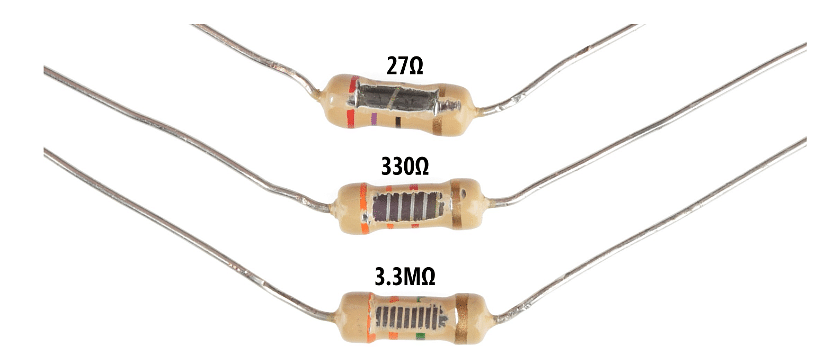
Resistors
Discover about the Chapter video:
Current Electricity Detailed Video Explanation:
Also Read:
Types of Resistors
[Click Here for Previous Year Questions]
There are many different types of resistors that can be used in electronic circuits. The properties of these various types of resistors vary depending on their manufacture and construction. For various applications, various types of resistors are available. Resistors come in a variety of shapes, sizes, and materials. Resistors are divided into two broad types: linear resistors and non-linear resistors. The following flow chart gives the complete classification of the different resistor types.
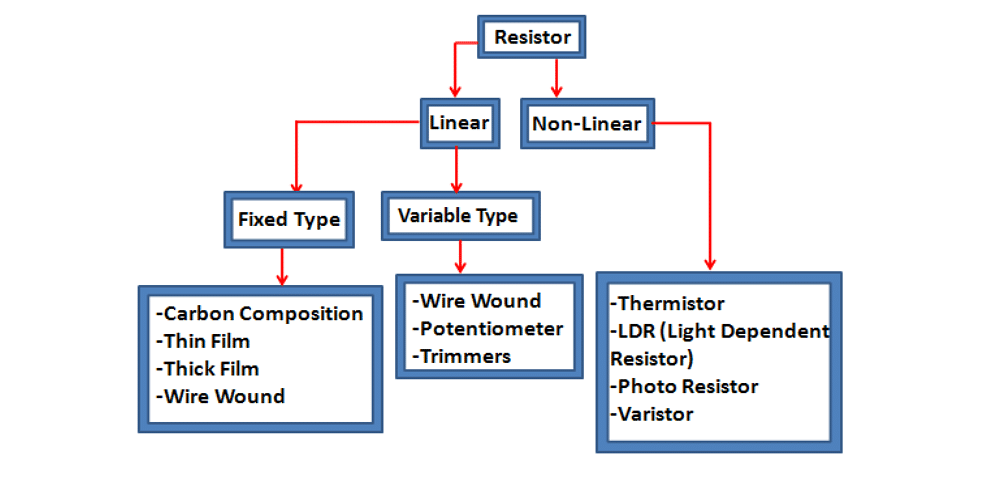
Resistors Classification
Linear Resistors
[Click Here for Sample Questions]
- Linear resistors are resistors whose resistance value varies with applied temperature and voltage.
- The majority of resistors are linear devices that generate a voltage drop across themselves when a current flows through them.
- Linear Resistors are further classififed as:
- Fixed resistors
- Variable resistors
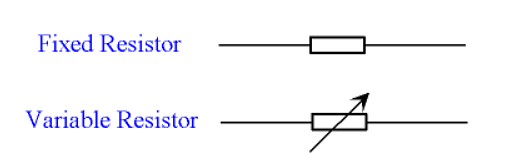
Linear Resistor Representation
Fixed Resistors
Fixed resistors are resistors that have a fixed value of resistance. Fixed resistors are one of the most common types of resistors. Fixed resistors are used in electronic circuits to set the proper conditions.
Fixed Resistor Types
- Resistors with Wire Wounds
- Resistors with Thin Films
- Resistors Made of Carbon
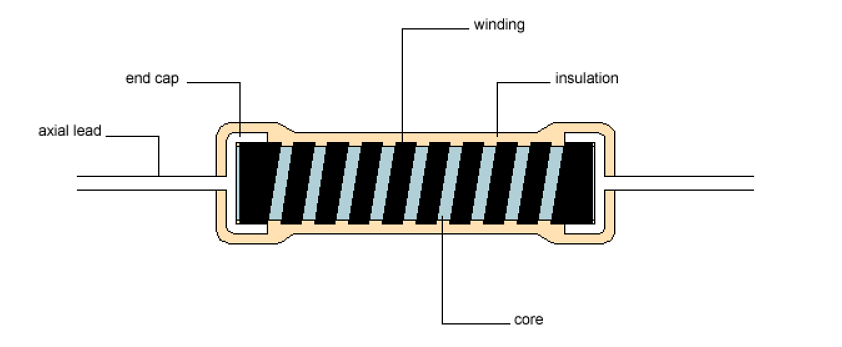
Fixed Resistor
Variable Resistors
Variable resistors are made up of a slider that taps on the main resistor element as well as a fixed resistor element. A variable resistor is a potentiometer with only two connecting wires instead of three.
Variable Resistor Types
- Potentiometer
- Trimmer Rheostat Resistor
- Trimmer Resistor
Also Read: Types of Resistors MCQs Current Electricity NCERT Solutions
Non-Linear Resistors
[Click Here for Previous Year Questions]
Non-linear resistors are those in which the electric current flowing through them changes with changes in applied voltage or temperature but does not follow Ohm's law. There are many different types of non-linear resistors, but the most common ones are listed below.
Thermistors
- Thermistors are a type of variable resistor that detects temperature changes.
- It is a two-terminal device that is extremely temperature sensitive.
- A thermocouple's resistance is inversely proportional to its temperature.
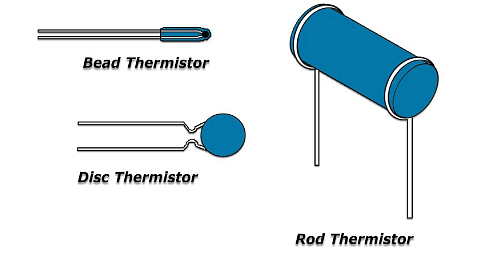
Different Types of Thermistors
Varistor Resistors
- A varistor is a non-linear resistor made of semiconductor, the current through which is non-linearly proportional to the voltage applied across it.
- MOVs, or metal oxide varistor, are the most common type of Varistor Resistors.

Varistor Resistor
Also Read: Current Electricity Revision Notes
LDR or Photo Resistors (Light Dependent Resistors)
- A photo resistor, also known as an LDR (Light Dependent Resistors) or a photoconductive cell, is a variable resistor that is controlled by light.
- With increasing incident light intensity, the photo resistor resistance decreases.

Light Dependent Resistor (LDR)
Surface Mount Resistors
- Surface Mount Resistors, also known as SMD resistors, have a rectangular shape.
- An SMD is a type of electronic component designed for use with SMT, or Surface Mount Technology.

Surface Mount Resistor
Read Also: Electrical Force
| How to select the power rating of a resistor?
|
Symbols of Resistors
[Click Here for Sample Questions]
The symbols used to represent resistors differ depending on the standard. American Standards is the most popular and widely used. IEC is another widely used standard (International Electrotechnical Commission). Given below are the symbols and notations ised in both standards for resistors.
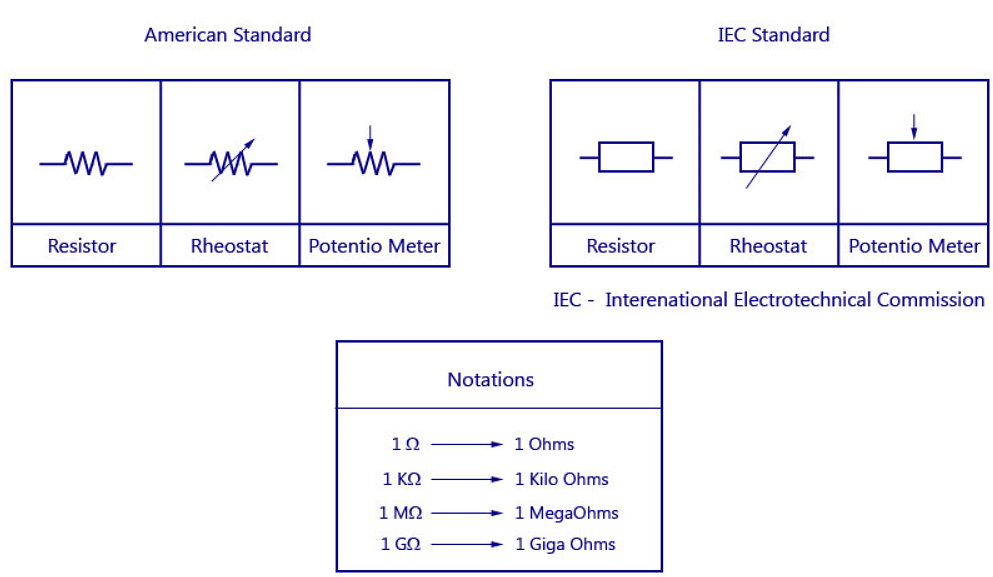
American and IEC Standard Notation for Resistors
Also Check:
Things to Remember
- Electricity flows through any material via electrons, which are negatively charged very small particles within the atom.
- Metals conduct electricity more easily than non-metallic materials because they provide little resistance to the flow of electrons through them.
- Metals, particularly gold, silver, and copper, are widely used in the manufacture of electrical or electronic goods.
- The degree of resistance is used to classify resistors.
- Ohm is a unit of resistance measurement.
- Ohm's law defines the relationship that governs the behavior of a resistor.
- Resistors are useful for blocking potential energy, and this energy blockage manifests as heat. This generated heat is sometimes wasted.
- Resistors are broadly classified as linear and non-linear resistors
Read More: Types of Resistors Important Questions
Read More:
Previous Year Questions
- If now we hav.e to change the null point at 9th wire, what should we do?… [ DUET 2007 ]
- The electrical permittivity and magnetic permeability of free space are… [ DUET 2003 ]
- Just after key K is pressed to complete the circuit, the reading will be …. [ KEAM 1999 ]
- The resistance between any two terminals is when connected in a triangle is…. [ NEET 1993 ]
- potential drop through 4Ω resistor is… [ NEET 1993 ]
- The potential difference per unit length of the wire will be… [ NEET 1999 ]
- Value of R for which the power delivered in it is maximum is given by... [ NEET 1992 ]
- In the circuit shown below, the current in the 1Ω resistor is…? [NEET 1988]
- In the network shown in the figure, each of the resistance is equal to…? [NEET 1995]
- Kirchhoff's first and second laws of electrical circuits are consequences of…? [NEET 2006]
- Two wires of the same metal have same length, but their cross-sections are in the ratio…? [NEET 1995]
- Which of the following acts as a circuit protection device? [NEET 2019]
- You are given several identical resistances each of value R=10Ω and each capable of carrying…? [NEET 1990]
- A potentiometer wire of length 10m and resistance 20Ω is connected in series with a…? [KEAM]
- In the circuit shown, the currents i1 and i2 are…? [KCET 2011]
Sample Questions
Ques: Give examples of resistive materials? (1 mark)
Ans: Glass, rubber, wood, mica are some of the resistive materials used in everyday life.
Ques: What exactly is a resistor? (2 marks)
Ans: A resistor is an element or component that controls the supply of electricity to electrical or electronic goods by reducing the electrical current. It also protects these items from damage caused by an excess of electricity.
Ques: What exactly is Ohm's law? (2 marks)
Ans: According to Ohm's law, the voltage (V) across a resistor is proportional to the current (I), and the proportionality constant is Resistance (R). Ohm is a unit of resistance measurement. In other words, 1 Ohm is the resistance between two points that requires 1 V (volt) of potential energy to transfer 1 A (ampere) current. We can express it mathematically as follows:
V = I.R, where R represents the resistance.
Ques: How do resistors function? (2 marks)
Ans: A resistor is a small ceramic rod that runs through the middle of the resistor and around which the copper wire wraps. The number of copper wire turns precisely determines the resistance that a resistor produces while in use. The greater the number of turns of copper wire, the greater the resistance. The resistance in the resistor is also affected by the thickness of the copper wire. The higher the resistance, the thinner the copper wire. Wire-wound resistors, in general, produce more precise results and are more stable at high operating temperatures.
Ques: What are the different types of non-linear resistors? (2 marks)
Ans: Non-linear resistors are classified as follows:
Thermisters
Varisters
Photo resistors
Ques: What is the definition of a resistor? (2 marks)
Ans: Resistors are classified as follows in terms of operation:
- Constant resistors
- Variable/adjustable resistors
Ques: What are the fixed resistor types? (2 marks)
Ans: Fixed resistors are classified into three types. The first is a carbon composition resistor, which is the most common and has a resistive substance made of carbon clay and tin copper leads. The second type is metalized resistor, which, like constantan, is composed of 60% copper and 40% nickel, and magnesium material has a high level of resistivity. The third type of resistor is the wired wound type, which is created using a film deposition technique that incorporates a thick film of resistive material into an insulating substance.
Ques: What exactly is a resistor? (2 marks)
Ans: A uniform flow of electricity and resistance are required in an electrical circuit. In an electric current, a resistor provides the optimal amount of resistance. It regulates the amount of current that flows through inductors and conductors.
Ques: The network PQRS, shown in the circuit diagram, has the batteries of 4 V and 5 V and negligible internal resistance. A milliammeter of 20 Ω resistance is connected between P and R. Calculate the reading in the milliammeter. (Comptt. All India 2012)

Ans: Applying loop rule to loop PQRP
-4 = 60(I – I1) – 20 I1 = 0
or – 4 = 60I – 60I1 – 20I1
or 20I1 -15 I = 1 …[+ by 4 …(i)]
Applying loop Yule to loop PRSP, we get
-5 + 200 I + 20 I1 = 0
4I1 + 40 I = 1 …[+ by 5 …(ii)]
![4I1 + 40 I = 1 …[+ by 5 …(ii)]](https://images.collegedunia.com/public/image/8dff790273812581915c2e8a9da157fc.png?tr=w-292,h-241,c-force)
Therefore, Reading of milliammeter = 0.064 A
Ques: State Kirchhoff’s rules. Explain briefly how these rules are justified. (Delhi 2014)
Ans: Kirchhoff’s rules.
- Kirchhoff’s junction rule : At any junction, the sum of the currents entering the junction is equal to the sum of currents leaving the junction.
- Kirchhoff’s loop rule : The algebraic sum of changes in potential in any closed loop involving resistors and cells is zero.
These two laws are justified on the basis of law of conservation of charge and the law of conservation of energy respectively.
Ques: Calculate the current drawn from the battery by the network of resistors shown in the figure. (Comptt. All India 2015)

Ans: Given: Circuit diagram can be rearranged as shown below:
It forms a wheatstone’s bridge
P/Q = R/S → ½ = 2/4 = ½
It is the condition of null point when no current flows through BD arm, i.e. 5 Ω.
Resistances P = (1 Ω) and R = (2 Ω) are in series;
Similarly, Resistances Q = (2 Ω) and S in series,


For Latest Updates on Upcoming Board Exams, Click Here: https://t.me/class_10_12_board_updates
Also Read:



Comments