



Education Journalist | Study Abroad Lead
Carbon Resistors type of resistors most common types of electronics used. Carbon Resistors are constructed out of small carbon fragments bonded together by a binder and shaped into a cylindrical shape with a terminal lead on one end. They possess different physical sizes with power dissipation limits commonly from 1 watt down to 1/8 watt. They can be classified as fixed and variable type. Resistance values and tolerance limits can be predicted using standard resistance color code.
Read More: Types of Resistors
Key Terms: Carbon Resistors, Electric Current, Resistor Color Coding, Resistors, Resistance, Metals, Alloys, nichrome, brass, platinum, tungsten, carbon, Electrical resistance
Carbon Resistors
[Click Here for Sample Questions]
The carbon resistor is a fixed resistor that limits or restricts the passage of electric current to a specific amount. Carbon composition resistors, on the other hand, are rarely utilized nowadays due to their expensive cost and lack of stability. To make the resistance, a variety of metals and alloys are utilized, including nichrome, brass, platinum, and tungsten. Most of these metals, however, have low electrical resistance when compared to carbon resistors since it is difficult to create high resistance without making the resistor bulky.
Resistance ∝ [Length ×Resistivity]
- The product of the resistor's length and resistivity is known to be directly proportional to resistance.
- The resistance is reproduced by carbon resistors within the practical requirements.
- Carbon composition resistors are also known as carbon resistors or carbon composition resistors.
- Produce highly accurate values of resistances.
- Are used to calibrate and compare resistances.
- Cheap, Compact and directly printed on circuit boards.

Carbon Resistor
Discover about the Chapter video:
Current Electricity Detailed Video Explanation:
Read More:
Carbon Resistor Construction
[Click Here for Previous Year Questions]
- The carbon resistor cylindrical resistive element is constructed of a blend of carbon or graphite powder and ceramic (made of clay).
- The resistive element with wire leads or metal end caps are embedded inside.
- Carbon powder is an excellent conductor of electricity.
- To shield the resistor from outside heat, the solid cylindrical resistive element is coated with plastic.
- Copper leads are connected at the two ends of the resistive element.
- In the early days of carbon composition resistors, no insulating materials were utilized.
- As a result, even at low temperatures, heat penetrates the resistor quickly and destroys it.
- Carbon composition resistors or carbon resistors come in different forms of resistance values and mostly range from 1 ohm to 22 megaohms.

Carbon Resistor Construction
Read More: Equivalent Resistance Formula
Parts of a Carbon Resistor
[Click Here for Sample Questions]
Resistors can be constructed with a variety of materials. The different parts of a carbon resistor are:
- Ceramic Core
- Nickel Cap
- Lead
- Carbon Film
- Protective Lacquer
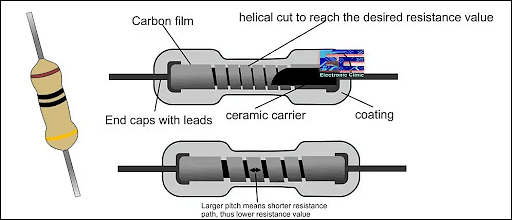
Parts of Carbon Resistor
Read More: Internal Resistance Formula
Factors Affecting the Resistance of Carbon Resistors
[Click Here for Previous Year Questions]
The resistance of carbon resistor depends upon 3 factors:
Carbon Quantity Addition
- The amount of carbon added has an inverse relationship with the resistance of the carbon composition resistor.
- Carbon is a good conductor of electricity and so more carbon is added, more electric current flows and only a small portion of the electric current is blocked.
- As a result, the carbon composition resistor with the highest carbon content has a low resistance.
- Only a little quantity of electric current passes when less carbon is introduced, but a larger amount of electric current is blocked.
- As a result, the carbon-based resistor with less carbon has higher resistance.
Solid Cylindrical Rod Length
- The length of a solid cylindrical rod determines the resistance of a carbon resistor.
- This is because the free electrons only have to travel a short distance, the cylindrical rod with a short length gives minimal resistance to the electric current.
- As a result, the chances of electrons colliding with atoms are reduced.
- As a result, only a few free electrons clash with the atoms.
- The small number of free electrons that hit atoms lose their energy as heat, while the enormous number of remaining free electrons travel freely.

Solid Cylindrical Rod Length
Solid Cylindrical Rod Cross-Sectional Area
- The cross-sectional area of the cylindrical rod is inversely proportional to the resistance of the carbon resistor.
- The free electrons can only flow in a small space since the cylindrical rod has a small cross-sectional area.
- As a result, the likelihood of free electrons colliding with atoms is high.
- Hence, the carbon composition resistor only receives a little quantity of electric current.
- The large cross-sectional area of the cylindrical rod provides plenty of room for free electrons to travel around.
- Thus, the chances of free electrons colliding with atoms are slim.
- The carbon composition resistor is subjected to a considerable amount of electric current.
Read Also: Static Electricity
Uses of Carbon Resistors
[Click Here for Sample Questions]
Some of the very common applications of Carbon resistors are listed below:
- Capable of withstanding high energy pulses inspite of the samll size.
- Circuit protection (surge or discharge protection), current limiting, high voltage power supply, high power or strobe lights, and welding.
- A medical defibrillator is an example of an application.
- High energy pulses of roughly 30 Joule must be shielded against sensitive measurement equipment attached to the patient.
Read Also : Ammeter Vs Voltmeter
Working of Carbon Resistor
[Click Here for Previous Year Questions]
- When making an electric or electronic circuit for a certain purpose, the exact amount of resistance in the circuit board must be induced.
- Carbon resistors, which are minuscule components, are used to do this.
- These components are a small packet of resistance that is plugged into the circuit to decrease the flow of current by a specified amount.
Carbon Resistor Color Coding
[Click Here for Sample Questions]
Different types and values of commercially available resistors are available, however, carbon resistors are more commonly employed in electronic circuits. Four colored bands are marked on the surface of carbon resistors to represent the resistance value.

- The resistance's value is determined by the first three bands (a,b,c) while the tolerance is determined by the fourth band (d).
- The first and second band colours correspond to the first two digits of resistance value respectively, while the third band's colour corresponds to the power of ten.
- This is then multiplied by two significant digits to yield the resistance value.
Also Read: Current Electricity NCERT Solutions
Advantages and Disadvantages of Carbon Resistors
[Click Here for Previous Year Questions]
Tabulated below are some advantages and disadvatages of carbon resistors:
| Advantages | Disadvantages |
|---|---|
| Endure high energy pulses | Noise qualities are poor |
| Entire carbon composition conducts electricity | Very high noise levels when current flows through the resistors |
| High Thermal mass and higher energy capability | Low Stability |
| Higher resistance and less expensive | Resistance fluctuates fast over a short time duration. |
Things to Remember
- The carbon resistor is made of resistive material : a mix of graphite, ceramic dust, and resin.
- Carbon is an excellent electrical conductor.
- As more carbon is added, more electric current flows and only a small portion of the electric current is blocked.
- Carbon resistors are made of a carbon-based content.
- The resistance of a resistor decreases as the carbon content increases.
- They are employed in electrical circuits that are not very big.
- The value of the resistance can also be changed by increasing or lowering the length of the spiral carbon sheet, which is directly proportional to the distance.
- The electric current is also carried by a tiny number of free electrons that move freely from one location to another.
- The negative temperature coefficient of resistance is the rate at which the material's resistance drops as the temperature rises.
Read More:
Previous Year Questions
- A capacitor of capacitance 5μF is connected as shown…
- A galvanometer acting as a voltmeter should have…
- The equivalent resistance across A and B is…
- A galvanometer having a coil resistance of 60O shows full scale deflection when..
- For the network shown in the figure, the value of the current i is….
- In the electric network shown, when no current flows through the 4Ω resistor…
- In the above circuit the current in each resistance is….
- Find the internal resistance of the cell....[JEE Mains 2018]
- In vertical circular motion, the ratio of kinetic energy of a particle…. [MHT CET 2016]
- The motion of a particle in straight line is…. [JKCET 2013]
- A charged particle enters a uniform magnetic field with a certain speed …. [JKCET 2006]
- From the top of a tower a body AA is projected vertically up…. [JKCET 2007]
- The potential difference per unit length of the wire will be… [ NEET 1999 ]
- Value of R for which the power delivered in it is maximum is given by... [ NEET 1992 ]
- Calculate the net resistance of the circuit between A and B ….[NEET 2000]
- If specific resistance of a potentiometer wire is 10−7Ωm and….[NEET 2001]
Also Check:
Sample Questions
Ques: What is the use of a thermistor? (1 mark)
Ans: Thermistors are used to convert temperature into electric voltage.
Ques: What is the tolerance of gold color resistance? (1 mark)
Ans: The tolerance of gold color resistance is 5%.
Ques: What is the tolerance of silver strip? (1 mark)
Ans: The tolerance of silver strip is ∓ 10%.
Ques: What is meant by carbon resistor? (2 marks)
Ans: Carbon resistors are constructed out of small carbon fragments bonded together by a binder and shaped into a cylindrical shape with a terminal lead on one end. The resistor's body is protected with paint or plastic. The mostly carbon composition resistors are composed of metal or carbon films over a ceramic carrier and are used in electrical circuits. The carbon resistor's most significant advantage is its capacity to withstand high-energy pulses. The energy for the electric current running through the carbon resistor is carried throughout its entire body. Carbon resistors come in different physical sizes and power dissipation levels.
Ques: What are the parts of carbon resistors? (2 marks)
Ans: Resistors can be constructed with a variety of materials. The different parts of a carbon resistor are:
- Ceramic Core
- Nickel Cap
- Lead
- Carbon Film
- Protective Lacquer
Ques: What is the difference between resistor and Carbon resistor? (2 marks)
Ans: The process of restricting the passage of electrons or electric current to a specific level is known as resistance, and the device or component used to do so is known as a resistor. While carbon resistor is a fixed resistor that limits or restricts the passage of electric current to a specific amount.
Ques: The resistance of carbon resistor depend on which factors? (2 marks)
Ans: The amount of carbon used, the length of the solid cylindrical rod, and the cross-sectional area of the solid cylindrical rod all influence the resistance of the carbon resistor.
Ques: What are the uses of carbon resistors? (2 marks)
Ans: Carbon resistors used in DC power supplies, power control circuits, high-frequency applications, general-purpose electronics equipment, computers, current limiting circuits in high voltage power supplies, welding controls circuits, and surge protection circuits.
Ques: What is a rheostat? What are its uses? (2 marks)
Ans: Rheostat is variable resistors that are used to manually increase or decrease resistance to control the flow of electric current. it can be used as a potential divider and variable resistor.
Ques: What is a fixed resistor? (2 marks)
Ans: Fixed resistors have a fixed resistance value that does not change with changes in voltage or temperature. In an ideal world, a fixed resistor would give a constant resistance in all conditions.
Ques: What are the disadvantages of carbon resistors? (2 marks)
Ans: The disadvantage of carbon resistors is due to the mixing of diverse materials, the noise qualities of carbon composition resistors are poor. When current flows, the noise level rises. Also, the main disadvantage of carbon resistors is their lack of stability. The resistance of a carbon composition resistor will fluctuate fast even over a short period of time.
Ques: What problems mostly occur in carbon resistors? (2 marks)
Ans: Water absorption is the most typical issue with carbon resistors. The resistance of the carbon composition resistor may increase or decrease when it detects water.
Ques: What are the factors on which carbon resistors depend? (4 marks)
Ans: The resistance of carbon resistor depends upon 3 factors:
Carbon quantity Addition: The amount of carbon added has an inverse relationship with the resistance of the carbon composition resistor. Carbon is a good conductor of electricity, as we all know. As a result, as more carbon is added, more electric current flows and only a small portion of the electric current is blocked.
Solid cylindrical rod length: The length of a solid cylindrical rod determines the resistance of a carbon resistor. Because the free electrons only have to travel a short distance, the cylindrical rod with a short length gives minimal resistance to the electric current. As a result, the chances of electrons colliding with atoms are reduced.
Solid cylindrical rod cross-sectional area: The cross-sectional area of the cylindrical rod is inversely proportional to the resistance of the carbon resistor. The free electrons can only flow in a small space since the cylindrical rod has a small cross-sectional area. As a result, the likelihood of free electrons colliding with atoms is high.
Ques: State the advantages of carbon resistors. (2 marks)
Ans: Carbon resistors have the advantage of being able to endure high-energy pulses. The entire carbon composition body conducts the energy when current travels through the resistor. For example, a wire-wound resistor has a substantially lower wire volume to carry electricity. As a result, the carbon composition resistor has a substantially higher thermal mass, resulting in a higher energy capability. Carbon resistors have a higher resistance than wire-wound resistors and are significantly less expensive.
Ques: Which are the resistors given below are the most commonly used variety of commercial resistors? (2 marks)
a) Ultrasonic resistor
b) Wire-wound resistor
c) Bio amplification resistor
d) Aluminium resistor
Ans: The Correct Option is (b)
Explanation: A passive electrical device that restricts the flow of current is referred to as a wire-wound resistor. This resistor is made by winding the wires of an insulating base, where the wire is made up of an alloy like manganin. They are quite insensitive to temperature.
Ques: Which among the following materials comprise resistivities that range between 10-8 Ωm to 10-6 Ωm? (2 marks)
a) Insulators
b) Semiconductors
c) Conductors
d) None of these
Ans: The Correct Option is (c)
Explanation: Conductors are the types of material that allow the flow of charge in one or more directions, and metals are good conductors. So, the resistivity of conductors lies between 10-8 Ωm to 10-6 Ωm.
Ques: Which among the following materials possess a resistivity greater than 1014 Ωm? (2 marks)
a) Bakelite
b) Aluminium
c) Silicon
d) Copper
Ans: The Correct answer is Option (a)
Explanation: Insulators produce a high resistance to the flow of charges as they are the kind of material that does not conduct electric current, and this is the reason, insulators like hard rubber Bakelite etc., have very high resistivity that ranges between 1014 to 1016 Ωm.
For Latest Updates on Upcoming Board Exams, Click Here: https://t.me/class_10_12_board_updates
Also Read:



Comments