



Education Journalist | Study Abroad Lead
The main use of resistors is to control the flow of electric current. Resistors are used in heaters, toasters, microwaves, electric stoves, and other household heating appliances. Electrons in a resistor collide with ions slowing down the flow of electricity. It lowers the current and also produces heat. Resistors are majorly used for limiting electric current, voltage division, heat generation, matching, and loading circuits.
| Table of Content |
Key Terms: Resistance, Resistor, Oscillators, Telecommunications, Amplifiers, Digital Multimeters, Modulators, De-modulators, Transmitters
What are Resistors?
[Click Here for Sample Questions]
A resistor is an electrical component that opposes the passage of current. It reduces the flow of current, adjusts signal levels, terminates transmission lines, and divides voltages. Resistors are a common element in any electrical network or circuit.
- Resistance refers to the opposition offered to the electron flow in a closed circuit.
- When the electrons start flowing in the resistor, they collide with each other, which in turn decreases electric current or electric flow. This is known as resistance.
- The SI unit of resistance is ohm and it is affected by a number of factors such as the dimensions of the object, temperature, etc.
Discover about the Chapter video:
Current Electricity Detailed Video Explanation:
Also check:
Need of Resistors
[Click Here for Previous Year Questions]
Resistors help us measure different resistances and control the flow of different electrons.
- It is made of different color codes which have particular resistance values that we require for different circuits.
- These are mainly used in various electrical circuits to fix the amount of resistance passing through it.
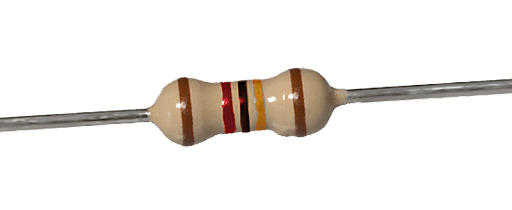
Resistor
Read More: Resistors MCQ
Uses of Resistor
[Click Here for Sample Questions]
Resistors find use in:
- Oscillators
- Telecommunications
- Amplifiers
- Digital Multimeters
- Modulators
- De-modulators
- Transmitters
Read More: Difference between Earth and Neutral
Uses of Resistor in Circuit Functions
[Click Here for Previous Year Questions]
In most of the circuits, there is a resistor knob that is used to control the flow of resistance. Resistors are used in large machinery to reduce any damage to the appliance.
The main uses of this knob-type resistor :
- Controlling the loudness of amplifier signals.
- Controlling the speed of motors and other machinery.
- It helps us to find out modulation at different resistances.

Resistors in Circuits
Read More: Resistors Important Questions
Uses of Resistors in LED and Transistors
LEDs are known for their low consumption of electricity as they can’t conduct a high amount of current. Hence, resistors are used in between the semiconductors for better control of the desired current range that is ideal for them.
Use of Resistors for Heating
The collision between electrons and ions in resistors produces heat and hence resistors are used in heaters and toasters.
- Electric cookers, Microwaves, and Sterilizing units also use these resistors.
- The metal filament of a bulb glows white-hot as a result of the high temperature produced due to the resistance when electricity is passed through it.
Use of Resistors in Dividing Voltages
Dividing the voltage is required when some components need to work in a lesser voltage than the supplied input voltage. Each component requires different voltages hence dividing voltages can help the components to run smoothly. Connecting the resistors in series will help to lower the voltage equally across each resistor.
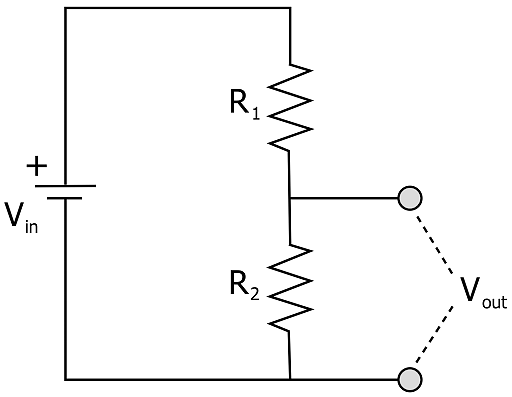
Resistors used to divide voltages
Use of Resistors in Amplifiers
The amplifier is used to increase the sound. Resistors are mainly used in it to produce various signals and clock pulses for different resistances
Uses of Resistors as Temperature Sensors
Some resistors can change their resistance according to the temperature. These can be used as temperature sensors and are linked to devices that can automatically decrease the Air Conditioner temperature according to the room temperature.
Use of Resistors in bulbs
White light produced in the bulb is due to the collision of electrons and ions in the resistor which produces heat. Most of the bulbs with filaments have a resistor in them for the generation of light.

Resistors in Bulbs
Use of Resistors in Blinking and rainbow lights
In the blinking lights, the lights have to blink at a certain time and the resistor decides what amount of current we have to send for the blinking. In the rainbow lights also color-coding resistors will function by changing the frequency of flow.
Also check:
Resistance Formula
[Click Here for Sample Questions]
The resistance of a resistor can be calculated by Ohm’s Law:
V= I*R
Where,
- I refer to the current
- V is the voltage
- R is the resistance of the material
Things to Remember
- Resistance refers to the opposition offered to the electron flow in a closed circuit.
- A resistor is mainly used in order to control the flow of the current.
- Resistors help us measure different resistances and control the flow of different electrons.
- Resistors are used in amplifiers to produce various signals and clock pulses for different resistances.
- Each component requires different voltages hence using resistors to divide voltages can help the components to run smoothly.
- The resistance of a resistor can be calculated by Ohm’s Law: V= I*R.
Previous Year Questions
- One kilowatt hour is equal to….[NEET 1997]
- The resistance of a wire is ′R′ ′ ohm. If it is melted and stretched to ′n′ times its original length, its new resistance will be…..[NEET 2017]
- If the ammeter has a coil of resistance 480ohm and a shunt of 20ohm, the reading in the ammeter will be….[NEET 2015]
- If both the coils are connected in parallel, the time taken by the same quantity of water to boil will be….[NEET 2003]
- The internal resistance of the battery is...[NEET 2011]
- An aluminum rod and a copper rod are taken such that… [DUET 2007]
- In the adjacent shown circuit, a voltmeter of internal resistance… [BITSAT 2009]
- A wire of resistance of 12 ohms is in the form of a circle… [JIPMER 1999]
- A cell of constant emf first connected to a resistance… [BITSAT 2006]
- In an a.c. circuit the e.m.f. (∈) and the current (i) at any instant… [NEET 2008]
- A circuit contains two resistors R1 and R2 in series… [JIPMER 2019]
- The masses of three copper wires are in the ratio… [VITEEE 2015]
- A letter 'A' is constructed of a uniform wire with resistance… [BITSAT 2012]
- In a region of magnetic induction… [NEET 1988]
- A 10V battery with internal resistance of 1Ω and a 15V battery with… [JKCET 2018]
- Resistances 1 Ω,2 Ω, and 3 Ω are connected to form a triangle… [VITEEE 2017]
- A milliammeter of range 10 mA has a coil of resistance… [KCET 2001]
- Twelve resistors each of resistance… [BITSAT 2019]
- The equivalent resistance between the points P and Q in the network… [UPSEE 2006]
- What is the potential drop between points A and C in the following circuit… [BCECE 2006]
Sample Questions
Ques. Explain the principle of working of a resistor? (1 mark)
Ans. A resistor works by converting electrical energy to heat which is dissipated into various forms.
Ques. How are insulators different from resistors? (1 mark)
Ans. Insulators stop the flow of current into the circuit whereas resistors control the flow of current.
Ques. What is the use of color-coding on resistors? (1 mark)
Ans. The color-coding on resistors is used to calculate the value of resistance.
Ques. What is the tolerance level of gold and silver color codes? (1 mark)
Ans. The tolerance level of color codes gold and silver are 5% and 10% respectively.
Ques. What is the advantage of connecting resistors in series? (1 mark)
Ans. The circuit can function more accurately and there is an equal voltage drop across each resistor.
Ques. Which resistor is used for Industrial purposes? (1 mark)
Ans. The wire-Wound resistor is used for Industries.
Ques. Draw the table for various color codes of resistors along with their tolerances. (5 marks)
Ans. The color codes of resistors with their tolerances are –
| Color | Digit | Multiplier | Tolerance(%) |
|---|---|---|---|
| Black | 0 | 100 | - |
| Brown | 1 | 101 | 1 |
| Red | 2 | 102 | 2 |
| Orange | 3 | 103 | |
| Yellow | 4 | 104 | |
| Green | 5 | 105 | 0.5 |
| Blue | 6 | 106 | 0.25 |
| Violet | 7 | 107 | 0.1 |
| Grey | 8 | 108 | 0.05 |
| White | 9 | 109 | |
| Gold | 10-1 | 5 | |
| silver | 10-2 | 10 |
Ques. Mention any 4 types of resistors. (2 marks)
Ans. The 4 types of resistors are –
- Potentiometer
- Thermistor
- Rheostat
- Metal Film Resistor
Ques. Draw a schematic diagram of an electric circuit consisting of a battery of two cells each of 1.5 V\(\Omega\), 5\(\Omega\), 10\(\Omega\) and 15\(\Omega\) resistors and a plug key, all connected in series. (1 Mark) [AI 2009]
Ans. The diagram is as below:

Schematic diagram of an electric circuit
Ques. State Ohm's law. Draw a labeled circuit diagram to verify this law in the laboratory. If you draw a graph between the potential difference and current flowing through a metallic conductor, what kind of curve will you get? Explain how you would use this graph to determine the resistance of the conductor. (5 Marks) [Board Term I, 2016]
Ans. Ohm's law: The electric current flowing through a conducting wire, III, is directly proportional to the potential difference across its ends, VVV, provided its temperature stays unchanged.
- Mathematically, V\(\propto\) I.
- The graph obtained by plotting the potential difference against the current flowing in a conductor is a straight line.

- From Ohm's law, V∝I or V = IR, where R is the resistance. Thus, R= V/I, which represents the slope of the V-I graph.
Thus, the slope of the V-I graph gives the resistance of the conductor.
Ques. (a) List the factors on which the resistance of a conductor in the shape of a wire depends.
(b) Why are metals good conductors of electricity while glass is a bad conductor of electricity? Give reasons.
(c) Why are alloys commonly used in electrical heating devices? Give reason. (3 Marks) [2018 (AI, Delhi, Foreign)]
Ans. (a) The resistance of a conductor:
(i) is directly proportional to the length of the conductor, l.
R∝l
(ii) is inversely proportional to the cross-sectional area of the conductor, A.
R∝1/A
(iii) depends on the material of the conductor.
(b) Metals have a much lower resistivity than glass. This makes metals better conductors of electricity.
(c) Alloys have a high resistivity and do not oxidise or burn readily at high temperatures, making them perfect for use in heating devices.
Ques. The resistance of a wire of 0.01 cm radius is 10 Ω. If the resistivity of the material of the wire is 50×10−8 Ωm, find the length of the wire. (3 Marks) [Board Term I, 2014]
Ans. Given:
- Radius of wire, r=0.01 cm =10−4 m
- Resistivity, \(\rho=50\times10^{-8}\ \Omega\text m\)
- Resistance, \(R=10\ \Omega\)
- Length of wire, l=?
These quantities are related by,
\(\boxed{R=\rho\dfrac{l}{A}}\)
where \(A=\pi r^2\) is the cross-sectional area of the wire. We have,
\(l = \frac{RA}{\rho}\)
\(=\frac{R \times \pi r^2}{\rho}\)
\(=\frac{10 \Omega \times \pi \times(10^{-4}\ m)^2}{50 \times 10^{-8} \Omega m}\)
= 0.628 m or 62.8 cm
For Latest Updates on Upcoming Board Exams, Click Here: https://t.me/class_10_12_board_updates
Also check:



Comments