




NMAT by GMAC 2026 is a national-level management entrance exam conducted by the Graduate Management Admission Council (GMAC) for MBA and PGDM admissions at NMIMS and more than 50 other top B-schools across India. Registration for NMAT 2026 closed on October 10, 2026, and the exam window runs from November 2 to December 20, 2026. Candidates who have already registered must now book their test slots before October 22, 2026.
- Slot Booking: The last date to register and schedule your NMAT 2026 exam slot is October 25 2026. Slots are allotted on a first-come, first-served basis across Pearson VUE test centres — book early to get your preferred date and city.
- Exam Window: NMAT 2026 testing opens on November 2, 2026 and closes on December 20, 2026. You can choose any available date in this window.
- Retake Registration: NMAT 2026 allows up to 3 attempts per cycle. Retake registration opens on November 3, 2026 and stays open until December 17, 2026. The retake fee is INR 3,000 plus applicable taxes, with a minimum 15-day gap between attempts.
- Retake Scheduling: The NMAT Retake scheduled will be open from Tuesday, 3rd November ’26 till Thursday, 17th December ’26.
- Result and Scorecard: GMAC releases individual scorecards within 48 hours of each attempt. The first scorecards are expected from November 3–4, 2026. Scores are valid only for 2027 academic year admissions.
The NMAT registration fee is INR 3000 + applicable taxes. The NMAT 2026 retake fee is also INR 3000 + applicable taxes. You will receive first five score reports from NMAT for free. However, any additional score reports (beyond the first five) will cost you INR 400 per score report + applicable taxes.
Check:
- NMAT Registration 2026 (Additional Phase), Check Last Date, Fees, Application Form Link @ mba.com
- NMAT Exam Dates 2026: Additional Phase Exam Dates Out, Admit Card, Scheduling & Result Dates

What is NMAT by GMAC 2026?
NMAT by GMAC is a national-level computer-based management entrance exam conducted by GMAC (Graduate Management Admission Council) — the same organization that runs the GMAT. The exam’s original full form is Narsee Monjee Management Aptitude Test. GMAC took over the management of the test in 2015 and rebranded it as NMAT by GMAC.
- The NMAT 2026 is the primary gateway to MBA and PGDM programs at all NMIMS (Narsee Monjee Institute of Management Studies) campuses across India.
- Apart from NMIMS, more than 50 other business schools accept NMAT 2026 scores for their management admissions, including XIM University, TAPMI, K J Somaiya, Great Lakes, and many others.
- You can choose from multiple exam dates during a 7-week testing window (November 2 to December 20, 2026).
- You can also retake the exam up to three times in the same cycle, giving you the chance to improve your score before applying to institutes.
- The exam is conducted at Pearson VUE test centres across India and internationally.
| Particulars | Details |
|---|---|
| Exam Name | NMAT by GMAC 2026 |
| Full Form | Narsee Monjee Management Aptitude Test by GMAC |
| Conducting Body | Graduate Management Admission Council (GMAC) |
| Exam Level | National Level |
| Exam Mode | Computer-Based Test (Computer-Adaptive) |
| Total Duration | 120 minutes (2 hours) |
| Number of Questions | 108 questions (36 per section) |
| Number of Sections | 3 (Language Skills, Quantitative Skills, Logical Reasoning) |
| Score Range | 36 to 360 (scaled) |
| Negative Marking | No |
| Number of Attempts | Up to 3 attempts per cycle |
| Testing Window 2026 | November 2 – December 20, 2026 |
| Accepting Colleges | More than 50 colleges across India |
| Official Website | mba.com/exams/nmat |
Related Links:
- NMAT 2026 Exam Pattern: Section-Wise Breakdown and Marking Scheme
- NMAT 2026 Syllabus: Topic-Wise Guide for All Three Sections
- NMAT 2026 Eligibility Criteria: Who Can Apply?
NMAT 2026 Registration: Process and Fees
NMAT 2026 registration opened on August 20, 2026 and closed on October 25, 2026. The registration window is now open. Candidates who have not yet registered should proceed as soon as possible.
How to register for NMAT?
The
NMAT 2026 registration is a fully online process at mba.com. Here is the step-by-step process:- Create an account on the official NMAT website at mba.com using your email ID.
- Fill in your personal details, academic background, and contact information.
- Select the programme(s) you want to apply to. The base registration includes up to 5 programme choices.
- Upload a recent photograph and signature as per the specifications.
- Pay the registration fee online using credit card, debit card, or net banking.
- Save your registration confirmation and login credentials safely.
NMAT 2026 Fees
| Attempt | Expected Fee (Approx) |
|---|---|
| First Attempt (Registration) | Rs 3,000 (plus taxes) |
| First Retake | Rs 1,800 (plus taxes, approx) |
| Second Retake | Rs 1,800 (plus taxes, approx) |
| Rescheduling Fee | Rs 1,000 (plus taxes, approx) |
Note: NMAT fees are the same for all categories. There is no fee waiver or concession based on category. Fees are non-refundable.
All fees paid to GMAC for NMAT are non-refundable. Confirm exact fees on the official NMAT website before payment.
NMAT 2026 Slot Booking: How to Schedule Your Exam
NMAT 2026 slot booking is a separate step after registration. You need to log in to your NMAT account and choose your preferred exam date, time, and test centre. The slot booking deadline is October 25, 2026 — this is the most urgent task for registered candidates right now.
Slots are filled on a first-come, first-served basis. Popular cities and weekend slots fill up within days. Book immediately if you have not done so.
Steps to Book Your NMAT 2026 Exam Slot
- Log in to your NMAT account at mba.com with your registered email ID and password.
- Go to the exam scheduling section in your dashboard.
- Browse available exam dates between November 2 and December 20, 2026.
- Select your preferred test centre city and specific Pearson VUE test centre.
- Choose a time slot (morning or afternoon, based on availability).
- Confirm your booking. You will receive a Test Appointment Confirmation (TAC) by email.
NMAT 2026 Test Centres
NMAT 2026 is conducted at Pearson VUE test centres across India and at international locations. Major Indian cities where NMAT test centres are available include Delhi, Mumbai, Bengaluru, Chennai, Hyderabad, Kolkata, Pune, Ahmedabad, Jaipur, Chandigarh, Bhopal, Lucknow, and many others. The full list of test centres is available on the NMAT scheduling portal.
NMAT 2026 Rescheduling
If you want to change your booked exam slot, you can reschedule by paying INR 1,200 plus applicable taxes.
- Rescheduling is open until December 17, 2026.
- You must reschedule at least 24 hours before your scheduled exam time.
- Log in to your NMAT account and use the rescheduling option in your dashboard.
NMAT 2026 Important Dates
The NMAT by GMAC 2026 official schedule has been released by GMAC. Registration is now closed. The most urgent upcoming deadline is slot booking on October 25, 2026 — just 8 days from now. If you have registered and not yet scheduled your exam, do it immediately.
Slot booking closes on October 25, 2026. Test slots fill up quickly on a first-come, first-served basis. Book your slot now to secure your preferred exam date and test centre city.
| Event | Date 2026 | Status |
|---|---|---|
| Slot Booking Last Date | October 25, 2026 | Upcoming |
| Exam Window Opens (First Attempt) | November 2, 2026 | Upcoming |
| Retake Registration Opens | November 3, 2026 | Upcoming |
| Result / Scorecard Release | Within 48 hours of each attempt (from November 3, 2026) | Upcoming |
| Rescheduling Last Date | December 17, 2026 | Upcoming |
| Retake Registration Last Date | December 17, 2026 | Upcoming |
| Exam Window Closes | December 20, 2026 | Upcoming |
| Registration Opens | August 20, 2026 | (Over) |
| Registration Last Date | October 10, 2026 | (Over) |
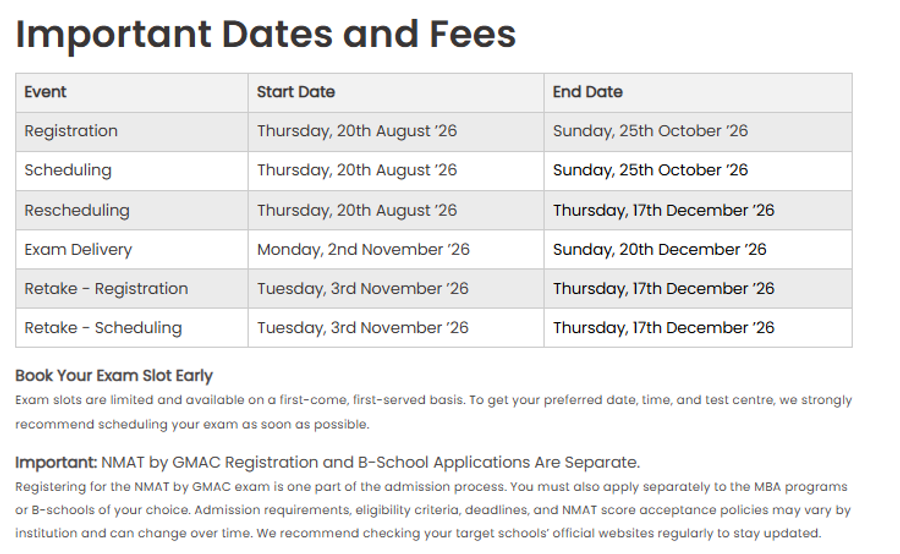
Source: NMAT by GMAC Official Website
Related Links:
- NMAT Exam Centers 2026: Check NMAT Test Cities, Exam Day Guidelines
- NMAT 2026 Admit Card: Download Steps and Details
NMAT 2026 Eligibility Criteria
NMAT by GMAC 2026 has basic eligibility requirements based on graduation marks. There is no upper age limit and no subject restriction on your graduation stream. Here is what you need to qualify.
Academic Eligibility for NMAT 2026
- You must hold a graduate degree in any discipline from a recognized university.
- You need at least 50% marks in graduation (aggregate). For SC, ST, and PWD candidates, the minimum is 45%.
- Final year graduation students can also appear for NMAT 2026, subject to each institute’s individual conditions.
- Students with professional degrees such as CA, CS, or ICWA can also apply if the institute recognizes it as equivalent to graduation.
Other NMAT 2026 Eligibility Conditions
- There is no upper age limit for NMAT by GMAC.
- You can attempt NMAT in multiple years. Within a single testing cycle, you can take it up to 3 times.
- Foreign nationals and NRI candidates can also apply for NMAT 2026.
- Work experience is not required for NMAT registration itself, but some institutes (e.g., Great Lakes) may require it for specific programmes.
Note: Each institute accepting NMAT scores may set additional eligibility conditions. Always check the individual B-school’s admission policy before applying.
Institute-Specific Eligibility (Selected Colleges)
| Institute | Programme | Minimum Eligibility |
|---|---|---|
| NMIMS Mumbai | MBA (Core) | Graduation with 50% marks |
| XIM University, Bhubaneswar | MBA (Business Management) | Graduation with 55% marks |
| K J Somaiya Institute of Management | MBA | Graduation with 50% marks |
| TAPMI Manipal | PGDM | Graduation with 50% marks |
| Great Lakes Institute of Management | PGPM | Graduation + Work experience (check official page) |
| SDA Bocconi Asia Center | MBA | Graduation (any discipline) |
NMAT 2026 Exam Pattern and Marking Scheme
The NMAT by GMAC 2026 exam has three sections — Language Skills, Quantitative Skills, and Logical Reasoning — with 36 questions in each section. The total exam is 120 minutes (2 hours). A key feature is that you can choose the order of the three sections before you start the exam. Each section has its own timer.
| Section | Number of Questions | Time Allotted | Scaled Score Range |
|---|---|---|---|
| Language Skills | 36 | 28 minutes | 12 – 120 |
| Quantitative Skills | 36 | 52 minutes | 12 – 120 |
| Logical Reasoning | 36 | 40 minutes | 12 – 120 |
| Total | 108 | 120 minutes | 36 – 360 |
Source: NMAT by GMAC Official Website
NMAT 2026 Marking Scheme
- Each correct answer gives +3 raw marks.
- There is no negative marking in NMAT 2026. Wrong or unattempted answers give 0 marks.
- Raw scores are converted to scaled scores by GMAC through a normalization process. The final scaled score ranges from 36 to 360 overall and 12 to 120 per section.
- Since there is no penalty, you should attempt all 108 questions. Never leave a question blank.
Related Links:
- NMAT 2026 Exam Pattern: Detailed Section-Wise Analysis
- NMAT 2025 Paper Analysis: Difficulty and Good Attempts
Key Features of NMAT 2026 Exam Format
- Section order choice: At the start of the exam, you select the order in which you want to attempt the three sections. This is a major advantage — you can start with your strongest section to build confidence.
- Separate section timer: Each section has its own independent countdown. Time does not carry over from one section to another.
- Computer-adaptive: NMAT uses a computer-adaptive testing format. Question difficulty adjusts based on your performance within the section.
- Multiple attempts: You can take NMAT up to 3 times in the 2026 cycle — your first attempt and up to 2 retakes. There must be at least a 15-day gap between attempts.
- No calculator provided: You cannot use a physical or on-screen calculator. Mental math and estimation skills are important for the Quantitative section.
NMAT 2026 Syllabus: Section-wise Topics
GMAC does not publish an official fixed syllabus for NMAT by GMAC. The NMAT 2026 syllabus below is based on topics observed in previous years’ papers. You should prepare all topics listed here, as questions can come from any of these areas across all three sections.
Language Skills Syllabus for NMAT 2026
The Language Skills section tests your command over English. It is the most time-pressured section — only 28 minutes for 36 questions, which means less than 47 seconds per question. Speed and accuracy both matter here.
- Reading Comprehension: Passages of 300–500 words followed by inference, main idea, tone, and detail questions
- Vocabulary: Synonyms, antonyms, and fill-in-the-blank with contextual word choice
- Grammar and Usage: Error correction, sentence improvement, and identifying grammatically incorrect sentences
- Para-Jumbles: Rearranging 4–6 sentences into a coherent paragraph
- Para Completion: Choosing the sentence that best completes or best starts a paragraph
- Verbal Analogies: Word pair relationships (e.g., tool:function, part:whole)
Quantitative Skills Syllabus for NMAT 2026
Quantitative Skills is the longest section at 52 minutes. It covers a broad range of arithmetic, algebra, and data-based topics. Data Interpretation is a high-weight sub-area here.
- Arithmetic: Percentages, profit and loss, simple and compound interest, ratio and proportion, time-work, time-speed-distance, averages, and mixtures
- Algebra: Linear and quadratic equations, inequalities, surds and indices, and functions
- Geometry and Mensuration: Lines, angles, triangles, circles, polygons, areas and volumes of 2D and 3D figures
- Number System: HCF, LCM, divisibility rules, prime factorization, remainders, and unit digits
- Data Interpretation: Bar graphs, pie charts, line graphs, tables, and mixed/complex graphs — DI is the most scoring sub-area if practiced well
- Data Sufficiency: Two-statement problems where you judge if the given data is enough to answer a question, without actually solving it
- Modern Mathematics: Permutations, combinations, probability, and set theory
Logical Reasoning Syllabus for NMAT 2026
Logical Reasoning has 40 minutes for 36 questions. It tests both analytical puzzle-solving and critical thinking skills. Most questions here are paragraph-based or diagram-based.
- Analytical Puzzles: Linear and circular seating arrangements, floor-based puzzles, scheduling, and blood relation puzzles
- Critical Reasoning: Strengthen the argument, weaken the argument, assumption, inference, conclusion, and evaluate questions — these are similar to GMAT CR question types
- Coding-Decoding: Letter-based, number-based, and symbol-based coding patterns
- Series Completion: Number series, letter series, and alphanumeric series
- Logical Deduction: Syllogisms, statement-assumption, and statement-conclusion questions
- Decision Making: Course of action and cause-effect type questions
- Visual Reasoning: Figure-based pattern recognition and matrix reasoning (less common but possible)
Related Links:
NMAT 2026 Admit Card
The NMAT 2026 admit card will be available on your dashboard on the official NMAT website 24 hours after you schedule your exam slot. Since NMAT allows self-scheduling, the admit card is not released on a single common date. You will get a fresh admit card for each of your attempts.
To download the NMAT 2026 admit card, follow these steps:

The admit card contains your name, registration number, exam date, time slot, test centre address, photograph, and important exam day instructions. You must carry a government-issued photo ID along with the admit card on exam day.
Related Links:
NMAT 2026 Result and Scorecard
NMAT 2026 results will come out on a rolling basis throughout the testing window. GMAC releases each candidate’s individual scorecard within 48 hours of their exam attempt. If you take the exam on November 2, your score will be available by November 4, 2026. There is no single result declaration date for NMAT — every candidate gets their score soon after their own attempt.
How to Download NMAT 2026 Scorecard
- Log in to your NMAT account at mba.com using your registered email ID and password.
- Go to the "My Account" section and look for the scorecard download option.
- Download your scorecard in PDF format.
- Send your score to the colleges you are applying to, as per each institute’s individual admission process.
What Does the NMAT 2026 Scorecard Show?
- Your overall scaled score (36–360) and the section-wise scaled scores (12–120 each for Language, Quantitative, and Logical Reasoning).
- If you take multiple attempts, you will have a separate scorecard for each attempt.
- Most colleges use your best score across all NMAT 2026 attempts, but some institutes may have specific policies — check each college’s admissions page before deciding on a retake strategy.
- NMAT 2026 scores are valid only for admissions to programmes starting in the 2027 academic year. Scores cannot be used for later years.
- GMAC does not share your scores directly with institutions. You need to submit scores to the colleges you apply to as part of their application process.
Related Links:
NMAT 2026 Cutoff: Expected Scores for Top Colleges
NMAT 2026 cutoff will be released by each institute individually after the exam window closes in December 2026. Since the exam has not yet begun (window opens November 2), all cutoffs listed here are expected estimates based on previous years’ data. Actual cutoffs will depend on exam difficulty, total number of candidates, and each college’s intake for 2027.
These are expected cutoffs based on analysis of previous year data. Official NMAT 2026 cutoffs will be released by each institute after the exam window ends in December 2026.
Expected NMAT 2026 Cutoff: NMIMS Campuses
| NMIMS Campus | Program | Expected Overall Cutoff | Expected Sectional Cutoff (Each Section) |
|---|---|---|---|
| NMIMS Mumbai | MBA / MBA HR / MBA Business Analytics / MBA Digital Transformation | 209+ | 60 |
| NMIMS Mumbai | MBA Pharmaceutical Management | 190+ | 60 |
| NMIMS Bangalore | MBA | 209+ | 60 |
| NMIMS Hyderabad | MBA | 209+ | 60 |
| NMIMS Navi Mumbai | MBA | 209+ | 60 |
| NMIMS Indore | MBA | 209+ | 60 |
Expected NMAT 2026 Cutoff: Other Top B-Schools
| College | Expected NMAT Score Cutoff (2026) |
|---|---|
| NMIMS Mumbai (Flagship MBA) | 235-245+ |
| K. J. Somaiya Institute of Management, Mumbai | 225+ |
| XIMB - Xavier Institute of Management Bhubaneswar (HR) | 225+ |
| TAPMI - T. A. Pai Management Institute, Manipal | 200-215+ |
| Great Lakes Institute of Management, Chennai | 200-215+ |
| SOIL Institute of Management, Gurgaon | 200-215+ |
| IFMR Graduate School of Business, Chennai | 190-210+ |
| VIT Vellore - MBA Program | 180-200+ |
| SRM University | 180-200+ |
Important: NMIMS Mumbai only considers the NMAT score from your first attempt. Retake scores are not accepted. Other colleges may accept the best score from all attempts.
Related Links:
- NMAT 2026 Cutoff: NMIMS Campus-Wise and Section-Wise Cutoffs
- NMAT 2026 Score vs Percentile: What Score Gets You What Percentile?
Top Colleges Accepting NMAT 2026 Score
More than 50 MBA and PGDM colleges across India accept NMAT by GMAC 2026 scores. Each college runs its own admission process — you need to apply to each institute separately. A higher score increases your chances at more competitive colleges. Here are some of the top colleges accepting NMAT 2026.
| College | Location | Program |
|---|---|---|
| NMIMS Mumbai | Mumbai, Maharashtra | MBA, MBA HR, MBA Business Analytics, MBA Digital Transformation |
| NMIMS Bangalore | Bengaluru, Karnataka | MBA |
| NMIMS Hyderabad | Hyderabad, Telangana | MBA |
| K. J. Somaiya Institute of Management | Mumbai, Maharashtra | MBA |
| TAPMI - T. A. Pai Management Institute | Manipal, Karnataka | MBA programs |
| XIMB - Xavier Institute of Management | Bhubaneswar, Odisha | MBA HR |
| IFMR Graduate School of Business | Chennai, Tamil Nadu | MBA |
| Great Lakes Institute of Management | Chennai, Tamil Nadu | PGPM |
| SDA Bocconi Asia Center | Mumbai, Maharashtra | MBA |
| VIT Vellore | Vellore, Tamil Nadu | MBA |
| FLAME University | Pune, Maharashtra | MBA, MBA Communication Management |
| SPJIMR | Mumbai, Maharashtra | Global Management Programme (GMP) |
| ISB Hyderabad | Hyderabad, Telangana | Advanced Management Programme |
This is a representative list. The complete and updated list of NMAT 2026 accepting colleges is available on the official NMAT website at mba.com.
You must apply separately to each institute. A high NMAT score alone does not guarantee admission — each college has its own shortlisting and interview process.
Related Links:
- Top MBA Colleges Accepting NMAT 2026: College-Wise Cutoff and Fees
- NMIMS Mumbai MBA 2026: Placements, Fees, Ranking
NMAT 2026 Score Analysis: What is a Good Score?
NMAT uses a scaled scoring system. Your raw score (based on correct answers) is converted to a scaled score using GMAC’s normalization process. This ensures fairness across different test forms that may have varying difficulty levels. Understanding the score range helps you set a clear preparation target.
NMAT 2026 Score Interpretation Table
| Score Category | Overall Score (out of 360) | What It Means |
|---|---|---|
| Excellent | 240 and above | Strong contender for NMIMS Mumbai Core; competitive for XIM and TAPMI |
| Good | 210 – 239 | Competitive for NMIMS Bengaluru, K J Somaiya, Great Lakes |
| Average | 185 – 209 | Eligible for several mid-tier NMAT-accepting colleges |
| Below Average | Below 185 | Limited options; consider using retake within the cycle to improve |
How NMAT Score Normalization Works
Because NMAT 2026 is spread across a 7-week window (November 2 to December 20), different candidates take slightly different question sets of varying difficulty. GMAC uses a statistical normalization (equating) process to make sure that a candidate who got a harder test form is not penalized compared to someone who got an easier set. Your final scaled score reflects your ability level, not just the raw count of correct answers.
Using the NMAT Retake Feature Strategically
NMAT’s 3-attempt rule is one of its biggest advantages over other MBA entrance exams. Here is how to use it well:
- Take your first attempt early (November) to get a baseline score and identify weak sections.
- Use the 15-day gap before your retake to work specifically on your weakest section. Do not try to improve everything at once.
- Most institutes use your best score across attempts. However, verify each institute’s policy — a few may use your latest score instead.
- Taking the exam in early November leaves room for two retakes before December 20. If you wait until December, you may not have time to retake.
- Section-wise, identify which section is dragging your overall score down and target that in your retake prep.
What Happens After NMAT 2026? Admission Process
There is no centralized NMAT counselling. Each college that accepts NMAT 2026 scores runs its own independent selection process. After the exam, you must apply separately to each institute you want to join. Here is the typical admission process at NMAT-accepting colleges.
Step-by-Step NMAT Admission Process
- Take the NMAT Exam: Attempt your exam during November 2 – December 20, 2026. You can take up to 3 attempts.
- Receive Your Scorecard: Get your scorecard within 48 hours of your attempt. Share scores with colleges as required by each institute.
- Apply to Institutes: Apply to the colleges you want. Most NMAT-accepting colleges have application deadlines in December 2026–January 2027. Apply early to improve your chances of being shortlisted for early rounds.
- Shortlisting: Colleges shortlist candidates based on NMAT score, academic record (Class 10, Class 12, graduation marks), work experience (where applicable), and application essays or statements of purpose.
- Group Discussion (GD) / Written Ability Test (WAT): Shortlisted candidates are invited for GD or WAT rounds, typically held in February–March 2027.
- Personal Interview (PI): Candidates who clear GD/WAT are called for personal interviews, usually conducted at the institute’s campus or online.
- Final Merit List: Institutes prepare a final merit list based on a weighted combination of NMAT score, GD/WAT performance, PI score, academic record, and work experience.
- Admission Offer: Final selected candidates receive admission offers, usually in March–April 2027. Seat acceptance and fee payment complete the process.
Related Links:
- NMAT 2026 Retake Registration: Fees, Deadlines, and Steps
- NMAT 2026 Slot Booking: How to Schedule Your Exam
NMAT Admission Process at NMIMS Mumbai
NMIMS Mumbai’s MBA Core programme, the most sought-after NMAT destination, uses this selection process:
- NMAT score for initial shortlisting (minimum cutoff applies, expected around 208+)
- Case Discussion (CD) round for all shortlisted candidates — NMIMS uses CD instead of a traditional GD
- Personal Interview (PI) for candidates who clear the CD round
- Final selection uses a composite score based on CD + PI performance + NMAT score + academic and professional background
Each institute sets its own selection criteria and weightages. Always check the admissions page of each college you are targeting before preparing for their specific round.
Related Links:
NMAT 2026 Preparation Tips and Strategy
The NMAT 2026 exam window opens on November 2, 2026 — less than 3 weeks away. If your slot is in early November, you need a focused, high-intensity preparation plan right now. Here are the most effective strategies for each section and for the exam overall.
Language Skills: Speed is the Priority (28 minutes, 36 questions)
- Language Skills gives you less than 47 seconds per question — the tightest time constraint of all three sections. Your biggest enemy here is reading slowly.
- Practice reading comprehension passages daily from business publications (Mint, Economic Times). Focus on identifying the main idea and tone quickly — do not read every sentence with equal attention.
- Build your vocabulary from NMAT-style word lists, focusing on high-frequency synonyms and antonyms.
- Practice grammar error correction from previous NMAT papers. Most errors in NMAT grammar questions are subject-verb agreement, tense errors, and pronoun misuse.
- For para-jumbles, look for the opening sentence (one that introduces a topic without reference to a prior idea) and the concluding sentence first, then link the middle sentences.
Quantitative Skills: Accuracy over Speed (52 minutes, 36 questions)
- At 52 minutes, Quant gives you about 86 seconds per question — the most breathing room of the three sections. Use this time for accuracy, not rushing.
- Revise core formulas: percentages, profit-loss, time-work, simple and compound interest, and time-speed-distance. Most arithmetic questions use one or two of these concepts together.
- Data Interpretation is the most scoring sub-area if you are well-practiced. Spend at least 30% of your Quant prep time on DI sets — tables, bar graphs, and pie charts are most common.
- For Data Sufficiency, practice the elimination method. You rarely need to fully solve the problem — just determine if the data is sufficient. This saves significant time.
- Permutation-combination and probability questions in NMAT are usually not very complex. Do not skip modern math in your preparation.
Logical Reasoning: Puzzles First, Then Critical Reasoning (40 minutes, 36 questions)
- Analytical puzzles (seating arrangements, floor puzzles) can be solved with certainty once set up correctly. They reward time investment. Do 2–3 puzzles from NMAT mock tests daily.
- Critical Reasoning questions in NMAT are similar to GMAT CR. Practice strengthen, weaken, and assumption question types specifically — these are the most common CR types in NMAT.
- Coding-decoding and series completion questions are usually quick to solve. Use them to build your score without spending much time.
- Do not spend more than 2 minutes on any single LR question. If a puzzle is taking too long, mark it and move on — return at the end of the section.
General NMAT 2026 Preparation Tips
- Take full-length mocks weekly: Simulate 108 questions in 120 minutes with the section-order choice. Most coaching platforms (TIME, IMS, Career Launcher) offer NMAT-specific mock tests.
- Analyze every mock test: After each mock, spend as much time analyzing as you spent taking the test. Identify which question types are costing you the most time.
- Experiment with section order: Many candidates find starting with Logical Reasoning or Quantitative (when fresh) and doing Language last works well. Find your best order through mocks, because you will choose the order in the real exam.
- Attempt all 108 questions: Since NMAT has no negative marking, never leave a question unanswered. Even a random guess has a positive expected value.
- Plan your retakes: Take your first attempt in early to mid-November to leave room for 1–2 retakes if needed. Do not treat the first attempt as a throwaway — aim for your target score from the start.
FAQs
Ques. What is NMAT by GMAC 2026?
Ans. NMAT by GMAC 2026 is a national-level management entrance exam conducted by GMAC (Graduate Management Admission Council) for MBA and PGDM admissions at NMIMS and more than 50 other colleges in India. The 2026 exam window runs from November 2 to December 20, 2026. Candidates can take the exam up to 3 times per cycle.
Ques. What are the important dates for NMAT 2026?
Ans. Key NMAT 2026 dates are: registration closed October 10, 2026; slot booking last date is October 22, 2026; exam window runs November 2 to December 20, 2026; retake registration is open November 3 to December 17, 2026; scorecards are released within 48 hours of each attempt.
Ques. What is the NMAT 2026 exam pattern?
Ans. NMAT 2026 has three sections: Language Skills (36 questions, 28 minutes), Quantitative Skills (36 questions, 52 minutes), and Logical Reasoning (36 questions, 40 minutes). Total: 108 questions in 120 minutes. There is no negative marking. The scaled score ranges from 36 to 360. You can choose the order of sections before you start the exam.
Ques. How many times can I take NMAT 2026?
Ans. You can take NMAT 2026 up to 3 times in the same testing cycle — one initial attempt and up to two retakes. You need at least a 15-day gap between any two attempts. Retake registration opens November 3, 2026 and closes December 17, 2026. The retake fee is INR 3,000 plus applicable taxes.
Ques. What is a good score in NMAT 2026?
Ans. A score of 210 or above is considered good and makes you competitive for colleges like NMIMS Bengaluru, K J Somaiya, and Great Lakes. For NMIMS Mumbai Core, you typically need 208 or above. A score of 240+ is excellent and puts you in a strong position for the most competitive NMAT-accepting programmes. Sectional scores also matter — aim for 65+ in each section.
Ques. What is the eligibility for NMAT 2026?
Ans. You need a graduation degree from a recognized university with at least 50% marks. SC, ST, and PWD candidates need 45%. Final year students can also apply. There is no upper age limit. Foreign nationals and NRI candidates are also eligible. Each institute may have additional requirements — always check the specific college’s admissions page.
Ques. When will NMAT 2026 results be declared?
Ans. NMAT 2026 results are released on a rolling basis. You get your scorecard within 48 hours of your exam attempt. If you take the exam on November 2, your score is available by November 4. There is no single result date — each candidate gets their score individually after their own attempt.
Ques. Which colleges accept NMAT 2026 scores?
Ans. More than 50 colleges across India accept NMAT 2026 scores. The main ones are all NMIMS campuses (Mumbai, Bengaluru, Navi Mumbai, Hyderabad, Indore), XIM University, K J Somaiya, TAPMI Manipal, Great Lakes Institute of Management, SDA Bocconi Asia Center, ICFAI Business School, and many more. You need to apply separately to each college.
Ques. Is there negative marking in NMAT 2026?
Ans. No, there is no negative marking in NMAT 2026. A correct answer gives you +3 raw marks. Wrong or unattempted questions give 0 marks. Because there is no penalty, you should always attempt all 108 questions — never leave any question blank.
Ques. How is the NMAT 2026 score calculated?
Ans. Your raw score (correct answers × 3) is converted to a scaled score through GMAC’s normalization process. The scaled score ranges from 36 to 360 overall and 12 to 120 per section. Normalization ensures fairness across different test forms of varying difficulty that different candidates may receive during the 7-week testing window.
Ques. Can I reschedule my NMAT 2026 exam after booking my slot?
Ans. Yes. You can reschedule your NMAT 2026 exam by paying a fee of INR 1,200 plus applicable taxes. The rescheduling facility is available until December 17, 2026. You must reschedule at least 24 hours before your scheduled exam time. Log in to your account at mba.com to use the rescheduling option.
Ques. Does NMAT have a centralized counselling process?
Ans. No. There is no centralized NMAT counselling. Each institute that accepts NMAT scores runs its own independent admission process — shortlisting, GD/WAT, and personal interview. You must apply separately to each college, and each college has its own application deadline, selection criteria, and weightages.
The information about NMAT by GMAC 2026 on this page is based on official GMAC notifications, previous year data, and third-party sources available at the time of writing. Dates and other details are subject to change. Candidates should check the official NMAT website at mba.com/exams/nmat for the latest and most accurate information about the exam schedule, eligibility, fees, and participating institutes.



Comments
Found 22 Comments
You can check here for the NMAT 2025 Question Paper (Available): Download NMAT Previous Year Papers PDFs with Solutions
You can check here for the NMAT Mock Test 2026: Attempt Full Test, Chapter-wise Test Online for Free
The CMAT (2026) exam date has not been officially announced yet. However, based on the latest notification by the National Testing Agency (NTA), it is expected to be held in the last week of January 2026.
You can check here for the NMIMS NPAT 2024 Sample Papers, Old Question Papers and Practice Tests
You can check here for the NMAT Mock Test 2025: Attempt Full Test, Chapter-wise Test Online for Free
You can check here for the AIBE Mock Test 2025 (Available), Attempt Free Online Mock Test
You can check here for the MHT CET Syllabus 2026: Download PDF, Check Section-wise Syllabus, Weightage & Important Topics
You can check here for the NMAT Mock Test 2025: Attempt Full Test, Chapter-wise Test Online for Free
The NMAT 2025 exams began on 5 November 2025. The candidates can check the exam analysis and the NMAT 2025 question paper.
You can check here for the NMAT Mock Test 2025: Attempt Full Test, Chapter-wise Test Online for Free
You can check here for the Top MBA Colleges Accepting NMAT Score Based on 2025 Ranking
Yes, taking NMAT practice tests can help you achieve passing or competitive marks. These tests familiarize you with the actual exam pattern, improve your time management, and identify weak areas in sections like Quantitative Skills, Logical Reasoning, and Language Skills. By practicing mock tests and reviewing your mistakes, you can strengthen your conceptual understanding and accuracy. Many NMAT aspirants improve their scores by analyzing their mock test performance and adjusting their study strategies.
There is no specified limit mentioned for how many free mocks you can take for the NMAT by the GMAC exam series. However, for the official NMAT practice tests via GMAC, you get two free attempts for the “free practice exam 1” (108 questions) after registration
You can download the previous year's question papers for the All India Institute of Medical Sciences (B.Sc. Nursing) exam from the official website: Visit AIIMS Examinations Office at aiimsexams.ac.in. and go to the ‘Downloads’ or ‘Question Papers / Previous Years’ section. Once there, select the relevant year, click the PDF link, and save the file for practice.
You can check here for the NMAT Mock Test 2025: Attempt Full Test, Chapter-wise Test Online for Free
You can check here for NMAT Question Paper, Download Previous Year Papers PDFs with Solutions. To download official NMAT (National Management Admission Test) question papers, visit the official NMAT by GMAC website. Here, you can access a free online practice exam containing 108 past NMAT exam questions, which you can attempt twice.
You can check here for the NMAT PYQs: Practice NMAT Previous Year Questions for All Sections – QA, LR, VARC
Please post your questions in this thread, and we will be happy to resolve your queries.
Based on your NMAT 2024 score of 188, here are some top MBA colleges in India that accept NMAT scores:
These colleges have varying cutoffs and seat intakes.
You can check here to see the colleges participating in NMAT Entrance exam. Top Colleges in India Accepting NMAT Based on 2023