



Education Content Expert
Plants are known as the most essential living thing on the earth that are useful for both humans and animals. Plants generate oxygen, which is necessary for living things to survive. They help to maintain a balance of ecology while serving as a source of food and oxygen. They provide food and shelter to humans and animals.
There are different parts of plants that play a crucial role in their functioning of the same. Some important parts of plants are as follows:
| Table of Content |
Key Terms: Parts of Plants, Plants, Roots, Stem, Leaves, Seeds, Flower, Fruits, Chlorophyll, Shoot System, Root System
Parts of Plants
[Click Here for Sample Questions]
Plants have several different parts that serve different purposes for the proper functioning of the plant. The component of a plant that is visible above ground is referred to as the shoot system, whilst the section hidden in the ground is referred to as the root system.
Different Parts of Plants are as follows:
- Roots
- Stem
- Leaves
- Flowers
- Fruits
These are some of the most crucial components of plants. Below is an explanation of each component of a plant in detail.
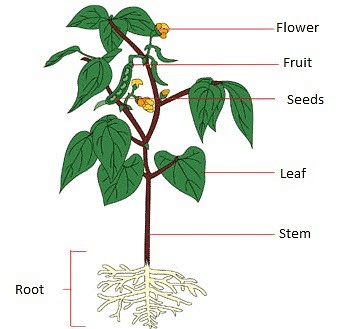
Parts of Plants
What are Roots?
[Click Here for Sample Questions]
Roots are an important part of plants that fixes it into the soil. They absorb water and minerals from the soil and result in plant growth and storage of food materials. There are different types of roots with different formations.
- Primary roots formed by elongation of radicles growing inside the soil also known as secondary and tertiary roots
- Such roots are known as adventitious roots. Primary roots are replaced by a number of roots in monocots as they live shortly.
- Pneumatophore roots grow vertically in an upward direction for the respiration of oxygen.
Read More:
Modifications of Roots
[Click Here for Sample Questions]
Root is a portion of the plant that is underground and anchors the plant firmly by absorbing water and minerals from the soil. In order to transmit and absorb water and minerals from the soil to various parts of the plant, several plants have modified and altered the shape of their roots.
Modifications of Tap Roots
Tap roots are modified for the following purposes:
For Food Storage
Some plants absorb food material, causing the roots to swell up and become fleshy. New buds can again appear when the conditions are favorable, either from the fleshy root or from a little portion of the stem above.
They can be divided into one of two categories based on their shapes:
- Conical roots are broad at the base and conical at the tip.
- Fusiform roots have a center that is inflated and taper to both ends.
- Napiform roots are spherical at the base and taper toward the tip.
- Tuberous roots don't have a particular shape.
For Better Respiration
Halophytes, like Rhizophora, have roots that emerge from the ground and spread upward to obtain oxygen for respiration. These plants breathe through tiny pores called lenticels.
Nodulated Roots
Leguminous plants have adapted their roots to form root nodules that are home to bacteria that fix nitrogen, including Rhizobium. They assist in turning atmospheric nitrogen into nitrates, which the plant can use.
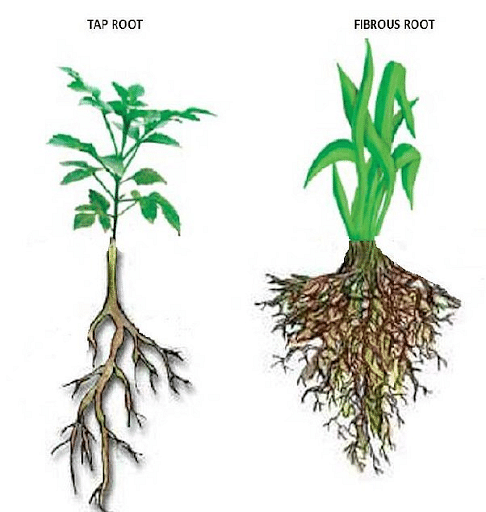
Tap Root and Fibrous Roots
Modification of Adventitious Roots
Adventitious Roots are modified for the following purposes:
For Food Storage
Adaptive roots are transformed into
- Plain Tuberous roots do not take on any shape and are bloated. such as sweet potatoes
- Single beads make up nodulose roots. They have a distinct form and swell at the top, like ginger.
- The collection of advective roots used for Food Preservation is also known as fasciculated tuberous roots. They have distinct shapes.
- Swollen and restricted moniliform roots, such as those of grasses
- Annulated roots, such as ipecac, have the appearance of discs stacked one on top of the other.
For Support
- Supporting Roots: These roots develop from the branches of the tree, hang down and penetrate the soil, supporting the tree.
- Stilt Roots: These roots grow at an angle from the basal node of the boot.
- Climbing Roots: These roots arise from the nodes and attach to support to climb over to provide support for the plant.
- Clinging Roots: These roots penetrate the cracks of support and fix the plant.
- Extension Roots: These are vertically elongated basal parts of the stem that spread out in different directions in the soil.
What is Stem?
[Click Here for Sample Questions]
The portion of the plant that is found above ground is the stem. It produces leaves, fruits, and flowers. The node is the area where the leaves emerge, while the internode is the area between the nodes.
- From the plumule, stems grow to the ground vertically.
- Stems are typically fragile at first and unable to stand upright. It finally develops into the trunk. The bark, a thick outer layer that protects the trunk, is present.
- The plant is supported by the stem. They help in Vegetative Propagation A few underground stems have been modified to store food, including potatoes and ginger.
Functions of Stem
Functions of stems are as follows:
- Photosynthesis: Gives a plant that subsequently turns into a tree a clear structure.
- Support: The stem holds the plant's buds, flowers, leaves, and fruits aloft. The plants are anchored by their roots and stems, which enable them to stand straight up.
- Transportation: It is the component that moves prepared food from the leaves to other sections of the plant as well as water and minerals from the root.
- Storage: Plants store prepared food in the form of starch in their stems.
- Reproduction: A few stems to aid in vegetative propagation for Reproduction in Plants and also aid in fruit and bloom production.
- Guards: Keeps Xylem and phloem safe so they can carry out their duties.
What are Leaves?
[Click Here for Sample Questions]
Leaves contain Chlorophyll which enables plants to use water, carbon dioxide, and sunlight to prepare their food. Petiole, leaf base and lamina are the three basic structural components of a leaf.
- A leaf's leaf base is a projecting component.
- The leaf's lamina is made up of veins and veinlets that give the leaf blade stiffness and aid in the delivery of mineral nutrients.
Functions of Leaves
Leaves serve three purposes:
- Photosynthesis: In the presence of sunshine, green leaves use water and carbon dioxide to prepare food for plants.
- Transpiration: Leaves are essential for removing extra water from plants through microscopic pores known as stomata.
- Reproduction: Bryophyllum leaves can produce new Bryophyllum plants.
Other Parts of Plants
[Click Here for Sample Questions]
There are other parts of the plant that are described below:
Flowers
Plants' reproductive organs are called flowers. They are also called the colorful part of the plant.
- They are mostly in charge of producing fruit.
- The ovules found in the flowers are fertilized, leading to the production of fruit.
- Additionally, they contain pollen that aids in flower pollination.
- The ovules develop into fruit after a combination process of fertilization and pollination.
Parts of Flowers
- Petals: Insects and birds are drawn to the vibrant parts of flowers.
- Sepals: Under the petals, the green, leafy sepals shield the flower buds from harm.
- Stamens: An anther and filament make up the male portion of this flower.
- Pistil: The stigma, style, and ovary make up the female portion of the flower.
Fruits
- Fruits are the result of plant reproduction.
- They serve as a layer of defense for seeds.
- The main purpose of a fruit is to spread seeds and promote plant reproduction.
Seeds
Seeds are the main mode of reproduction. They are most usually discovered in fruits, where they can germinate and grow into new plants.
- A seed is essentially an embryonic, immature plant that, either by itself or in the presence of stored nourishment, is protected from the environment for the first few weeks after germination (the testa).
- Multiplication, perennation (survival during difficult seasons like the winter), dormancy (a state of halted development), and dispersal are all tasks that seeds excel at performing.
Functions of Plant
[Click Here for Sample Questions]
Every part of the plant performs its respective functions. They are been described as follows:
- Function of Roots: Roots absorb water and minerals from the soil. The ability to act as a support system for the plant so that it stands straight on the ground is another of their most basic roles.
- Function of Stems: The fruit, flowers, and leaves are produced by the stem. Giving the plant a solid base and protection is one of the stem's main roles. Stems help plants reproduce vegetatively. Stems of desert plants can stop excessive water loss and store a significant amount of food for later use.
- Function of Seeds: Seeds promote the germination of new plants. Seeds contain food storage in the form of cotyledons and endosperms. Inside, the embryo is protected by what is essentially a protective seed coat.
- Functions of Leaves: Plants prepare the majority of their food with the help of leaves. They consist of chlorophyll and help in the process of photosynthesis.
Read Also:
| Related Topics | ||
|---|---|---|
| Sexual Reproduction | Modification of Roots | Reproduction |
| Transpiration | Pollination | Translation Protein Synthesis |
Things to Remember
- Roots, stems, leaves, flowers, fruit, and seeds are a few of the most important parts of plants.
- Stem is the portion of the plant that is found above ground stem it helps to produce leaves, fruits, and flowers.
- Roots are important for absorbing water and minerals and fixing the plant to the soil.
- Leaves consist of chlorophyll helping plants to use water, carbon dioxide, and sunlight to prepare their food.
- There are other parts of plants such as flowers, fruits, seeds, etc.
Sample Questions
Ques. What are the four components that plants need to produce food? (2 Marks)
Ans. The four components that plants need to produce food are
- Solar Energy
- Water
- Carbon Dioxide
- Chlorophyll
Ques. What are the parts of flowers? (3 Marks)
Ans: The parts of a flower are:
- Petals: The colorful components of flowers attract insects and birds.
- Sepals: The green, leafy sepals that lie underneath the petals protect the flower buds from damage.
- Stamens: The male component of this flower is composed of an anther and filament.
- Pistil: The feminine component of the flower is made up of the stigma, style, and ovary.
Ques. What is the female part of Flower? (1 Mark)
Ans. Pistil is the female part of the plant. It holds the structure that becomes the fruits and seeds. It is made up of three functional components namely stigma, style, and ovary.
Ques. Explain the function of roots. (3 Marks)
Ans. There are different functions of roots:
- Anchoring of the plant to the soil: Roots are able to hold the soil particles tightly at one position with the help of which plants can grow taller.
- Absorption of water and nutrients from the soil: Water is absorbed by roots. It is taken into the body by different methods like osmosis, respiration, and transpiration. the non-availability of water can lead to the closing of stomata, and other deficiencies and may have less impact on photosynthesis. Conduction of absorbed water and nutrients to stem
- Vegetative reproduction: This is a form of asexual reproduction in which a plant itself can grow from a fragment or cutting off the parent plant. They can survive well under stable conditions.
Ques. Explain the function of the stem. (2 Marks)
Ans. Stem produces flowers, fruits, and leaves. From the plant to the leaves, it disperses nutrients and minerals. The stem serves as the plant's framework. Additionally, it protects the plant and aids in asexual propagation.
Ques. Explain the function of leaves. (2 Marks)
Ans. A leaf's veins allow water and nutrients to travel through it. Petiole, leaf base and lamina are the three fundamental components of a leaf. The plant's leaves aid in photosynthesis. They aid in eliminating any extra water through the stomata. It is, in a nutshell, for transpiration. Some plants contain leaves that help with reproduction.
Ques. What are Nodulated roots, explain their function. (3 Marks)
Ans. Nodulated roots are bead-like structures present in roots and are found in plants and are associated with Rhizobium, The root nodules contain nitrogen and Rhizobia. Mostly found among the legume family- Fabaceae or Leguminosae. Plants that are connected with Rhizobium, the symbiotic nitrogen-fixing bacteria, have nodulated roots. Rhizobia and nitrogen are found in the root nodules.
- It consists of a process with each rhizobium having a defined host-plant range of Rhizobia called Nodulation.
- They are found in the soil, respond to the plant-root environment (rhizosphere) by increasing their population levels, and attaching to the root surface.
- Nodulate roots can be controlled by various factors both external (heat, acidic soil, drought) and internal (autoregulation of nodulation, ethylene)
- The bacteria present in the roots convert molecular nitrogen in the atmosphere into nitrites and nitrates, which are converted into amino acids also known as biological nitrogen fixation.
- The function of nodulated roots is to give shelter to bacteria.
Ques. What is the role of flowers in plants? (2 Marks)
Ans. The most important function of flowers is reproduction. They assist in fusing male and female gametes. Flowers provide nectar to insects, some birds, and other creatures, which helps pollen migrate from one flower to another.
Ques. What is the role of fruits in plants? (2 Marks)
Ans. A fruit's primary role is to disperse seeds and encourage plant reproduction. As a result, regardless of how tasty, sweet, or soft the fruit is, it is produced by all flowering plants.
Ques. What macro- and micronutrients are present in plants? (2 Marks)
Ans. For plant growth, development, and production, some necessary elements are nitrogen (N), phosphorus (P), sulfur (S), zinc (Zn), and iron (Fe). Plant responses to N, P, S, Fe, or Zn deficiency have primarily been addressed independently. In addition to changing micronutrient pathways, macronutrients like N, P, and/or S also show how they interact with one another.
For Latest Updates on Upcoming Board Exams, Click Here: https://t.me/class_10_12_board_updates
Check-Out:



Comments