



The pelagic zone is defined as the region of a lake, river, or ocean that is not connected to the coast or the bottom, or, outside the coastal areas. The pelagic zone is an ecological zone that extends throughout the ocean's water column.
- It is made up of the ocean's water column and can be subdivided further by depth into areas.
- The pelagic zone extends from the sea's surface to its deepest depths.
- As the distance between the surface and the water column changes, pressure rises, and temperature and light decreases..
- Salinity, dissolved oxygen, and micronutrients like iron, magnesium, and calcium all alter as a result of this process.
| Table of Content |
Read More: Why are Plants Green?
Key words: Pelagic zone, Marine, Planktons, Sea, Phytoplankton, Animals, Micronutrients, Salinity, Oxygen, Iron, Magnesium, Calcium
What is Pelagic Zone?
[Click Here for Sample Questions]
The pelagic zone, an ecological realm, covers the entire ocean water column. The pelagic zone has the largest volume of the earth’s inhabitants. It comprises the water column of the open ocean.
- Three types of pelagic lives are present.
- Phytoplanktons are microscopic organisms that live solely in the highest oceanic layer.
- They are photosynthetically combining carbon dioxide and dissolved nutritional salts.
- Zooplanktons are marine creatures that mostly rely on water movement for transportation.
- Some species, such as jellyfish, are poor swimmers.
- Zooplankton feeds on phytoplankton and smaller zooplankton.
- Bony and cartilaginous fishes, mollusks, and decapods dominate the nekton, or free swimmers, with mammals and reptiles being rarer.
Also check: Microbes in Human welfare
Depth and Layers of Pelagic Zone
[Click Here for Sample Questions]
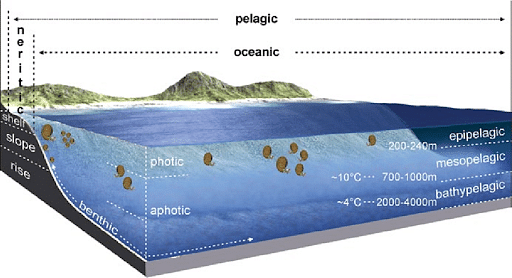
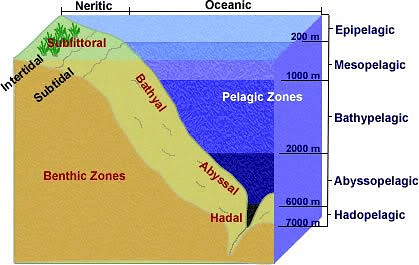
The pelagic zone can cover up to five vertical areas in the ocean, depending on the depth of the water. This is what they are:
Epipelagic Zone
This zone extends from the surface to roughly 200 meters beneath the surface.
- It's the zone on the surface where enough light gets through to allow photosynthesis.
- Phytoplankton, diatoms, and dinoflagellates are the main organisms in this area.
- This zone contains large fish like tunas and sharks.
- Smaller animals only come up to this zone at night to avoid the large predators in the area.
Read More: Difference Between Transpiration and Evaporation
Mesopelagic Zone
It is present at 200 to 1,000 meters below from the epipelagic zone is this zone.
- It is also called twilight zone.
- As few light does reach the area, it is insufficient for photosynthesis.
- To make the most of limited light, several species living in this zone have big eyes.
- The oxygen level is quite low.
- Squids, nautilus shells, swordfish, and other species are capable of surviving in low oxygen environments.
Also check: Importance of Ecosystem
Bathypelagic Zone
Found at 1,000 to 4,000 meters beneath of the continental slope.
- It is termed as the high-pressure zone.
- This zone can only be inhabited by species with specific characteristics that allow them to resist such high pressures.
- The fishes seen here lacks their swimbladders.
- To save energy, the organisms here remain still.
- This zone is home to a lot of bioluminescent fish, gigantic squids and sperm whales.
- The temperature is around 2-4°C.
Abyssopelagic Zone
The continental slope levels out in this zone, which ranges from 4,000 to 6,000 meters.
- It makes up over a third of the ocean's depths.
- Colorless and blind organisms exist here.
Also check: Colour blindness
Hadopelagic Zone
This zone is found in 6,000 to 11,000 meters from abyssopelagic area. .
- This zone has a very small number of species.
- Many organisms can be found In hydrothermal vents.
- Food is in scarce in this zone.
Also Read:
| Related Articles | ||
|---|---|---|
| Biogenetic Lawt | Bones of the Ankle | Conduction of Nerve Impulse |
| Aquatic Ecosystem | Our Environment | Terrestrial Ecosystem |
Pelagic Ecosystem
[Click Here for Sample Questions]
Phytoplankton is the foundation of the pelagic environment. Photosynthesis allows them to produce their own nourishment. They require sunlight and live in the upper zone.
- In the deeper zones, biodiversity is said to be decreasing.
- Organisms in the pelagic zone range in size from microscopic planktons to huge animals.
- Humans rely on phytoplanktons for oxygen, and many creatures rely on them for sustenance.
- This zone is also home to zooplanktons.
- Heterotrophic planktons, which constitute the majority of micro and microorganisms are also included.
- Rather than on land, pelagic birds live on the open waters.
- Planktonic crabs, squids, and forage fish are their favorite foods.
- The following elements make up the pelagic environment:
- Phytoplankton makes up the pelagic environment using photosynthesis.
- They live in the higher zone and require sunlight.
Things to Remember
- Pelagic zone is defined as a liver, lake, or ocean that is not associated with sore and botthom.
- The open ocean is a part of the ocean outside of coastal areas.
- Pelagic life can be found in all layers of the water column, although the number of individuals and species decreases as depth rises.
- Pelagic ecosystem is influenced by presence or absence of sunlight, temperature, oxygen and nutrients available in these areas.
- Marine life is influenced by underwater topography as well as the surface of the sea, in addition to changes in the oceanic pelagic zone.
- Planktons are the major organisms found in this zone.
- Phtoplankton are the main producers utilizing sunlight for photosynthesis.
Also Read:
Sample Questions
Ques. What are the difficulties in the pelagic zone? (3 marks)
Ans. Wave and wind activity, pressure, prey availability, and water temperature may all have an impact on the species in this zone. The pelagic zone encompasses a large area. The prey may be dispersed across a large area, and the animals may have to travel a long distance to find it.
Between the breeding and feeding regions, some animals must travel hundreds of kilometers. They are exposed to variations in water temperature, human activities, and prey types. As a result, creatures in the pelagic zone encounter a number of difficulties.
Ques. What is the nature of pelagic life? (3 marks)
Ans. There are three types of pelagic life. All marine animals eat phytoplankton, which are microscopic organisms that live solely in the sunny uppermost oceanic layer and use sunlight to photosynthetically combine carbon dioxide and dissolved nutritional salts. Zooplanktons are marine creatures that mostly rely on water motion for transportation, however, some, like jellyfish, are poor swimmers. Zooplankton feeds on phytoplankton and smaller zooplankton, and small crustacean copepods and euphausiids are the most abundant. The free-swimming nekton is dominated by bony and cartilaginous fishes, mollusks, and decapods, with mammals and reptiles being rarer.
Ques. What is the meaning of the pelagic zone, and what are the several types of plants that live in these areas? (5 marks)
Ans. The pelagic zone is the area of a lake, river, or ocean that is not connected to the land or the seabed. Throughout their lives, the pelagic zone is never in contact with the seabed or the seafloor. Nutrient-poor, the pelagic zone. The other fishes hunt for food by swimming large distances and eating nutrient-depleted creatures.
Plants in the pelagic zone - The pelagic zone is home to a variety of species and plants. Plants of various types can be found here. Photosynthetic plants can be found in the upper zone since it receives a lot of sunshine. The producers of the marine ecosystem are photosynthetic plants. Solar energy is converted to nutrients and oxygen by these organisms. This is crucial for plants to live. The pelagic zone is home to photosynthetic organisms like phytoplankton, dinoflagellates, and algae. The light dims as we travel deeper until it's completely dark at the bottom. Bathyal and abyssal zones split the region. The former is the zone above the abyssal zone, while the latter is the zone near the ocean bed.
Ques. What are the Pelagic Zone's several layers? (5 marks)
Ans. Five layers pf pelagic zone is as follows.
Epipelagic: This is the lighter zone, where photosynthesis is possible. In the water, this is where all primary production happens. This layer is densely populated by plants and animals. Plankton, seaweed, jellyfish, tuna, and dolphins are examples of creatures found in the pelagic zone.
Mesopelagic: Heterotrophic bacteria can be found in the mesopelagic zone. Swordfish, squid, wolffish, and cuttlefish are some of the organisms that call this place home.
Bathypelagic: The ocean is completely black at this depth of Pelagic water. Aside from a few bioluminescent animals like anglerfish, there are no living plants on this planet. Detritus falling from the above zone feeds the organisms that live here. Marine snow is another name for this occurrence. Giant squid and dumbo octopus are among the residents of this zone.
Abyssopelagic: This zone begins at a depth of approximately 4000 meters. Cold temperatures, high pressure, and total darkness are unsuitable for most animals. Squid, swimming cucumbers, sea pigs, and sea spiders are among the animals present in this zone. The majority of the species that live here have no eyes and are transparent. The utter lack of light is the explanation for this evolution.
Hadopelagic: This refers to the deepest region of the ocean, which is located within oceanic trenches. From 6000 to 11000 meters deep, the zone can be found. The Pacific Ocean has the majority of its hadal habitat.
Ques. What are the benefits of the pelagic zone? (2 marks)
Ans. In the uppermost layers of the pelagic zone, the availability of sunlight near the water's surface leads to a greater abundance of life. Many fish species like to linger near the surface because plankton species that make their own food (in the same way as plants do) thrive there.
Ques. What characterizes a pelagic zone? (2 marks)
Ans. The number of nutrients and dissolved oxygen, as well as the presence or lack of sunshine, water temperature, salinity, and pressure, and the presence of continental or underwater topographic obstacles, all influence the regional and vertical distributions of pelagic life.
Ques. What types of organisms can be found in the pelagic zone? (3 marks)
Ans. Pelagic Invertebrates- Invertebrates in low latitudes create a huge number of eggs, whereas invertebrates at high latitudes produce fewer, larger eggs and offspring.
Pelagic Fish- These are fish that live in coastal ocean and lake waters, but not at or near the sea's bottom. These are forage fish that migrate from one location to another. Plankton is their food.
Pelagic Reptiles- Of the 65 species of marine snakes, only the pelagic sea snake spends its entire existence in the pelagic zone. On land, it's defenseless. Many sea turtle species spend their first year of life in the pelagic zone, then come closer to the shore when they reach adulthood.
For Latest Updates on Upcoming Board Exams, Click Here:https://t.me/class_10_12_board_updates
Do Check Out:



Comments