



Content Curator
Relative motion is a joint property of the object under study as well as the observer. There is no such thing referred to as absolute rest or absolute motion.
- Motion is always specified with respect to an observer or frame of reference.
- The term relative does not refer to the Earth but is basically the velocity or acceleration of an object taken as constant when equated with other moving objects.
- The relative motion formula gives the relative velocity or relative acceleration of an object with respect to a reference frame.
| Table of Content |
Key Terms: Relative Motion, Relative Acceleration, Relative velocity formula, Motion, Gravity, Frame of reference, Speed, Distance, Displacement.
What is Relative Motion?
[Click Here for Sample Questions]
Relative motion is described as the motion of one object with regard to another object. It is determined by assuming that the other object is fixed, meaning it has no motion of its own.
- This is done by looking at the reference frame of another object.
- A reference frame is an abstract coordinate system used to determine the position and velocity of objects in that frame.
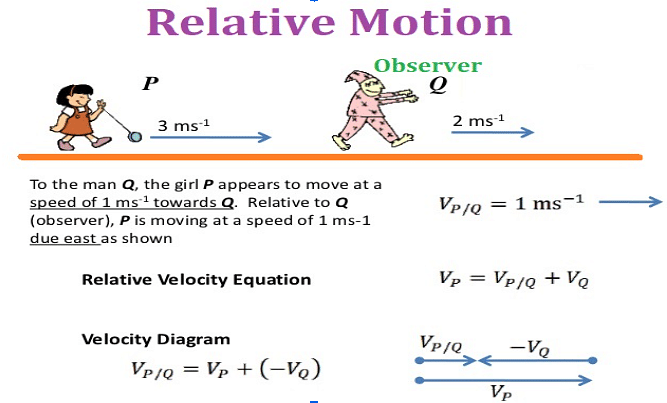
Example of Relative motion
An associated concept is that of relative velocity, which is described as the velocity of one object relative to another. That is, imagine that object A is moving.
- The relative velocity of object A is that specified by an observer in the exact reference frame as another object B.
- An instance of relative velocity would be an individual sitting on a moving train. In their frame of reference, they do not move.
- However, if they look out the window and see a tree, the tree appears to be moving away from the train at a velocity opposite to that with which the train is actually moving.
Relative Motion Formulas
[Click Here for Sample Questions]
The formula for relative motion constitutes:
- Relative velocity formula
- Relative acceleration formula
Relative Velocity Formula
The relative velocity of an object is determined based on the reference frame of another. The following is the formula expressing this relative velocity in one dimension:
Vag = Vbg + Vab
Where
- Vag means the velocity of object A relative to the ground G
- Vbg means the velocity of object B relative to the ground G
- Vab means the velocity of object A with regard to object B.
All these velocities have units of meters per second (m/s).
Relative Acceleration Formula
The relative acceleration equation is obtained by taking the time derivative of the relative velocity equation. The easiest structure of this equation is as follows:
Aag = Abg + Aab
Where
- Aag means the acceleration of object A with regard to the ground G
- Abg means the acceleration of object B with regard to the ground G
- Aab means the acceleration of object A with regard to object B
The equation gets a bit more complicated when going into multiple dimensions. Ultimately, velocity is a vector. It has both magnitude and direction.
- Both the x and y components of the vector must be added in two dimensions. The z component is added in three dimensions.
- This means that if the velocity is not pure (ie, unidirectional), the velocity must be separated into component vectors and added.
What is Relative Acceleration?
[Click Here for Sample Questions]
Relative acceleration is the same as the concepts of relative velocity and relative motion. Like other concepts, relative acceleration is defined as the acceleration of object A in the reference frame of a fixed object and observer B. Acceleration, itself, is described as the change in velocity over time.
- A rigid body is an ideal extended solid body that cannot deform or change its shape regardless of the forces acting on it.
- For relative acceleration, it is assumed that the moving object is a rigid body, so there is no deformation between the center and observation point A.
- Rigid bodies don't really exist in the real world, as all shapes experience some form of deformation during motion.
- However, it is a good approximation for most solids, as deformation is usually minimal under everyday conditions.
- Examples of rigid bodies include large solid metal spheres or flat wooden discs.
- Objects that are small, such as a particle, or that are naturally flexible, such as a wire, are not considered rigid bodies.
Relative Acceleration Equation
The relative acceleration equation is obtained by taking the time derivative of the relative velocity equation. The easiest structure of this equation is as follows:
Aag = Abg + Aab
Where
- Aag means the acceleration of object A with regard to the ground G
- Abg means the acceleration of object B with regard to the ground G
- Aab means the acceleration of object A with regard to object B
All these terms are in units of meters per second squared (m/s2).
This equation deals only with translational acceleration, which means that it only considers an object moving along a line and not experiencing any other forces or accelerations. Yet, it is also necessary to consider the rotational acceleration when viewing the relative acceleration of a rigid body.
- When adding rotation to the equation, there is an additional acceleration, centripetal, and tangential acceleration that must be realized.
- Centripetal, or normal, acceleration is defined as the acceleration of a rotating object moving at the same speed in a circular motion.
The equation for centripetal acceleration is
Ac = V2/r
where
- Ac represents the centripetal acceleration with units in ‘m/s2’ (meters per second squared).
- V represents the circular velocity of the object with units in ‘m/s’ (meters per second).
- r represents the radius of the circular object, with units in ‘m’ (meters).
Adding the centripetal acceleration to the relative acceleration equation converts it to
Aa = Ab + Aabn + Aabt
Where
- Aa represents the acceleration of point A to an outside observer.
- Ab represents the acceleration of point B to an outside observer.
- Aabn represents the centripetal acceleration.
- It is given by Aabn = V2ab/r (Where Vab is the constant rotational velocity of point A with respect to point B and r is the radius).
- Aabt represents the tangential acceleration of point A with regard to point B (i.e. the time derivative of Vab, given by Aab/r).
Also Read:
What is Relative Velocity?
[Click Here for Sample Questions]
When calculating the relative motion of any object, such as a boat in a current or an airplane in the wind, relative velocities must be taken into account.
- A reference frame plays an important role in calculating relative motion based on acceleration, velocity, and position.
- Whenever two objects are moving in the same direction, the relative velocities of objects A and B can be defined as the relative velocities of that object.
The relative velocity formula involves the vector sum of relative velocities, which can be expressed as
vAB = vA – vB
Where
- VAB is the relative velocity of A with respect to B.
- VA is the velocity of A with respect to stationary ground.
- VB is the velocity of B with respect to stationary ground.
When A and B both are moving in the same direction, then the velocity of A and B both are taken as positive, then the resultant relative velocity is given by
vAB = (+vA) - (+vB) ⇒ vAB = vA – vB
When A and B both are moving in the opposite direction, then either the velocity of A or velocity of B both are taken as negative, then the resultant relative velocity is given by
vAB = (+vA) - (-vB) ⇒ vAB = vA + vB
Solved Examples
[Click Here for Sample Questions]
Ques. Airplane A flies at a velocity of 640 m/s to the east, while airplane B travels at a velocity of 530 m/s to the west beside airplane A. Calculate the relative velocity of airplane A with respect to airplane B.
Ans. Let us define the velocity of airplane A as VA and the velocity of airplane B as VB.
Given
- VA = 640 km/h due east
- VB = 530 km/h due west
Now, the relative velocity of plane A relative to plane B is given as
VAB = VA – VB
Since, both the airplanes are moving in the opposite direction to each other, therefore both either velocity of A or B can be taken as negative. We take the velocity of plane B as negative. Then
VAB = 640 km/h – ( – 530 km/h) = 1170 km/h
Hence, the relative velocity of airplane A with respect to airplane B is 1150 km/h due east.
Ques. Suppose two trains A and B are moving with uniform velocities along parallel tracks but in the same direction. Suppose the velocity of train A is 70 km h-1 and that of train B is 60 km h-1. Compute the relative velocities of the trains.
Ans. Given
- Velocity of train A, vA = 70 km h-1 due east
- Velocity of train B, vB = 60 km h-1 due east
Since both the trains are moving in the same directions, thus the relative velocity of A with respect to B or vise-versa, is given by
vAB = vA - vB
⇒ vAB = 70 - 60 = 10 km h-1
Things to Remember
- Relative motion is specified as the motion of one object with reference to another object.
- Relative acceleration is defined as the acceleration of object A in the reference frame of a fixed object and observer B.
- Relative velocity in one dimension: Vag = Vbg + Vab
- Relative acceleration equation: Aag = Abg + Aab
- The equation for centripetal acceleration: Ac = V2/r
- Relative velocity formula: vAB = vA + vB
Sample Questions
Ques. Explain the relative motion with an example. (3 Marks)
Ans. Suppose Car A is moving west at 20 m/s and Car B is moving west at 5 m/s.
The relative motion (velocity) of Car A to Car B is provided by the difference in their velocities. Hence,
Vab = Va - Vb = 20 - 5 = 15 m/s.
The relative motion equation is actually the relative velocity equation, which is:
Vag = Vbg + Vab
Where
- Vag means the velocity of object A with regard to the ground
- Vbg means the velocity of object B with regard to the ground
- Vab means object A’s velocity in relation to object B.
Ques. State the formula for relative acceleration. (3 Marks)
Ans. The simple linear translation formula of relative acceleration is
Aa = Ab + Aab
Where
- Aa means the acceleration of object A to the ground
- Ab means the acceleration of object B to the ground
- Aab means the acceleration of object A with regard to object B.
Ques. State the difference between velocity and relative velocity. (2 Marks)
Ans. Velocity is measured as a function of a reference point relative to another point, while relative velocity is measured as a function of another point. To measure the relative velocity of an object, the absolute frame must contain the rest or rotating frame, as well as the relative frame.
Ques. How do you calculate acceleration? (2 Marks)
Ans. By definition, acceleration (a) is the change in velocity (Δv) over time (Δt) and is represented by the formula
a = Δv/Δt
Using this method, you can measure changes in velocity in meters per second squared (m/s2).
Ques. What are some examples of relative motion? (2 Marks)
Ans. The relative motion of any object is its motion or speed in reference to some other object. The ball would fall in regard to the speed of the object such as a bus when it is thrown upside while in a moving thing/object.
Ques. State the difference between absolute acceleration and relative acceleration. (2 Marks)
Ans. In the local frame of reference of the structure, relative acceleration occurs. The total acceleration is the sum of the relative acceleration and the ground acceleration and this acceleration has a universal reference frame. Velocity is also displacement when both of them are relative and absolute.
Ques. Can you explain relative acceleration with an example? (2 Marks)
Ans. Relative acceleration describes the acceleration of an object or observer B in reference to an object or observer A at rest.
The relative acceleration of B with respect to A is given by
aAB = aB − aA
Ques. Suppose two trains A and B are moving with uniform velocities along parallel tracks but in opposite directions. Suppose the velocity of train A is 60 km h-1 due east and that of train B is 60 km h-1 due west. Compute the relative velocities of the trains. (3 Marks)
Ans. Given
- Velocity of train A, vA = 60 km h-1 due east
- Velocity of train B, vB = 60 km h-1 due west
Since both the trains are moving in opposite directions to each other, thus the relative velocity of A with respect to B or vise-versa, is given by
vAB = vA + vB
⇒ vAB = 60 + 60 = 120 km h-1
Ques. A motorcycle traveling on the highway at a velocity of 150 km/h passes a car traveling at a velocity of 100 km/h. What is the velocity of the motorcycle from the perspective of the passenger in the car? (3 Marks)
Ans. Let us define the motorcycle’s velocity as VM and the car’s velocity as VC.
Given
- VM = 150 km/h
- VC = 100 km/h
Now, the velocity of the motorcycle relative to the passenger sitting in the car is given as
VMC = VM – VC
Since, both the car and motorcycle are moving in the same direction, therefore both taken as positive. Therefore
VMC = 150 km/h – 100 km/h = 50 km/h
Therefore, the motorcycle’s velocity relative to the passenger of the car is 50 km/h.
Ques. Airplane A flies at a velocity of 550 m/s to the north, while airplane B travels at a velocity of 600 m/s to the south beside airplane A. Calculate the relative velocity of airplane A with respect to airplane B. (3 Marks)
Ans. Let us define the velocity of airplane A as VA and the velocity of airplane B as VB.
Given
- VA = 550 km/h due north
- VB = 600 km/h due south
Now, the relative velocity of plane A relative to plane B is given as
VAB = VA – VB
Since, both the airplanes are moving in the opposite direction to each other, therefore both either velocity of A or B can be taken as negative. We take the velocity of plane B as negative. Then
VAB = 550 km/h – (-600 km/h) = 1150 km/h
Hence, the relative velocity of airplane A with respect to airplane B is 1150 km/h due north.
Ques. A motorcycle going on the road at a velocity of 180 km/h passes a car going at a velocity of 130 km/h. What is the velocity of the motorcycle from the perspective of the passenger in the car? (3 Marks)
Ans. Let us define the motorcycle’s velocity as VM and the car’s velocity as VC.
Given
- VM = 180 km/h
- VC = 130 km/h
Now, the velocity of the motorcycle relative to the passenger sitting in the car is given as
VMC = VM – VC
Since, both the car and motorcycle are moving in the same direction, therefore both taken as positive. Therefore
VMC = 180 km/h – 130 km/h = 50 km/h
Therefore, the motorcycle’s velocity relative to the passenger of the car is 50 km/h.
Ques. In which of the following illustrations of motion, can the body be viewed roughly as a point object?
(a) A railway carriage moves without jerking between two platforms.
(b) A monkey seating on top of a person cycling smoothly on a circular path.
(c) A spinning cricket ball that turns snappily on striking the ground.
(d) A tumbling beaker has fallen off the edge of the table. (3 Marks)
Ans. Options (a) and (b) are correct.
(a) The railway carriage moves without jerks between two stations, so the distance
between two platforms is supposed to be big compared to the length of the train. Therefore the train is considered a point object.
(b) The monkey may be considered a point object because the value of distance covered on
a circular track is much greater.
(c) As the turning of the ball is not soft, therefore the distance covered by the ball is not big at an appropriate time. Therefore ball cannot be considered a point object.
(d) Again a tumbling beaker slipped off the edge of a table cannot be considered a point object because the distance covered is not much larger.
Ques. A jet airplane flying at the speed of 600 km h-1 discharges its products of combustion at the speed of 1400 km h-1 relative to the jet plane. What is the speed of the latter with regard to an observer on the ground? (3 Marks)
Ans. The jet airplane’s velocity from the perspective of an observer on the ground = 600 km/h.
If Vj and v0 represent the velocities of the jet and observer respectively, then
vj – v0 = 600 km h-1
Furthermore, if vc describes the products of combustion’s velocity about the jet plane, then
vc – vg = – 1400 km/h
The negative sign suggests that the products of combustion move in a direction opposite to that of the jet plane.
Speed of combustion products w.r.t. observer
= vc – u0 = (vc – vj) + (vj – v0) = (-1400 + 600) km h-1 = – 800 km h-1.
Ques. Explain clearly, with examples, the distinction between
(a) The Magnitude of displacement (often referred to as distance) over an interval of time, and the entire (total) length of path covered by a particle over a similar interval;
(b) The magnitude of the average velocity over a time interval and the average speed over the same interval. (The average speed of a particle over a time interval is defined as the total path length divided by the time interval).
Both (a) and (b) indicate that the second quantity is either larger than or equal to the first. When is the equality sign true? [For simplicity, consider one-dimensional motion only] (5 Marks)
Ans. (a) Assume a particle moves from point A to B along a straight path and returns to A along a similar path. The magnitude of the displacement of the particle will be zero as the particle has returned to its initial place. The total length of the path covered by the particle is
AB + BA = AB + AB = 2 AB
Therefore, the second quantity is larger than the first.
(b) Assume, in the above-mentioned instance, the particle takes time t to cover the entire journey. Then, the magnitude of the particle’s average velocity over time-interval:
v = Magnitude of displacement /Time-interval = 0/t =0
While the particle’s average speed over the similar time-interval will be
S = Total path length /Time-interval= 2 AB /t
Furthermore, the 2nd quantity (average speed) is larger than the 1st (magnitude of average velocity).
Note: In both the above-mentioned circumstances, the two quantities are equal if the particle moves from one point to another along a straight path in a similar direction only.
Ques. A rock is discharged from the top of a tower of height 19.6 m. Compute its final velocity only before touching the ground. (3 Marks)
Ans. As per the formula of motion under gravity:
v2 − u2 = 2 gs
Where
- u means the Initial velocity of the rock i.e. 0
- v means the final velocity of the rock
- s means the height of the rock i.e 19.6 m
- g means acceleration because of gravity i.e. 9.8 m s−2
∴ v2 − 02 = 2 × 19.6 × 9.8
⇒ v2 = 2 × 19.6 × 9.8 = (19.6)2
v = 19.6 m s−1
Therefore, the rock’s velocity is 19.6 m s−1 just before touching the ground.
For Latest Updates on Upcoming Board Exams, Click Here: https://t.me/class_10_12_board_updates
Do Check Out:



Comments