



Content Curator
Resistor color codes play an important role in designing electronic devices. This article discusses some important choice-based questions on Resistor Color Codes from the Current Electricity concept of the latest CBSE Class 12 Physics Syllabus.
Resistor values are indicated with color codes as defined by the International Standard IEC 60062. The color coding is usually done with four color bands. To know the value of resistors, the calculations based on color code are to be known.
The color bands are printed on the resistors to determine the resistance value. Some interesting features are:
- The leaded resistors with a power rating up to 1 W are marked in this way.
- Apart from the resistance, the color codes also indicate the tolerance limit and the rate of failure of the resistors.
- The exact band number is dependent on the number of bands which varies from 3 to 6 bands.
- The first two indicate the resistance and the third is the multiplier.
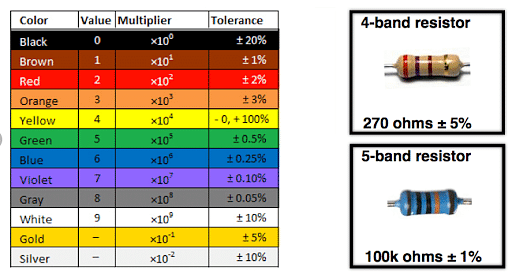
Resistor Color Codes for 4 - band and 5 - band Resistor
Read More: NCERT Solutions for Class 12 Physics Current Electricity
Resistor Color Codes MCQs
Q.1. Resistor Color codes were developed by:
- Radio Manufacturers Association (RMA)
- International Organization for Standardization (ISO)
- Electronics Industries Alliance (EIA)
- a & b are correct
Click here for the answer
A.1. The correct option is A. Radio Manufacturers Association (RMA)
Explanation: The resistor color code was invented by the Radio Manufacturers Association (RMA) in the 1920s.
Q.2. Why is Color Coding used for Resistors?
- Cylindrical Shape
- Small Size
- Due to Through Hole Component
- A & B are correct
Click here for the answer
A.2. The correct option is D. A & B are correct
Explanation: Electronic components and wires are given color coding to identify their value and function. The color bands help in identifying Components and wires are coded with colors to identify their value and function. These help in identifying resistor resistive values, tolerance percentage, and resistor size indicative of its power rating.
Q.3. The number of color bands used in resistors is _______.
- 7
- 6
- 5
- 4
Click here for the answer
A.3. The correct option is B. 6
Explanation: Resistors have color bands divided into three types: 4 band resistor, 5 band resistor, and 6 band resistor.
Q.4. Red color bands on resistors are read from________.
- Left to Right
- From both sides
- Right to Left
- All are correct
Click here for the answer
A.4. The correct option is A. Left to Right
Explanation: Resistors do not start with a metallic band on the left. Hence if a resistor has a gold or silver band on one end, there is a resistor tolerance of 5% or 10%. The resistor position on this band is read from left to right.
Read More:
Q.5. What are the first two bands on the resistors?
- Tolerance
- Decimal Multiplier
- Two digits
- All are incorrect
Click here for the answer
A.5. The correct option is C. Two digits
Explanation: The first two bands on a resistor are two digits that denote the resistance value in Ohms. In a 3-band or 4-band resistor, the third band is representative of the multiplier.
Q.6. The digit that represents the green band on a resistor is ________.
- 3
- 4
- 5
- 6
Click here for the answer
A.6. The correct option is C. 5
Explanation: From the resistor color code table, green is represented by the digit 5.
Q.7. _______ is to be added after the first two digits in a decimal multiplier?
- Resistance
- Digits
- Tolerance
- Zeros
Click here for the answer
A.7. The correct option is D. Zeros
Explanation: The first two digits are representative of the resistance values and after that, zeroes are added to the decimal multiplier as given in the resistor code.
Q.8. Zero Ohm resistors are used for __________.
- Connect the Tracks
- As Jumpers
- Increase Machine Production Time
- All are correct
Click here for the answer
A.8. The correct option is D. All are correct
Explanation: Zero Ohm resistors are most conveniently used as jumpers, connected with tracks, and also useful in increasing the machine production time.
Also Check Out:
Q.9. A no band on the resistor means the tolerance is __________.
- 0.3%
- 15%
- 30%
- 20%
Click here for the answer
A.9. The correct option is D. 20%
Explanation: Tolerance is defined as the percentage error in resistance of the resistor. Thus, a gold tolerance band has a tolerance of 5%, silver has a tolerance of 10% and when there is no band, the tolerance is 20%.
Q.10. The color coding indicates the _______ value or rating of the resistor.
- Numerical
- Resistance
- Alphabetical
- a & c are correct
Click here for the answer
A.10. The correct option is A. Numerical
Explanation: Color codes help in identifying the value and function of the electronic components and wires. They also help in identifying the resistive value, percentage tolerance, and wattage rating based on the resistor size.
Q.11. 7 digit is represented by ________ in the resistor color code.
- Blue
- Violet
- Green
- Red
Click here for the answer
A.11. The correct option is B. Violet
Explanation: As per the resistor color code, the 7 digit stands for Violet.
Also Check Out:



Comments