



Education Journalist | Study Abroad Lead
Resistor Colour Codes are the coloured painted bands that produce a system of identification. These colour codes are used to denote the tolerance rating of a resistor is given as: Brown = 1%, Red = 2%, Gold = 5%, Silver = 10 %. If the resistor has no fourth tolerance band then the default tolerance would be at 20%. Resistors are available in a range of different resistance values from fractions of an Ohm ( Ω ) to millions of Ohms.
Read More: Difference between AC and DC
Key Terms: Color code, Electrical current, Resistors, Resistor colour code, Tolerance band, Ohm’s law, 4-Band Resistors, 5-Band Resistors, 6-Band Resistors, Ohm
Reading Resistor Colour Codes
[Click Here for Sample Questions]
To read the color code mentioned on the resistor, hold the resistor carefully such that the tolerance band is on your right, starting from the left, note down all the colors of the bands and write them down in the sequence. Now use the color code chart to see which digits they represent and get their values. The multiplier band is just next to the tolerance band.
Reading a typical 4-band, 5-band, and 6-band resistors
- 4-Band Resistors: The four-band color code variation is mostly used. In four-band resistors the first two bands represent resistance value, the next one is for multiplier and the last one represents tolerance.
- 5-Band Resistors: These are resistors with high precision. The extra band is an indicator of the third significant digit. The fourth band represents the multiplying factor and the fifth band represents tolerance.
- 6-Band Resistors: The first three colors are the indicators of significant digits. The fourth band is the indicator of the decimal multiplier and the fifth band represents the tolerance. The sixth band is the indicator of the temperature coefficient.
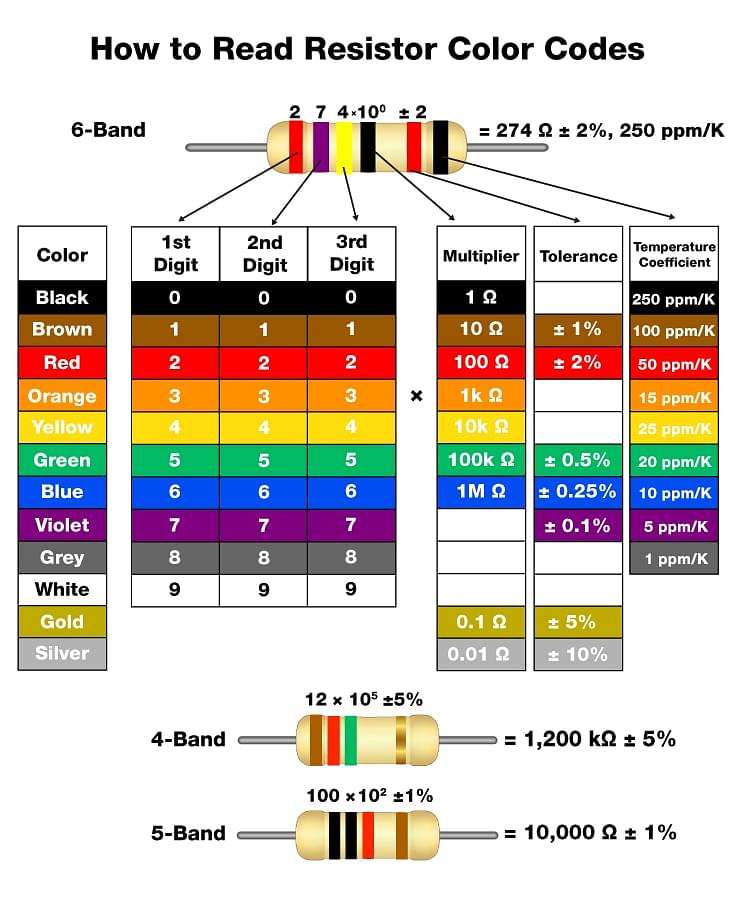
Reading Resistor Colour Codes
One can learn the color code values using the following mnemonic:
| BB ROY of Great Britain had a Very Good Wife All the first letters represent the code of color and their positions are the indicator of digit values. |
Discover about the Chapter video:
Current Electricity Detailed Video Explanation:
Also read:
The Standard Resistor Color Code Chart
[Click Here for Previous Year Questions]
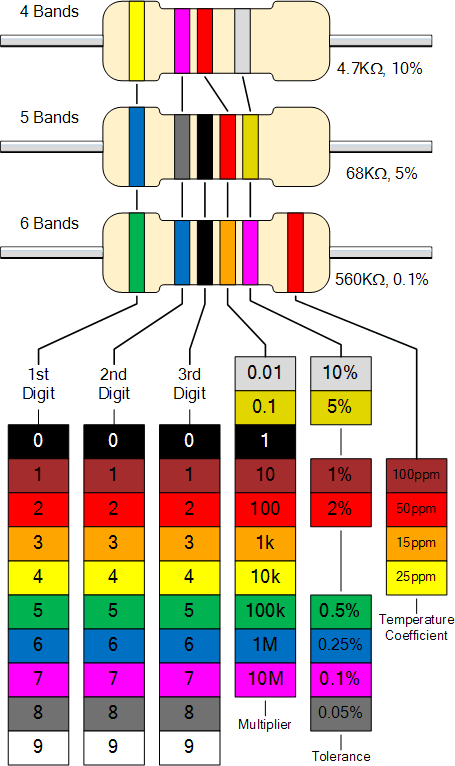
Resistor Colour code chart
Resistor Colour Code Table
The table shows the resistor color codes:

Resistor Colour Code Table
Resistor Color Code And Tolerance Value
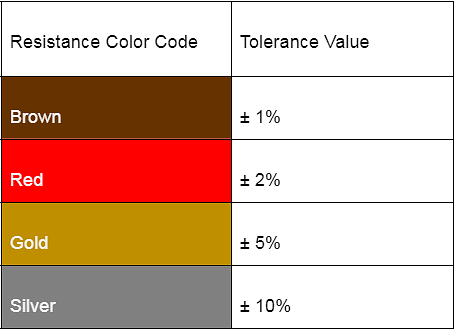
Resistor Color Code And Tolerance Value
Calculating Resistor Values
[Click Here for Sample Questions]
The Resistor Colour Code system is all good, however we need to understand how to apply it to get the correct value of the resistor. The “left-hand” or the most significant coloured band is the band that is nearest to a connecting lead with the colour coded bands being read from left-to-right as follows:
| Digit, Digit, Multiplier = Colour, Colour x 10 colour in Ohm’s (Ω) |
For instance, a resistor has the following coloured markings;
| Yellow Violet Red = 4 7 2 = 4 7 x 102 = 4700Ω or 4k7 Ohm |
- The fourth and fifth bands determine the percentage tolerance of the resistor. Resistor tolerance can be defined as a measure of the resistors variation from the specified resistive value and is a consequence of the manufacturing process and is expressed as a percentage of its “nominal” or preferred value.
- Typical resistor tolerances for film resistors range from 1% to 10% while the carbon resistors possess tolerances up to 20%. Resistors with tolerances lower than 2% are known as precision resistors with the or lower tolerance resistors being more expensive.
- Most five band resistors are the precision resistors with tolerances of either 1% or 2%. Whereas, most of the four band resistors have tolerances of 5%, 10% and 20%.
The colour code used to denote the tolerance rating of a resistor is given as:
| Brown = 1%, Red = 2%, Gold = 5%, Silver = 10 % |
- The default tolerance would be at 20% if resistor has no fourth tolerance band.
- Sometimes it is easier to remember the resistor colour code by using short, easily remembered sentences in the form of expressions, rhymes, and phrases, called an acrostic, which have a separate word in the sentence to represent each of the Ten + Two colours.
- The resulting mnemonic matches the first letter of each word to each colour which makes up the resistors colour code by order of increasing magnitude and there are many different mnemonic phrases which can be used.
-
Here are just a few of the more “cleaner” versions but many more exist:
- Bad Boys Ring Our Young Girls But Vicky Goes Without
- Better Be Right Or Your Great Big Venture Goes Wrong
- Buster Brown Races Our Young Girls But Vicky Generally Wins (This one indicates the position of Brown
- Bad Booze Rots Our Young Guts But Vodka Goes Well (in) Silver Goblets (This one includes the tolerance bands of Gold, Silver)
Read more: Resistor Color Codes MCQ
Types of Resistors
[Click Here for Previous Year Questions]
Resistors are available in many shapes and sizes. The most common types available are through-hole and surface mount. The two main resistors are as follows:
- Linear Resistor: The resistors whose values change with the temperature and voltage applied are called linear resistors.
- Non-linear Resistor: The resistors whose values change according to the ohm’s law are non-linear resistors.

Types of Resistors
Resistors are very small in size so anything written on the resistors cannot be read. To overcome this problem, in 1920 the Radio manufacturer’s association invented the color codes for resistors.
- All resistors with a power rating of up to one watt are marked with color bands.
- Color bands provide the resistance value, tolerance rate, and failure rate.
- The number of bands in a resistor varies from three to six.
- The first two bands are the indicator of resistance value and the third band serves as a multiplier.
- A resistor may have many color bands where each band carries a specific purpose and function.
Read More:
Things to Remember
- Resistors are available in many shapes and sizes. The most common types available are through-hole and surface mount.
- All resistors with a power rating of up to one watt are marked with color bands, these bands provide the resistance value, the tolerance rate, and failure rate.
- To read the color code mentioned on the resistor, hold the resistor carefully such that the tolerance band is on your right, starting from the left, note down all the colors of the bands and write them down in the sequence.
- The multiplier band is just next to the tolerance band.
- There are 3 types of typical band resistors: 4-Band Resistors, 5-Band Resistors, and 6-Band Resistors.
- Letters represent the code of color and their positions are the indicator of digit values.
Read Also: Resistor Color Codes Important Questions
Previous Year Questions
- Charge is a….. [KEAM]
- Two pith balls, each of mass 1.8 g are suspended from….
- A charge +q is placed at origin. There are two concentric spherical surfaces; S1 of radius R and S2 of radius….
- Two charges, each equal to q , are kept at x=−a…. [JEE Main 2013]
- If the electric dipole is slightly rotated from its equilibrium orientation, then its angular frequency ω is…. [JEE Main 2019]
- the kinetic energy of the particle becomes zero when the distance of the particle from the origin is…. [JEE Main 2020]
- The resistance between any two terminals is when connected in a triangle is…. [NEET 1993]
- potential drop through 4Ω resistor is… [NEET 1993]
- The potential difference per unit length of the wire will be… [NEET 1999]
- Value of R for which the power delivered in it is maximum is given by... [NEET 1992]
- Three resistances each of 4Ω are connected to form a triangle… [NEET 1993]
- In a potentiometer the null point is received at 7th wire… [DUET 2007]
- A 2V battery, a 15Ω resistor and a potentiometer of 100 cm length… [JCECE 2011]
- A potentiometer wire AB having length L and resistance 12r is joined to… [JEE Main 2019]
- A resistance is shown in the figure. Its value and tolerance are given respectively by ...[JEE Main 2019]
Check Out:
Sample Questions
Ques: Why are resistors color-coded? (1 mark)
Ans. Resistors are very tiny so writing any code on them is nearly impossible and also reading any code is also very difficult. So, resistors are coded with colors to give some specifications.
Ques: What happens if we use the wrong resistor? (1 mark)
Ans. If one uses the wrong resistor, the equipment may stop functioning, or the resistor itself ends up burning.
Ques: Where do we use resistors in everyday life? (1 mark)
Ans. Resistors are used in all electronic boards, laptop boards, mobile phones and motherboards, home accessories circuits, kettles, lamps, headphones.
Ques: Name a few devices where resistors are used? (3 marks)
Ans. The resistors are used in the following devices:
- Amplifiers
- Transistors
- Digital Multimeter
- Oscillators
- Modulators and demodulators
- Telecommunication devices
Ques: How to remember the resistor colour code? (2 marks)
Ans. The resistor colour codes can be memorised and remembered with the help of mnemonic device “BB ROY of Great Britain had a Very Good Wife,” the capital letters represent the first letters of the colours and their positions the digit values.
Ques: What type of resistor should one use in the circuit? (1 mark)
Ans. The resistor used in the circuit should have twice the power rating.
Ques: What is the color code of 333kΩ, ± 5% five band resistor? a) Orange, Orange, Red, Orange, Gold; b) Orange, Orange, Orange, Orange, silver; c) Orange, Orange, Orange, Red, Gold; d) Orange, Orange, Orange, Orange, Gold. (3 marks)
Ans: The Correct option is d) Orange, Orange, Orange, Orange, Gold.
Ques: How does a resistor colour code work? (2 marks)
Ans. The resistor bands comprise several colour bands which together specify the resistance value, tolerance and sometimes the reliability rate. Resistors with high precision possess five bands. The first three bands indicate the significant digits, the fourth band is the multiplying factor and the fifth band represents the tolerance.
Ques: What is the resistor colour code for a 1000 Ω resistor? (2 marks)
Ans. A 1000 Ω resistor possess a four-band colour code which follows a colour sequence of Brown, Black, Red and Gold. The 1000 Ω resistor has a mulitplying factor of 100 (Red) and a tolerance level of ±5% (Gold).
Ques. Determine the resistance of the given resistor with the given colour sequence (Red, Green, Red, Gold). (4 marks)
Ans. It is already known that the first two colours represent the significant digits of resistance value. So the given colours represent digits 2 and 5. The third band is a multiplier band. Hence, the colour red represents a multiplier factor of 102. The last band determines the tolerance level and the tolerance level of the resistor is ±5%. Hence, the resistance value of the given resistor is 2500 ± 5% Ω or 2.5 kΩ.
Ques: What colour bands would a resistor of resistance value 1000 Ω having a tolerance level ±5% have? (2 marks)
Ans. The colour bands of the resistor would look like this:

For Latest Updates on Upcoming Board Exams, Click Here: https://t.me/class_10_12_board_updates
Also Read:



Comments