



Education Journalist | Study Abroad Lead
Space Wave Propagation refers to the transmission of radio waves within the troposphere layer of the Earth's atmosphere, or within 20 kilometers of the atmosphere. As the radio waves involved can go directly to the troposphere layer, space wave propagation is also known as tropospheric propagation. When radio waves from a broadcasting antenna travel into space around the Earth to reach a receiving antenna, this is known as space wave propagation. Radio waves can propagate in the troposphere either directly or after reflection from the ground. In this article, we will understand space wave propagation, its components, and its applications.
Read more: Questions on antenna sizing
| Table of Contents |
Key terms: Radio wave propagation, space wave propagation, Radar communication, communication range, troposphere layer, Earth, Radio waves, Atmosphere
Also Read: Pulse Amplitude Modulation
Radio Wave Propagation
[Click Here for Sample Questions]
Radio wave propagation is the process through which radio waves travel from one location to another. Radio wave propagation not only defines the behavior of waves as they move from one point to another, but it also shows how radio waves are impacted by the medium through which they travel, and in particular, how they travel through different portions of the atmosphere.

Radio Wave Propagation
Different types of radio wave propagation in free space and the atmosphere can be categorized into three categories:
- Skywave Propagation- When a wave must travel a longer distance, skywave propagation is preferred.
- Ground wave Propagation- The propagation of a ground wave follows the earth's contour. A direct wave is a name given to such a wave. Due to the Earth's magnetic field, the wave might bend and be reflected back to the receiver.
- Free space Propagation- The transmission of electromagnetic radiation across a straight-line channel in a vacuum or ideal atmosphere, sufficiently far from all objects that could affect the wave in any manner, is known as free space propagation.
Read more: Need for modulation
Space Wave Propagation
[Click Here for Previous Year Questions]
The propagation of radio waves within the troposphere layer of the Earth's atmosphere, or within 20 kilometers of the atmosphere, is referred to as space wave propagation. There are both direct and reflected waves in it. Direct waves are those that travel directly from the source antenna to the receiving antenna at the destination without being interrupted or obstructed. After being reflected off of the ground and barriers like buildings, reflected waves eventually reach the receiving antenna at the destination. Space waves are radio waves that have an extraordinarily high frequency.
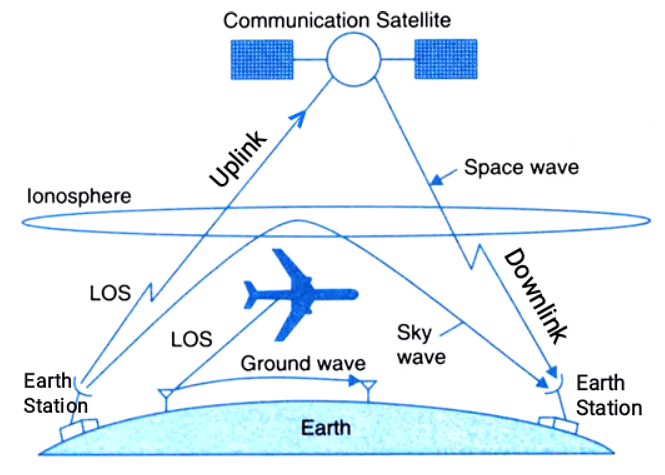
Space Wave Propagation
Such waves can travel across the troposphere. There are two other names for it:
- Tropospheric propagation- In general, the troposphere extends up to 10 to 20 kilometers above the earth's surface. As a result, space wave propagation occurs in the atmospheric zone around 20 km. Because the radio waves involved can go directly to the troposphere layer of the atmosphere, space wave propagation is also known as tropospheric propagation.
- Line-of-sight propagation- The wave traverses a minimal distance of sight in line-of-sight communication. That is, it travels up to the distance that the naked eye can see. If there is a barrier in the transmission path, line-of-sight propagation will be disrupted. This mode is utilized for infrared or microwave communications because the signal can only travel a short distance in this mode.
Also Read: What is internet history of internet
Components of Space Wave Propagation
[Click Here for Sample Questions]
The three components on which space wave propagation depends are:
- Tropospheric Wave- After reflection from the troposphere, radio signals reach the receiving antenna.
- Direct Waves- The radio waves that are directly received by the receiving antenna after being broadcast from the sending antenna.
- Ground Reflected Waves- After being reflected by the ground, radio waves reach the receiving antenna

Space wave propagation, or line-of-sight propagation, is not necessarily smooth, as seen in the diagram. It signifies that this method of transmission may encounter impediments that cause signal attenuation or loss. To avoid these problems, the height of both the transmitting and receiving antennas, as well as the distance between them, must be adjusted. In this case, the formula below appears to be useful:
DM = (2RhT)-½ + (2RhR)-½
where DM is the distance measured between the two antennas,
R is the radius of the earth,
hT is the height of the transmitting antenna, and
hR is the height of the receiving antenna.

Space Wave Propagation
Also Read:
Space Wave Propagation Applications
[Click Here for Previous Year Questions]
The propagation mode of space waves is used in a variety of communication systems, including:
- Satellite communication
- Line-of-sight communication
- Radar communication
- Microwave Linking
- Television Broadcasting
Very high-frequency bands ranging from 30 MHz to 300 MHz, ultra-high frequency (UHF) bands, and microwaves all utilize space waves. Because both skywave and ground wave propagation fail at such high frequencies, this is the case.
These frequencies have smaller antennas that can be installed at heights of several wavelengths above the ground. The curvature of the earth blocks the waves here due to the line-of-sight aspect of this propagation. As a result, if one wishes to receive a signal from beyond the horizon, one must guarantee that the receiving antenna is tall enough to intercept line-of-sight waves.
The line of sight distance, which is defined as the distance between the transmitting and receiving antennas at which both can see one another, is the limit of space wave propagation. It's also known as the communication range, and it can be enhanced by raising the antennas' heights. Furthermore, the curvature of the globe has an impact on the propagation of space waves.
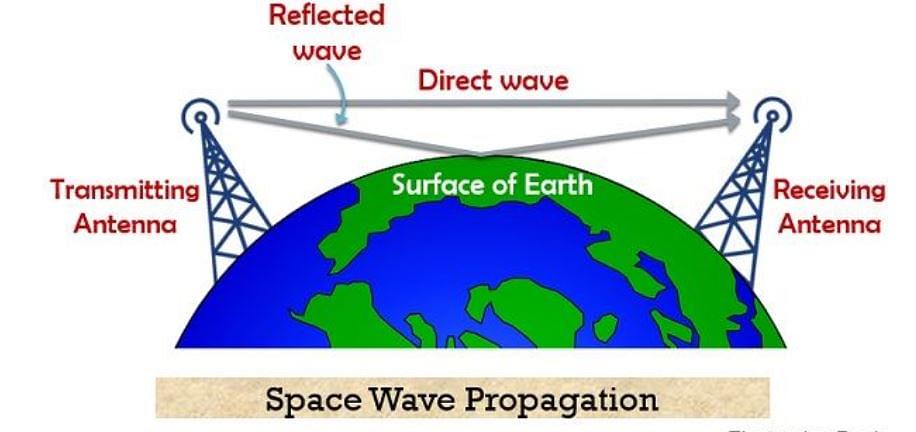
Process of Space Wave Propagation
Also Read: Difference Between AM and FM
Limitations of Space Wave Propagation
[Click Here for Sample Questions]
The limitations of space wave propagation are:
- These waves are influenced by the earth's curvature.
- The propagation of these waves occurs along the line of sight distance, which is defined as the distance between the transmitting antenna and the receiving antenna and is also known as the range of communication.
Also Read: Space travel equipment
Things to Remember
- The behavior of radio waves as they spread from one location to another or into different areas of the atmosphere is known as radio wave propagation.
- Space wave propagation refers to radio waves that occur within 20 kilometers of the troposphere and includes both direct and reflected waves.
- When radio waves from a broadcasting antenna travel into space around the Earth to reach a receiving antenna, this is known as space wave propagation.
- Waves can propagate directly from the earth's surface to the troposphere's surface in tropospheric propagation.
- The waves travel in a straight line and cover the shortest distance possible in line-of-sight propagation. It indicates that the waves propagate to a point where they can be seen with the naked eye.
- The curvature of the earth and the straight path traveling nature of the space waves affect the space wave propagation.
- Line-of-sight communication, television broadcasting, and microwave connecting are all examples of applications that involve space wave propagation.
Also Read: What is optical fiber
Previous Year Questions
Sample Questions
Ques. What is the propagation range of space waves? (2 marks)
Ans. The range of space wave propagation is restricted by a line of sight, which is defined as the distance between the transmitting and receiving antennas at which both can see each other. It's also known as the communication range, and it can be enhanced by raising the antennas' heights.
Ques. Define space wave propagation and give two applications related to the propagation. (3 marks)
Ans. The propagation of radio waves within the troposphere layer of the Earth's atmosphere, or within 20 kilometers of the atmosphere, is referred to as space wave propagation.
Space wave propagation is used in applications such as line-of-sight communication, television broadcasting, and microwave networking.
Ques. Describe briefly radio wave propagation and classify it. (2 marks)
Ans. Radio wave propagation describes how radio waves behave when they travel from one location to another or into different areas of the atmosphere. Ground wave propagation, skywave propagation, and free space propagation are three types of radio wave propagation.
Ques. What is the difference between the propagation of sky waves and the propagation of space waves? (2 marks)
Ans Skywave propagation is the transmission of radio waves from a transmitter to the receiver via the ionosphere's free electrons reflecting signals, whereas space wave propagation is the transmission of radio waves directly into space.
Ques. Why is the space wave propagation also termed as the line of sight propagation? (3 marks)
Ans. Space wave propagation refers to radio waves that occur within 20 kilometers of the troposphere and includes both direct and reflected waves. Line of sight propagation is named after the fact that the signals travel in a straight line from the transmitter to the receiver.
Ques. What are the benefits and drawbacks of utilizing space waves in the atmosphere? (5 marks)
Ans. The absorption of these high or extremely high-frequency waves in the atmosphere is negligible, which is one of the advantages of communicating via space waves. As a result, provided there are no additional issues, space waves can be used for long-distance communication.
Space waves, on the other hand, travel in a straight path. The wave cannot travel beyond a certain point, regardless of the height of the sending and receiving antennas, due to the curvature of the earth's surface.
Ques. Why is the propagation of space waves confined to a short distance across the Earth's surface? (3 marks)
Ans. The propagation of space waves are confined to a short distance across the surface of the Earth as:
- Line of sight communication refers to the transmission of a signal directly from the emitting antenna to the receiving antenna.
- Because of the curvature of the globe, waves traveling directly from the transmitting antenna to the receiving antenna are obstructed.
- It sets a restriction on the maximum line-of-sight distance between the two antennas, as well as the maximum distance across which transmission can be received.
For Latest Updates on Upcoming Board Exams, Click Here: https://t.me/class_10_12_board_updates
Check-Out:



Comments