



Content Curator
Ground wave propagation is a signal propagation that takes place on the surface of the ground. It is used to cover areas on a regional basis with the help of medium and long waves. It is a type of radio wave propagation. It is used by radio broadcast stations to provide relatively local radio communications coverage to small regions. Ground Wave Propagation is better for propagation over short distances during the daytime. Methods like Sky-wave ionospheric propagation are not possible during the day as the Signals on these frequencies get attenuated by the D region. So that is why we need ground-wave propagation for radio stations to achieve their coverage.
| Table of Content |
Key Terms: Ground Wave Propagation, Ground wave radio signals, surface wave, Sky-wave ionospheric propagation, Polarisation, Radio wave, Long wave
What is Surface Wave?
[Click Here for Sample Questions]
When the radio signals, instead of just propagating in a straight line, follow the curvature of the Earth, this is called a surface wave. As the surface of the earth has induced current in it and it slows down the wave-front, and thus they tilt downwards towards the Earth. So the wave is able to curve around the Earth and can be received well beyond the horizon.

Also Check:
| Learn more about Waves | ||
|---|---|---|
| Wave function | Longitudinal and Transverse Wave | Unit of Wavelength |
| Doppler effect | Uses of Radar | Unit of sound |
Working of Ground Wave Propagation
[Click Here for Previous Year Questions]
- Ground wave radio signals are made with many constituents.
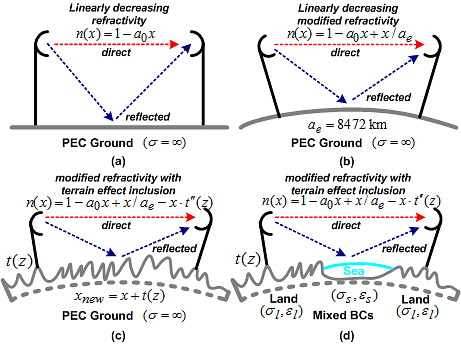
- The antennas in the line of sight will provide a direct wave as well as a reflected signal.
- The direct signal is the wave travelling directly between the two antennas without being affected by locality.
- A reflected signal will also be present as the transmission will be reflected by objects such as hills, buildings or the earth's surface itself.

Ground Wave Propagation
- For local coverage, ground wave propagation is used with a medium wave broadcast transmitter antenna.
- A surface wave is also used for this, as it follows the curvature of the Earth and thus coverage is achieved even behind the horizon.
- The total of components like these is known as the ground wave.

Ground Wave Propagation
- After the horizon, the curvature of the earth blocks the direct and reflected waves, and then the signal is made up of the surface wave that is diffracted, and this is why sometimes the surface wave is also referred to as the ground wave propagation.
Factors Affecting Ground Wave Propagation
[Click Here for Sample Questions]
Frequency: A wave travelling along the Earth's surface is attenuated. A lot of factors decide the degree of attenuation. The first factor is frequency as losses rise with increasing frequency.
Ground on Ground Propagation: Signal attenuation is affected by Terrain roughness, Ground conductivity, and the dielectric constant. Also, the ground penetration becomes greater at lower frequencies. However, terrain with good conductivity provides the best result. So, the type of soil and the content of moisture is of importance. Salty seawater is the best. City centres and Dry sandy terrain are by far the worst.
Ground Wave Propagation: Effect of Ground
Polarisation: There is a major effect of the type of antenna and its polarisation on ground wave propagation. Vertical polarisation has less attenuation than horizontal Polarisation.

Advantages of Ground Wave Propagation
[Click Here for Previous Year Questions]
- They bend around the corners or obstructions while propagating making them more efficient.
- The change in atmospheric conditions also does not affect them.
- Ground wave propagation uses lower frequencies. Therefore, interference mostly occurs due to noise only and not electromagnetic waves.
- Ground wave propagation can cover longer distances.
- Change in atmospheric conditions does not affect ground wave propagation.
- In order to reduce short circuit of electric field, surface waves are vertically polarised.
Disadvantages of Ground Wave Propagation
[Click Here for Sample Questions]
- The earth’s atmosphere causes more energy losses when high-frequency waves are transmitted.
- As the distance of the surface waves from the transmitter increases, path loss increases.
- When the waves interact with Eddy current from the earth surface, they undergo attenuation.
- If polarisation of ground surface is affected, short circuit of electric field occurs.
Applications of Ground Wave Propagation
[Click Here for Previous Year Questions]
- For local radio communications, ground wave propagation is used.
- These are used for one-way communication between the military to submerged submarines because these waves penetrate a lot of depth into seawater.
- These are used for AM, FM and television broadcasting.
- During day time, ground wave propagation of radio signals spanning short distances are ideal.
Also Check:
Things to Remember
- Ground wave propagation is used to cover a regional basis with the help of medium and long waves.
- In ground wave propagation, signal travels over the surface of the ground.
- It is a type of Radio wave propagation where radio waves use various parts of the atmosphere to travel from one place to another.
- Ground wave propagation is used by radio broadcast stations to provide relatively local radio communications coverage to small regions.
- This method of propagation is better for propagation over short distances during the daytime.
- The antennas in the line of sight will provide a direct wave as well as a reflected signal.
- The direct signal is the wave travelling directly between the two antennas without being affected by locality.
- A reflected signal will also be present as the transmission will be reflected by objects such as hills, buildings or the earth's surface itself.
- A surface wave follows the curvature of the Earth and thus coverage is achieved even behind the horizon.
Sample Questions
Ques: Where is floor wave propagation used? (3 marks)
Ans: Ground Wave propagation is a way of radio wave propagation that uses the location among the floor of the earth and the ionosphere for transmission. The ground wave can propagate a full-size distance over the earth's floor, in particular inside the low frequency and medium frequency part of the radio spectrum.
Ques: What is the range of floor wave propagation? (2 marks)
Ans: At high frequency, aside from bypass (reflected signals) radio waves are Line-Of-Sight so the limit is due to the curvature of the earth. At low frequencies (much less than 1 MHz) radio waves can comply with the curvature (a ground wave) and can travel a good deal in addition. At very low frequencies (VLF radio) radio waves can circle the earth.
Ques: How does floor wave propagation work? (3 marks)
Ans: Actually waves never propagate. Only strength propagates in a wave-like pattern.
Let’s say an earthquake jerks the floor. The ground is fabricated from debris. So the power propagates as debris bumps into each different in the direction of propagation by passing their momenta to each other. When a ground particle receives momentum its momentum is going up, while it transfers this momentum to the following particle its momentum drops. This up and down oscillation of momentum values shape a wave pattern, but the particle does not get completely displaced within the course of propagation.
Ques: Why electric discipline aspects of EM waves are absorbed by way of the floor whilst it's far aligned parallel in case of ground wave propagation? (3 marks)
Ans: Ground-wave transmission is widely used at medium and occasional frequencies. Earth's attenuation increases as the frequency will increase. Horizontal polarization can not be used at these frequencies because the electric strains of pressure are parallel to and contact the earth. Since the earth acts as a fairly correct conductor at low frequencies, it might short out the horizontal electric lines of pressure and save the radio wave from travelling very far. Therefore vertical polarization is used for floor-wave transmission, allowing the radio wave to tour an enormous distance along the floor with minimal attenuation.
Ques: Does radio broadcasting require all modes of propagation (skywave, ground wave, and line-of-sight propagation)? (4 marks)
Ans: Radio broadcasting can take advantage of all of these modes however in many cases all are not required. For one instance, the skywave is wanted for long-range carriers to faraway international locations and is provided with the aid of the BBC and Deutsche Welle, to call the best two instances.
Meanwhile, Line-of-sight has primary benefits for TV where too lengthy variety could make interference from more distant transmitters a severe problem. Keeping shorter distances allows many extra regions to have decent reception which can also be higher able to deal with local matters as an additional benefit. The floor wave is especially on hand for proclamations of special signals such as time alerts.
Ques: How long do longwave radio alerts tours? (2 marks)
Ans: Longwave is broadly speaking Ground wave propagation, even though it can absolutely show a few Skywave propagations if the proper antenna is used. Some nighttime, pay attention to the AM radio bands between approximately 530kHz and, say, 1.0MHz. You may be amazed at what you hear.
Ques: Why are AM broadcast signals propagated by using the floor all through the day and with the aid of the sky at night? (4 marks)
Ans: Ground Wave propagation is a way of radio wave propagation that makes use of the vicinity between the floor of the earth and the ionosphere for transmission.
The ground wave can propagate a considerable distance over the earth's floor mainly within the low frequency and medium frequency part of the radio spectrum.
Ground wave radio signal propagation is good for surprisingly brief distance propagation on those frequencies at some stage in the daytime.
Sky-wave ionospheric propagation is not feasible in the course of the day due to the attenuation of the indicators on those frequencies as a result of the D location in the ionosphere.
In view of this, lower-frequency radio communications stations want to depend on floor-wave propagation to obtain their insurance.
Ques: Why is ground wave transmission of alerts restricted to a frequency of 1500 kHz? (2 marks)
Ans: As the earth is a sphere ground wave transmission entails bending of waves through refraction within the environment. Refraction takes place while the waves encounter a distinctive density inside the propagation medium. It is also restrained to lower frequencies with higher wavelengths. Higher frequency waves generally tend to undergo an immediate line without refraction. Hence they may be utilized in line-of-sight propagation.
For Latest Updates on Upcoming Board Exams, Click Here:https://t.me/class_10_12_board_updates
Do Check Out:



Comments