



Education Journalist | Study Abroad Lead
Sulphur trioxide is a chemical compound with the chemical formula SO3. It is produced on a large scale as a precursor to sulfuric acid. There are three forms of sulphur trioxide, namely, gaseous monomer, crystalline trimer and solid polymer. At temperatures just below room temperature, sulphur trioxide is a solid with a relatively narrow liquid range. The main cause of acid rain is gaseous SO3. In sulfonation reactions, sulphur trioxide is used as a reagent. These processes enable the production of detergents, dyes, and pharmaceuticals. Sulphur trioxide is either produced in situ from sulfuric acid or used as a solution in the acid.
| Table of Contents |
Key Terms: Chemical Compound, Covalent Bond, Atoms, Molecule, Sulphur, Oxygen, Reaction, Valence Electrons
Sulphur Trioxide Formula
[Click Here for Sample Questions]
Sulphur Trioxide is a covalently bonded chemical compound with a formula of SO3. By looking at the formula itself, we come to know that one molecule of sulphur trioxide possesses one sulphur atom and three oxygen atoms.
SO3 is a trigonal planar molecule. Its structure belongs to the D3h point group, as predicted by VSEPR theory. The sulphur atom has an oxidation state of +6 and a formal charge value that can range from 0 to +2.
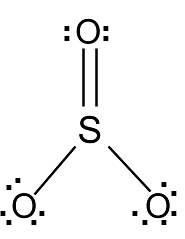
Formula of Sulphur Trioxide
Structure of Sulphur Trioxide
[Click Here for Sample Questions]
Sulphur trioxide is a tetra-atomic chemical molecule in which three oxygen molecules and three sulphur molecules bond with an equal number of valence electrons. A single molecule of sulphur trioxide has 24 valence electrons. Six electrons are required to complete the octet in the SO3 molecule, where both the sulphur and oxygen atoms require two valence electrons to stabilise their atoms.
The sulphur trioxide molecule contains three double covalent bonds between sulphur and oxygen atoms. Due to the formation of the double bond, sulphur trioxide has a trigonal pyramidal structure with no lone pair on the central atom sulphur. Because sulphur is weak in comparison to oxygen, sulphur trioxide has no charge, and the oxygen atoms are so electronegative that sulphur gives them their electron.

Structure of Sulphur Trioxide
Properties of Sulphur Trioxide
[Click Here for Sample Questions]
Mentioned below are the physical and chemical properties of sulphur trioxide:
- Physical Properties: Sulphur Trioxide has a colourless to white crystalline solid appearance and is odourless in nature. It is also soluble in water and has a density of 1.92 g/cm³. The molar mass of SO3 80.066 g/mol and the boiling and melting points of the compound are 44.9 °C and 16.9 °C respectively.
- Chemical Properties: Sulphur trioxide is highly reactive in nature and possesses oxidising properties, hence, it is also used as an oxidising agent.
- On reaction with water, SO3 forms sulfuric acid. The chemical equation is shown below.
SO3 + H2O → H2SO4
- Sulphur trioxide reacts with the base sodium hydroxide to form sodium hydrogen phosphate. The chemical equation is shown below:
SO3 + NaOH → NaHSO4
Molecular and Structural Bonding of Sulphur Trioxide
[Click Here for Sample Questions]
The molecular and structural bonding is described below:
- SO3 is a D3h symmetry trigonal planar molecule in its gaseous state, as predicted by VSEPR theory. As a result, SO3 is said to be a member of the D3h point group.
- Gaseous sulphur trioxide has an electrical dipole moment of zero. This is due to the S-O bonds forming a 120° angle.
- The sulphur atom has an oxidation state of +6 and a formal charge of 0 according to the electron-counting formalism.
- The Lewis structure contains one S=O double bond and two S–O dative bonds without the use of d-orbitals.
Production of Sulphur Trioxide
[Click Here for Sample Questions]
Sulphur Trioxide is made using various methods, as follows:
- In the Environment: In air, sulphur dioxide is directly oxidised to sulphur trioxide, and this reaction can be described as follows:
SO2 + ½ O2 = SO3 ΔH = -198.4
- Laboratory: Sulphur trioxide is synthesised in a chemical laboratory through the two-stage pyrolysis of sodium bisulfate. As an intermediate product, sodium pyrosulfate is given: The chemical reaction at 315 °C dehydration is as follows:
2NaHSO4 → Na2S2O7 + H2O
The reaction, which occurs at 460 °C, can be described as follows:
Na2S2O7 → Na2SO4 + SO3
KHSO4 compounds, on the other hand, do not undergo a similar reaction. It can also be made by combining concentrated sulfuric acid with phosphorus pentoxide.
-
In Industry: The contact process can be used to produce SO3 in the industrial setting. Sulphur dioxide, which can be produced by burning iron pyrite (an iron sulphide ore) or sulphur. After being purified by electrostatic precipitation, the SO2 compound is oxidised by atmospheric oxygen over a catalyst at temperatures ranging from 400 to 600 °C. On silica or kieselguhr support, a typical catalyst contains vanadium pentoxide (V2O5) activated with potassium oxide K2O. Also, platinum works very well, but it is much more expensive and is easily poisoned (i.e. rendered ineffective) by impurities.
Applications of Sulphur Trioxide
[Click Here for Sample Questions]
Sulphur trioxide is a reagent that is required in sulfonation reactions. Dyeing, pharmaceuticals, and detergents are produced as a result of these processes. Sulphur trioxide can be produced in situ from sulfuric acid or used as a solution in the acid. Some of its applications are:
- SO3 can be used as a bleaching agent to remove the residual hydrogen peroxide or as a digesting agent to separate the pulp from the lignin.
- It can be used as a catalyst in the oxidation of sulphur dioxide to sulphur trioxide.
- Strong inorganic acid mists containing sulfuric acid are used in industry or in the production of commercial products.
- It is also a crucial reagent in sulfonation reactions.
- It can be used to make solar energy devices and photoelectric cells.
Things to Remember
- The chemical compound sulphur trioxide is available in a variety of forms, including molecular species and crystalline.
- It is colourless and emits liquid fumes into the air at room temperature. It is also a strong oxidising agent and a highly reactive substance that can catch fire.
- It is a thermodynamically unstable compound in relation to selenium dioxide.
- Metals are corroded by it and it violently reacts with water to form sulfuric acid. Sulphur Trioxide has the chemical or molecular formula SO3.
- Sulphur is a crystalline solid that ranges in colour from colourless to white. When it dissolves in water, it reacts to form sulfuric acid. Its odour is determined by its form. It has a strong sulphur dioxide-like odour in its vapour form, but no odour in its mist form.
- It is manufactured on a large scale as a precursor to sulfuric acid. Sulphur Trioxide can be synthesised in the laboratory via two-stage pyrolysis of NaHSO4. An intermediate product is sodium pyrosulfate. It is widely used as an essential in sulfonation reactions.
- It can be used as a bleaching agent to remove residual hydrogen peroxide, as well as a digesting agent to separate pulp from lignin. Sulphur trioxide is produced as a byproduct of sulphur dioxide oxidation.
Sample Questions
Ques. What is the reaction between Sulphur Trioxide and water? (2 marks)
Ans. A lot of heat is required to generate a lot of sulfuric acid. This is the reaction that can be used to produce sulfuric acid by converting metal sulphides or sulphur to SO2, catalytically converting it to SO3, and then reacting the SO3 with water.
We combine SO3 gas with fairly concentrated sulfuric acid, however, to produce even more concentrated acid. As a result, we are reacting with a low concentration of water in H2SO4, and the reaction is proportionally less violent. The reaction is
SO3 + H2O → H2SO4
Ques. What causes Sulphur Trioxide to be electrophilic in nature? (2 marks)
Ans. Sulphur can be bonded to three different oxygens twice. The sulphur atom in the middle has a formal charge of zero, but the oxygens to which it is bonded are extremely electronegative (known as electron hogs), so the sulphur atom in the middle has a partial plus charge. As a result, in an attempt to compensate, it will accept electrons.
Ques. State whether SO3 is an acid or a base. (2 marks)
Ans. It can be described as acidic. Because sulphur is nonmetal, and we know that nonmetal oxides are generally acidic. When SO3 is dissolved in H2O, the solution turns blue litmus into red, indicating that the solution is acidic.
Ques. Describe the manufacture of H2SO4 by contact process? (3 marks)
Ans. The following are the steps involved in the production of sulphuric acid via the contact process:
- Sulphur dioxide is produced by burning sulphur (or iron pyrites) in air.
S + O2 = SO2
4FeS2 + 11O2 → 2Fe2O3 + 8SO2
- Catalytic sulphur dioxide oxidation to sulphur trioxide
2SO2 + O2 → 2SO3 ΔrHo = −196.6kJ
- To make oleum, sulphur trioxide is dissolved in 98% sulphuric acid (fuming sulphuric acid)
SO3 + H2SO4 → H2S2O7
- Oleum is diluted with water to produce the desired concentration of sulphuric acid.
H2S2O7 + H2O → 2H2SO4
Ques. What are the uses of Sulphur Trioxide? (3 marks)
Ans. Some of the uses of Sulphur Trioxide are:
- It can be used as a bleaching agent to remove residual hydrogen peroxide or as a digesting agent to separate pulp from lignin.
- Sulphur trioxide is produced as a byproduct of sulphur dioxide oxidation.
- It is a strong inorganic acid mist containing sulfuric acid that is used in industry or the production of commercial products.
- It is a reagent required in the sulfonation reaction.
- It is used to make photovoltaic cells and solar energy devices.
Ques. What is Sulphur Trioxide? (2 marks)
Ans. Sulphur trioxide is a chemical compound with the chemical formula SO3. Sulphur trioxide comes in a variety of forms, each with its own molecular species and crystalline structure. It is colourless in liquid form and emits fumes into the atmosphere under normal conditions. It is a highly reactive substance that is also a strong oxidising agent and a fire hazard. In comparison to selenium dioxide, it is a thermodynamically unstable compound.
Ques. Is sulphur trioxide harmful? (2 marks)
Ans. Sulphur trioxide, in addition to being a strong oxidising agent, is highly hygroscopic and corrosive, resulting in severe burns upon ingestion and inhalation. Because SO3 compounds react violently with water and produce highly corrosive sulfuric acid, they should be handled with extreme caution. It should also be kept away from organic materials as it has a strong dehydrating nature and has the ability to react violently with such materials.
Ques. How is Sulphur Dioxide produced commercially? (2 marks)
Ans. Commercially, chemists produce massive amounts of sulphur dioxide by heating a sulphide ore, such as iron sulphide. They then liquefy the gas after drying it under 25 atm pressure. It is typically kept in steel barrels. The roasting process involves the following reaction: Liquefaction occurs at 25 atm.
Ques. Give the decomposition reaction of sulphur dioxide. (2 marks)
Ans. Sulphur Dioxide reacts with carbonates and bicarbonates resulting in the evolution of CO2 gas. The reaction is
Na2CO3 + 2SO2 + H2O → NaHSO3 + CO2
NAHCO3 + SO2 → NaHSO3 + CO2
Ques. Sulphur trioxide is prepared by the following two reactions. (3 marks)
S8 + 8O2 = 8SO2; ΔH = −2374.kJ
2SO2 + O2 = 2SO3; ΔH = −198.kJ
Calculate the net change in enthalpy for the formation of one mole of sulphur trioxide from sulphur and oxygen.
Ans. Divide the first equation by 8 to show 1 SO2 being produced. Now, divide the first equation by 2 to show 1 SO3 being produced. Add the two equations to get the overall equation.
S8 + 8O2 = SO2; ΔH = −296.75 kJ
SO2 + ½ O2 = SO3; ΔH = −199.kJ
S8 + 3/2 O2 = SO3; ΔH = −396 kJ
Check-Out:



Comments