



Content Writer
Thermodynamics implies the study of the relation between heat, work, temperature, and energy. It is a branch of physics that explains how thermal energy is converted into other forms of energy.
- The laws of thermodynamics determine if the system is able to perform useful work in its surroundings.
- The term was coined by William Thomson in 1749.
- It is used in the field of science and engineering.
- System, Process and Equilibrium are three important terms used in thermodynamics.
- It transfers energy from one place to another.
- The heat is generated by the movement of particles within an object.
- Human body in a crowded room follows the law of thermodynamics.
- Many people closed in a crowded, closed room follows both the first and second laws.
- Heat from the body of individuals is converted into sweat.
Key Terms: Thermodynamics, Law of Thermodynamics, Entropy, Enthalpy, Temperature, Entropy, Energy, Heat, Work, System, Adibatic Process, Isothermal, Isochoric Process, Isobaric Process
What is Thermodynamics?
[Click Here for Sample Questions]
Thermodynamics is the study of the combined properties of both heat and work, along with its variations in the state. The whole chapter included in NCERT Class 11 Chemistry is based on supporting the transference and transformation of energy from one form to another.
- The measurement of energy has to be around a specific method.
- It is basically the education of the flow of energy.
- Thermodynamics is a type of macroscopic science which deals with bulk data.
- It is made from a combination of two words named thermo and dynamics.
- The term thermo means heat, and the word dynamics means mechanical motion that requires work.
- The process deals with the interrelation of radiation, energy and physical characteristics of matter.
Example of What is Thermodynamics?Example: Consider the situation of taking a bath in a bathtub immediately after filling the tub. The water is as hot as 120 degrees Fahrenheit. In the intial phase water will appear warm as temperature of water is higher than person’s body.
|
Thermodynamics Timeline
The timelines used in the field of thermodynamics are as follows:

Thermodynamics Timeline
Different Branches of Thermodynamics
[Click Here for Sample Questions]
The different branches of thermodynamics are as follows:
Classical Thernodynamics
Classical Thermodynamics is a type of thermodynamics where the change in state of matter is examined using macroscopic methods. It takes into consideration the unit of temperature and pressure.
Statistical Thermodynamics
Statistical Thermodynamics is a branch of thermodynamics where the behaviour of molecules can be determined by the properties of molecules and how they interact with others.
Chemical Thermodynamics
Chemical thermodynamics is a branch of chemistry that specifies how energy interacts with other chemical processes. Spontaneity is the main goal of this branch of thermodynamics.
Equilibrium Thermodynamics
Equilibrium Thermodynamics is defined as the way of transforming energy and matter from one state of the environment to another state of the environment.
Thermodynamics Terms
[Click Here for Sample Questions]
Some terms used in thermodynamic are as follows:
System
System refers to the part of universe where required observations are made. The value of the system is either real or imaginary. It is divided into three categories which are as follows:
Open System
When there is the interchange of energy and material taking place with the surroundings, then it is known as an open system.
Closed System
A system is a closed system when there is no interchange of matter but the exchange of energy is likely to happen.
Isolated System
When no interchange of energy or materials takes place with the surroundings it is then known as an isolated system.
Homogeneous System
A system is thought to be homogeneous when every constituent present is in a similar stage and is uniform throughout the system.
Heterogeneous system
A combination is said to be heterogeneous when it contains two or more points and the composition is not uniform.
State of the system
The state of a thermodynamic system is its macroscopic or bulk possessions which can be labeled by state variables:
- Pressure (P)
- Volume (V)
- Temperature (T)
- Amount (n)
Surroundings
Everything else in the universe excluding the system is called surroundings.
The Universe = System + Surroundings.

Thermodynamics System and Surroundings
Thermodynamic Process
[Click Here for Sample Questions]
The process of thermodynamics is divided into four categories which are as follows:
Isothermal Process
In the isothermal process, temperature residues are the same throughout the procedure.
Adiabatic Process
In the adiabatic process, heat exchanged with surrounds sums to zero.
Isochoric Process
In the isochoric process, volume remnants are the same all over the process.
Isobaric Process
In the isobaric process, pressure remains similar all through the process.

Thermodynamics Process
Laws of Thermodynamics
[Click Here for Sample Questions]
Thermodynamics consists of four laws which are as follows:
Zeroth Law of Thermodynamics
Zeroth law of thermodynamics states that if two bodies are places in thermal equilibrium with the third body then first two bodies tends to be in thermal equilibrium with each other.
TA = TC and TB = TC
then
TA = TB
First Law of Thermodynamics
First Law of Thermodynamics states that energy can neither be created nor destroyed but can be transformed from one form to another.
ΔQ = ΔU + ΔW
Where
- ΔQ is the heat given to a thermodynamic system
- ΔW is the Work Done
- ΔU is the Internal Energy
Second Law of Thermodynamics
The second law of thermodynamics states that entropy always increases in an isolated system. The isolated system will move toward the state of maximum entropy or thermal equilibrium.
- The entropy of universe is continously increasing due to spontaneous processes taking place in it.
ΔS system + ΔS surrounding > 0 i.e., ΔS total > 0

Second Law of Thermodynamics
Third law of Thermodynamics
Third law of thermodynamics states that when the value of temperature reaches to absolute zero then entropy of the system will become constant.
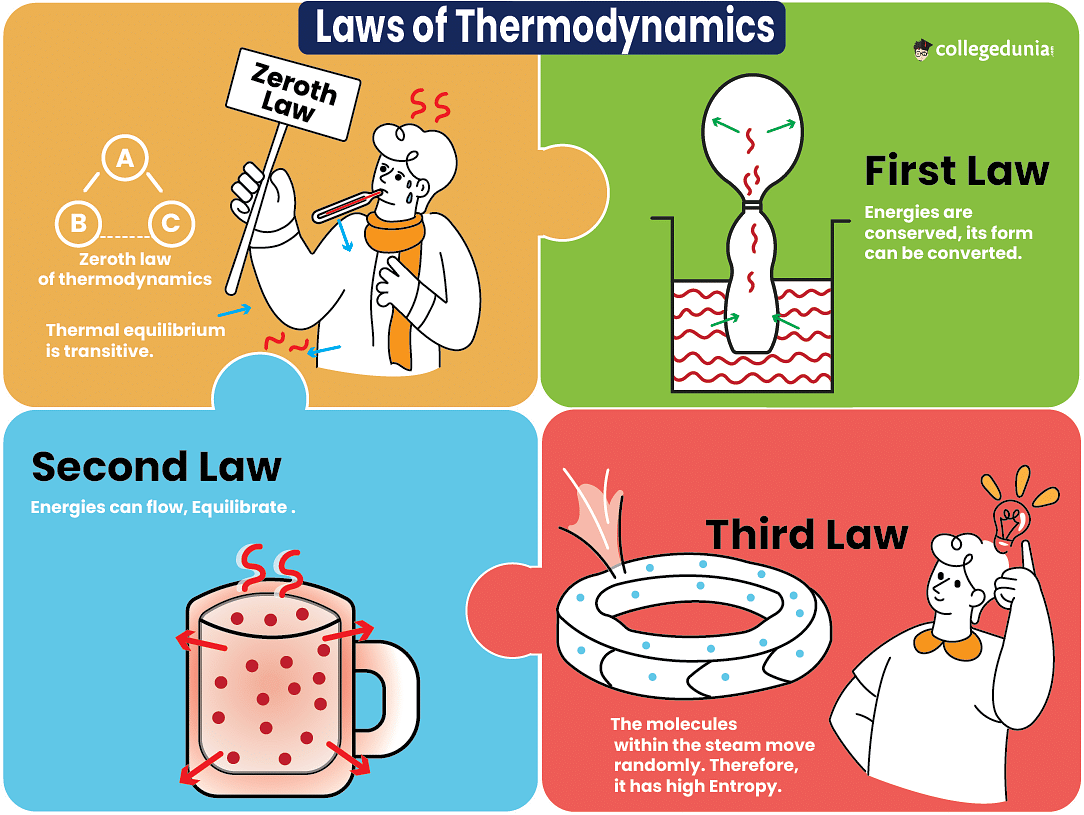
Laws of Thermodynamics
Thermodynamics Properties
[Click Here for Sample Questions]
The important properties of thermodynamics are as follows:
Internal Energy
Internal Energy is the amount of each form of energy that a method can possess. In thermodynamics, it is signified by AM which might change, when
- The heat is passed inside or outside of the system
- Work is performed on or by the system
- The matter moves in or leaves the system
Change in Internal Energy by Doing Work
Bringing the change in the internal energy by performing work. The primary state of the system is state A and Temperature being TA. Internal energy = uA. On doing a few mechanical works the innovative state is called state B and the temp is TB.
- It is established to be TB > TA
- uB is the internal energy after the change.
Δu = up – uA
Change in Internal Energy by Transfer of Heat
The internal energy of a system can be improved by the transfer of heat from the surroundings to the system without doing work.
Δu = q
- q stands as the heat immersed by the system.
- It can be dignified in terms of temperature difference.
- q is positive when heat is transferred from the surroundings to the system.
- q is negative when heat is transferred from the system to the surroundings.
- When a change of state is performed by doing work and transfer of heat.
Δu = q + w
The first law of thermodynamics states that energy can neither be produced nor be destroyed. The energy of an isolated system is constant. Δu = q + w.
Work (Pressure-volume Work)
Considering a cylinder that comprises one mole of an ideal gas in which a frictionless piston is fitted.
- Total Volume of the gas = V
- Pressure of the gas = P
- external pressure = Pa
- If, Pa > P
- final volume = Vf
- Distance moved by the piston = l
- cross-sectional area of piston = A
- volume change ΔV = l x A = (Vf – Vi)
P = F/A
- F = P x A
- W = F x d. (force x distance)
- Pa x A x [= Pa (-AV)
- W = – P Δ V
- -ve sign is used for work done by the system in case of expansion in volume by convertions.
- If in a system volume expands from V1 to V2
W = – \(\int _{v_i}^{v_f}\) Pa dV
Work Completed in Isothermal and Revocable Extension of Ideal Gas
W rev = – \(\int _{v_i}^{v_f}\) Pex dV = – \(\int _{v_i}^{v_f}\) (pin ± dP) dV. Since dP x dV is very small we can write,
- W rev = –\(\int _{v_i}^{v_f}\)Pin dV
- For ideal gas PV = nRT
P = \(\frac{nRT}{V}\)
- Therefore, at constant temperature,
- W rev = \(\int _{v_i}^{v_f}\) nRT \(\frac{dV}{V}\) = – nRT In \(\frac{V_f}{V_i}\)
– 2.303 nRT log \(\frac{V_f}{V_i}\)
- Work Completed in Isothermal and Revocable Extension of Ideal Gas

Work does on an ideal gas in a cylinder when it is compressed by a constant external pressure, Pa (in single step) is equal to the shaded area.
Isothermal and Free Expansion of Gas
For the expansion of an ideal gas into a vacuum W = 0
- Since, Pex = 0
Δ U = 0, q = 0
- For isothermal irreversible change
q = – W = P ex (Vf – Vi)
- For isothermal reversible change
q = – W = nRT In \(\frac{V_f}{V_i}\)
= 2.303 nRT log \(\frac{V_f}{V_i}\)
- For adiabetic change q = 0
Δ U = W ad
Enthalpy
Enthalpy is known as the total heat content of the system which is equal to the sum of internal energy and pressure-volume work. Accurately, H = U + PV
Change in Enthalpy
Change in enthalpy is the heat engrossed or developed by the system at constant pressure.
ΔH = qp
- For exothermic reaction (System fails energy to Surroundings),
- ΔH and qp both are negative.
- For endothermic reaction (System captivates energy from the Surroundings).
- ΔH and qp both are positive.
Relation between ΔH and Δu.
Let us consider a general reaction A → B and Let HA be the enthalpy of reactant A and HS be that of the products.
HA = UA + PVA
- HB = UB + PVB
- ΔH = HB - HA
- = (UB + PVB) – (UA + PVA)
- ΔH = ΔU + PΔV (HB - HA)
- ΔH = ΔU + PΔV
- At constatnt pressure and temperature using ideal gas law,
- PVA = nART (For reactant A)
- PVB = nBRT (For product B)
- Thus, PVB – PVA = nBRT – nART
- = (nB – nA) RT
- PΔV = Δ n g RT
ΔH = ΔU + Δ n g RT
Conventions of Thermochemical Equations
Some important conventions of thermochemical equations are as follows:
- The coefficients in a thermochemical equation mention the number of moles of reactants and products.
- The numerical value of Δt HΘ refers to the numberof the moles of substance specified by an equation.
- If a chemical reaction is reversed, the value of Δt HΘ is reversed in sign.
Example of Conventions of Thermochemical EquationsExample: N2 (g) + 3H2 (g) → 2NH3 (g) Δt HΘ = – 91.8 kJ mol -1 2NH3 (g) → N2 (g) + 3H2 (g) Δt HΘ = + 91.8 kJ mol -1 |
Hess’s Law of Continuous Heat Summation
Hess’s Law states that total quantity of heat changed or captivated in a reaction is similar whether the reaction takes place in one step or several steps. Let us consider the following reactions:
- C (graphite,s) + O2 → CO2
- Δt HΘ = – 393.5 kJ mol -1
- CO (g) + \(\frac{1}{2} \) O2 (g) → CO2 (g)
- Δt HΘ = – 283.0 kJ mol -1
- CO2 (g) → CO (g) + \(\frac{1}{2} \)O2 (g)
- Δt HΘ = + 283.0 kJ mol -

Born-Haber Cycle
It is not possible to conclude the Lattice enthalpy of the ionic compound by direct experiment. Therefore, it can be intended by following steps. The diagrams which show the particular stages are called as Born-Haber Cycle.

Spontaneity
A process that can take place by itself or has an inclination to take place is called a spontaneous procedure. The spontaneous process need not be immediate. Its actual speed can differ from slow to quite fast.
Example of SpontaneityExample: A few examples of spontaneous processes are:
|
Read More:
| Related Articles | ||
|---|---|---|
| Kinetic Theory | Sublimation | Kinetic Energy |
| Specific Heat Capacity of Water | Heat Vs Temperature | Phase Transition |
Entropy
The entropy is an amount of degree of randomness or disorder of a method. In this process, the substance is slightly in a solid-state while it is supreme in a gaseous state.
- The change in entropy in a spontaneous procedure and is expressed as ΔS
- Mathematically, Change in entropy is represented as:
(ΔS) = S final state (product) – S initial state (reactions)
- For reversible and isothermal process,
- Change in entropy is represented as:
ΔS = \(\frac{q_{rev}}{T} = \frac{ \Delta H}{T}\)
- When a system is in equilibrium, ΔS = 0
Gibbs Energy and Spontaneity
A new thermodynamic function, the Gibbs energy or Gibbs function G, can be termed as G = H-TS
ΔG = ΔH – TΔS
- Gibbs energy change = enthalpy change – temperature x entropy change
- ΔG gives a criterion for freedom at continuous pressure and temperature
- If ΔG is negative (< 0) the procedure is spontaneous.
- If ΔG is positive (> 0) the procedure is non-spontaneous.
- Free Energy Change in Reversible Reaction
The criterion for equilibrium are as follows:
- A + B ⇒ C + D is
- Δ r G = 0
- When all the reactants and products are in standard state,
- Δr GΘ is related to the equilibrium constant of the reaction as
- 0 = Δr GΘ - RT In K
- Δr GΘ = – RT In K
- Δr GΘ = – 2.303 RT log K
- Δr GΘ = Δr HΘ – TΔr SΘ
– RT in K
Important Topics for JEE MainAs per JEE Main 2024 Session 1, important subtopics included in the thermodynamics are as follows:
Some memory based important questions asked in JEE Main 2024 Session 1 include:
|
Things to Remember
- Thermodynamics specifies relationship between heat, temperature, work and energy.
- Enthalpy, Spontaneity and Entropy are important properties of the law of thermodynamics.
- Photosynthesis is one of the important application of the law.
- Thermodynamics Important Questions and Thermodynamic Property Questions are available for practice.
- NCERT Solutions For Class 11 Chemistry Chapter 6: Chemical Thermodynamics are also available where students can practice NCERT problems.
Previous years Questions
- A frictionless piston-cylinder based enclosure contains some amount of gas at a pressure of 400kPa400kPa.
- Then the change in the internal energy of the gas is (Given R=8.32Jmol−1K−1 )
- What will be the final temperature of the system after the equilibrium has been attained ?
- The ratio of the final to initial pressure is
- The weakest and strongest among these acids are respectively
- which of the following statements is correct ?
- An ideal gas expands in volume from 1?10−3m3 to
- What would be the net change in internal energy?
Sample Questions
Ques. What are the Different Kinds of Thermodynamic Processes. (4 Marks)
Ans. There are four kinds of thermodynamic processes mentioned below. Those are:
- Isothermal Process – Temperature residues are the same all through the procedure.
- Adiabatic Process – Heat exchanged with surrounds sums to zero.
- Isochoric Process – Volume remnants same all over the process.
- Isobaric Process – Pressure remains similar all through the process.
Ques. What is the First Law of Thermodynamics. (2 Marks)
Ans. The first law is knowns as the Law of Conservation of Energy and states that there is no creation or destruction of energy. There can only be a transmission of energy that is when it modifies from one form to another.
ΔQ = ΔU + ΔW
Where
- ΔQ is the heat given to a thermodynamic system
- ΔW is the Work Done
- ΔU is the Internal Energy
Ques. Explain: (A) How is Thermodynamic Equilibrium Reached
(B) What does the system mean. (2 Marks)
Ans. (A) It is explained in the chapter that thermodynamic equilibrium is reached with the transfer of heat energy among objects. It is meant that for two objects to reach thermal equilibrium, the temperature of those has to be similar.
(B) The system is termed as the portion of the universe which is under observation.
Ques. A geyser heats water flowing at a rate of 3.0 litre per minute from 27°C to 77°C. If the geyser operates on a gas burner, find out the rate of the consumption of fuel if its heat of combustion is 4.0 x 10⁴ J/g. (3 Marks)
Ans. The volume of water heated is 3.0 litre per min
Mass of water heated is m = 3000 g per min
Increase in temperature,
Δ T = 77oC – 27oC = 50oC
Specific heat of water, c = 4.2 Jg -1 oC-1
amount of heat used, Q = mc Δ T
or Q = 3000 g min -1 x 4.2 Jg -1 oC-1 x 50oC
= 63 x 104 J min -1
Rate of combustion of fuel = \(\frac{63 \times 10^4 Jmin^{-1}}{1.0 \times 10^4 Jg^{-1}}\) = 15.75 g min -1
Ques. What amount of heat must be supplied to 2.0 x 10⁻² kg of nitrogen (at room temperature) to raise its temperature by 45°C at constant pressure? (Molecular mass of N2 = 28, R = 8.3 J mol-1 K-1) (3 Marks)
Ans. Here, mass of gas , m = 2 x 10⁻² kg = 20 g
rise in temperature, Δ T = 45oC
Heat required, Δ Q = ?; Molecular mass, M = 28
Number of moles, n = \(\frac{m}{M} = \frac{20}{28} = 0.714\)
As nitrogen is a diatomic gas, molar specific heat at constant pressure is
Cp = \(\frac{7}{2}R = \frac{7}{2}\) x 8.3 J mol -1 K-1
as Δ Q = nCpΔ T
∴ Δ Q = 0.714 x \( \frac{7}{2}\) x 8.3 x 45 J = 933.4 J.
Ques. Enthalpy of combustion of carbon to carbon dioxide is -393.5 KJ mol -1. Calculate the heat released upon formation of 45.5g of CO 2 from carbon and oxygen gas. (3 marks)
Ans. C(s) + 0 2(g) → CO 2(g); ΔH = -393.5 KJ mol -1
Heat released in the formation of 44g of CO 2 = -393.5 KJ
Heat released in the formation of 45.5g of CO 2 = (393.5 KJ) x (45.5g)/(44g) = 406.9KJ
Ques. Calculate the maximum work obtained when 0.75 mol of an ideal gas expands isothermally and reversible at 27°C from a volume of 25 L to 35 L. (3 Marks)
Ans. For an isothermal reversible expansion of an ideal gas
w = – nRT log V2/V1 = – 2.303 nRT log V2/V1
Putting n = 0.75 mol; V1 = 25 L; V2 = 35 L, T = 27 + 273 = 300 K R = 8.314 JK-1 mol-1.
w = – 2.303 × 0.75 × 8.314 × 300 log 35/25
w = -955.5J.
Ques. Calculate ΔG at 280 K for the reaction,
2NO + O2 → 2NO2
when ΔH and ΔS of the reaction are -300 J and -0.35 J/K respectively. (3 Marks)
Ans. Given, ΔH = -100 J, ΔS = -0.25 J/K and T = 280 K
- We know that,
- ΔG = ΔH – TΔS
- ΔG = (-300) -280(0.35)
- ΔG = -300 – 98
- ΔG = -398 J
Ques. Calculate the temperature at which ΔG of the given reaction is 100 J when ΔH and ΔS of the reaction are -250 J and -0.5 J/K respectively
H2 + I2 → 2HI. (3 Marks)
Ans. Given, ΔG = 100 J, ΔH = -250 J and ΔS = -0.5 J/K
- We know that,
- ΔG = ΔH – TΔS
- Thus,
- ⇒ 100 = (-250) – T(-0.5)
- ⇒ 100 = -250 + T/2
- ⇒ 100 + 250 = T/2
- ⇒ T = 750 K
Ques. If an ideal heat engine operates in a Carnot cycle between 800 K and 600 K and if it absorbs 6000 J of heat at a higher temperature then find the heat supplied from the source. (3 Marks)
Ans. Given, T1 = 800 K and T2 = 600 K
- Heat Absorbed at High Temperature = 6000 J
- Heat Supplied from Source =?
- Efficiency of Heat Engine (E) = 1 – (T2 / T1)
- Efficiency of Heat Engine (E) = 1 – 600/800 = 1- 3/4
Efficiency of Heat Engine (E) = 1/4 - We know that, E = Heat Supplied from Source/Heat Absorbed at High Temperature
- 1/4 = Heat Supplied from Source/6000
- Heat Supplied from Source = 1500 J
Ques. Find the Efficiency of the Heat Engine if it operates between 900 K and 450 K. (3 Marks)
Ans. T1 = 900 K and T2 = 450 K
- Efficiency of Heat Engine (E) = 1 – (T2 / T1)
- Efficiency of Heat Engine (E) = 1 – 450/900 = 1- 1/2
- Efficiency of Heat Engine (E) = ½
- E = 1/2 × 100 % = 50%
For Latest Updates on Upcoming Board Exams, Click Here:https://t.me/class_10_12_board_updates
Do Check Out:



Comments