



Education Journalist | Study Abroad Lead
Earthing is the process of protecting against unwarranted spikes and bouts of electricity. Earthing and grounding are similar, which gets insulated against accidental currents. In grounding, the main live wire is connected to a power supply to power an appliance.
The difference between earthing and grounding is that in "earthing", the circuit is physically connected to the ground, which has a zero-voltage potential (Earth). In "Grounding", the circuit is not physically linked to the ground, but its potential is zero in comparison to other areas. Another key difference between earthing and grounding is that grounding connects the current-carrying portion to the ground. The non-current carrying portions, on the other hand, are connected to the ground in earthing.
Read more: Relation between Line Voltage and Phase Voltage
| Table of Content |
Key Terms: Solidly Grounded System, Resistance and Reactance Grounding, Earthing Plate System, Earthing Rod System, Circuit, Zero-voltage Potential, Electric Field and Charges
What is Earthing?
[Click Here for Sample Questions]
Earthing refers to the connection of the equipment's non-current carrying parts to the earth. When a failure develops in the system, the potential of the non-current component of the equipment rises, and any human or stray animal who comes into contact with the body of the equipment may get electrocuted.
Earthing transfers the leakage current to the earth, preventing electric shock to the personnel. It is also a discharge path for surge arrester, gap, and other devices, protecting them from lightning. In Earthing, various components of the installation are connected to the earth through use of an earth conductor or earth electrode in close contact with the soil at a depth below ground level.
NCERT Solutions of: Class 12 Physics Chapter 1 Electric Charges and Field
Types of Earthing
Earthing, also known as electrical grounding, can be accomplished in a variety of ways, including factory wire, housing, other machinery, and electrical equipment. Earthing systems come in a variety of shapes and sizes, as shown below:
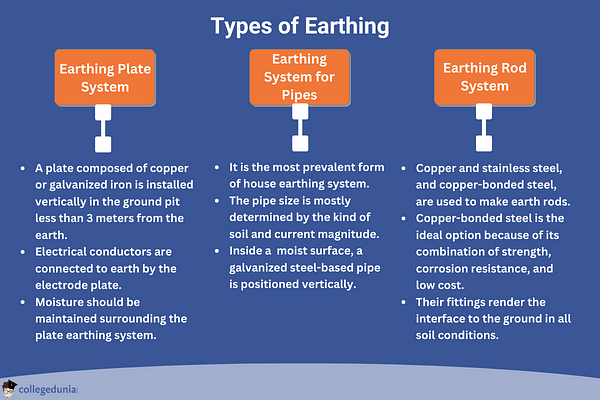
Types of Earthing
Read More:
What is Grounding?
[Click Here for Previous Year Questions]
The current-carrying portions are directly connected to the ground in grounding. Leaking current’s return path is provided by grounding. It protects the power system equipment from damage. Current in all three phases of the equipment becomes unbalanced when equipment malfunctions. Grounding discharges the fault current to the earth, bringing the system back into balance.
Grounding Benefits
Some of the common benefits of Grounding are:
- Removal of voltage surge and discharge of excess electricity to the earth.
- Grounding of the equipment ensures its safety and increases service reliability.
Types of Grounding
The different types of Grounding Systems are shown below:

Types of Grounding Systems
Difference between Earthing and Grounding
[Click Here for Sample Questions]
The term "earthing" refers to the connection of a non-current carrying portion, such as the equipment's body or enclosure, to the ground. The current-carrying component of the transformer, such as the neutral, is directly connected to the ground during grounding.
Key differences between Earthing and Grounding are tabulated below:
| Earthing | Grounding |
|---|---|
| The green color wire is used for earthing. | The black color wire is used for grounding. |
| Earthing protects equipment and humans from electrical shock. | Grounding balances the uneven load. |
| The earth electrode connects the equipment's body to the earth pit, which is buried beneath the ground. | The grounding wire connects the equipment's neutral to the earth. |
| The system in earthing is physically connected to the ground and has zero potential. | The equipment which is present in grounding is not physically connected to the ground, and the current on the ground is not zero. |
| Earthing reduces the high potential of electrical equipment induced by a defect and thereby protects the human body from electrical shock. | Grounding prevents electrical equipment from damage by providing a path for an undesired current. |
| There are five different ways to earth yourself. Pipe earthing, plate earthing, rod earthing, earthing through the tap, and strip earthing are the various techniques of earthing. | There are three different types of grounding. Solid grounding, resistance grounding, and reactance grounding are the three types of grounding. |
Read more: Physical Significance of Electric Field
Previous Year Questions
- In the given circuit, what will be the equivalent resistance between the points…. [JIPMER 2006]
- Two charges, each equal to q, are kept at x=−a and x=a ...[JEE Main 2013]
- The kinetic energy attained by the particle after moving a distance y is..[KEAM]
- When the Gaussian spherical surface is doubled , then then the outward electric flux will be… [NEET 2011]
- The total electric flux passing through the cylindrical surface is...[KEAM]
Things to Remember
- Earthing is used to link the non-current carrying component to the ground. The current-carrying component is directly connected to the ground in grounding.
- Grounding is in charge of load balancing while earthing is in charge of electrical shock safety.
- The earthing electrode must be situated at least 1.5 meters away from the building whose installation system is earthed.
- The ground wire should have a resistance of less than 1 ohm.
- It's important to make sure that the electrode and circuit wires are made of the same material.
- The electrodes must be in a vertical position in order to contact the earth's strata.
- Only half of the wire shall be utilized for electrical wiring, and the conductor must be larger than 2.6 square mm.
Read More:
Sample Questions
Ques: What factors have an impact on earthing? (3 marks)
Ans: Factors that influence Earth's resistivity are:
- Soil Resistivity
- The state of the soil
- Moisture.
- Dissolved Salts
- The weather situation.
- Physical Characteristics.
- Earth Pit's location.
- Grain size and distribution also have an impact.
Ques: What are different kinds of earthing? (3 marks)
Ans: Earthing is divided into five categories:
- Neutral with a solid ear.
- Neutral has been unearthed.
- Earthed resistance is in a state of neutrality. Earthing with low resistance. Earthing with high resistance.
- Neutralized by reactance.
- Using earthing transformers is a good idea (such as the Zigzag transformer)
Ques: What are the advantages of earthing? (2 marks)
Ans: For a half-hour or longer each day, we can go barefoot outside on the Earth or swim in the river. Soil, grass, sand, gravel, and rock are examples of conductive surfaces for grounding on land. However, we are not permitted to walk on asphalt, vinyl, or wood.
Ques: What is the primary objective of grounding? (2 marks)
Ans: One of the most essential benefits of grounding electrical currents is that it protects the equipment, home, and everyone who lives there from power surges. If lightning strikes or the power surges at home for any reason, your system will be exposed to dangerously high volts of electricity.
Ques: What exactly is the purpose of earthing? (2 marks)
Ans: Earthing is a technique for preventing electric shocks. It accomplishes this by allowing a fault current to flow to the ground through a conduit. It also causes the protective device (either a circuit breaker or a fuse) to turn off the power to the circuit with the problem.
Ques: What is the difference between grounding and earthing? (2 marks)
Ans: The terms "earthing" and "grounding" are often used interchangeably. The fundamental distinction between earthing and grounding is that earthing implies that the circuit is physically connected to the ground with a potential of zero volts. Grounding, on the other hand, refers to a circuit that is not physically linked to the ground but has zero potential.
Ques: What happens if you don't have earthing? (2 marks)
Ans: People could be electrocuted if the house is not earthed. The safety switches will not work without an earth connection, and an electrical accident could cause a house or appliances to become 'live' as the current flows to earth. The electrical cable and the earth stake have a poor or no connection.
Ques: What is the significance of grounding? (2 marks)
Ans: Damaged circuits or electrical overloads can be dangerous to humans and their houses; thus, grounding is important. When there are power surges, the extra electricity that is injected into the system may jump out of the wire. This stray voltage can give rise to a fire, it can also damage appliances, or shock bystanders if it isn't grounded.
Ques: Explain touch potential. (2 Marks)
Ans: The touch voltage occurs between the feet of a human and simulated object whenever they come in contact is known as touch potential. It is equal to the potential difference between a person's feet and the body part touching a faulty structure. The human body resistance is highly inconsistent. The current passing through the body relies on this resistance. Therefore, the human body can be subjected to different voltage or current fluctuations, leading to death in worst cases if it comes in contact with a faulty electrical circuit.
Ques: Specify the benefits of earthing. (2 Marks)
Ans: The major advantages of electrical earthing are:
- Ensures the safety of electrical appliances and devices from the excessive amount of electric current.
- Helps in the flow of electric current directly inside the ground.
- Keeps the electric appliance safe from the damage
- It protects building breakdown from the lightning
- It shields from fire occurred because of an electric short circuit and saves goods from fire.
For Latest Updates on Upcoming Board Exams, Click Here: https://t.me/class_10_12_board_updates
Also Read:



Comments