




MHT CET 2026 May 15 Shift 1 PCM Question Paper is available for download here. Maharashtra State CET Cell conducted MHT CET 2026 PCM Exam on May 15 in Shift 1 from 9 AM to 12 PM in CBT mode.
The MHT CET 2026 PCM question paper includes the following:
- The MHT CET 2026 PCM Question Paper consists of 150 multiple-choice questions (MCQs) totalling 200 marks divided into 3 sections: Physics, Chemistry, and Mathematics, with 50 questions in each subject.
- Physics and Chemistry questions carry 1 mark each while Mathematics questions carry 2 marks each.
- There is no negative marking for incorrect answers.
MHT CET 2026 May 15 Shift 1 PCM Question Paper with Solution PDF
| CD PDF | CD PDF with Solutions |
|---|---|
| Download Collegedunia PDF 0.87 MB | - |
Also Check:
MHT CET 2026 May 15 Shift 1 PCM Questions with Solutions
Physics (Q1 - Q50)
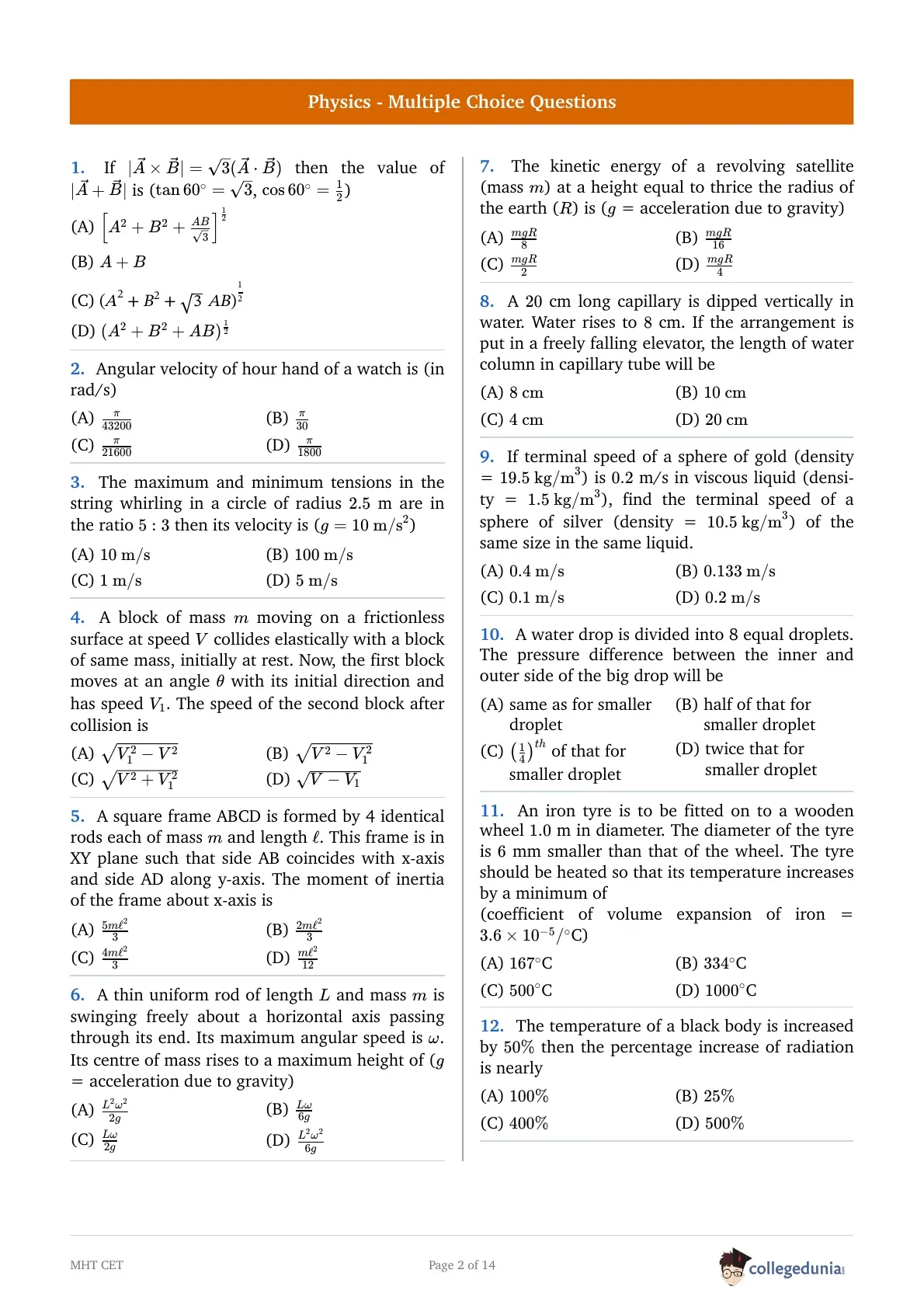
If \(|\vec{A}\times \vec{B}|=\sqrt{3}(\vec{A}\cdot \vec{B})\) then the value of \(|\vec{A}+\vec{B}|\) is (\(\tan 60^{\circ }=\sqrt{3}\), \(\cos 60^{\circ }=\frac{1}{2}\))
Angular velocity of hour hand of a watch is (in rad/s)
The maximum and minimum tensions in the string whirling in a circle of radius \(2.5\) m are in the ratio \(5:3\) then its velocity is (\(g=10\ \text{m/s}^{2}\))
A block of mass \(m\) moving on a frictionless surface at speed \(V\) collides elastically with a block of same mass, initially at rest. Now, the first block moves at an angle \(\theta\) with its initial direction and has speed \(V_{1}\). The speed of the second block after collision is
A square frame ABCD is formed by 4 identical rods each of mass \(m\) and length \(\ell\). This frame is in XY plane such that side AB coincides with x-axis and side AD along y-axis. The moment of inertia of the frame about x-axis is
A thin uniform rod of length \(L\) and mass \(m\) is swinging freely about a horizontal axis passing through its end. Its maximum angular speed is \(\omega\). Its centre of mass rises to a maximum height of (\(g\) = acceleration due to gravity)
The kinetic energy of a revolving satellite (mass \(m\)) at a height equal to thrice the radius of the earth (\(R\)) is (\(g\) = acceleration due to gravity)
A \(20\) cm long capillary is dipped vertically in water. Water rises to \(8\) cm. If the arrangement is put in a freely falling elevator, the length of water column in capillary tube will be
If terminal speed of a sphere of gold (density = \(19.5\ \text{kg/m}^{3}\)) is \(0.2\) m/s in viscous liquid (density = \(1.5\ \text{kg/m}^{3}\)), find the terminal speed of a sphere of silver (density = \(10.5\ \text{kg/m}^{3}\)) of the same size in the same liquid.
A water drop is divided into 8 equal droplets. The pressure difference between the inner and outer side of the big drop will be
An iron tyre is to be fitted on to a wooden wheel \(1.0\) m in diameter. The diameter of the tyre is \(6\) mm smaller than that of the wheel. The tyre should be heated so that its temperature increases by a minimum of
(coefficient of volume expansion of iron = \(3.6\times 10^{-5}/^{\circ }\)C)
The temperature of a black body is increased by \(50\%\) then the percentage increase of radiation is nearly
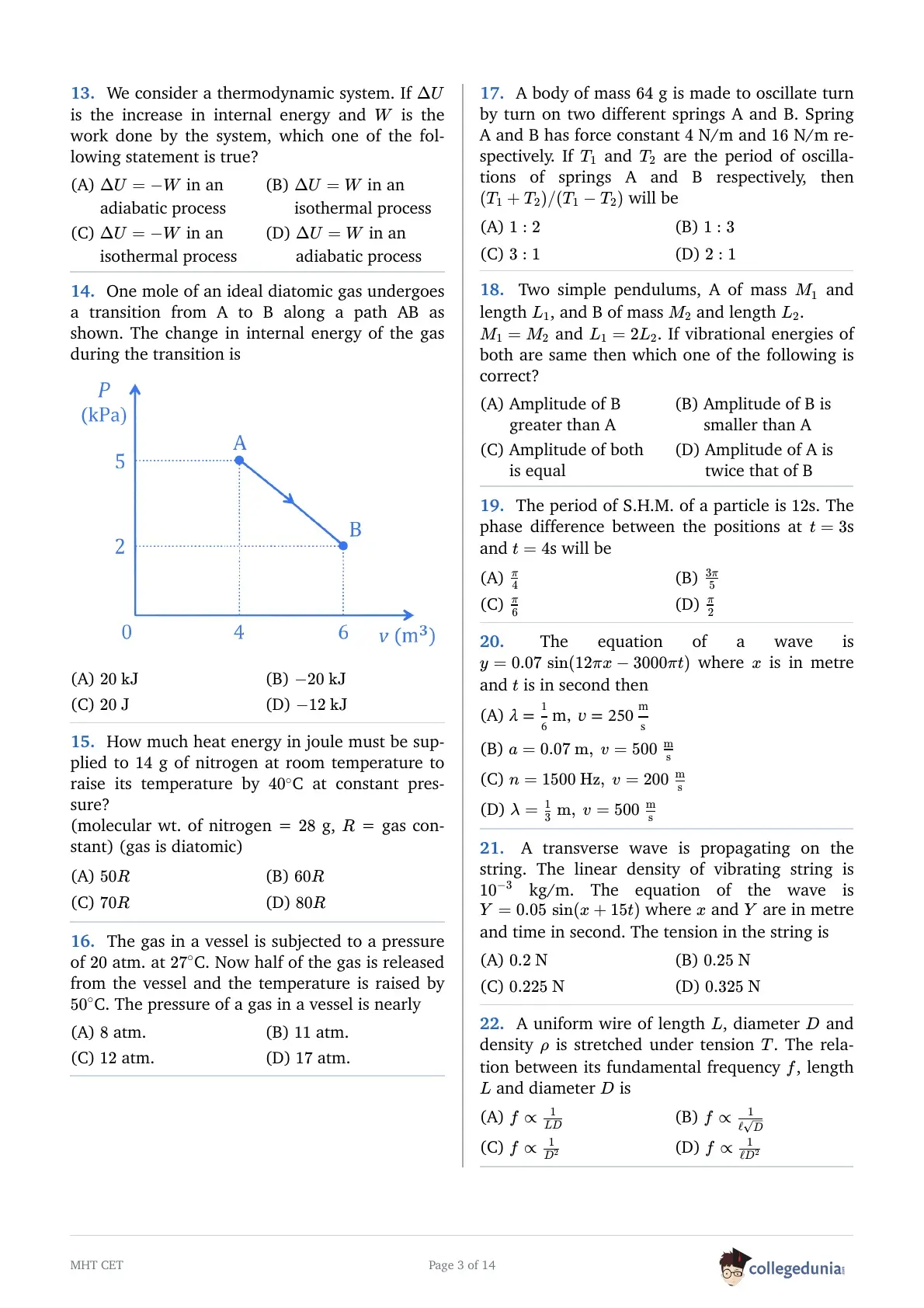
We consider a thermodynamic system. If \(\Delta U\) is the increase in internal energy and \(W\) is the work done by the system, which one of the following statement is true?
One mole of an ideal diatomic gas undergoes a transition from A to B along a path AB as shown. The change in internal energy of the gas during the transition is

How much heat energy in joule must be supplied to \(14\) g of nitrogen at room temperature to raise its temperature by \(40^{\circ }\)C at constant pressure?
(molecular wt. of nitrogen = \(28\) g, \(R\) = gas constant) (gas is diatomic)
The gas in a vessel is subjected to a pressure of \(20\) atm. at \(27^{\circ }\)C. Now half of the gas is released from the vessel and the temperature is raised by \(50^{\circ }\)C. The pressure of a gas in a vessel is nearly
A body of mass \(64\) g is made to oscillate turn by turn on two different springs A and B. Spring A and B has force constant \(4\) N/m and \(16\) N/m respectively. If \(T_{1}\) and \(T_{2}\) are the period of oscillations of springs A and B respectively, then \((T_{1}+T_{2})/(T_{1}-T_{2})\) will be
Two simple pendulums, A of mass \(M_{1}\) and length \(L_{1}\), and B of mass \(M_{2}\) and length \(L_{2}\).
\(M_{1}=M_{2}\) and \(L_{1}=2L_{2}\). If vibrational energies of both are same then which one of the following is correct?
The period of S.H.M. of a particle is \(12\)s. The phase difference between the positions at \(t=3\)s and \(t=4\)s will be
The equation of a wave is \(y=0.07\,\sin (12\pi x-3000\pi t)\) where \(x\) is in metre and \(t\) is in second then
A transverse wave is propagating on the string. The linear density of vibrating string is \(10^{-3}\) kg/m. The equation of the wave is \(Y=0.05\,\sin (x+15t)\) where \(x\) and \(Y\) are in metre and time in second. The tension in the string is
A uniform wire of length \(L\), diameter \(D\) and density \(\rho\) is stretched under tension \(T\). The relation between its fundamental frequency \(f\), length \(L\) and diameter \(D\) is
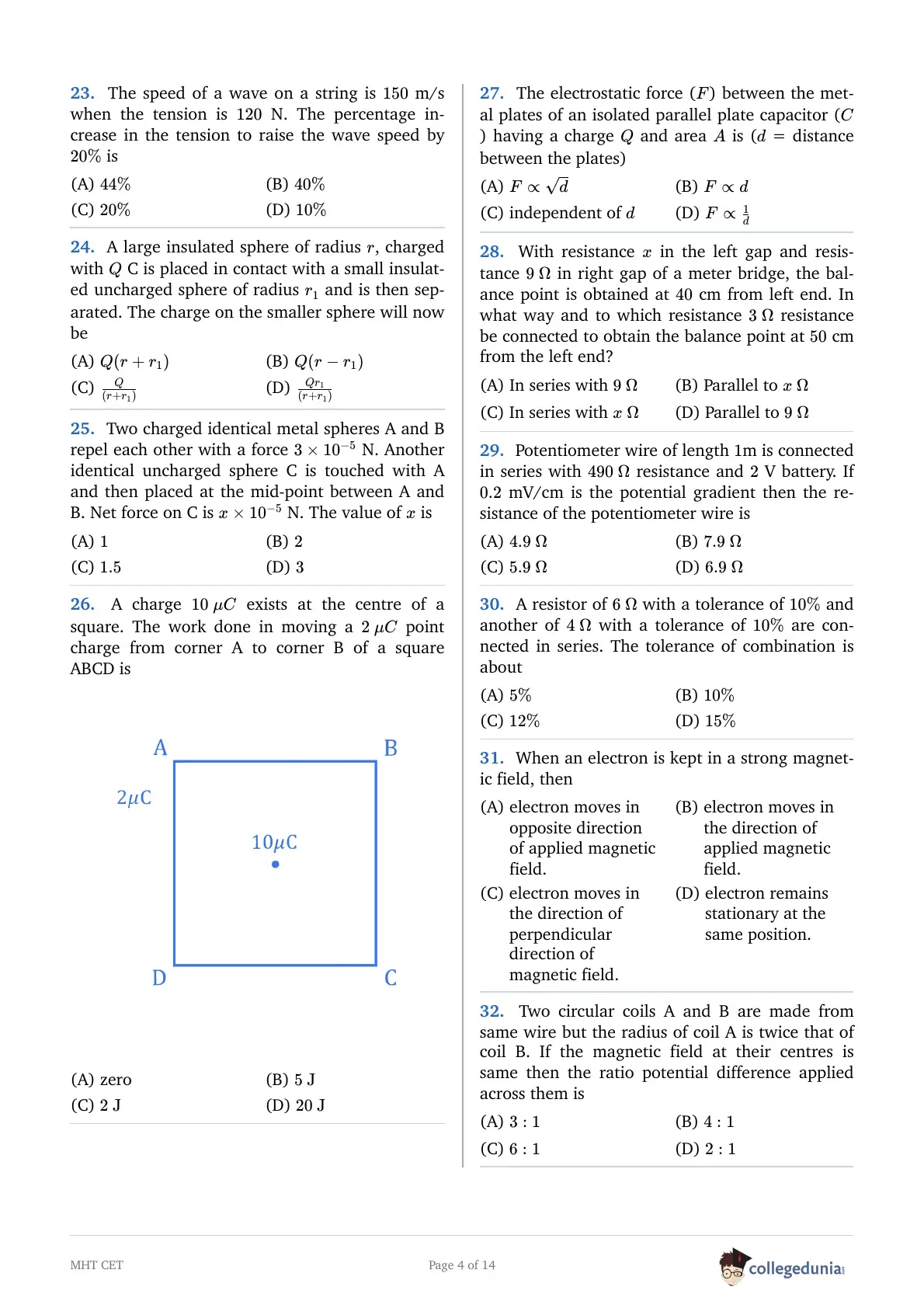
The speed of a wave on a string is \(150\) m/s when the tension is \(120\) N. The percentage increase in the tension to raise the wave speed by \(20\%\) is
A large insulated sphere of radius \(r\), charged with \(Q\) C is placed in contact with a small insulated uncharged sphere of radius \(r_{1}\) and is then separated. The charge on the smaller sphere will now be
Two charged identical metal spheres A and B repel each other with a force \(3\times 10^{-5}\) N. Another identical uncharged sphere C is touched with A and then placed at the mid-point between A and B. Net force on C is \(x\times 10^{-5}\) N. The value of \(x\) is
A charge \(10\ \mu C\) exists at the centre of a square. The work done in moving a \(2\ \mu C\) point charge from corner A to corner B of a square ABCD is

The electrostatic force (\(F\)) between the metal plates of an isolated parallel plate capacitor (\(C\)) having a charge \(Q\) and area \(A\) is (\(d\) = distance between the plates)
With resistance \(x\) in the left gap and resistance \(9\ \Omega\) in right gap of a meter bridge, the balance point is obtained at \(40\) cm from left end. In what way and to which resistance \(3\ \Omega\) resistance be connected to obtain the balance point at \(50\) cm from the left end?
Potentiometer wire of length \(1\)m is connected in series with \(490\ \Omega\) resistance and \(2\) V battery. If \(0.2\) mV/cm is the potential gradient then the resistance of the potentiometer wire is
A resistor of \(6\ \Omega\) with a tolerance of \(10\%\) and another of \(4\ \Omega\) with a tolerance of \(10\%\) are connected in series. The tolerance of combination is about
When an electron is kept in a strong magnetic field, then
Two circular coils A and B are made from same wire but the radius of coil A is twice that of coil B. If the magnetic field at their centres is same then the ratio potential difference applied across them is
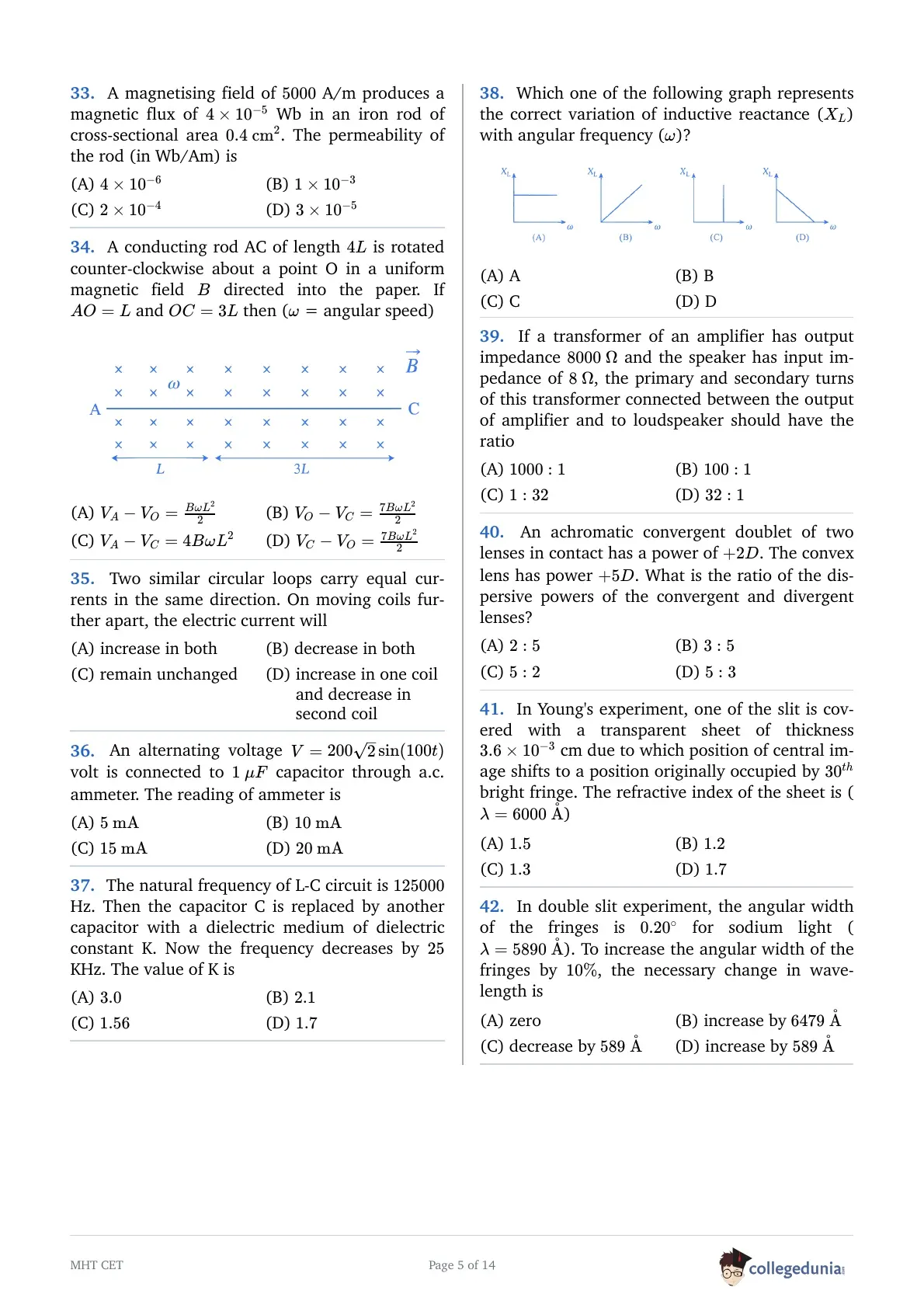
A magnetising field of \(5000\) A/m produces a magnetic flux of \(4\times 10^{-5}\) Wb in an iron rod of cross-sectional area \(0.4\ \text{cm}^{2}\). The permeability of the rod (in Wb/Am) is
A conducting rod AC of length \(4L\) is rotated counter-clockwise about a point O in a uniform magnetic field \(B\) directed into the paper. If \(AO=L\) and \(OC=3L\) then (\(\omega\) = angular speed)

Two similar circular loops carry equal currents in the same direction. On moving coils further apart, the electric current will
An alternating voltage \(V=200\sqrt{2}\sin (100t)\) volt is connected to \(1\ \mu F\) capacitor through a.c. ammeter. The reading of ammeter is
The natural frequency of L-C circuit is \(125000\) Hz. Then the capacitor C is replaced by another capacitor with a dielectric medium of dielectric constant K. Now the frequency decreases by \(25\) KHz. The value of K is
Which one of the following graph represents the correct variation of inductive reactance (\(X_{L}\)) with angular frequency (\(\omega\))?

If a transformer of an amplifier has output impedance \(8000\ \Omega\) and the speaker has input impedance of \(8\ \Omega\), the primary and secondary turns of this transformer connected between the output of amplifier and to loudspeaker should have the ratio
An achromatic convergent doublet of two lenses in contact has a power of \(+2D\). The convex lens has power \(+5D\). What is the ratio of the dispersive powers of the convergent and divergent lenses?
In Young's experiment, one of the slit is covered with a transparent sheet of thickness \(3.6\times 10^{-3}\) cm due to which position of central image shifts to a position originally occupied by \(30^{th}\) bright fringe. The refractive index of the sheet is (\(\lambda =6000\ \text{Å}\))
In double slit experiment, the angular width of the fringes is \(0.20^{\circ }\) for sodium light (\(\lambda =5890\ \text{Å}\)). To increase the angular width of the fringes by \(10\%\), the necessary change in wavelength is
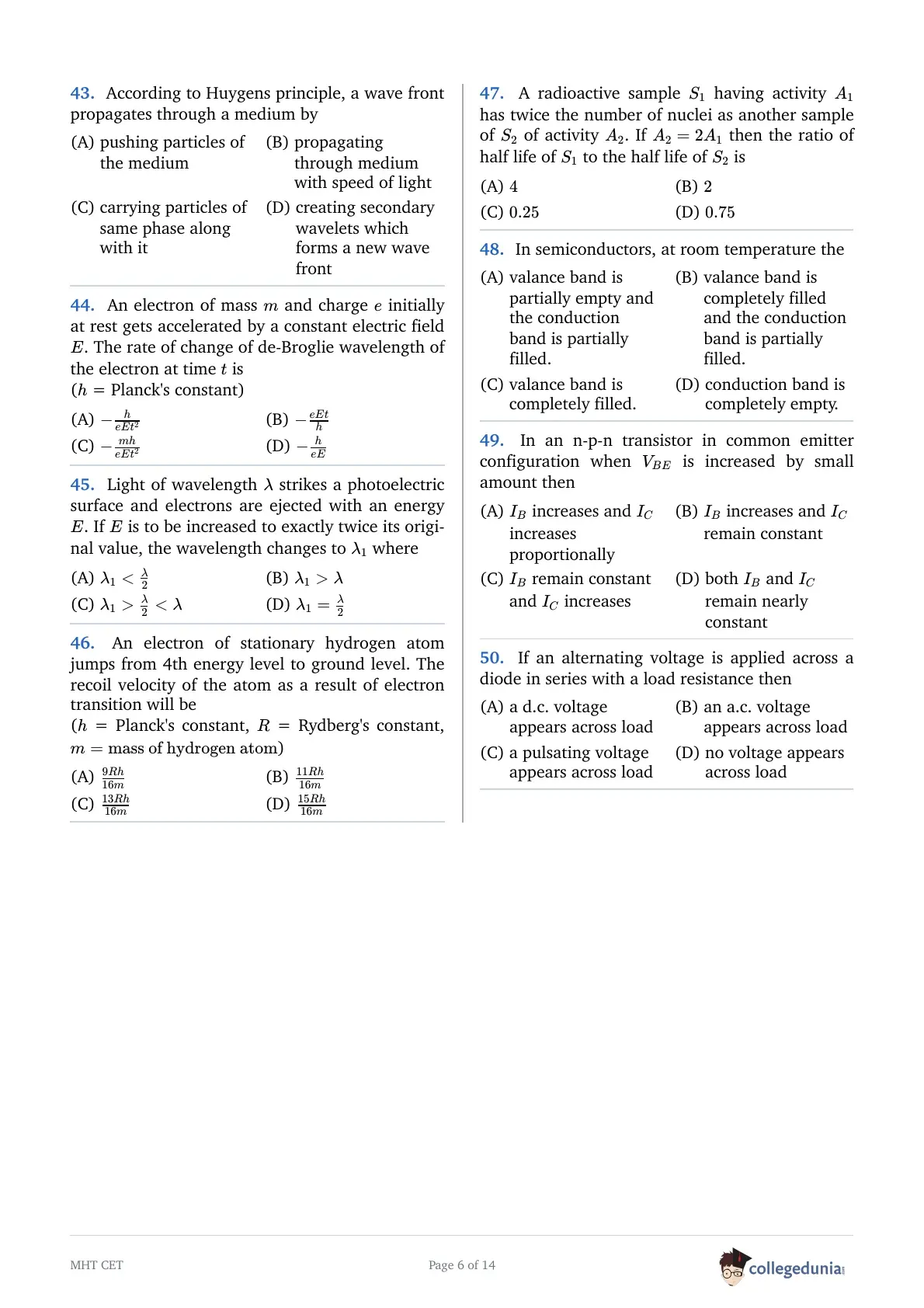
According to Huygens principle, a wave front propagates through a medium by
An electron of mass \(m\) and charge \(e\) initially at rest gets accelerated by a constant electric field \(E\). The rate of change of de-Broglie wavelength of the electron at time \(t\) is
(\(h\) = Planck's constant)
Light of wavelength \(\lambda\) strikes a photoelectric surface and electrons are ejected with an energy \(E\). If \(E\) is to be increased to exactly twice its original value, the wavelength changes to \(\lambda _{1}\) where
An electron of stationary hydrogen atom jumps from 4th energy level to ground level. The recoil velocity of the atom as a result of electron transition will be
(\(h\) = Planck's constant, \(R\) = Rydberg's constant, \(m=\text{mass of hydrogen atom}\))
A radioactive sample \(S_{1}\) having activity \(A_{1}\) has twice the number of nuclei as another sample of \(S_{2}\) of activity \(A_{2}\). If \(A_{2}=2A_{1}\) then the ratio of half life of \(S_{1}\) to the half life of \(S_{2}\) is
In semiconductors, at room temperature the
In an n-p-n transistor in common emitter configuration when \(V_{BE}\) is increased by small amount then
If an alternating voltage is applied across a diode in series with a load resistance then
Chemistry (Q51 - Q100)
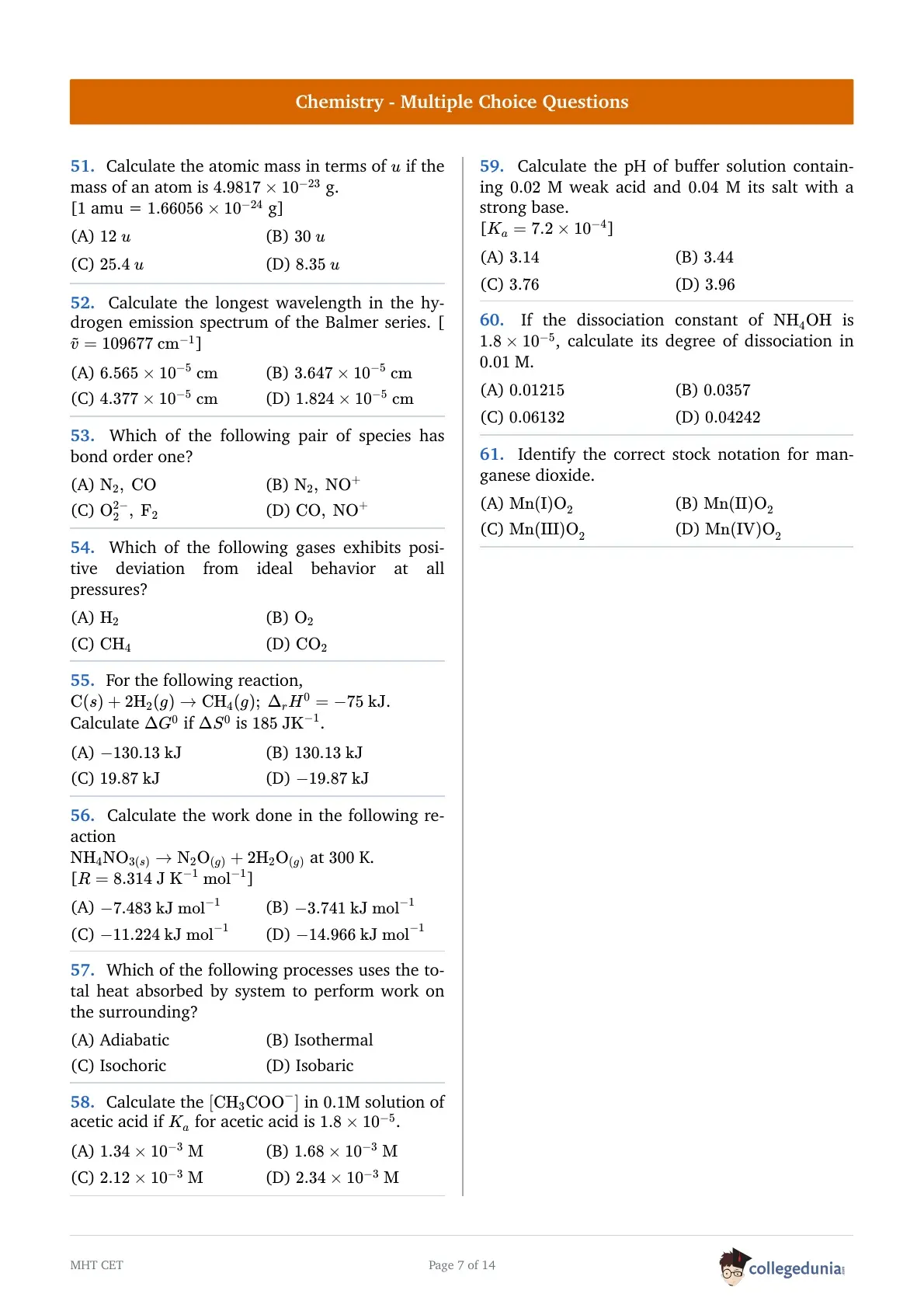
Calculate the atomic mass in terms of \(u\) if the mass of an atom is \(4.9817\times 10^{-23}\) g.
[\(1\) amu = \(1.66056\times 10^{-24}\) g]
Calculate the longest wavelength in the hydrogen emission spectrum of the Balmer series. [\(\tilde{v}=109677\ \text{cm}^{-1}\)]
Which of the following pair of species has bond order one?
Which of the following gases exhibits positive deviation from ideal behavior at all pressures?
For the following reaction,
\(\text{C}(s)+2\text{H}_{2}(g)\rightarrow \text{CH}_{4}(g);\ \Delta _{r}H^{0}=-75\ \text{kJ}\).
Calculate \(\Delta G^{0}\) if \(\Delta S^{0}\) is \(185\ \text{JK}^{-1}\).
Calculate the work done in the following reaction
\(\text{NH}_{4}\text{NO}_{3(s)}\rightarrow \text{N}_{2}\text{O}_{(g)}+2\text{H}_{2}\text{O}_{(g)}\) at \(300\) K.
[\(R=8.314\ \text{J K}^{-1}\ \text{mol}^{-1}\)]
Which of the following processes uses the total heat absorbed by system to perform work on the surrounding?
Calculate the \([\text{CH}_{3}\text{COO}^{-}]\) in \(0.1\)M solution of acetic acid if \(K_{a}\) for acetic acid is \(1.8\times 10^{-5}\).
Calculate the pH of buffer solution containing \(0.02\) M weak acid and \(0.04\) M its salt with a strong base.
[\(K_{a}=7.2\times 10^{-4}\)]
If the dissociation constant of \(\text{NH}_{4}\text{OH}\) is \(1.8\times 10^{-5}\), calculate its degree of dissociation in \(0.01\) M.
Identify the correct stock notation for manganese dioxide.


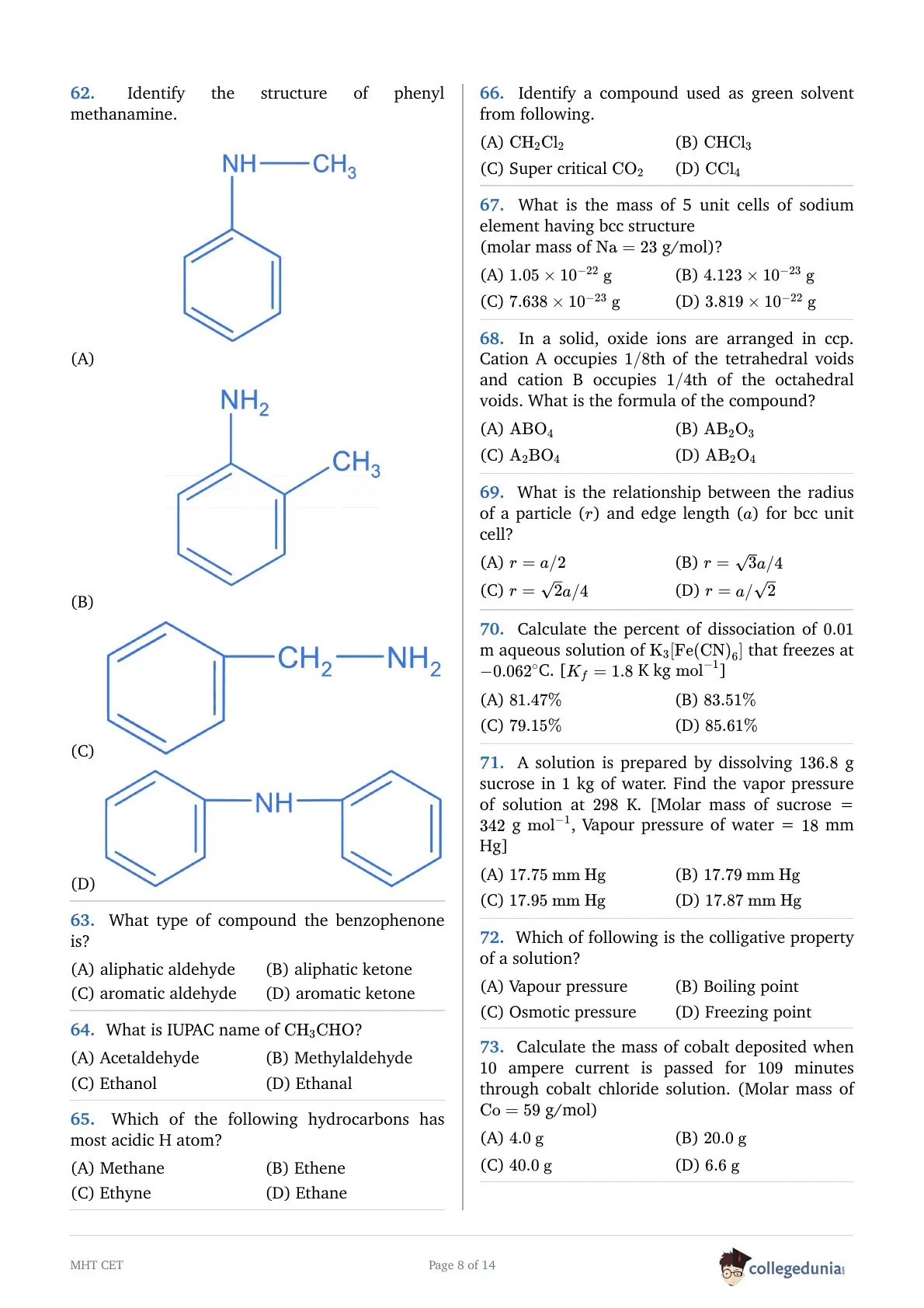
What type of compound the benzophenone is?
What is IUPAC name of \(\text{CH}_{3}\text{CHO}\)?
Which of the following hydrocarbons has most acidic H atom?
Identify a compound used as green solvent from following.
What is the mass of 5 unit cells of sodium element having bcc structure
(molar mass of \(\text{Na}=23\) g/mol)?
In a solid, oxide ions are arranged in ccp. Cation A occupies \(1/8\)th of the tetrahedral voids and cation B occupies \(1/4\)th of the octahedral voids. What is the formula of the compound?
What is the relationship between the radius of a particle (\(r\)) and edge length (\(a\)) for bcc unit cell?
Calculate the percent of dissociation of \(0.01\)m aqueous solution of \(\text{K}_{3}[\text{Fe(CN)}_{6}]\) that freezes at \(-0.062^{\circ }\)C. [\(K_{f}=1.8\) K kg \(\text{mol}^{-1}\)]
A solution is prepared by dissolving \(136.8\) g sucrose in \(1\) kg of water. Find the vapor pressure of solution at \(298\) K. [Molar mass of sucrose = \(342\) g \(\text{mol}^{-1}\), Vapour pressure of water = \(18\) mm Hg]
Which of following is the colligative property of a solution?
Calculate the mass of cobalt deposited when \(10\) ampere current is passed for \(109\) minutes through cobalt chloride solution. (Molar mass of \(\text{Co}=59\) g/mol)
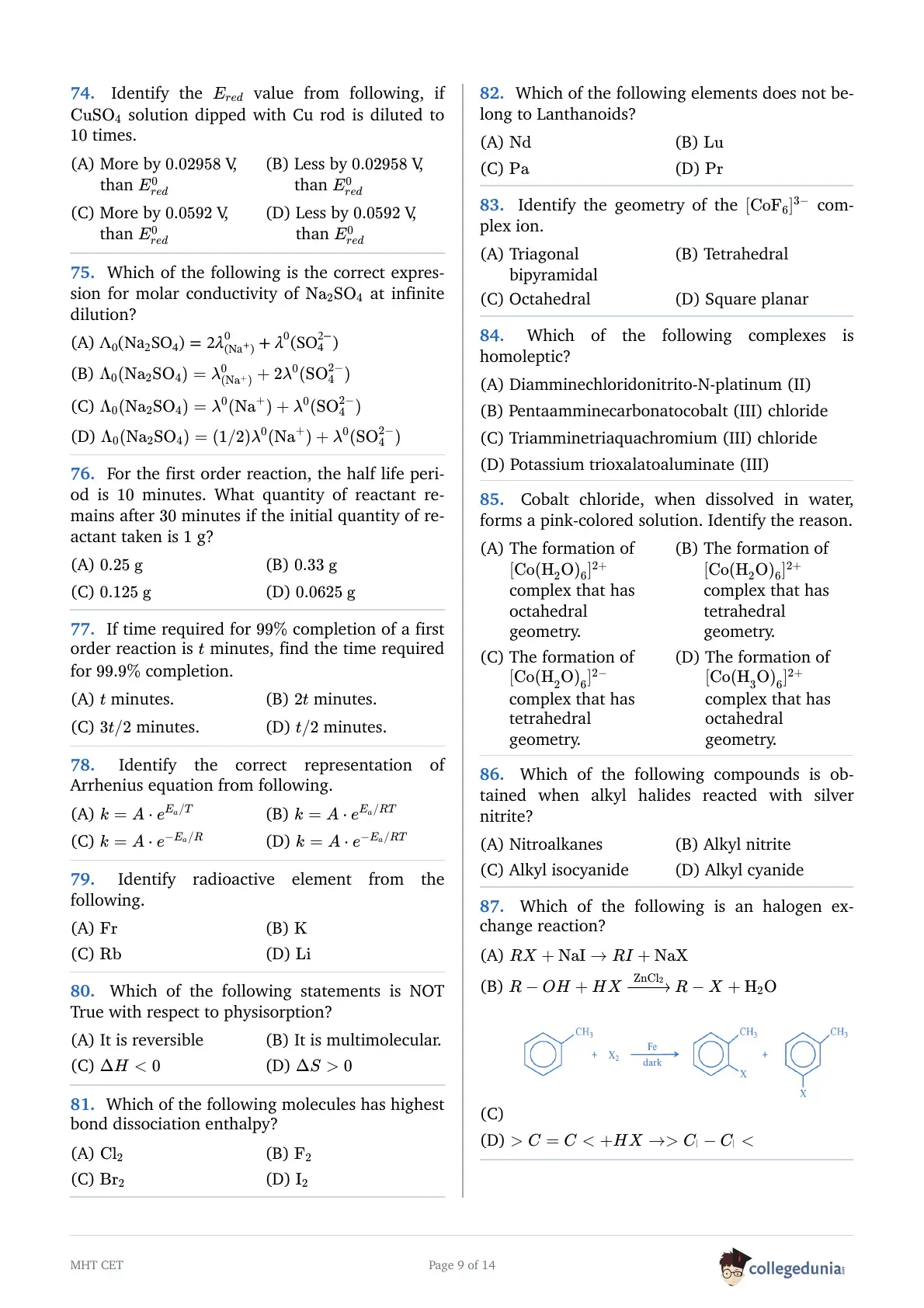
Identify the \(E_{red}\) value from following, if \(\text{CuSO}_{4}\) solution dipped with Cu rod is diluted to \(10\) times.
Which of the following is the correct expression for molar conductivity of \(\text{Na}_{2}\text{SO}_{4}\) at infinite dilution?
For the first order reaction, the half life period is \(10\) minutes. What quantity of reactant remains after \(30\) minutes if the initial quantity of reactant taken is \(1\) g?
If time required for \(99\%\) completion of a first order reaction is \(t\) minutes, find the time required for \(99.9\%\) completion.
Identify the correct representation of Arrhenius equation from following.
Identify radioactive element from the following.
Which of the following statements is NOT True with respect to physisorption?
Which of the following molecules has highest bond dissociation enthalpy?
Which of the following elements does not belong to Lanthanoids?
Identify the geometry of the \([\text{CoF}_{6}]^{3-}\) complex ion.
Which of the following complexes is homoleptic?
Cobalt chloride, when dissolved in water, forms a pink-colored solution. Identify the reason.
Which of the following compounds is obtained when alkyl halides reacted with silver nitrite?
Which of the following is an halogen exchange reaction?
- (A) \(RX+\text{NaI}\rightarrow RI+\text{NaX}\)
- (B) \(R-OH+HX\xrightarrow{\text{ZnCl}_{2}}R-X+\text{H}_{2}\text{O}\)
- (C)
![]()
- (D) \(>C=C\lt +HX\rightarrow >C_{{}^{|}}-C_{{}^{|}}\lt\)

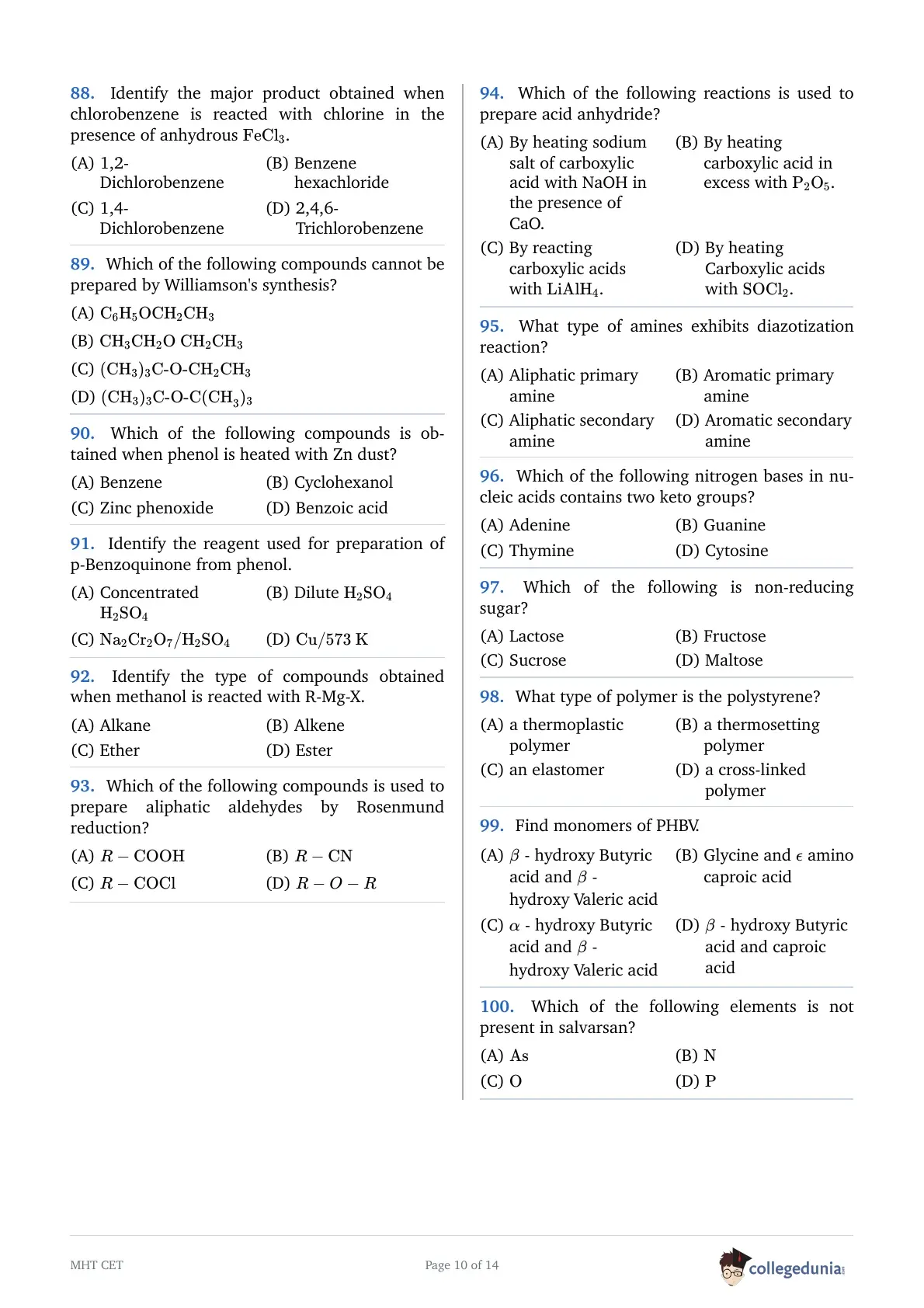
Identify the major product obtained when chlorobenzene is reacted with chlorine in the presence of anhydrous \(\text{FeCl}_{3}\).
Which of the following compounds cannot be prepared by Williamson's synthesis?
Which of the following compounds is obtained when phenol is heated with Zn dust?
Identify the reagent used for preparation of p-Benzoquinone from phenol.
Identify the type of compounds obtained when methanol is reacted with R-Mg-X.
Which of the following compounds is used to prepare aliphatic aldehydes by Rosenmund reduction?
Which of the following reactions is used to prepare acid anhydride?
What type of amines exhibits diazotization reaction?
Which of the following nitrogen bases in nucleic acids contains two keto groups?
Which of the following is non-reducing sugar?
What type of polymer is the polystyrene?
Find monomers of PHBV.
Which of the following elements is not present in salvarsan?
Mathematics (Q101 - Q150)
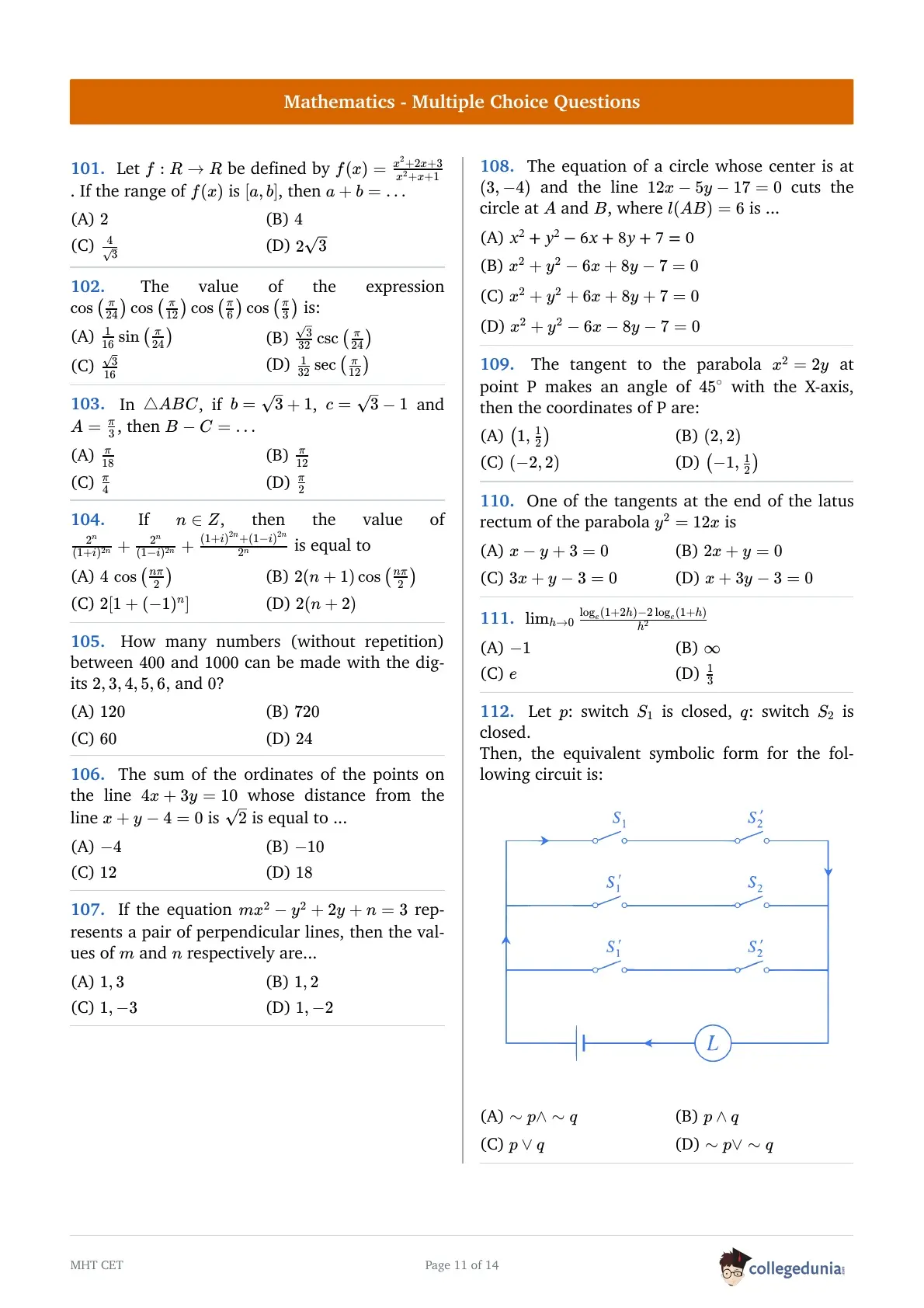
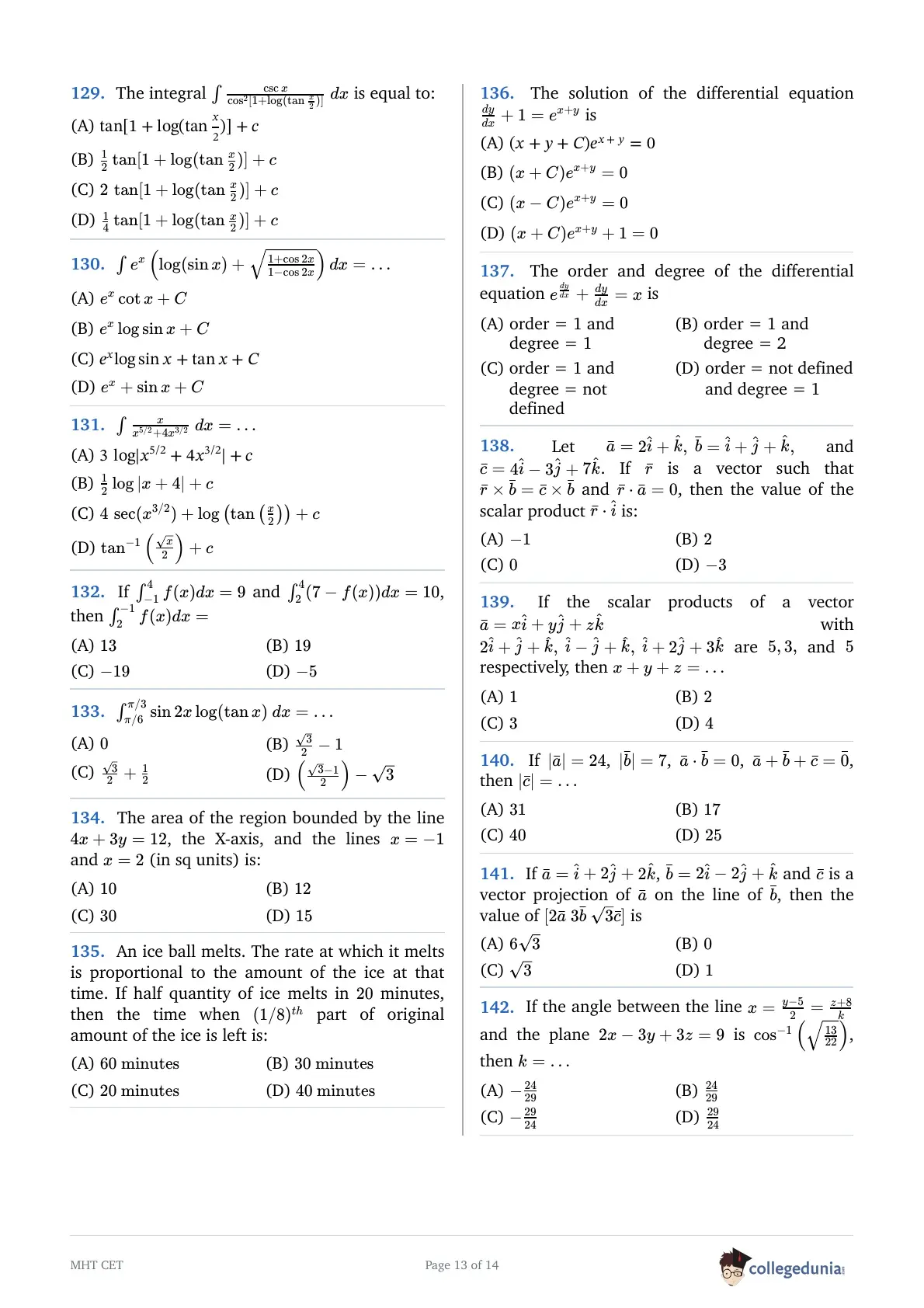
Let \(f:R\rightarrow R\) be defined by \(f(x)=\frac{x^{2}+2x+3}{x^{2}+x+1}\). If the range of \(f(x)\) is \([a,b]\), then \(a+b=\ldots\)
The value of the expression \(\cos \left(\frac{\pi }{24}\right)\cos \left(\frac{\pi }{12}\right)\cos \left(\frac{\pi }{6}\right)\cos \left(\frac{\pi }{3}\right)\) is:
In \(\triangle ABC\), if \(b=\sqrt{3}+1\), \(c=\sqrt{3}-1\) and \(A=\frac{\pi }{3}\), then \(B-C=\ldots\)
If \(n\in Z\), then the value of \(\frac{2^{n}}{(1+i)^{2n}}+\frac{2^{n}}{(1-i)^{2n}}+\frac{(1+i)^{2n}+(1-i)^{2n}}{2^{n}}\) is equal to
How many numbers (without repetition) between \(400\) and \(1000\) can be made with the digits \(2,3,4,5,6,\) and \(0\)?
The sum of the ordinates of the points on the line \(4x+3y=10\) whose distance from the line \(x+y-4=0\) is \(\sqrt{2}\) is equal to ...
If the equation \(mx^{2}-y^{2}+2y+n=3\) represents a pair of perpendicular lines, then the values of \(m\) and \(n\) respectively are...
The equation of a circle whose center is at \((3,-4)\) and the line \(12x-5y-17=0\) cuts the circle at \(A\) and \(B\), where \(l(AB)=6\) is ...
The tangent to the parabola \(x^{2}=2y\) at point P makes an angle of \(45^{\circ }\) with the X-axis, then the coordinates of P are:
One of the tangents at the end of the latus rectum of the parabola \(y^{2}=12x\) is
\(\lim _{h\rightarrow 0}\frac{\log _{e}(1+2h)-2\log _{e}(1+h)}{h^{2}}\)
Let \(p\): switch \(S_{1}\) is closed, \(q\): switch \(S_{2}\) is closed.
Then, the equivalent symbolic form for the following circuit is:

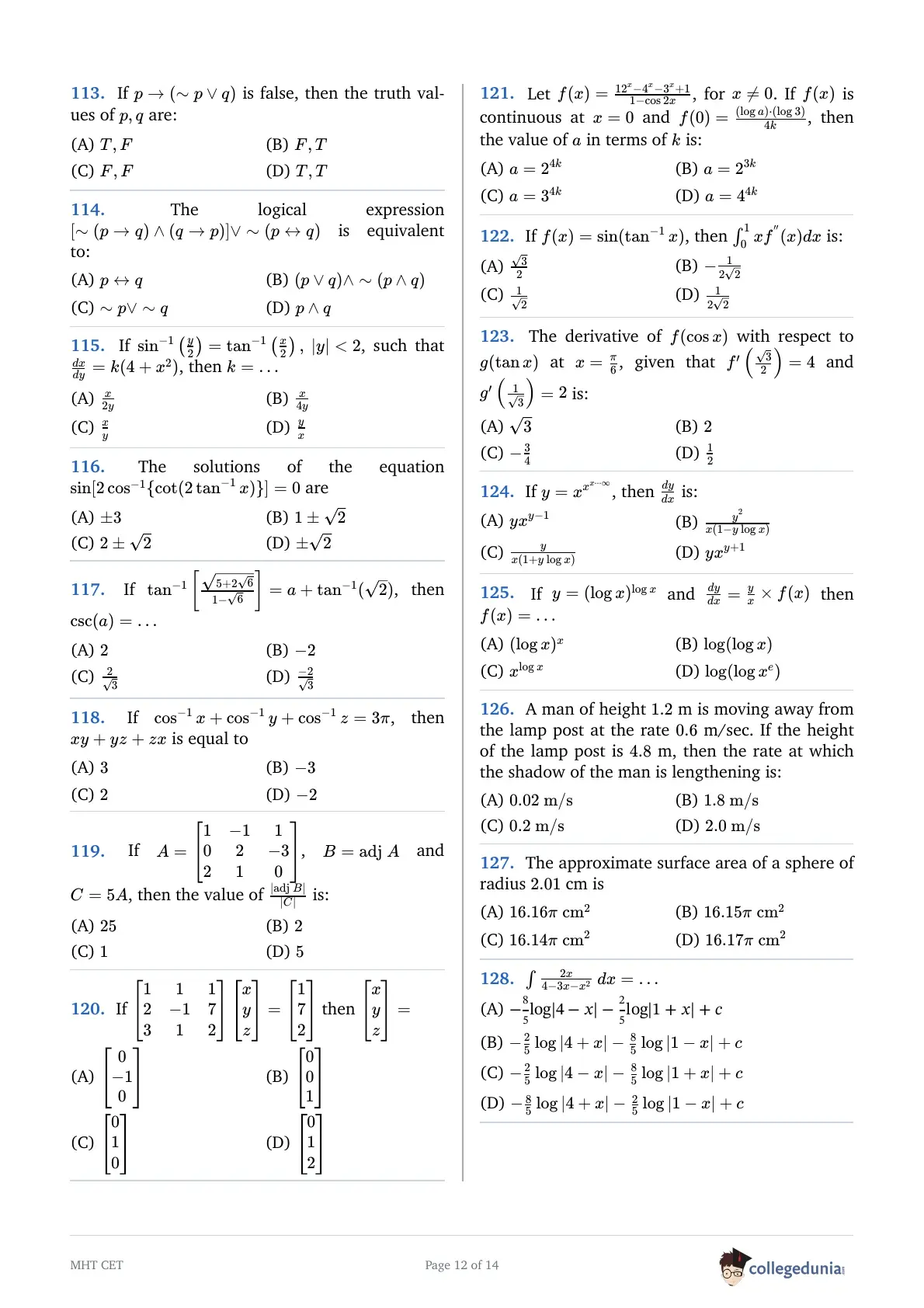
If \(p\rightarrow (\sim p\vee q)\) is false, then the truth values of \(p,q\) are:
The logical expression \([\sim (p\rightarrow q)\wedge (q\rightarrow p)]\vee \sim (p\leftrightarrow q)\) is equivalent to:
If \(\sin ^{-1}\left(\frac{y}{2}\right)=\tan ^{-1}\left(\frac{x}{2}\right),\ |y|\lt 2\), such that \(\frac{dx}{dy}=k(4+x^{2})\), then \(k=\ldots\)
The solutions of the equation \(\sin [2\cos ^{-1}\{\cot (2\tan ^{-1}x)\}]=0\) are
If \(\tan ^{-1}\left[\frac{\sqrt{5+2\sqrt{6}}}{1-\sqrt{6}}\right]=a+\tan ^{-1}(\sqrt{2})\), then \(\csc (a)=\ldots\)
If \(\cos ^{-1}x+\cos ^{-1}y+\cos ^{-1}z=3\pi\), then \(xy+yz+zx\) is equal to
If \(A=\begin{bmatrix} 1 & -1 & 1 \\ 0 & 2 & -3 \\ 2 & 1 & 0 \end{bmatrix}\), \(B=\text{adj}\ A\) and \(C=5A\), then the value of \(\frac{|\text{adj}\ B|}{|C|}\) is:
If \(\begin{bmatrix} 1 & 1 & 1 \\ 2 & -1 & 7 \\ 3 & 1 & 2 \end{bmatrix}\begin{bmatrix} x \\ y \\ z \end{bmatrix}=\begin{bmatrix} 1 \\ 7 \\ 2 \end{bmatrix}\) then \(\begin{bmatrix} x \\ y \\ z \end{bmatrix}=\)
Let \(f(x)=\frac{12^{x}-4^{x}-3^{x}+1}{1-\cos 2x}\), for \(x\neq 0\). If \(f(x)\) is continuous at \(x=0\) and \(f(0)=\frac{(\log a)\cdot (\log 3)}{4k}\), then the value of \(a\) in terms of \(k\) is:
If \(f(x)=\sin (\tan ^{-1}x)\), then \(\int _{0}^{1}xf^{''}(x)dx\) is:
The derivative of \(f(\cos x)\) with respect to \(g(\tan x)\) at \(x=\frac{\pi }{6}\), given that \(f'\left(\frac{\sqrt{3}}{2}\right)=4\) and \(g'\left(\frac{1}{\sqrt{3}}\right)=2\) is:
If \(y=x^{x^{x\cdot \cdot \cdot \infty }}\), then \(\frac{dy}{dx}\) is:
If \(y=(\log x)^{\log x}\) and \(\frac{dy}{dx}=\frac{y}{x}\times f(x)\) then \(f(x)=\ldots\)
A man of height \(1.2\) m is moving away from the lamp post at the rate \(0.6\) m/sec. If the height of the lamp post is \(4.8\) m, then the rate at which the shadow of the man is lengthening is:
The approximate surface area of a sphere of radius \(2.01\) cm is
\(\int \frac{2x}{4-3x-x^{2}}\ dx=\ldots\)
The integral \(\int \frac{\csc x}{\cos ^{2}[1+\log (\tan \frac{x}{2})]}\ dx\) is equal to:
\(\int e^{x}\left(\log (\sin x)+\sqrt{\frac{1+\cos 2x}{1-\cos 2x}}\right)dx=\ldots\)
\(\int \frac{x}{x^{5/2}+4x^{3/2}}\ dx=\ldots\)
If \(\int _{-1}^{4}f(x)dx=9\) and \(\int _{2}^{4}(7-f(x))dx=10\), then \(\int _{2}^{-1}f(x)dx=\)
\(\int _{\pi /6}^{\pi /3}\sin 2x\log (\tan x)\ dx=\ldots\)
The area of the region bounded by the line \(4x+3y=12\), the X-axis, and the lines \(x=-1\) and \(x=2\) (in sq units) is:
An ice ball melts. The rate at which it melts is proportional to the amount of the ice at that time. If half quantity of ice melts in \(20\) minutes, then the time when \((1/8)^{th}\) part of original amount of the ice is left is:
The solution of the differential equation \(\frac{dy}{dx}+1=e^{x+y}\) is
The order and degree of the differential equation \(e^{\frac{dy}{dx}}+\frac{dy}{dx}=x\) is
Let \(\bar{a}=2\hat{i}+\hat{k},\ \bar{b}=\hat{i}+\hat{j}+\hat{k},\) and \(\bar{c}=4\hat{i}-3\hat{j}+7\hat{k}\). If \(\bar{r}\) is a vector such that \(\bar{r}\times \bar{b}=\bar{c}\times \bar{b}\) and \(\bar{r}\cdot \bar{a}=0\), then the value of the scalar product \(\bar{r}\cdot \hat{i}\) is:
If the scalar products of a vector \(\bar{a}=x\hat{i}+y\hat{j}+z\hat{k}\) with \(2\hat{i}+\hat{j}+\hat{k},\ \hat{i}-\hat{j}+\hat{k},\ \hat{i}+2\hat{j}+3\hat{k}\) are \(5,3,\) and \(5\) respectively, then \(x+y+z=\ldots\)
If \(|\bar{a}|=24\), \(|\bar{b}|=7\), \(\bar{a}\cdot \bar{b}=0\), \(\bar{a}+\bar{b}+\bar{c}=\bar{0}\), then \(|\bar{c}|=\ldots\)
If \(\bar{a}=\hat{i}+2\hat{j}+2\hat{k}\), \(\bar{b}=2\hat{i}-2\hat{j}+\hat{k}\) and \(\bar{c}\) is a vector projection of \(\bar{a}\) on the line of \(\bar{b}\), then the value of \([2\bar{a}\ 3\bar{b}\ \sqrt{3}\bar{c}]\) is
If the angle between the line \(x=\frac{y-5}{2}=\frac{z+8}{k}\) and the plane \(2x-3y+3z=9\) is \(\cos ^{-1}\left(\sqrt{\frac{13}{22}}\right)\), then \(k=\ldots\)
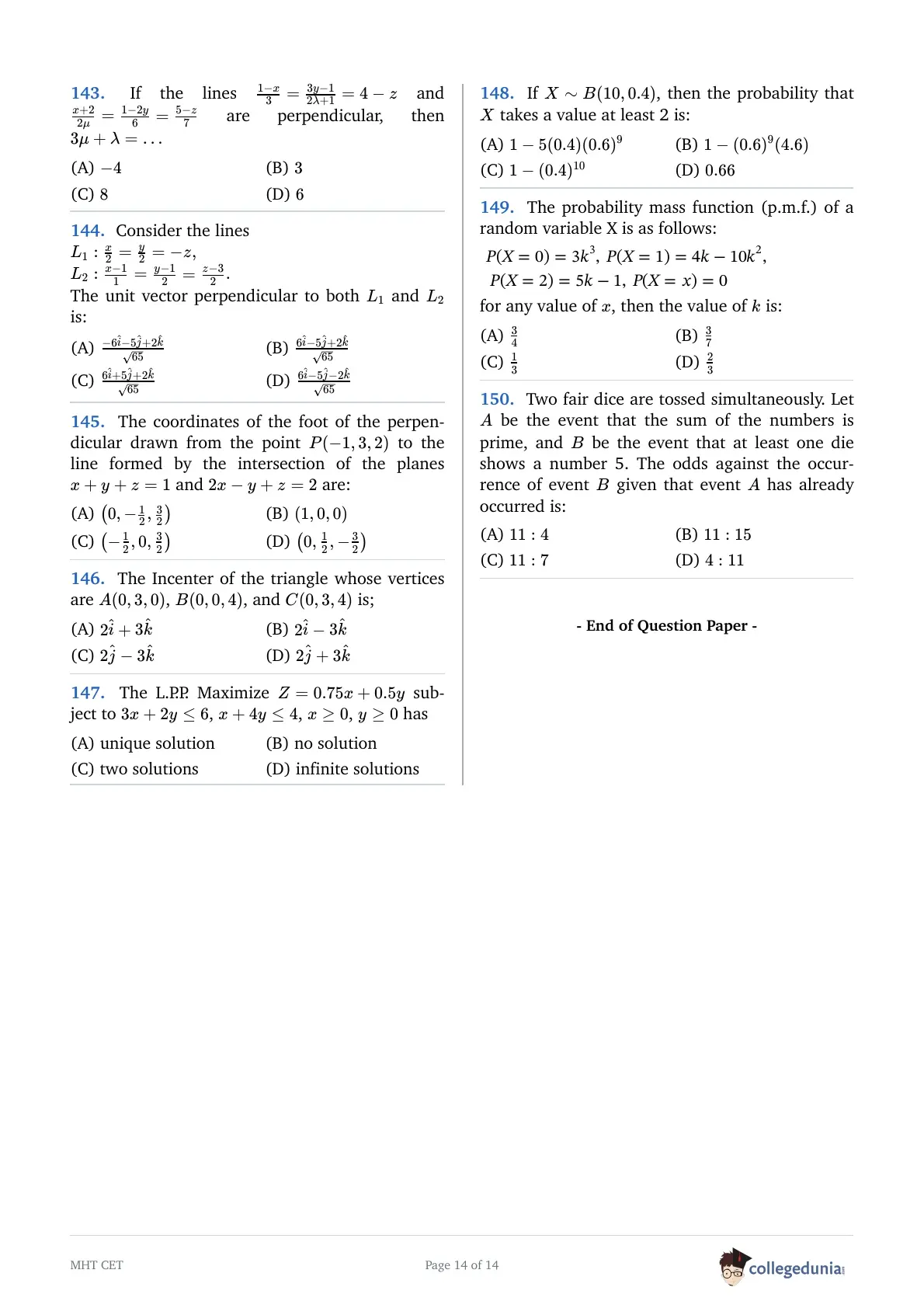
If the lines \(\frac{1-x}{3}=\frac{3y-1}{2\lambda +1}=4-z\) and \(\frac{x+2}{2\mu }=\frac{1-2y}{6}=\frac{5-z}{7}\) are perpendicular, then \(3\mu +\lambda =\ldots\)
Consider the lines
\(L_{1}:\frac{x}{2}=\frac{y}{2}=-z,\)
\(L_{2}:\frac{x-1}{1}=\frac{y-1}{2}=\frac{z-3}{2}.\)
The unit vector perpendicular to both \(L_{1}\) and \(L_{2}\) is:
The coordinates of the foot of the perpendicular drawn from the point \(P(-1,3,2)\) to the line formed by the intersection of the planes \(x+y+z=1\) and \(2x-y+z=2\) are:
The Incenter of the triangle whose vertices are \(A(0,3,0)\), \(B(0,0,4)\), and \(C(0,3,4)\) is;
The L.P.P. Maximize \(Z=0.75x+0.5y\) subject to \(3x+2y\leq 6\), \(x+4y\leq 4\), \(x\geq 0\), \(y\geq 0\) has
If \(X\sim B(10,0.4)\), then the probability that \(X\) takes a value at least 2 is:
The probability mass function (p.m.f.) of a random variable X is as follows:
\(P(X=0)=3k^{3},\ P(X=1)=4k-10k^{2},\ P(X=2)=5k-1,\ P(X=x)=0\) for any value of \(x\), then the value of \(k\) is:
Two fair dice are tossed simultaneously. Let \(A\) be the event that the sum of the numbers is prime, and \(B\) be the event that at least one die shows a number 5. The odds against the occurrence of event \(B\) given that event \(A\) has already occurred is:
MHT CET 2026 PCM Exam Pattern and Marking Scheme
| Parameter | Details |
|---|---|
| Conducting Body | Maharashtra Common Entrance Test Cell (Maharashtra CET Cell) |
| Exam Mode | Online (Computer-Based Test) |
| Duration | 180 minutes (3 hours) |
| Groups / Subjects | PCM (Physics, Chemistry, Mathematics) for Engineering |
| Total Questions |
150 |
| Total Marks | 200 |
| Question Type | Multiple Choice Questions (MCQs) |
| Marks Distribution |
|
| Negative Marking | No |
| Syllabus Weightage |
|



Comments