

-modified.png?h=56&w=56&mode=stretch)


GMAT 2027, or the Graduate Management Admission Test, is a computer-adaptive entrance exam accepted by business schools worldwide for admission into MBA and Master's in Management programs.
GMAT 2027 does not have a fixed annual exam date; candidates can book an appointment based on their preferred preparation schedule. Candidates can take the GMAT at an authorised Pearson VUE test centre or through the online proctored format.
- The exam consists of Quantitative Reasoning, Verbal Reasoning, and Data Insights, with 64 questions to be completed in 135 minutes. Each section is allotted 45 minutes, requiring candidates to manage time separately across all three sections.
- Candidates can choose the order in which they attempt the three sections. The total GMAT score ranges from 205 to 805, reported in 10-point increments.
- Quantitative Reasoning primarily tests Arithmetic and Elementary Algebra, with an emphasis on logical problem-solving.
- Verbal Reasoning tests Reading Comprehension and Critical Reasoning; Sentence Correction is not part of the current format. Data Insights covers Data Sufficiency, Two-Part Analysis, Graphics Interpretation, Multi-Source Reasoning, and Table Analysis.
- Candidates must maintain a minimum 16-day gap between attempts and can take the exam up to 5 times in a rolling 12-month period. GMAT scores remain valid for 5 years from the date of the exam.
Check Out:
- GMAT Syllabus 2026: Question Types, Topics, Free Practice Tests
- GMAT Registration 2027: Check Fees, Eligibility, Dates
- GMAT Exam Eligibility 2027: Age Limit, ID Requirements
Key Summary
- GMAT 2027 is a computer-adaptive, appointment-based exam with no fixed national test date, unlike JEE or CAT.
- The GMAT exam has three equally weighted sections, Quantitative Reasoning, Verbal Reasoning, and Data Insights, totaling 64 questions in 2 hours 15 minutes.
- GMAT exam fees for GMAT 2027 range from around $324.50 (test center) to $354.00 (online), inclusive of 18% GST for Indian candidates.
- GMAT admissions are direct and individual; there is no centralized counselling like JoSAA, and candidates apply separately to each business school.
What is GMAT 2027?
GMAT, or the Graduate Management Admission Test, is a standardized, computer-adaptive entrance exam used globally for admission into graduate management and business programs. It is owned and administered by the Graduate Management Admission Council (GMAC).
- It measures the analytical, quantitative, verbal, and data literacy skills considered essential for success in an MBA or Master's in Management program.
- GMAT 2027 is not restricted to a single country. GMAT 2027 is a global exam, accepted by business schools in the US, Europe, Asia, and India.
| Particular | Details |
|---|---|
| Exam Name | Graduate Management Admission Test (GMAT 2027) |
| Conducting Body | Graduate Management Admission Council (GMAC) |
| Courses Covered | MBA, Master's in Management, Executive MBA (EPGP/PGPX) |
| Exam Level | Global |
| Exam Mode | Computer-Adaptive Test (CAT), Online or Test Center |
| Total Questions | 64 questions across 3 sections |
| Total Duration | 2 hours 15 minutes |
| Score Range | 205 to 805 |
| Score Validity | 5 years |
| GMAT Exam Fees (India) | Approx. ₹27,100 (test center) to ₹29,570 (online), incl. GST |
| GMAT Official Website | mba.com |
Check Out:
GMAT 2027: Important Dates (Tentative)
Unlike other national-level exams, GMAT 2027 does not follow a fixed exam-day calendar. It is administered 7 days a week at Pearson VUE test centers and 24/7 through the online proctored format.
Candidates instead book an appointment that suits their own preparation timeline and then appear for the exam.
- 16-Day Retake Rule: A minimum 16-calendar-day gap is mandatory between two attempts.
- Yearly Limit: Up to 5 attempts allowed in a rolling 12-month period.
- Lifetime Limit: GMAC has removed the historical lifetime cap; only the annual limit applies now.
| Period | Demand Level | Recommended Booking Window |
|---|---|---|
| May – October | Peak (Round 1 & Round 2 rush) | 8 to 12 weeks in advance |
| January – March | Low | 1 to 2 weeks in advance |
| Rescheduling Deadline | At least 14 days before appointment | |
Check Out:
GMAT Eligibility Criteria 2027
GMAC does not restrict candidates by academic stream, grades, or professional background. It keeps the bar low by design, since the exam is meant to be a skills assessment rather than a knowledge test tied to a specific curriculum.
- Age Limit: Minimum 18 years to register independently. Candidates aged 13–17 can take the GMAT exam with a signed parental consent form, but only at physical test centers.
- Educational Qualification: None mandated. A bachelor's degree is not required to sit for GMAT 2027.
- Work Experience: Not required, and freshers, final-year students, and working professionals can all register.
- Nationality: Open to citizens of all countries, reinforcing that the GMAT exam is not restricted by nationality.
| Eligibility for GMAT Exam | Requirement |
|---|---|
| Age Limit | 18+ (13–17 with parental consent, test center only) |
| Educational Qualification | None required |
| Work Experience | Not required |
| Nationality | Open to all countries |
| Identification Proof | Government-issued photo ID (Passport for Indian test-takers) |
| Gap Between Attempts | Minimum 16 calendar days |
| Maximum Attempts | 5 per rolling 12-month period |
| Lifetime Attempts | No lifetime cap |
Check Out:
GMAT Practice Paper 2025
| Paper Name | Question Paper PDF | Solution PDF |
|---|---|---|
| GMAT 2025 Sample Paper 1 | Download PDF | Check Solutions |
| GMAT 2025 Sample Paper 2 | Download PDF | Check Solutions |
| GMAT 2025 Sample Paper 3 | Download PDF | Check Solutions |
| GMAT 2025 Practice Paper Set 1 | Download PDF | Check Solutions |
| GMAT 2025 Practice Paper Set 2 | Download PDF | Check Solutions |
| GMAT 2025 Practice Paper Set 3 | Download PDF | Check Solutions |
| GMAT 2025 Quant Practice Paper Set 1 | Download PDF | Check Solutions |
| GMAT 2025 Verbal Practice Paper Set 1 | Download PDF | Check Solutions |
| GMAT 2025 DI Practice Paper Set 1 | Download PDF | Check Solutions |
GMAT Practice Paper 2024
| Paper Name | Question Paper PDF | Solution PDF |
|---|---|---|
| GMAT 2024 Quant Sample Paper 1 | Download PDF | Check Solutions |
| GMAT 2024 Quant Sample Paper 2 | Download PDF | Check Solutions |
| GMAT 2024 Quant Sample Paper 3 | Download PDF | Check Solutions |
| GMAT 2024 Verbal Sample Paper 1 | Download PDF | Check Solutions |
| GMAT 2024 Verbal Sample Paper 2 | Download PDF | Check Solutions |
| GMAT 2024 Verbal Sample Paper 3 | Download PDF | Check Solutions |
GMAT Verbal Practice Paper
| Paper Name | Question Paper PDF | Solution PDF |
|---|---|---|
| GMAT Verbal Practice Paper 1 | Download PDF | Check Solutions |
| GMAT Verbal Practice Paper 2 | Download PDF | Check Solutions |
| GMAT Verbal Practice Paper 3 | Download PDF | Check Solutions |
| GMAT Verbal Practice Paper 4 | Download PDF | Check Solutions |
| GMAT Verbal Practice Paper 5 | Download PDF | Check Solutions |
| GMAT Verbal Practice Paper 6 | Download PDF | Check Solutions |
| GMAT Verbal Practice Paper 7 | Download PDF | Check Solutions |
| GMAT Verbal Practice Paper 8 | Download PDF | Check Solutions |
| GMAT Verbal Practice Paper 9 | Download PDF | Check Solutions |
GMAT Exam Fees 2027
GMAT exam fees depend on whether a candidate opts for a physical test center or the online proctored format. All payments go through the official GMAT website, mba.com, and Indian candidates must budget for an additional 18% GST on top of the base GMAT registration fee.
The GMAT exam cost in India is higher than the base USD price once local taxes are added.
- The GMAT exam fees in India include your test appointment, an instant unofficial score, and your official scorecard.
- The fee also covers sending your official score to up to 5 business schools for free.
- GST is auto-applied the moment your billing address or test location is set to India.
| Exam Format | Base Fee (USD) | GST (18%) | Total (USD) | Estimated GMAT Fees in India (INR) |
|---|---|---|---|---|
| Physical Test Center | $275.00 | $49.50 | $324.50 | ~₹27,100 |
| Online Exam (From Home) | $300.00 | $54.00 | $354.00 | ~₹29,570 |
Check Out:
- GMAT vs GMAT Focus 2026: Key Differences in Exam Pattern, Timing, & Score
- GMAT Rescheduling & Cancellation: Check Policies, Process, and Fees 2026
- Tips for GMAT Critical Reasoning: Inference vs. Assumption
GMAT Exam Fee Waiver 2027
GMAC gives up to 10 GMAT fee waivers to universities that request them.
- Each university decides its own eligibility criteria for students to receive these waivers.
- The coupons are valid for 1 year, so you need to contact the universities directly to learn their requirements and apply.
- Once you get a fee waiver code from a university, you can use it when registering for the GMAT exam.
- The code covers the full exam fee and must be used before its expiration date.
GMAT 2027 Application Process
The GMAT application process is fully digital and can be completed at any time of year through the official GMAT website. Since GMAT 2027 is appointment-based rather than window-based, candidates do not need to wait for a specific registration period to open.
- Select Schools: Choose up to 5 free score recipients within 48 hours of receiving the official score.
- Verify & Submit: Review your school selections and confirm the score-reporting request before the free-reporting window closes.
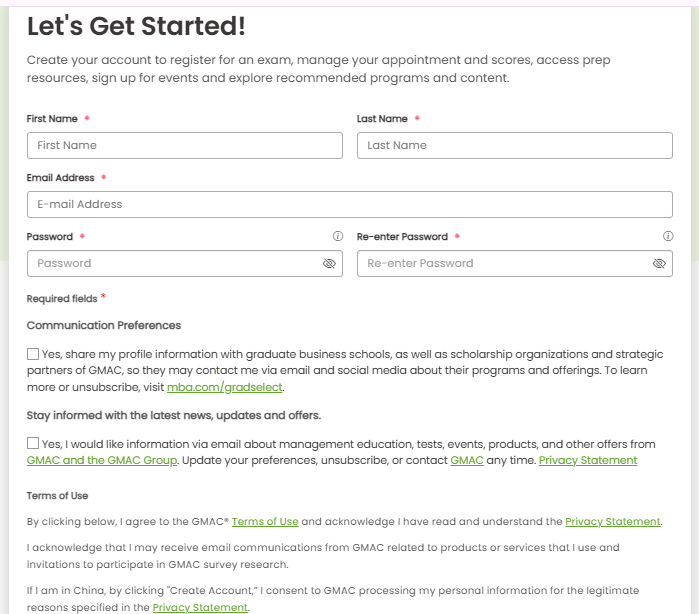
Source: Official GMAT Registration Page
| Phase | Step | Key Details |
|---|---|---|
| Phase 1 | Pre-Registration | Valid passport (mandatory for Indian test-center candidates)International payment method enabled |
| Phase 2 | Create Account | Sign up on mba.com; enter details exactly as per passport |
| Select Format | Choose In-Person Test Center or Online Exam | |
| Choose Center | Compare up to 3 local test centers (if in-person) | |
| Book Slot | Select date and time from the live calendar | |
| Pay & Confirm | GST auto-applied for Indian billing address; pay via international card | |
| Phase 3 | Select Schools | Choose up to 5 free score recipients within 48 hours of receiving the official score |
Documents Required for GMAT Registration
The Graduate Management Admission Council enforces strict identity-verification rules for GMAT 2027.
- Test Center ID: Carry the original, unexpired passport; photocopies or digital copies are not accepted.
- Online Exam ID: Keep an accepted ID ready for verification, and ensure the document is physical or displayed as permitted—not just a phone-screen copy.
| Format | Accepted Documents |
|---|---|
| Physical Test Center (India) | Original, unexpired Indian Passport only |
| Not Accepted | Aadhaar, PAN, Voter ID, Driving Licence, DigiLocker copies, photocopies |
| Online Exam (From Home) | Valid Passport OR physical/e-Aadhaar (PDF); a phone screen display is not permitted |
GMAT Exam Pattern 2027
The current GMAT exam syllabus and structure runs for 2 hours 15 minutes across 64 questions. There is no Analytical Writing Assessment (essay) section in this pattern.
Candidates can attempt the three sections in any order they prefer. The current GMAT pattern allows you to bookmark questions and change up to 3 answers per section at the end of the time limit.
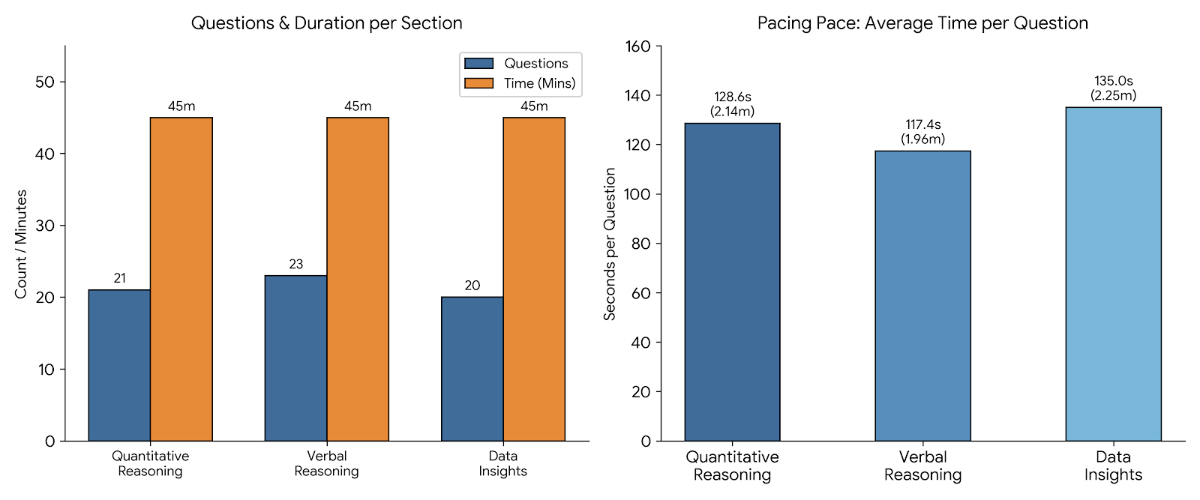
- Section-wise Timing: Each section has a fixed 45-minute duration, so manage time independently across Quantitative Reasoning, Verbal Reasoning, and Data Insights.
- Calculator Use: The on-screen calculator is available only for Data Insights; Quantitative and Verbal Reasoning sections do not permit calculator use.
- Optional Break: One 10-minute break, taken after the first or second section.
- Score Validity: GMAT 2027 scores remain valid for 5 years from the test date.
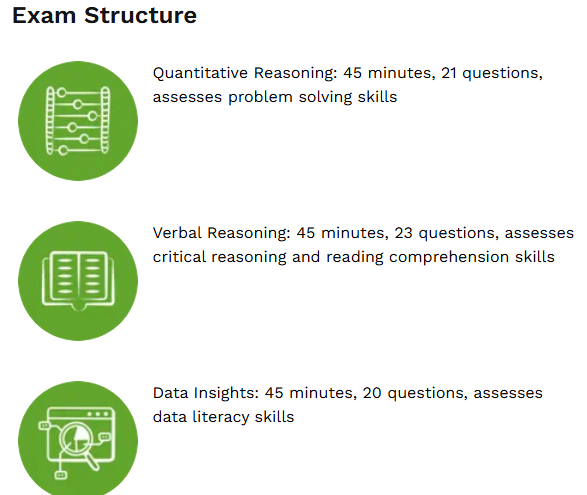
Source: GMAT exam pattern
| Section | Questions | Time | Core Skill Areas | Calculator |
|---|---|---|---|---|
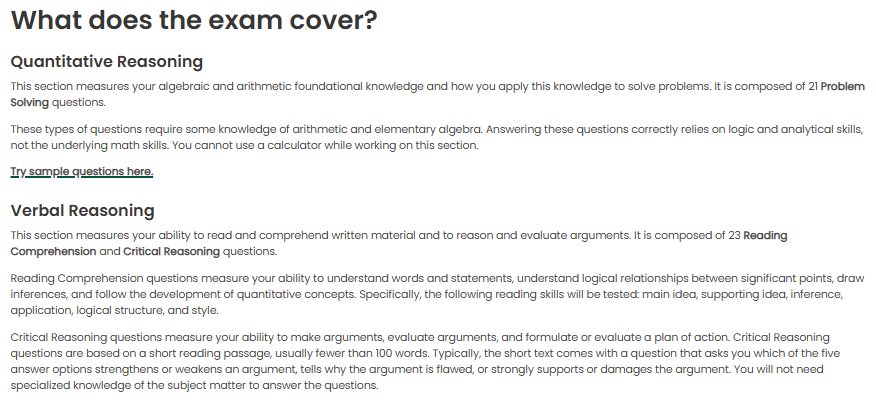
| Quantitative Reasoning | 21 | 45 mins | Arithmetic, Elementary Algebra, Problem Solving | Not Allowed |
| Verbal Reasoning | 23 | 45 mins | Reading Comprehension, Critical Reasoning | Not Allowed |
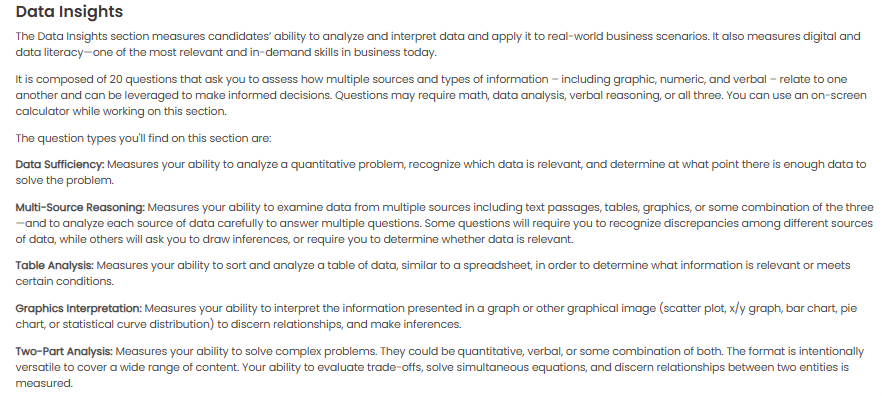
| Data Insights | 20 | 45 mins | Data Sufficiency, Multi-Source Reasoning, Table Analysis, Graphics Interpretation, Two-Part Analysis | On-Screen Calculator Allowed |
| Total | 64 | 135 mins | — | — |
Check Out:
GMAT Syllabus 2027: Section-Wise Breakdown
The GMAT syllabus for MBA aspirants is organized into three sections, each testing a different combination of quantitative, verbal, and data-literacy skills rather than following a fixed academic curriculum.
- Data Insights is the most data-focused section, testing the ability to interpret, compare, and combine information from different formats.
- Data Sufficiency focuses on deciding whether the provided information is sufficient to answer a question, rather than simply calculating the answer.
- Graphics Interpretation assesses the ability to analyse charts and graphs, while Two-Part Analysis tests solving questions involving two related variables or conditions.
Source: Official GMAT Syllabus
GMAT Quantitative Syllabus
The Quant syllabus covers four broad areas: Arithmetic, Algebra, Word Problems, and Descriptive Statistics.
- Arithmetic focuses on number properties, percentages, ratios, proportions, powers, roots, and related numerical concepts.
- Algebra includes equations, inequalities, absolute values, functions, sequences, AP, and GP.
- Word Problems and Statistics cover real-life mathematical applications such as speed, time, work, profit and loss, interest, mixtures, averages, and Venn diagrams.
A total of 21 questions are asked from the Quant section.
Students can completely skip the following topics from the Quant syllabus, as they are no longer tested in the GMAT Focus Edition Quant section:
- Geometry (Lines, angles, triangles, polygons, circles, solids, volume, perimeter, area)
- Coordinate Geometry (Slopes, line equations, midpoints, distance formula)
| Quant Topic | Subtopics Covered |
|---|---|
| 1. Arithmetic | Number Properties, Divisibility, Factors & Multiples, Prime Factorisation, GCD & LCM, Even/Odd & Consecutive Integers, Remainders & Modular Arithmetic |
| Fractions, Decimals & Percentages | Fraction–Decimal–Percentage Conversion, Repeating Decimals, Rounding Off, Percentage Increase/Decrease, Successive Percentage Changes |
| Ratios, Proportions & Rates | Ratios of Multiple Variables, Direct Proportion, Inverse Proportion |
| Powers & Roots | Laws of Exponents, Surds, Simplification of Radical Expressions |
| 2. Algebra | Linear Equations, Quadratic Equations, Simultaneous Equations, Systems of Linear Equations |
| Inequalities | Linear & Quadratic Inequalities, Number-Line Representation, Combining Inequalities |
| Absolute Value | Absolute Value Equations and Inequalities |
| Functions & Sequences | Domain, Range, Function Evaluation, Custom-Defined Functions/Operators, Arithmetic Progression (AP), Geometric Progression (GP) |
| 3. Word Problems | Rate, Time & Work, Distance–Speed–Time, Average Speed, Relative Speed, Combined Work & Pipes |
| Commercial Mathematics | Profit & Loss, Discount, Marked Price, Simple Interest, Compound Interest |
| Mixtures & Alligation | Mixture Problems, Concentration, Price-Based Mixtures, Alligation |
| Descriptive Statistics | Mean, Median, Mode, Range, Standard Deviation (Conceptual) |
| Sets & Venn Diagrams | 2-Set and 3-Set Venn Diagrams, Union/Intersection, Neither, Basic Venn Diagram Calculations |
GMAT Verbal Syllabus
The entire 45-minute Verbal section consists of just 23 questions split between Reading Comprehension (RC) and Critical Reasoning (CR):
- The biggest change to the exam was the complete removal of Sentence Correction (grammar).
- You no longer need to memorize complex rules about idioms, subject-verb agreement, or modifiers.
| Verbal Reasoning Topic | Subtopics Covered |
|---|---|
| 1. Critical Reasoning (CR) | Assumption, Strengthen/Weaken, Evaluate the Argument, Flaw in the Argument, Inference/Drawing Conclusions, Boldface Questions |
| 2. Reading Comprehension (RC) | Main Idea/Primary Purpose, Detail Questions, Inference Questions, Logical Structure/Function, Tone/Attitude |
Data Insights
This section consists of 20 questions to be completed in 45 minutes, and an on-screen calculator is allowed.
- The Data Insights section tests your ability to analyse, interpret, and evaluate data rather than simply perform calculations.
- It covers five question types: Data Sufficiency, Multi-Source Reasoning, Table Analysis, Graphics Interpretation, and Two-Part Analysis.
You have an average of 2 minutes and 15 seconds per question.
| Data Insights Topic | Subtopics Covered |
|---|---|
| Data Sufficiency (DS) | Number Properties, Algebra & Inequalities, Word Problems, Logic & Set Theory, Evaluating Whether Given Information Is Sufficient |
| Multi-Source Reasoning (MSR) | Interpreting Multiple Sources, Identifying Contradictions/Discrepancies, Resolving Conflicts, Synthesising Information Across Text and Tables |
| Table Analysis (TA) | Sorting and Interpreting Tables, Mean, Median, Mode, Range, Percentages, Ratios, Conditional Statements, True/False and Yes/No Analysis |
| Graphics Interpretation (GI) | Interpreting Charts and Graphs, Scatter Plots, Trendlines, Cumulative Charts, Flowcharts, Bubble Charts, Estimation, Slopes, Basic Probability |
| Two-Part Analysis (TPA) | Simultaneous Equations, Permutations & Combinations, Speed/Distance Problems, Strengthen/Weaken Arguments, Interdependent Answer Choices |
Check Out:
How are GMAT Scores Calculated?
The GMAT score is not determined simply by the number of correct answers. Its computer-adaptive scoring system considers your performance and the difficulty of the questions you receive.
- Difficulty matters: Getting questions correct at higher difficulty levels can support a stronger ability estimate than simply accumulating correct answers on easier questions.
- All three sections count: Quantitative Reasoning, Verbal Reasoning, and Data Insights each play an important role in determining the overall score.
- Completion is critical: Since unanswered questions can negatively affect scoring, candidates should manage time carefully and aim to attempt every question.
| Scoring Factor | How It Affects the Score |
|---|---|
| Questions Answered | All 64 questions must be attempted; unanswered questions can lead to a significant scoring penalty. |
| Accuracy | Correct and incorrect responses affect the algorithm’s ongoing estimate of your ability. |
| Question Difficulty | The difficulty of questions you answer correctly or incorrectly influences your estimated ability and final score. |
| Adaptive Algorithm | The difficulty level adjusts as you progress through each section based on your responses. |
| Section Contribution | Quantitative Reasoning, Verbal Reasoning, and Data Insights each contribute to the overall score. |
| Final Score | Section results are combined into a total score ranging from 205 to 805, in 10-point increments. |
Check Out:
GMAT Topic-Wise Weightage
The GMAT syllabus is designed around core mathematical reasoning, comprehension, and data-analysis skills rather than extensive subject coverage.
- Quantitative Reasoning focuses mainly on Arithmetic and Algebra, with emphasis on applying concepts quickly and logically.
- Verbal Reasoning is centred on Reading Comprehension and Critical Reasoning, testing understanding, inference, and argument evaluation.
- Data Insights combines data interpretation, sufficiency, and analytical reasoning across different formats.
Quantitative Reasoning
Geometry has been removed from the GMAT maths syllabus; the section is now split mainly between Arithmetic and Algebra.
- Core Focus: The Quantitative Reasoning section primarily covers Arithmetic and Algebra, with geometry no longer included in the syllabus.
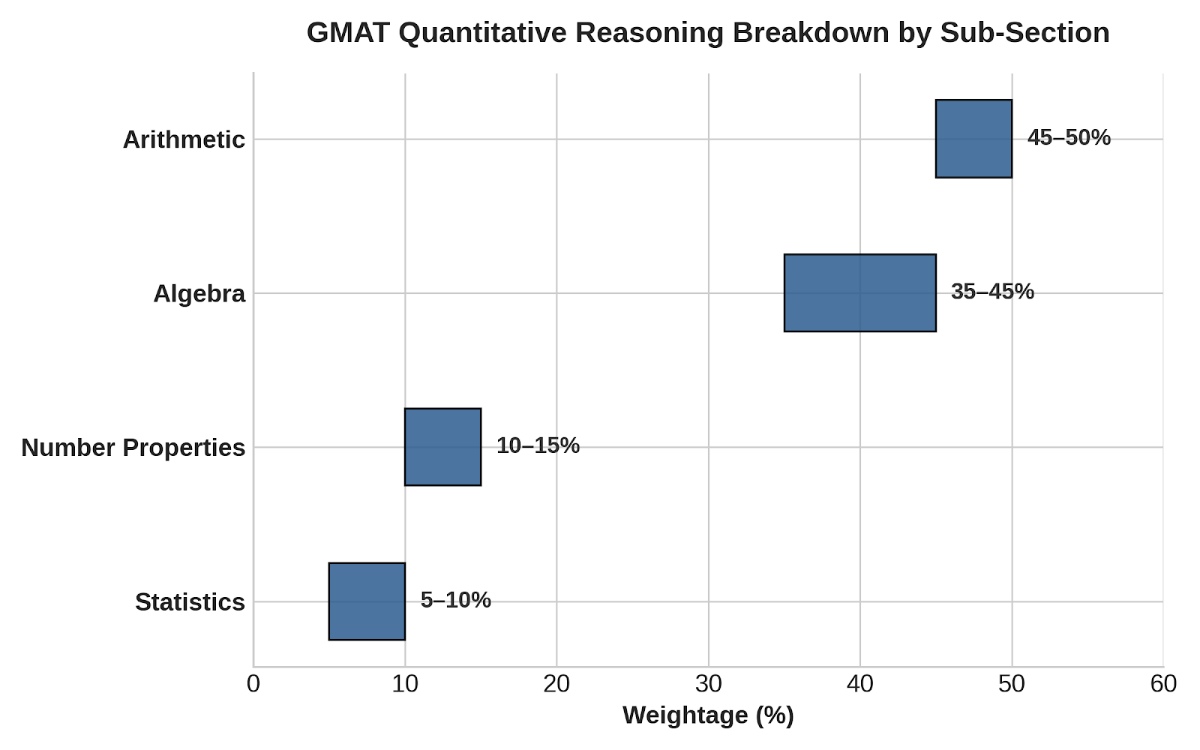
- Topic Distribution: Arithmetic carries the highest share, followed by Algebra, while Number Properties and Statistics have comparatively smaller weightages.
| Sub-Section | Weightage | High-Frequency Topics |
|---|---|---|
| Arithmetic | 45–50% | Ratios, Percentages, Profit & Loss, Interest, Averages, Time-Speed-Distance |
| Algebra | 35–45% | Linear/Quadratic Equations, Inequalities, Functions, Exponents |
| Number Properties | 10–15% | Divisibility, Prime Factorisation, Remainders, LCM/HCF |
| Statistics | 5–10% | Mean, Median, Mode, Range, Standard Deviation basics |
Verbal Reasoning
Sentence Correction has been fully removed from the GMAT exam syllabus; the section now focuses purely on comprehension and logic.
- Comprehension-Based: The section focuses entirely on Reading Comprehension and Critical Reasoning, with Sentence Correction removed from the current syllabus.
- Question Emphasis: Reading Comprehension forms the larger share, while Critical Reasoning tests argument analysis, assumptions, and logical reasoning.
| Question Type | Weightage | Focus |
|---|---|---|
| Reading Comprehension | ~65% (10-12 Qs) | Main idea, inference, tone, detail retrieval |
| Critical Reasoning | ~35%( 12-14 Qs) | Strengthen/weaken arguments, assumptions |
Data Insights
- Data-Driven Skills: Data Insights combines data sufficiency, interpretation, and analytical reasoning across multiple question formats.
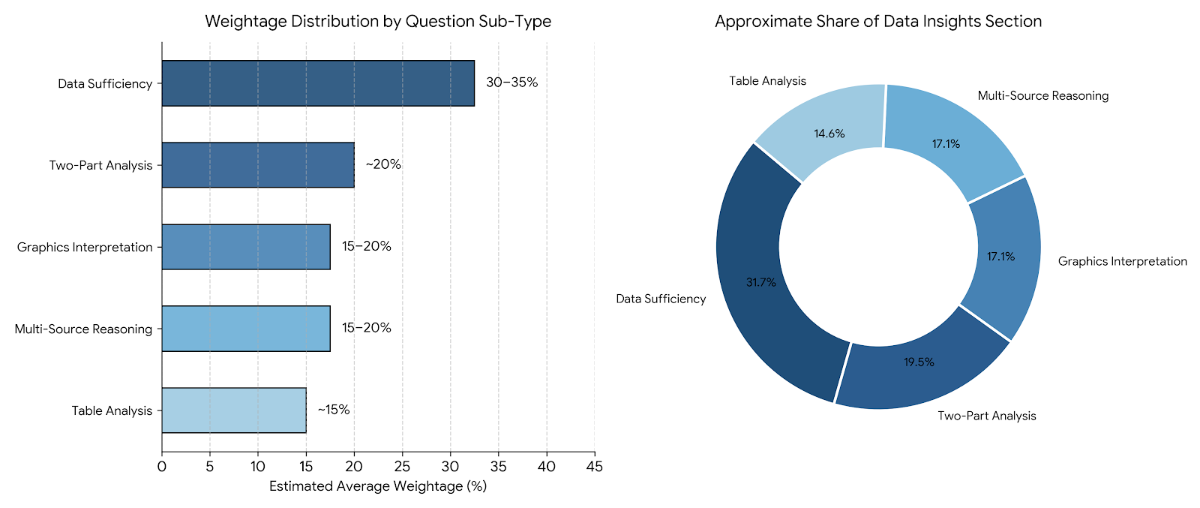
- Highest-Weightage Areas: Data Sufficiency carries the largest share, followed by Two-Part Analysis, Graphics Interpretation, Multi-Source Reasoning, and Table Analysis.
| Sub-Type | Weightage |
|---|---|
| Data Sufficiency | 30–35% |
| Two-Part Analysis | ~20% |
| Graphics Interpretation | 15–20% |
| Multi-Source Reasoning | 15–20% |
| Table Analysis | ~15% |
Check Out:
GMAT Preparation Tips 2027: Section Wise
A structured GMAT preparation strategy is more effective than simply increasing study hours, as the exam emphasizes time management, logical thinking, and pattern recognition rather than rote memorization.
Quantitative Reasoning: Build Speed and Accuracy
- Focus on arithmetic and elementary algebra, with emphasis on ratios, percentages, equations, and inequalities.
- Practise time-saving calculation methods and shortcuts to improve speed without compromising accuracy.
- Maintain an error log to identify recurring mistakes and separate conceptual gaps from careless errors.
Verbal Reasoning: Focus on Logic and Structure
- In Reading Comprehension, identify the author’s purpose, argument, and paragraph-wise role instead of focusing only on factual details.
- In Critical Reasoning, distinguish the premise, conclusion, and underlying assumption to understand the argument’s logical structure.
- Try to predict the answer before reviewing the options to avoid being influenced by plausible but incorrect choices.
General GMAT Preparation Strategy
- Use the Review & Edit feature selectively, mainly for questions where you are genuinely deciding between options.
- Consider structured online courses or GMAT classes if you need guided preparation, regular practice, and a defined study schedule.
- Use platforms such as GMAT Club to access practice resources, discuss strategies, and learn from other candidates’ preparation experiences.
Also Check:
Test Centers for GMAT 2027
Pearson VUE operates authorized GMAT test centers across most tier-1 and tier-2 Indian cities, alongside the 24/7 online proctored option.
- Wide City Coverage: GMAT test centers are available across major tier-1 and tier-2 cities in North, West, South, and East India.
- Flexible Testing Option: Candidates can choose between a Pearson VUE test center and the 24/7 online proctored GMAT exam.
| Region | Cities |
|---|---|
| North | Delhi NCR, Chandigarh, Lucknow, Jaipur |
| West | Mumbai, Pune, Ahmedabad, Nagpur |
| South | Bengaluru, Hyderabad, Chennai, Kochi, Coimbatore |
| East | Kolkata, Bhubaneswar, Ranchi, Guwahati |
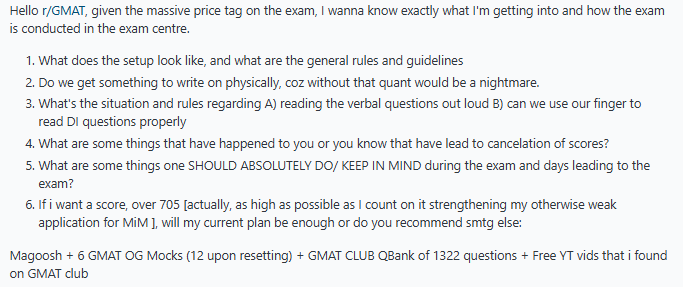
Indian students on Reddit discuss the following regarding the GMAT exam:
- Test Center: Individual computer cubicles with surveillance; headphones/earplugs are provided, and breaks are strictly timed.
- Scratch Work: Use the provided laminated scratch pad and dry-erase markers; request a new pad when needed.
- Test Rules: Avoid talking to other candidates or carrying unauthorized materials; limited self-whispering and screen-pointing are generally allowed.
- Preparation: Practise mocks around your actual exam time and maintain a consistent sleep, meal, and study routine.

Source: Reddit
Check Out:
GMAT vs GRE: Key Differences
Many MBA aspirants researching GMAT 2027 also come across the GRE while comparing options, since a growing number of business schools now accept both.
- GRE is a more general graduate-admissions exam accepted across disciplines, while GMAT 2027 is purpose-built around business-school data literacy and quantitative reasoning.
- Purpose: GMAT is primarily designed for MBA and management programmes, while GRE is accepted across a broader range of graduate programmes, including some MBA programmes.
- Exam Structure: GMAT includes Quantitative Reasoning, Verbal Reasoning, and Data Insights; GRE has Verbal Reasoning, Quantitative Reasoning, and Analytical Writing.
| Parameter | GMAT | GRE |
|---|---|---|
| Full Form | Graduate Management Admission Test | Graduate Record Examination (GRE full form) |
| Primary Use | MBA and management programs | Wide range of graduate programs, including some MBAs |
| Format | Computer-adaptive, business-focused | Computer-adaptive, broader academic focus |
| Sections | Quant, Verbal, Data Insights | Verbal, Quantitative, Analytical Writing |
| Score Range | 205–805 | 130–170 per section |
Also Check:
GMAT 2027: Result and Scorecard
The GMAT provides an unofficial score immediately after the test, followed by the verified official scorecard.
- Instant Results: The on-screen score includes your overall score, section scores, and percentiles.
- Official Scorecard: The verified score report is generally available within 3–5 business days, though it may take up to 20 days in rare cases.
| Stage | Timeline | What You Get |
|---|---|---|
| Unofficial Score | Instant, on-screen | Overall score, section scores, percentiles |
| Official Scorecard | 3–5 business days (up to 20 in rare cases) | Verified, detailed performance report |
Within 48 hours of receiving the official scorecard, candidates select up to 5 business schools to receive scores for free; additional reports cost $35 per school.
Check Out:
GMAT 2027: Counselling and Admission
Unlike JEE or CAT, where a central authority matches rank to seat, GMAT admissions are entirely direct and individual. Each business school reviews applications separately, and there is no unified counselling portal.
- Application Process: After sending scores, candidates must submit the complete application and supporting documents before the school’s deadline, followed by interviews and final admission decisions.
- Seat Confirmation: Once admitted, candidates need to pay the required non-refundable enrollment deposit within the specified deadline to secure their seat.
| Step | What Happens |
|---|---|
| Send Scorecard | Choose up to 5 schools within 48 hours of the official score |
| Submit Application | Transcripts, resume, essays, and 2–3 LoRs before the school's round deadline |
| Interview Invitation | Typically 4–6 weeks after the application deadline |
| Final Decision | Accepted, Waitlisted, or Denied on a pre-announced date |
| Secure Seat | Pay a non-refundable enrollment deposit directly to the school |
Must Read:
Colleges Accepting GMAT Score
Both Indian and international colleges accept GMAT scores for a range of MBA formats, though the specific program type matters.
- General Indian residents cannot use GMAT scores for the 2-year flagship MBA at IIMs or FMS Delhi, those exams require CAT specifically.
Top GMAT Accepting Colleges in India
| Institute | Program | Estimated Competitive Focus Score |
|---|---|---|
| ISB Hyderabad | PGP / YLP | 650–675+ |
| IIM Ahmedabad | PGPX (Executive) | 645+ |
| IIM Bangalore | EPGP | 645–665+ |
| IIM Calcutta | MBA-Ex | 645–665+ |
| SPJIMR Mumbai | PGDM / PGPM | 655+ |
| XLRI Jamshedpur | PGDM (GM) | 645+ |
Top Global GMAT-Accepting Colleges
| Institute | Target Focus Score |
|---|---|
| Stanford GSB | 695+ |
| Harvard Business School | 695+ |
| The Wharton School | 685+ |
| INSEAD | 645–665+ |
| London Business School | 645–665+ |
Also Check: Average GMAT Score for Top MBA Programs and Business Schools 2026
GMAT 2027 FAQs
Ques. What is the Graduate Management Admission Test (GMAT)?
Ans. It's a computer-adaptive exam administered by GMAC that tests quantitative, verbal, and data-literacy skills for admission into MBA and management programs worldwide.
Ques. What is the GRE full form, and how does it differ from GMAT?
Ans. GRE stands for Graduate Record Examination. The GRE test is a broader graduate-admissions exam, while GMAT 2027 is built specifically around business-school skills — the difference between GMAT and GRE mainly lies in this focus.
Ques. What is the GMAT exam syllabus for 2027?
Ans. The GMAT syllabus covers three sections — Quantitative Reasoning (Arithmetic, Algebra), Verbal Reasoning (Reading Comprehension, Critical Reasoning), and Data Insights (Data Sufficiency, Table Analysis, Graphics Interpretation, and more).
Ques. What are the GMAT exam fees in India?
Ans. GMAT exam fees in India come to roughly ₹27,100 for a test center appointment and ₹29,570 for the online exam, including 18% GST. This makes the GMAT exam cost in India higher than the plain USD base fee.
Ques. Is there a free GMAT mock test available?
Ans. Yes, several official and third-party platforms offer a free GMAT mock test or GMAT mock test online free option, useful for gauging your starting score before committing to full-length paid practice.
Ques. What is the GMAT exam eligibility criteria? Ans. GMAT eligibility criteria are minimal: candidates must be at least 18 (13–17 with parental consent), and there's no mandatory degree, minimum marks, or work experience required.
Ques. Is the GMAT exam for a specific country?
Ans. No. GMAT exam is for which country is a common question, but the GMAT is a global test — open to candidates of all nationalities and accepted by business schools worldwide.
Ques. What is the GMAT registration fee, and where do I pay it?
Ans. The GMAT registration fee is paid through the official GMAT website, mba.com, and depends on whether you choose a physical test center or the online proctored format.
Ques. Which colleges accept GMAT scores in India?
Ans. Colleges accepting GMAT score in India include ISB Hyderabad, IIM Ahmedabad (PGPX), IIM Bangalore (EPGP), IIM Calcutta (MBA-Ex), SPJIMR, and XLRI, mainly for executive and 1-year programs rather than the 2-year flagship IIM MBAs.
Ques. What is the GMAT quantitative syllabus and GMAT math syllabus weightage?
Ans. The GMAT quantitative syllabus is split mainly between Arithmetic (45–50%) and Algebra (35–45%), with smaller shares for Number Properties and Statistics — geometry has been removed from the current GMAT maths syllabus.
Ques. How do I prepare for GMAT — should I take GMAT classes online?
Ans. How to prepare for GMAT depends on your starting level; many candidates combine self-study with GMAT classes online or GMAT courses online, along with regular GMAT practice test attempts and error-log review.
Ques. What is GMAT Club, and is it useful for GMAT prep?
Ans. GMAT Club is a popular online community where candidates discuss GMAT prep strategies, share GMAT practice test experiences, and exchange GMAT sample test resources.
Ques. Where can I find a reliable GMAT practice test or GMAT mock paper?
Ans. The official GMAT website (mba.com) offers GMAT practice exam material directly from GMAC, which tends to be more reliable for gauging your real score than most third-party GMAT mock paper resources.
*The article might have information for the previous academic years, which will be updated soon subject to the notification issued by the University/College.



Comments
Found 2 Comments
You can register two to three months before your preferred test date, although, you may register up to six months in advance. Use the Registration and Score Reporting Timeline in the GMAT Handbook to assist you in selecting your test date. You can schedule your exam in the following ways - Online: Create your mba.com account or Phone: Call GMAT Customer Service for your region (Note: You may be charged an additional service fee of USD 10).
Yes, you will now have the choice to validate your identity using your Aadhaar Card or passport during the GMAT online exam registration process as long as the Card is current and valid. For the test center version of the GMAT exam, the passport remains the only acceptable ID; Aadhaar Card has been introduced as an alternative for only online GMAT exams.