



Education Journalist | Study Abroad Lead
Azeotrope is a mixture which at a given pressure (azeotropic pressure) boils at the same temperature (azeotropic temperature) and has the same composition in equilibrium vapour and liquid phases. An azeotrope is a mixture of at least two liquids that displays an equal concentration in the liquid as well as the vapour phase. The process of simple distillation cannot alter their proportions. Such mixtures can either have a lower boiling point or a higher boiling point of the components.
Definition of Azeotrope
[Click Here for Sample Questions]
An azeotrope can be defined as a mixture of two or more liquids that displays the same level of concentration in the liquid and vapor phase. Its proportion cannot be changed by simple distillation because when the azeotrope is boiled it produces vapor and the proportion of constituents in the vapour and the liquid which is not boiled is the same, even after distillation the composition remains unchanged.
- Azeotropes are also called a ‘constant boiling mixture’.
- Azeotropes do not follow Raoult’s Law which means these mixtures are not ideal solutions and show deviation from Raoult’s Law.
- In this type of mixture, one component has either a higher or lower boiling point than the other component.
- In these mixtures, the component exhibits the same mole fraction in the liquid phase and the vapor phase which is why they cannot be separated by the distillation method.
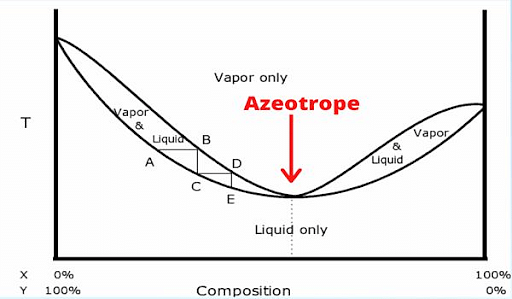
Azeotrope
Also Read:
| Related Links | ||
|---|---|---|
| Column Chromatography | General Principles and Processes of Isolation of Elements | Refining of Metals |
| Esterification | Methyl Acetate | Ethanoic Acid |
Types of Azeotropes
[Click Here for Previous years Questions]
There are different types of Azeotropes with different and unique properties from each other. They are the following:
-
Minimum Boiling Azeotrope
If an azeotrope shows positive deviation from Raoult’s law then it is called a minimum boiling azeotrope. It is also known as the positive boiling azeotrope. These azeotropes that are positive contain a boiling point lower than the boiling point of all of their constituents. Minimum boiling azeotropes are formed when the mixture has a lower boiling point and higher vapour point.
-
Maximum Boiling Azeotropes
Maximum boiling azeotropes are defined as the liquid mixtures which show negative deviation from Raoult's Law. Therefore, it is also referred to as a negative azeotrope. Maximum boiling azeotrope is formed when the mixture has lower vapour pressure and the highest boiling point.
-
Homogeneous Azeotropes
If the constituents of an azeotropic mixture are completely mixable in all proportions with each other, then this type of azeotrope is considered to be a homogeneous azeotrope. For example, any amount of ethanol can be mixed with water to form a homogeneous azeotropic mixture. An example of a homogeneous azeotropic mixture includes water mixed with ethanol.
-
Heterogeneous Mixture
If the azeotropes are present as a constituent in several mixtures and if these mixtures are not entirely mixable they are called heterogeneous azeotropes. These heterogeneous azeotropes are incompletely mixable and form two different liquid phases. For instance, mixtures such as chloroform and water, benzene, and water. This type of azeotrope is also called heteroazeotrope. In the condition of heteroazeotrope phase splitting may occur for a minimum boiling azeotrope with a large deviation from Raoult’s law.
-
Binary Azeotrope
Azeotrope which has two constituents in a mixture is called the binary azeotrope. Examples of binary azeotrope include the mixture of diethyl ether (33%) and halothane (66%).
Azeotropic Distillation
[Click Here for Sample Questions]
Azeotropic distillation is a special type of distillation used in industries and laboratories. Azeotropic distillation is done by adding to the liquid phase a volatile third component which changes the volatility of one of the two components more than the other so that the components can be separated by distillation.
- Azeotropic distillation is performed in batches in the traditional fractional distillation method only but the difference is that a third volatile compound is also added so that such mixture can be separated.
- If the mixture of binary solution and azeotrope is a minimum boiling point type then the distillate product should contain only one of the original components and the azeotropic agent.
- The composition of the distillate product then changes as the distillation proceeds as the separation is taking place between the different azeotropes.
Application of Azeotropes
[Click Here for Previous years Questions]
The applications of Azeotropes are as follows:
- Azeotropes are used as a standard in testing gas, chromatographs, detectors, and columns.
- The azeotropes are also used to separate the components of zeotropic mixtures. One example is that it is pretty difficult to separate the components of acetic acid and water. It is known that ethyl acetate forms azeotropes with water by adding small amounts of ethyl acetate in this mixture containing acetic acid and water, it would be possible to distill away the azeotropes formed.
Things to Remember
[Click Here for Sample Questions]
- An azeotrope can be defined as a mixture that boils at a constant temperature (the azeotropic temperature) at a given pressure (the azeotropic pressure) and has the same composition in the equilibrium vapour and liquid phases.
- Azeotrope is also referred to as constant boiling mixtures as their composition remains unchanged by distillation.
- There are various types of Azeotropes such as Heterogeneous and Homogeneous Azeotropes, Maximum and Minimum Boiling Azeotropes and Binary Azeotropes.
- Azeotropic distillation is done by adding a volatile third component to the liquid phase which changes the volatility of one of the two components more than the other so that the components are separated by distillation.
Also Read:
Previous Year Questions
- The Reaction 2so2 O2 2so3 Heat Will Be Favoured By
- Calculate Solubility Of Zr 3 Po 4 4 S In Terms Of
- What Is The Correct Volume Of Equilibrium Constant
- For The Following Three Reactions I Ii And Iii Equ
- In 2 Hi Rightleftharpoons H 2 I 2 The Forward Reac
- The Hydrolysis Of Sodium Carbonate Involves The Re
- Which Has Equilibrium Constant As One… [DUET 2006]
- Which Of The Following Is Not Involved In The Form
- E For The Cell Z N Z N 2 A Q C U 2 A Q C U Is 1 1
- For Which One Of The Following Systems At Equilibria
- The Reaction 2 A G B G 3 C G D G Is Begun With The
- If The Standard Electrode Potential For A Cell Is.. [JEE Mains 2019]
- The Addition Of An Inert Gas At Constant Volume To
- Favorable Condition For Product Formation In The
- The Dissociation Equilibrium Of A Gas Ab 2 Can Be
- An Increase In The Concentration Of The Reactants
- Ca Hc O 3 2 S Decomposes As Ca Hc O 3 2 S Cac O 3
- If A Ladder Weighing 250 N Is Placed Against A Smo
- K C For The The Reaction Ag Cn 2 Ag 2 Cn The Equi
- For The Reaction 2 A G B 2 G 2 A B 2 G The Equilib… [VITEEE 2010]
Sample Questions
Ques. What is an Azeotrope? (3 Marks)
Ans. Azeotropes are mixtures of at least two liquids that exhibit the same concentration at the liquid phase and vapour phase. Azeotropes do not follow Raoult’s Law they show positive and negative deviation from the ideal solution graph. Azeotropes are not an ideal solution.
Ques. Can we separate Azeotropes? What is pressure swing distillation which is used for distillation of Azeotropes? (3 Marks)
Ans. We can separate azeotropes using different methods like extractive distillation, azeotropic distillation, or pressure swing distillation. Pressure swing distillation uses pressure changes to change the composition of a mixture, enriching the distillate with desired components.
Ques. What is Extractive Distillation? (3 Marks)
Ans. Extractive distillation is defined as distillation in the presence of a miscible, high-boiling, relatively non-volatile component, the solvent, that forms no azeotrope with the other components in the mixture. The method of extractive distillation is utilized for those mixtures that have a low value of relative volatility, nearing unity.
Ques. Name different types of Azeotropes. (3 Marks)
Ans. Different types of Azeotropes are
- Homogeneous Azeotrope
- Heterogeneous Azeotrope
- Binary Azeotrope
- Maximum Boiling Azeotrope
- Minimum Boiling Azeotrope
Ques. Can we separate azeotrope through normal distillation? (3 Marks)
Ans. No, we cannot separate azeotropes with normal distillation. An azeotrope is a mixture of two or more liquids that displays the same concentration level in the liquid and vapour phase. The process of simple distillation can not alter the proportion of an azeotrope.
Ques. What is maximum boiling Azeotrope? (3 Marks)
Ans. Maximum boiling azeotropes are defined as the liquid mixtures which show negative deviation from Raoult's Law. hence, we also refer to it as a negative azeotrope. Maximum boiling azeotrope is formed when the mixture has lower vapour pressure and the highest boiling point.
Ques. What is heterogeneous azeotrope? (2 Marks)
Ans. A heterogeneous azeotrope is an azeotropic mixture in which the constitutions of mixtures are not completely miscible. A mixture of chloroform and water is an example of a heterogeneous azeotrope.
Ques. What are the uses of azeotropes? (3 Marks)
Ans. The use of azeotrope is to separate zeotropic mixture more conveniently, for example, acetic acid and water form a zeotropic mixture but acetic acid has boiling point too close to that of water so separating them with normal distillation is not possible so adding ethyl acetate forms azeotrope with water and ethyl acetate which makes acetic acid separable from water. Azeotropes are also used in gas chromatography.
For Latest Updates on Upcoming Board Exams, Click Here: https://t.me/class_10_12_board_updates
Do Check Out:



Comments