



Education Content Expert
Calcium Phosphate is the Calcium Salt of phosphoric acid that is found in bones, milk, teeth, and ground. The chemical formula of Calcium Phosphate is Ca3(PO4)2.
- It is also referred to as Tricalcium Phosphate or Calcium Phosphate Tribasic.
- Calcium Phosphate is a white amorphous or crystalline powder that is odorless, and tasteless.
- It is soluble in dilute nitric acid and hydrochloric acid but slightly dissolves in water and is insoluble in ethanol, and acetic acid.
- It competes and blocks the absorption of Strontium (Sr-90) and Radium (Ra-226) in the Gastrointestinal Tract.
- Calcium Phosphate is commonly used as an antacid, dietary supplement, and calcium replenisher.
Key Terms: Calcium Phosphate, Apatite, Mineral, Hydrochloric Acid, Calcium Hydroxide, Ethanol, Antacid, Phosphoric Acid
What is Calcium Phosphate?
[Click Here for Sample Questions]
Calcium Phosphate is a white amorphous or crystalline powder-like substance with the chemical formula Ca3(PO4)2.
- It appears to be a white powder that is odorless and tasteless.
- It is slightly soluble in water.
- It is soluble in dilute nitric acid and hydrochloric acid but insoluble in ethanol, and acetic acid.
- The complex form of Calcium Phosphate is Apatite which is a mineral rock.
- Apatite is a form of phosphorite that contains calcium phosphate mixed with other compounds.
- Calcium Phosphates are important materials in the fields of Biology, Geology, Medicine, and Dentistry.
- The formation, functions, and applications of Calcium Phosphate depend on its structure, composition, solubility, and stability.

Calcium Phosphate
Preparation of Calcium Phosphate
[Click Here for Sample Questions]
Calcium Phosphate can be prepared by reacting phosphoric acid (H3PO4) with solid Calcium Hydroxide Ca(OH)2.
Ca(OH)2 + H3PO4 \(\to\) Ca3(PO4)2 + H2O (Unbalanced Equation)
3Ca(OH)2 + 2H3PO4 \(\to\) Ca3(PO4)2 + 6H2O (Balanced Equation)
With the use of an aqueous solution of calcium hydroxide, dibasic calcium phosphate can be produced in these reactions. Monobasic calcium phosphate can be obtained by adding excess phosphoric acid to either a tribasic calcium phosphate solution or a dibasic solution and letting the solution evaporate.
Read More:
Calcium Phosphate Structure
[Click Here for Sample Questions]
Calcium Phosphate is a white crystalline or amorphous powder-like substance and has the chemical formula Ca3(PO4)2. It is the calcium salt of phosphoric acid.
Structure of Calcium Phosphate is as follows:
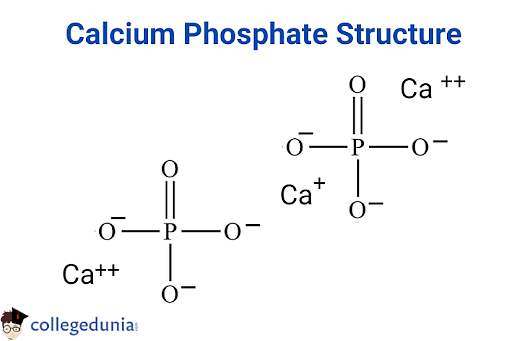
Calcium Phosphate Structure
Properties of Calcium Phosphate
[Click Here for Sample Questions]
The important properties of Calcium Phosphate are:
| Properties of Calcium Phosphate | |
|---|---|
| Chemical Formula | Ca3(PO4)2 |
| Molecular Weight/ Molar Mass | 136.06 to 310.20 g/mol |
| Density (Tribasic) | 3.14 g/cm³ |
| Boiling Point | Decomposes |
| Melting Point (Tribasic) | 1670°C |
Reaction between Calcium Phosphate and Water
When Calcium Phosphate reacts with water it releases phosphane and calcium hydroxide. The chemical reaction is given below:
Ca3P2 + 6 H2O \(\to\) 2 PH3 + 3 Ca(OH)2
Calcium Phosphate Solubility
[Click Here for Sample Questions]
Solubility is an important characteristic of Calcium Phosphate that affects its structure and applications. It is the only property that defines the course of several reactions involving calcium phosphates such as absorption, precipitation, hydrolysis, and phase transformation. The solubility of Calcium phosphate also plays a major role in biological processes such as hard tissue formation and resorption as well as pathological calcification.
- Calcium phosphate-based bone graft replacements are bioceramics with the greatest resemblance to bone minerals.
- It offers calcium phosphate excellent biocompatibility, biodegradability, and osteoconductivity.
- Calcium is a naturally occurring mineral found in food.
- It is required for many normal functions of the body apart from particular bone formation and maintenance.
- It binds to other minerals such as phosphate and helps to extract them from the body.
- Calcium phosphate is basically used to prevent and treat calcium deficiencies in the human body.
- Solubility in Calcium Phosphate varies by orders of magnitude, including variations in pH and concentrations of acids and bases.
- Water-soluble calcium phosphate is obtained from the skeletons of vertebrates.
- It is an important component for plant growth and is commonly dispersed in the soil.
- Calcium phosphate is quite insoluble in water but soluble in acids and is used in natural farming.
- It also may dissolve slightly in CO2-containing water.
Occurrence of Calcium Phosphate
[Click Here for Sample Questions]
Calcium and Phosphorus are the main nutrients that make up the bulk of animal mineral nutrient requirements that are used to fulfill both body tissue and milk needs. Calcium phosphates are found in numerous ways in nature.
- They are the primary minerals used to manufacture phosphate fertilizers and for a variety of phosphorus compounds.
- Dicalcium Phosphate Dihydrate (DCPD) is a popular and commonly used animal supplement.
- It is the most soluble of barely soluble calcium phosphate crystals, thus, making it a good option for rock phosphate dissolution tests.
- However, the use of DCPD in the soil is still temporary.
Uses of Calcium Phosphate
[Click Here for Sample Questions]
Calcium Phosphate is a very important mineral with the following uses:
- Calcium Phosphate is important for plant growth that is dispersed in soil.
- Calcium is a mineral that can be found in food that is essential for many normal functions of the body, in particular bone formation and maintenance.
- It is used in medicine in the form of a calcium replenisher.
- It is used as a buffer in food.
- It is used for manufacturing milk glass.
- It is used in the production of fertilizers.
- Calcium Phosphate is also used in dental powders and cosmetics.
- It is used as an antacid and dietary supplement in veterinary medicine.
- It is used as a stabilizer in plastics.
- It is also used to make luminescent materials.
Check More:
Calcium Phosphate Health Hazards
[Click Here for Sample Questions]
Here are certain health hazards associated with Calcium Phosphate:
- If the quantity of toxic doses of Calcium Phosphate becomes more than 2g/kg, unusual skin sensitization occurs.
- Breathing Calcium Phosphide could irritate the nose and throat and cause coughing and/or shortness of breath.
- High exposure to Calcium Phosphide could be hazardous as it can cause nausea, headache, dizziness, tremors, fatigue, vomiting, and convulsions.
- High levels of calcium can cause constipation or nausea.
- Calcium Phosphide when kept wet or in contact with moisture can release highly toxic Phosphine gas.
- Since it is reactive material it is listed under Special Health Hazard Substance List.
- High exposure to Calcium can even affect vital human organs such as the heart, liver, kidney, etc.
- Calcium Phosphate can also be used to kill rodents and is used in explosives and fireworks.
- Calcium Phosphate must be stored to avoid contact with oxidizing agents.
- We should make sure that the sources of ignition, such as open flames and smoking, are prohibited where Calcium Phosphide is used, handled, or stored.
- It is advisable to use explosion-proof electrical equipment and fittings where Calcium Phosphide is used, handled, manufactured, or stored.
Things to Remember
- Calcium Phosphate is an important mineral found in human bone and teeth.
- It is a calcium salt of phosphoric acid with the chemical formula Ca3(PO4)2.
- It appears as a crystalline or white amorphous powder that is tasteless and odorless.
- Calcium Phosphate is produced by reacting Phosphoric Acid (H3PO4) with solid Calcium Hydroxide (Ca(OH)2).
- It plays a vital role in biological processes such as hard tissue formation and resorption as well as pathological calcification.
- Calcium Phosphate is commonly used to avoid and cure calcium deficiency.
Sample Questions
Ques. How is Calcium Phosphate prepared? (3 Marks)
Ans. Calcium Phosphate is prepared through the reaction of Phosphoric Acid (H3PO4) with solid Calcium Hydroxide Ca(OH)2. The reaction is as follows:
- Ca(OH)2+H3PO4 \(\to\) Ca3(PO4)2+H2O (Unbalanced Equation)
- 3Ca(OH)2+2H3PO4 \(\to\) Ca3(PO4)2+6H2O (Balanced Equation)
Ques. What are the Uses of Calcium Phosphate? (3 Marks)
Ans. The uses of Calcium Phosphate are listed as follows:
- It is used as an antacid and dietary supplement in veterinary medicine.
- It is used as a calcium replenisher in medicine.
- Calcium Phosphate is also used in the manufacturing of milk glass.
- It is also used in the production of fertilizers for soil.
- It is used to clarify sugar syrups and is often used in dental powders.
Ques. What can be the side effects of Calcium Phosphate? (3 Marks)
Ans. There are the following side effects of Calcium Phosphate:
- Nausea and/or Vomiting
- Reduced Appetite
- Constipation
- Dry Mouth or Decreased Hunger
- Increases Sweat
Ques. What is the difference between Calcium Carbonate and Calcium Phosphate? (2 Marks)
Ans. Calcium Carbonate is the most constipating ingredient that provides the highest amount of Calcium at a less price whereas Calcium Phosphate is more volatile than calcium carbonate and does not cause any gas or constipation.
Ques. Is Calcium Phosphate safe to be used with food? (2 Marks)
Ans. The functioning of Calcium Phosphate is better when it is taken with food. One must ensure that they take calcium phosphate safely, and notify their doctor if they have any of the other medical conditions such as a history of kidney stones.
Ques. What are the benefits of Calcium Phosphate for the Human Body? (3 Marks)
Ans. Calcium Phosphate is used to treat disorders caused by low levels of calcium in the human body such as
- Bone Loss (Osteoporosis)
- Weak Bones (Osteomalacia / Rickets)
- Reduced Parathyroid Gland Function (Hypoparathyroidism)
- Muscle Disease (Latent Tetanus)
Ques. What type of Calcium is suitable for Osteopenia? (2 Marks)
Ans. Calcium Carbonate and Calcium Citrate are the two most commonly used calcium products. Calcium carbonate supplements dissolve better in an acidic environment, thus, it is advised to take them with a meal. Calcium citrate supplements may be taken at any time as they do not require acid to dissolve.
Ques. What are the names of oxidizing agents which shouldn’t be kept in contact with the Calcium Phosphate? (3 Marks)
Ans. The oxidizing agents which shouldn’t be kept with Calcium Phosphate are
- Perchlorates
- Peroxides
- Permanganates
- Chlorates
- Nitrates
- Chlorine
- Bromine
- Fluorine
Ques. What are the precautions to take where Calcium Phosphide is spilled? (3 Marks)
Ans. There are the following precautions that need to be taken when Calcium Phosphide is spilled:
- Evacuate the persons who are not wearing protective equipment from the area of the spill until clean-up is complete.
- Remove all ignition sources.
- Collect powdered material in the most convenient and safe manner and deposit the same in a sealed container.
- Ventilate the area after clean-up is complete.
- Keep Calcium Phosphide out of a confined space, such as a sewer, because of the possibility of an explosion, unless the sewer is designed to prevent the build-up of explosive concentrations.
- To contain and dispose of Calcium Phosphide as a hazardous waste.
- If an employee is required to clean up the spillage then they must be properly trained and equipped.
Ques. Is Calcium Phosphate a flammable material? (1 Mark)
Ans. No, Calcium Phosphate is non-flammable but will ignite spontaneously when it is wet and releases flammable gas such as Phosphine gas.
Ques. If Calcium Phosphate accidentally comes in contact with the skin or eye then what are the precautions to take? (3 Marks)
Ans. If a person comes in contact with Calcium Phosphate accidentally they should do the following:
- Quickly remove contaminated clothing.
- Immediately wash contaminated skin with large amounts of soap and water.
- If the eye comes in contact then immediately flush your eye with large amounts of water for at least 15 minutes, occasionally lifting your upper and lower lids, and seek medical attention immediately.
Ques. If a person breathes Calcium Phosphate accidentally then what are the precautions to take? (3 Marks)
Ans. If a person breathes Calcium Phosphate accidentally then they should do the following:
- Remove the person from exposure.
- Begin rescue breathing (using universal precautions) if breathing has stopped and CPR if heart action has stopped.
- Transfer promptly to a medical facility.
- Medical observation is recommended for 24 to 48 hours after breathing overexposure, as pulmonary edema may be delayed.
For Latest Updates on Upcoming Board Exams, Click Here: https://t.me/class_10_12_board_updates
Check-Out:



Comments