



Content Curator
Difference between Earth and Neutral is based on the nature of the current flow, connection point, conversion, and applications. It is an important topic from the Current Electricity chapter of the latest CBSE Class 12 Physics Syllabus.
- Earth wires have zero voltage just like the neutral wires.
- Earth wires provide a good grounding connection which helps save people, appliances, and property from damages caused due to electric shocks.
- The neutral wire helps provide a return path for the current supplied by the live conductor.
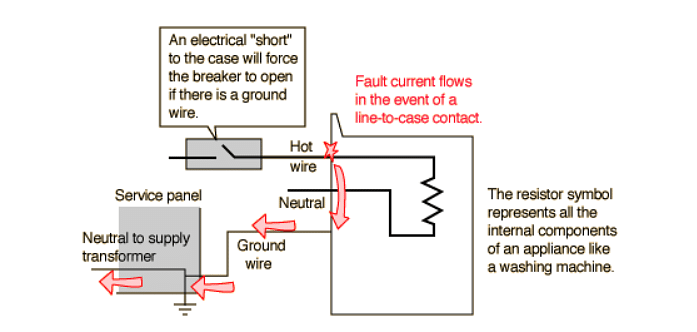
Earth and Neutral Wire Network
Let us look at some of the important questions based on the difference between earth and neutral wires.
Discover about the Chapter video:
Current Electricity Detailed Video Explanation:
Read More: Difference between Earth and Neutral Wires
Very Short Answer Questions (1 mark)
Ques. What is a live wire?
Ans. Live wires are wires connected directly to the transformers in the power stations.
Ques. What is an earth wire?
Ans. Earth wires do not carry current. they are used to prevent people and property from electric shocks.
Ques. What is a neutral wire?
Ans. Neutral wires provide a return path for the current to the generators thereby completing the circuit.
Ques. What are the voltage ratings for the live, earth, and neutral wires?
Ans. The voltage of live wires is equal to that of the main supply source, The voltage of neutral wires is approximately 0 V. The earth wire does not carry any electricity and hence the voltage is zero.
Ques. What is the voltage difference between neutral and earth wire?
Ans. The neutral-to-earth voltage is known as common-mode voltage.
Read More: Electric Circuit
Short Answer Questions (2 Marks)
Ques. How are the current flow in earth and neutral wire?
Ans. Earth wires in general conditions carry no current. however, in case of insulation failures, earth wires carry a minor current. A neutral wire on the other hand is always charged with some current.
Ques. Can earth and neutral wires be interchanged?
Ans. Earth wires cannot be turned into neutral wires. Neutral wires, however, can be turned into earth wires. This can happen from the neutral line or execute separately.
Ques. What are the roles of earth and neutral wires in an electrical circuit?
Ans. The earth wires are used for the surging points of the circuits as it prevents electrical appliances from electric shocks. Neutral wires allow a return path for the current to the source thus helping in completing the circuit. Neutral wires are also called the reference point.
Read More: SI Unit of Electric Current
Ques. What happens if the earth and neutral wires touch?
Ans. In AC single phase, no significant effect is produced when the neutral touches the earth wire. Neutral wires should provide the return path and the earth wire diverts the faulty current to the ground preventing electric shock in appliances. However, an earth wire carrying load current is capable of producing shocks on touching it.
Ques. Why is the earth also called ground wire?
Ans. Earth is also called ground wire as it is an essential safety element in electrical circuits. Any leakage or residual currents in the system are diverted into the ground. The earth wire is thus connected to an appliance at no current carrying condition and is expected to carry minor current only during insulation failures.
Also Check Out:
Long Answer Questions (3 Marks)
Ques. What are the features of the neutral wire?
Ans. Some of the features of the neutral wire are:
- Provides return path for AC which carries current in normal conditions.
- Can be used for phase current imbalance.
- The magnitude of the current carried is a fraction of the phase current or sometimes even double.
Ques. What are the features of the earth wire?
Ans. Some of the features of the earth wire are:
- Used for grounding to prevent leaks or residual current from damaging appliances.
- Earth is connected to the body of the equipment.
- Does not carry current under normal conditions.
- During Insulation failures, a minor current is carried.
Ques. Give three major differences between earth and neutral wires.
Ans. The differences between earth and neutral wires are:
| Earth | Neutral |
|---|---|
| Protects and provides safety to the appliances from residual current leakage. | Helps in load balancing in the alternate current (AC) carrying circuits by providing a return path. |
| Zero current flow except in case of insulation failure where it carries minor current. | Always charged and has a current flowing through it under normal conditions. |
| Serves as the surging point of electrical appliances and is connected directly to the appliance. | Serves as a zero-voltage reference point by providing the return path. Connected to the main power wiring. |
| The wire used for Earth has higher resistance than neutral. | The wire used for neutral has lower resistance than earth. |
| The earth wire only exists in AC circuits, but not in DC circuits. | The neutral wire exists in both AC and DC circuits. |
Ques. How does the earth wire protect the equipment from electrical shocks?
Ans. When a bare conductor touches the bare body of the equipment, there is a high risk of electric shock to the person using the equipment and to the appliance in itself. The earthing wire when connected to the equipment provides a low resistance path for the residual or leaked currents to get discharged onto the ground. This thus protects the personnel and the equipment.
Read More:
Very Long Answer Questions (5 Marks)
Ques. List down the advantages of grounding.
Ans. The advantages of grounding the substation are as follows:
- Electricity sources like power plants, substations, etc are extremely susceptible to lightning hazards or electrical and mechanical equipment failures, human errors, etc.
- In these cases, the current surge is of the order of kilo Amperes and is impressed in the plant or is generated from within.
- Earthing allows a sufficiently low impedance path such that the current gets dissipated onto the ground under faulty conditions without exceeding or using the instrument thereby affecting its service or continuity of operation.
- It provides a ground connection for the system neutral.
- Provides stability of voltage conditions
- Prevents excessive voltage peaks during disturbances
- Protects against lightning
- Provides a discharge path for surge arresters
- Assures a degree of human safety that a person working or walking in the vicinity of grounded facilities does not get exposed to the danger of a critical electric shock.
Read More: NCERT Solutions for Class 12 Current Electricity
Ques. Why is the magnitude of transient voltage small in an earthed neutral system?
Ans. In an earthed neutral system, the neutral wire is earthed directly or through resistance or reactance.
The advantages include:
- Arcing grounds are avoided as suitable switchgear is used
- Voltages of healthy phases remain a constant as the neutral point does not get shifted
- Faulty parts of the system can be isolated
- The magnitude of transient voltage is very small
- The more reliable system as it provides safety to personnel and equipment with reduced operational and maintenance costs
Ques. Why should the standard wire gauge earthing lead not be thinner than 8 SWG?
Ans. The standard wire gauge earthing lead is not thinner than 8 SWG due to the following reasons:
- Earthing wire prevents damage to equipment or personnel handling it.
- The minimum size of earthing wire is dependent on the current flowing through it.
- The cross-section area of the earthing lead should not be less than half of the area of the cross-section of the thickest wire used in the installation.
- The size of these conductors is dependent on the cable size that is employed in the wiring.
- The copper wire used as an earth continuity conductor has a size of 3 SWG.
- Earth wires smaller than 14 SWG should not be used.
For Latest Updates on Upcoming Board Exams, Click Here: https://t.me/class_10_12_board_updates
Check-Out:



Comments